Frankfurt Airport Transfers: Long-Distance Rail Direct From the Terminal
Oh, the joy of arriving at Frankfurt Airport, Germany's bustling gateway to the world! For many of us expats and seasoned travelers, that moment of stepping off the plane is often followed by a familiar knot of anxiety: "How am I going to get to where I'm actually going?" While taxis and local S-Bahn lines are fine for a quick dash into Frankfurt city, if your true destination lies further afield in this beautiful country, the thought of wrestling with multiple transfers or navigating unfamiliar roads after a long flight can be utterly daunting. This guide is here to unravel that stress, showing you exactly how easy and often preferable it is to hop on a long-distance train directly from the airport terminal, making your onward journey a breeze, especially when you know the best tools to book it.
Disclosure: This post may contain affiliate links. We may earn a commission at no extra cost to you if you make a purchase through these links. Read full disclosure.
Why Choose Long-Distance Rail for Your Frankfurt Airport Transfer?
When you first land in a new country, especially after a long journey, the last thing you want is more logistical hurdles. Frankfurt Airport (FRA) might seem massive, but it's incredibly well-connected by train, and this often overlooked option is, for many, the absolute best way to reach your final destination across Germany or even into neighboring countries. Trust me, I've done it enough times to know the difference it makes!
Unbeatable Convenience: Airport to City Center and Beyond
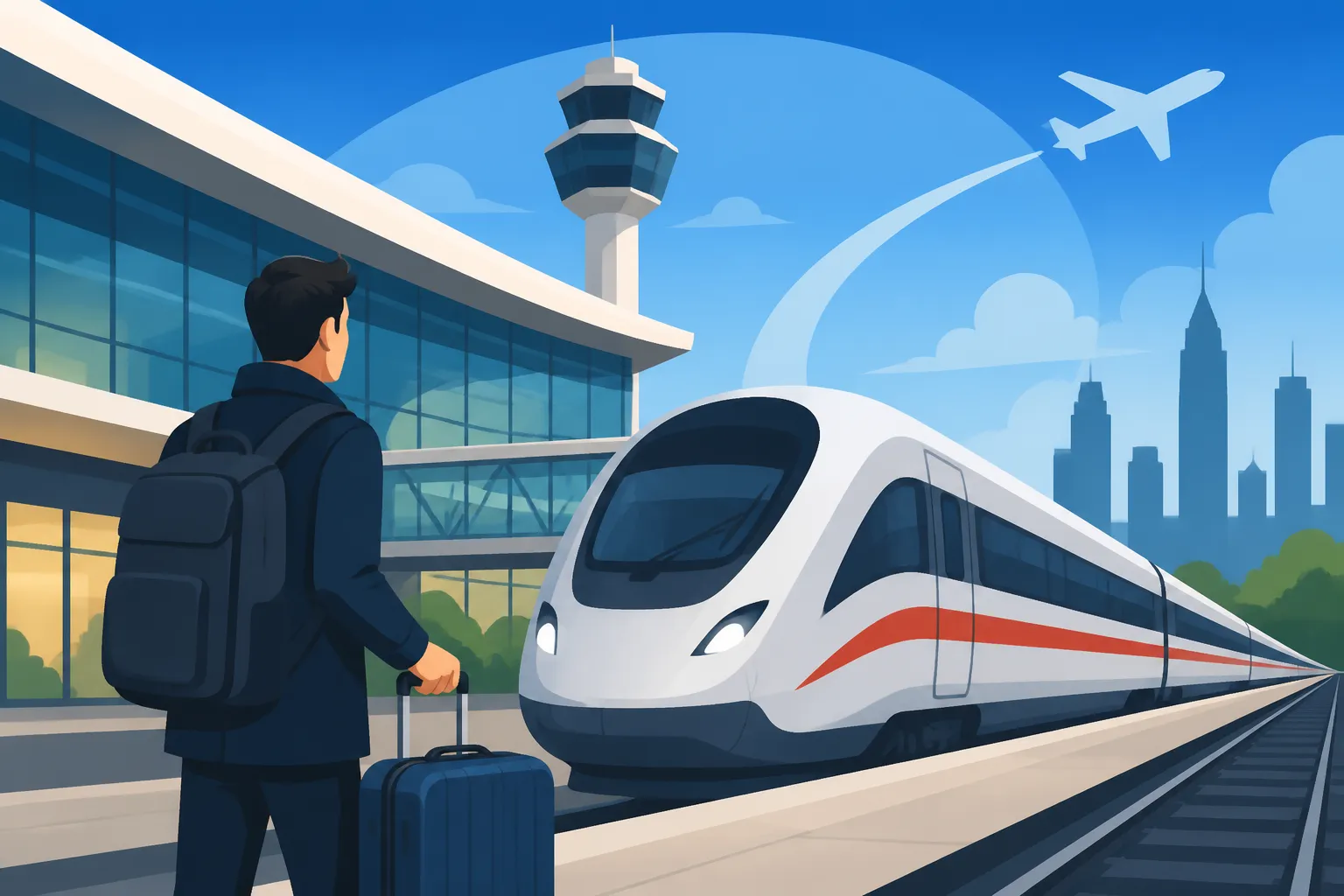
Let's face it: after spending hours cooped up in a plane, the idea of getting into another confined space, like a taxi stuck in rush hour traffic, is less than appealing. That's where long-distance trains truly shine. Frankfurt Airport has not one, but two train stations, and one of them, the Fernbahnhof, is dedicated entirely to high-speed and intercity connections. This means you can literally walk off your flight, clear customs, and within minutes, be on a comfortable train whisking you away towards Berlin, Munich, Cologne, or pretty much anywhere else.
Imagine this: You've just collected your luggage. Instead of hunting for a taxi stand or trying to figure out the local bus schedule in a new language, you simply follow the clear signs to the long-distance train station. No traffic jams, no confusing street signs, no hefty taxi fares racking up on the meter. You're directly connected to the extensive Deutsche Bahn (DB) network. This seamless transition is a game-changer, especially if you're traveling with kids, multiple bags, or just a serious case of jet lag. The ease of getting from the airport directly onto a train that will take you hundreds of kilometers away without a single change is, in my book, the definition of travel convenience. It truly makes getting around Germany a pleasure.
Cost-Effectiveness for Longer Journeys
While a taxi might be justifiable for a short hop into downtown Frankfurt, the moment your destination is, say, over 100 kilometers away, the cost of a private transfer quickly becomes astronomical. Long-distance rail, especially when booked in advance, can offer significant savings. Deutsche Bahn, Germany's national railway company, offers various fare categories that cater to different budgets and flexibility needs. The "Sparpreis" (saver fare) and "Super Sparpreis" (super saver fare) tickets, for instance, are fixed to a specific train and time but come at a fraction of the cost of last-minute or flexible tickets.
Consider a journey from Frankfurt Airport to Hamburg. A flight might seem quicker, but when you factor in the time to get to the airport early, go through security, wait for boarding, the actual flight, and then transfer from Hamburg Airport to the city center, the train often wins out on total travel time – and definitely on cost. A Sparpreis ticket purchased a few weeks in advance could cost you as little as €30-€50, while a comparable flight or private transfer would easily be several times that amount. Even a Flexpreis ticket, which allows for more flexibility, can be more economical than other modes of transport for substantial distances. It’s all about doing a bit of planning and knowing where to look for the best deals, and that's where tools like Omio become incredibly useful.
Environmental and Comfort Benefits
Let's talk about comfort. Modern German long-distance trains, particularly the high-speed ICE (Intercity-Express) trains, are designed with passenger comfort in mind. You get spacious seating, often with tables, plenty of legroom, and the ability to get up and stretch your legs, wander to the Bordrestaurant for a coffee or a meal, or simply gaze out the window at the stunning German landscape whizzing by. Compare that to the cramped seats of a domestic flight or being confined in a car. There's really no comparison for journeys over an hour or two.
Beyond personal comfort, choosing the train is also a greener choice. Trains have a significantly lower carbon footprint per passenger kilometer compared to flying or driving. As an expat living in Germany, I've grown to appreciate the country's commitment to sustainability, and traveling by train aligns perfectly with that ethos. It's a small but meaningful way to contribute to more environmentally friendly travel. Plus, there's a certain romanticism to train travel – the rhythmic clickety-clack, the ever-changing scenery, the sense of truly moving through the landscape rather than flying over it. It's a far more relaxing and enjoyable experience, allowing you to decompress from your international flight and truly begin your German adventure.
Navigating Frankfurt Airport's Train Stations: A Guide
Frankfurt Airport is one of Europe's busiest air hubs, and like any major airport, it can feel a bit overwhelming upon arrival. But don't fret about finding your train; the signage is generally excellent, guiding you efficiently to where you need to be. The key is knowing which of the two stations caters to your needs.
Regionalbahnhof vs. Fernbahnhof: Know Your Station
This is crucial for anyone arriving at Frankfurt Airport. Many people, especially newcomers, get confused between the two train stations located directly at the airport: the Regionalbahnhof (Regional Station) and the Fernbahnhof (Long-Distance Station).
The Regionalbahnhof is located directly below Terminal 1, concourse B. This station primarily serves local and regional trains, including S-Bahn lines (S8, S9) that connect directly to Frankfurt Hauptbahnhof (main station) and other cities within the Rhein-Main region like Mainz or Wiesbaden. If your destination is within this immediate area or if you need to go to Frankfurt city center, this is likely your station.
However, for virtually all long-distance journeys – whether you're heading to Berlin, Munich, Cologne, Stuttgart, or even further afield into other European countries – you'll need the Fernbahnhof. This station is purpose-built for high-speed ICE, IC (Intercity), and EC (Eurocity) trains. It's a much larger, more modern station designed to handle the volume of intercity and international travelers. It's truly a feat of engineering, specifically built to integrate air and rail travel seamlessly. You'll find it clearly signposted throughout the airport, often with an ICE train logo. Knowing this distinction from the get-go will save you a lot of time and potential stress!
Connecting to the Fernbahnhof from Terminals
So, you've landed, cleared immigration, and collected your luggage. Now, how do you get to the Fernbahnhof?
If you arrive at Terminal 1, you're in luck! The Fernbahnhof is directly connected to Terminal 1 via a pedestrian bridge. Simply follow the signs that say "Fernbahnhof" or "Long-Distance Trains" (look for the ICE logo). It's a short, pleasant indoor walk that takes about 10-15 minutes, depending on where exactly you emerge from Terminal 1. The path is well-lit, often features moving walkways, and is designed to be easily navigable even with luggage.
For those arriving at Terminal 2, the connection is just as straightforward, though it involves a different mode of transport: the SkyLine. The SkyLine is an automated people mover that connects Terminal 1 and Terminal 2, as well as the Fernbahnhof. Again, follow the signs for "Fernbahnhof" or "SkyLine." You'll board the SkyLine at Terminal 2, and it will take you directly to Terminal 1, where you then follow the pedestrian bridge signs to the Fernbahnhof. This entire process, including waiting for the SkyLine, usually takes about 15-20 minutes. The SkyLine runs frequently, so you won't be waiting long. It's surprisingly efficient and offers a nice elevated view of parts of the airport complex.
What to Expect at the Fernbahnhof
Upon arrival at the Fernbahnhof, you'll find a bustling, modern, and spacious station. It's not just platforms; it's a small ecosystem designed for travelers. There are numerous ticket counters (Reisezentrum), but honestly, the most efficient way to buy tickets on the spot is usually via the bright red ticket vending machines scattered throughout the station. These machines offer multiple language options, including English, and are generally easy to use. However, for the best prices and a smoother experience, I always recommend booking in advance, which we'll get to shortly.
The Fernbahnhof also features a variety of shops, cafes, and restaurants where you can grab a snack, a coffee, or even a full meal before your train departs. There are newsstands, pharmacies (Apotheke), and often even a small grocery store. You'll find comfortable waiting areas, clear display boards showing train departure times and platform numbers, and helpful information desks. The platforms themselves are clean and well-maintained. Just remember to check your platform number carefully, as sometimes tracks can change last minute (though this is less common for long-distance trains). Always keep an eye on the departure boards and listen for announcements. It’s a very organized space, built for efficiency and comfort, reflecting German engineering at its best.
Booking Your Long-Distance Train Ticket: Making it Easy with Omio
Now, let's talk about the real game-changer for many expats and tourists navigating German public transport: how you actually buy those tickets. While you can buy them at the station, for the best prices, widest selection, and sheer convenience, booking in advance online is almost always the way to go. And for that, I can't recommend Omio enough.
Why Omio is Your Best Friend for German Rail Travel
You know how frustrating it can be trying to navigate foreign websites, especially for something as critical as travel plans. Deutsche Bahn's own website is good, but for seamless, multilingual booking that compares all your options at a glance, Omio is simply a lifesaver. It’s not just for trains; it’s a platform that allows you to compare and book trains, buses, and even flights across Europe, all in one place and in your preferred language. This multi-modal approach means you can truly find the fastest, cheapest, or most convenient option for your specific journey, right from Frankfurt Airport to your final stop.
What makes Omio the hero here? Firstly, the user interface is incredibly intuitive. You don't need to speak German or understand the nuances of the German transport system to find what you're looking for. It aggregates information from various providers, including Deutsche Bahn, making it incredibly easy to see all available routes, times, and prices side-by-side. This means you can quickly compare an ICE train, a regional train, or even a long-distance bus from Frankfurt Airport, and select the best fit. Secondly, it handles currency conversions and payment in a straightforward manner, removing yet another layer of potential frustration. I've used it countless times to book my own trips across Germany and beyond, and it always delivers a smooth experience. If you’re looking to truly simplify your travel planning, especially when dealing with the initial arrival chaos, getting familiar with Omio is a must.
Step-by-Step Booking Process via Omio
Booking your train from Frankfurt Airport (FRA) with Omio is genuinely straightforward. Let me walk you through it:
- Go to the Omio website or download their app. This is your starting point. You'll immediately notice how clean and easy to understand the interface is.
- Enter your departure and arrival points. For your departure, simply type "Frankfurt Airport Fernbahnhof" (or just "Frankfurt Airport" and Omio will usually suggest the long-distance station). For your arrival, put in your final destination city in Germany, like "Munich," "Cologne," or "Berlin."
- Select your travel dates and passenger numbers. Input whether it's a one-way or round trip, and the number of adults and children.
- Click "Search." Omio will then pull up all the available options across different transport types. You'll see a clear list of trains, buses, and sometimes even flights, along with their prices, departure and arrival times, and journey durations.
- Filter and sort. This is where Omio really shines. You can filter results by price, duration, departure time, and even by transport type (e.g., just show me trains). You'll clearly see if it's an ICE, IC, or EC train.
- Select your preferred journey. Once you've found the best option for you, click on it. You'll then be prompted to review the details, including any changes (though direct trains from FRA Fernbahnhof are common for major cities).
- Choose your ticket type. Here you'll see options like "Flexpreis," "Sparpreis," or "Super Sparpreis." We'll dive into these in the next section, but generally, the cheaper options are less flexible.
- Add seat reservations (recommended!). For long journeys, especially on popular routes or during peak times, securing a seat reservation is highly advisable for a small extra fee. Omio usually makes this an easy add-on.
- Enter passenger details and payment. Fill in your name, contact information, and proceed to payment. Omio supports various payment methods, making it convenient for international travelers.
- Receive your e-ticket. Once purchased, your ticket will be sent to your email and will be accessible directly in the Omio app. You can often show the ticket on your phone, though printing a copy is sometimes a good backup.
Booking with Omio removes much of the friction associated with international travel planning, giving you peace of mind before you even land.
Understanding Ticket Types and Seating Reservations
When you're booking your train ticket, especially through a platform like Omio or directly with Deutsche Bahn, you'll encounter a few different fare categories. Understanding these can save you money and headaches.
- Super Sparpreis (Super Saver Fare): This is usually the cheapest option. It's a fixed-price ticket for a specific train and time. If you miss that train, your ticket is essentially worthless. No refunds, no changes. Perfect if your travel plans are rock-solid, and you're confident your flight won't be delayed.
- Sparpreis (Saver Fare): Slightly more expensive than Super Sparpreis, but still a great deal. Like the Super Sparpreis, it's for a specific train and time. However, it often comes with limited flexibility, sometimes allowing changes for a fee before the travel date, but usually no refunds after booking. It's a good compromise between cost and a tiny bit of wiggle room.
- Flexpreis (Flexible Fare): This is the most expensive, but also the most flexible option. A Flexpreis ticket allows you to travel on any train on your chosen route on the selected day. If your flight is delayed, or you just want to take a later train, no problem. You can change your plans without extra charges (within the same day/route). It's fully refundable before the first day of validity. This is often the best choice if you anticipate potential delays with your international flight or simply prefer maximum freedom.
Seating Reservations (Sitzplatzreservierung): For a small additional fee (typically around €4.90 for second class), you can reserve a specific seat. I cannot stress this enough: do it! Especially if you're traveling on a busy route, during peak hours, or with companions you want to sit with. German long-distance trains can get very full, and having a guaranteed seat, perhaps one with a table or by the window, makes a huge difference to your comfort. Omio usually prompts you to add a seat reservation during the booking process, making it incredibly simple. Trust me, standing for a two or three-hour journey with luggage after an international flight is not how you want to start your German adventure.
Practical Tips for a Smooth Rail Journey from Frankfurt Airport
You've landed, you've booked your ticket through Omio, and you're ready to roll. Now, let's make sure your actual train journey is as smooth and stress-free as possible. These little tips can make a world of difference.
Luggage Management on German Trains
Unlike flying, where every extra kilo costs you, trains are generally much more lenient with luggage. However, this doesn't mean you should bring your entire household! While there's no strict weight limit, you're expected to manage your own luggage.
On ICE and IC trains, you'll find ample storage options. There are overhead racks above your seat, perfect for smaller suitcases, backpacks, and carry-ons. For larger suitcases, there are dedicated luggage areas, usually at the ends of the carriages or sometimes in the middle. These can fill up quickly on busy trains, so it's always a good idea to board promptly and secure your space. If you have particularly bulky items, like skis or large musical instruments, you might want to look into Deutsche Bahn's luggage service for special transport, though this usually needs to be arranged in advance and might not be practical for immediate airport transfer. My personal advice: pack smart. If you can manage it easily through an airport and onto a train, you're golden. Remember, you'll need to lift your bags onto overhead racks or into the storage areas yourself.
Onboard Services and Amenities
German long-distance trains, especially the ICE fleet, are well-equipped to make your journey pleasant.
- Bordrestaurant / Bordbistro: Most ICE trains feature either a full-service Bordrestaurant (restaurant carriage) or a Bordbistro (bistro/snack bar). Here, you can purchase hot meals, sandwiches, snacks, coffee, soft drinks, and of course, German beer and wine. The quality is surprisingly good, and prices are reasonable for onboard service. It's a great way to grab a proper meal if you missed one at the airport or just fancy a relaxing break.
- Wi-Fi and Power Outlets: Almost all ICE trains offer free Wi-Fi, though the speed and reliability can vary, especially when passing through tunnels or rural areas. It's usually sufficient for checking emails, browsing, and light social media. You'll also find power outlets (Schuko CEE 7/4 socket, Type F) at most seats, so you can charge your phone, laptop, or tablet. Just make sure you have the correct adapter for European sockets!
- Quiet Zones (Ruhebereich): Many ICE trains have designated quiet zones where passengers are asked to refrain from loud conversations, phone calls, and noisy activities. If you're looking to work, read, or simply relax, these are fantastic. Conversely, if you plan on having a lively chat with your travel companions, choose a regular carriage.
- Family Zones (Kleinkindabteil): Some trains also have special areas for families with small children, offering more space and often a play area. If you're traveling with little ones, booking a seat in these areas can be a blessing.
These amenities contribute significantly to the overall comfort and enjoyment of your rail journey, turning a simple transfer into an integral part of your German experience.
Dealing with Delays and Cancellations
Even in highly efficient Germany, trains can sometimes be delayed or, on rare occasions, canceled. It's a reality of travel everywhere, but Deutsche Bahn has systems in place to help.
- Real-time Information: The best tool for staying updated is the DB Navigator app. Download it onto your smartphone before you travel. It provides real-time information on train departures, arrivals, platform changes, and any delays. You can track your specific train and get push notifications. The information boards at the station also constantly update.
- Missed Connections: If your incoming flight is delayed and you miss a Sparpreis or Super Sparpreis train, unfortunately, those tickets are typically non-flexible. However, if your long-distance train itself is delayed by a significant amount (e.g., 20+ minutes) and causes you to miss a connection, Deutsche Bahn is usually quite accommodating. Staff at the Reisezentrum or information desks can often endorse your ticket for a later train.
- Passenger Rights: In Germany and across the EU, rail passengers have rights. For delays of 60 minutes or more, you are entitled to compensation (25% of the fare for 60 minutes, 50% for 120 minutes or more). You can typically claim this directly through the DB website or at a Reisezentrum. Keep your ticket as proof. While dealing with a delay can be frustrating, especially after a long flight, knowing your options and having the DB Navigator app can alleviate much of the stress. Always remember that the staff at the station are there to help, even if there's a language barrier; often, they speak English.
Popular Long-Distance Rail Destinations from Frankfurt Airport
The beauty of arriving at Frankfurt Airport is its central location within Germany and Europe. From the Fernbahnhof, a vast network of connections opens up, ready to whisk you away to almost any major city.
Direct Connections to Major German Cities
Frankfurt Airport's Fernbahnhof is a central hub for Deutsche Bahn's high-speed network. This means direct, frequent, and fast connections to some of Germany's most vibrant cities.
- Cologne (Köln): One of the most popular routes. In just over an hour (around 1 hour 15 minutes) on an ICE, you can be in the heart of Cologne, gazing at its magnificent cathedral. Trains run very frequently, making it an incredibly convenient connection.
- Stuttgart: Also around 1 hour 15 minutes away by high-speed ICE, Stuttgart is easily accessible. This is perfect if you're heading to the automotive hub or exploring the Baden-Württemberg region.
- Munich (München): The capital of Bavaria is a bit further, but still a very manageable journey by ICE, typically taking around 3.5 to 4 hours. You'll pass through beautiful landscapes, making the trip itself part of the experience.
- Berlin: Germany's capital is a comfortable 4 to 4.5-hour journey by ICE. These trains are often equipped with modern amenities, allowing you to work or relax during the journey. Given the time and hassle of flying domestically (airport transfers, security, etc.), the train is often competitive on overall travel time and usually far more relaxing.
- Hamburg: Up north, Hamburg is roughly a 3.5 to 4-hour ride by ICE. It’s a direct and efficient way to reach Germany’s second-largest city, known for its harbor and vibrant cultural scene.
- Hanover (Hannover): A key transport hub in northern Germany, Hanover is typically just over 2 hours by ICE from Frankfurt Airport, offering a quick gateway to the region.
These direct connections illustrate why long-distance rail is such an appealing option. You simply board at the airport, settle in, and before you know it, you're arriving directly in the city center of your destination, often just a short walk or quick local transport ride from your hotel. This is where services like Omio really shine, allowing you to easily compare these direct routes and book the best one for your schedule.
Beyond Germany: International Rail Travel
The Fernbahnhof isn't just a gateway to Germany; it's also a major node for international rail connections, thanks to Europe's integrated train network. This is fantastic news if your ultimate destination is just across a border.
- Amsterdam, Netherlands: Direct ICE trains can take you to Amsterdam Centraal in about 4 hours, making it a very appealing option for cross-border travel.
- Brussels, Belgium: Also a direct ICE connection, reaching Brussels Midi/Zuid in roughly 3 to 3.5 hours.
- Vienna, Austria: While a longer journey (around 6.5 to 7 hours), direct Eurocity (EC) trains make it feasible and enjoyable, offering stunning scenery.
- Zurich, Switzerland: Another beautiful journey by ICE, taking approximately 4 hours, providing direct access to the financial heart of Switzerland.
- Paris, France: High-speed TGV trains connect Frankfurt with Paris Gare de l'Est in about 3.5 to 4 hours, offering a stylish and efficient way to reach the French capital.
The ability to connect seamlessly from an international flight at Frankfurt Airport directly onto a train that carries you across national borders without the fuss of additional airport security, customs checks (often handled onboard or are non-existent within the Schengen Area), or further flights is incredibly liberating. It highlights the true potential of European rail travel. When planning these international adventures, remembering Omio's capability to search and book across different European train operators is immensely helpful, simplifying what could otherwise be a complex booking process across multiple websites. It makes your post-flight journey not just a transfer, but the beginning of another adventure!
| Ticket Type | Price Level (vs. Flexpreis) | Flexibility / Changes / Refunds | Seat Reservation Included | Best For |
|---|---|---|---|---|
| Super Sparpreis | Lowest | None. Fixed train. No refunds/changes. | No (add-on) | Fixed plans, budget travelers. |
| Sparpreis | Low-Mid | Limited. Fixed train. No refunds/changes, sometimes paid change for different day. | No (add-on) | Good plans, slight buffer. |
| Flexpreis | Highest | High. Any train on chosen day. Refundable before 1st day of validity. | No (add-on) | Uncertain plans, flight delays, peace of mind. |
Navigating your arrival at Frankfurt Airport doesn't have to be a headache. By understanding the airport's excellent long-distance rail connections and utilizing modern booking platforms like Omio, you can transform a potentially stressful transfer into a comfortable, efficient, and even enjoyable part of your journey in Germany or beyond. So, next time you're touching down at FRA, skip the queues for taxis or rental cars and embrace the effortless charm of German high-speed rail. You'll be glad you did. For more tips on making the most of your time here, check out our guide on Getting Around Germany: Trains, Buses, Flights, and Car Hire or dive deeper into Deutsche Bahn Guide: Using Trains for City and Long-Distance Travel. If you're pondering the overall cost of living, you might find our article on Cost of Living in Germany: Budgeting Guide for Expats useful, or for broader financial considerations, Money Matters in Germany: Complete Financial Guide for Expats. For those needing to register their address soon after arrival, we have a detailed guide on The Anmeldung: Registering Your Address in Germany. And if you're traveling from outside the Schengen area, understanding the Schengen Visa for Germany: Short-Stay Visa Requirements and Tips is paramount. Don't forget, managing your money effectively is key, so check out Understanding the German Banking System: IBAN, SEPA, and More.
Disclaimer
The information provided in this guide is intended for general informational purposes only and is based on current knowledge and common practices in Germany. While we strive to keep the information up-to-date and accurate, transport schedules, prices, policies, and regulations can change without prior notice. Always verify the latest details with official sources such as Deutsche Bahn (DB) and Omio before making travel arrangements. We cannot be held responsible for any inaccuracies or consequences arising from the use of this information.