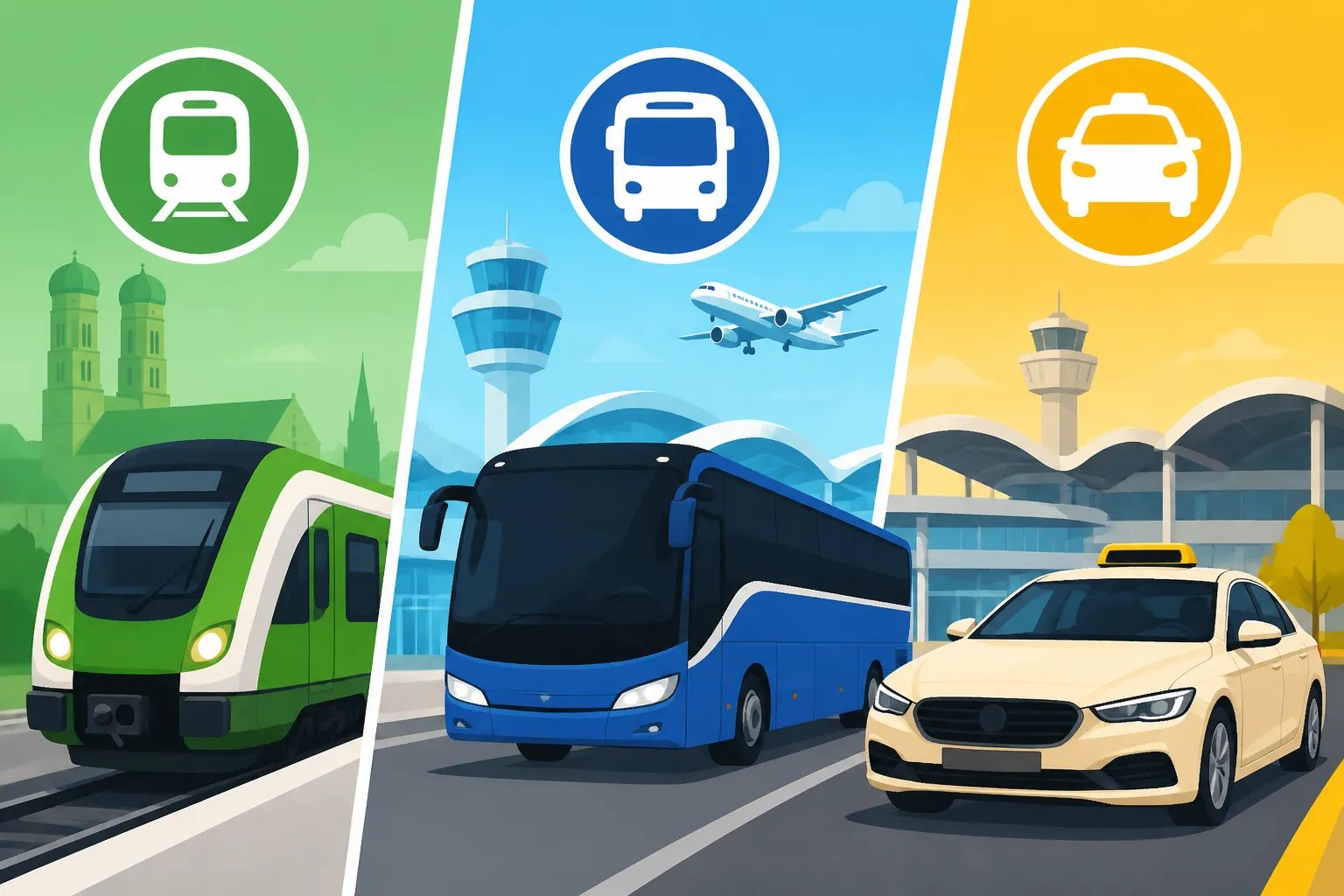
Munich Airport Transfers: S-Bahn, Lufthansa Express Bus, and Taxi Compared
Arriving at Munich Airport (MUC), especially after a long flight, can feel like stepping into a whole new world – exciting, yes, but also a bit disorienting. The last thing you want is to be staring blankly at a complex network map or wondering if you're about to overpay for a ride into the city. Trust me, I've been there, fumbling with change and trying to decipher signs after a red-eye. This guide is here to cut through the confusion and help you navigate your Munich airport transfer like a seasoned pro, ensuring a smooth journey to your destination, all while showing you how to simplify the entire process with Omio.
Disclosure: This post may contain affiliate links. We may earn a commission at no extra cost to you if you make a purchase through these links. Read full disclosure.
The Stalwart S-Bahn: Your Rail Link to Munich's Heart
Ah, the S-Bahn. For many, it's the quintessential German public transport experience: efficient, reliable, and sometimes a little bit of a puzzle for newcomers. Munich Airport is excellently connected to the city center by two S-Bahn lines, the S1 and the S8. They might seem similar, but understanding their nuances can save you time and stress.
Understanding S1 and S8 Routes and Frequencies
Both the S1 and the S8 lines run frequently from Munich Airport's S-Bahn station, located directly beneath Terminal 1 and Terminal 2. You don't need to hunt for it; just follow the green S-Bahn signs. The key difference lies in their routes and the areas of the city they serve.
The S1 generally heads towards the west of Munich, passing through stations like Neufahrn, Feldmoching, Laim, and then continuing to the Hauptbahnhof (Main Train Station) and further east towards Ostbahnhof. If your accommodation is on the western side of the city or close to the main station, the S1 might be your best bet. However, be aware that the S1 splits at Neufahrn, with only half the train continuing to the airport. Don't worry, the digital signs on the train will clearly indicate which carriages are going to the airport and which are not. Always double-check before you hop on!
The S8, on the other hand, takes a more direct route through the east of Munich, hitting Ostbahnhof first, then continuing to Marienplatz, the Hauptbahnhof, and further west. For anyone staying in the heart of the city, near Marienplatz or the English Garden, the S8 is often the quicker and more convenient option. Both lines typically run every 10-20 minutes, depending on the time of day, ensuring you rarely have to wait long. The journey time to the Hauptbahnhof for both lines is approximately 40-45 minutes, a surprisingly quick dash given the distance.
Ticketing and Fares: Decoding the MVV System
This is where many first-time visitors or new expats scratch their heads. Munich's public transport system, the MVV, operates on a zone-based fare structure. The airport is located in the very outer zone, making it a bit pricier than a city-internal ride. Don't fall into the trap of buying a standard single ticket for just a few zones; you need to cover the full distance.
The most common and cost-effective ticket for an airport transfer is the "Airport-City-Day Ticket" (Flughafen-Ticket). This special day ticket allows you to travel from the airport to the city (and vice versa) and then use all MVV public transport (S-Bahn, U-Bahn, trams, buses) within the entire MVV network for the rest of the day until 6 AM the next morning. It comes in a single person version and a group version, which is fantastic value if you're traveling with friends or family. You can purchase these tickets at the blue MVV ticket machines at the airport station, found in various languages. Remember, you must validate your ticket by stamping it in one of the small blue machines before you board the S-Bahn – skipping this step can lead to a hefty fine, and ignorance is no excuse in Germany!
For those planning a longer stay or frequent use of public transport, consider options like the IsarCard, but for a one-off airport trip, the Airport-City-Day Ticket is usually the best. Planning your ticket ahead of time can make arrival much smoother, and this is where a platform like Omio can truly shine, offering an easy way to compare and sometimes even pre-purchase tickets digitally. For a deeper dive into the German transit network, you might want to check out our guide on Public Transport Tickets and Passes: Navigating German Transit Systems.
Pros and Cons for Expats and Tourists
The S-Bahn offers a reliable, cost-effective, and authentically German way to get into the city. It runs mostly above ground initially, offering some glimpses of the Bavarian landscape before diving underground into the city. For many, the low cost is a huge draw, especially if you're on a budget or traveling solo. You'll avoid traffic jams, which can be a real headache on the roads, especially during peak hours.
However, it's not without its downsides. Luggage can be a challenge. While there are designated areas on the S-Bahn, these can quickly fill up, especially during rush hour or major events like Oktoberfest. Navigating crowded platforms and multiple changes with heavy bags can be a workout you didn't sign up for. Also, if you're unfamiliar with the MVV system, the ticketing machines can be daunting, and the whole "zone" concept can feel like solving a quadratic equation after an eight-hour flight. Despite the potential for a few initial head-scratchers, once you've done it once, it becomes second nature. It's truly a fantastic option for anyone looking for efficient and integrated travel from the airport.
Lufthansa Express Bus: A Direct Dash to the City Center
If the idea of S-Bahn lines, zones, and ticket validation makes your post-flight brain hurt, the Lufthansa Express Bus offers a refreshingly straightforward alternative. It’s a dedicated bus service designed specifically for airport transfers, and you don’t even need to be flying Lufthansa to use it!
Route, Stops, and Schedule
The Lufthansa Express Bus has a clear, no-nonsense route: from Munich Airport directly to the city center. It makes two primary stops in Munich itself: Nordfriedhof and the Hauptbahnhof (Main Train Station). The journey typically takes around 25-45 minutes, depending heavily on traffic conditions. This variability is something to keep in mind, especially if you're on a tight schedule for a connecting train or appointment.
The bus departs frequently, usually every 15 minutes, from clearly marked stops outside both Terminals 1 and 2 at the airport. You'll find the stops just outside the main exit doors, easy to spot with their distinctive branding. The bus is designed with travelers in mind, so there’s ample luggage space in the hold, meaning you don't have to wrestle your suitcase down narrow train aisles. The seats are comfortable, and often there's Wi-Fi on board, allowing you to catch up on messages or plan your next steps. For more on navigating train travel in Germany, including connecting services from the Hauptbahnhof, be sure to read our comprehensive Deutsche Bahn Guide: Using Trains for City and Long-Distance Travel.
Purchasing Tickets and Costs
One of the great appeals of the Lufthansa Express Bus is the simplicity of buying a ticket. You can purchase tickets directly from the bus driver, though often at a slightly higher price. For convenience and sometimes a small discount, it's better to buy your ticket online in advance. This means you can just hop on and show your digital ticket.
The cost is generally higher than the S-Bahn's Airport-City-Day Ticket but significantly less than a taxi. For a solo traveler, it's a happy medium, often prioritizing comfort and ease over the absolute lowest price. Children typically travel for free, which can be a huge bonus for families. When you book through Omio, you can easily compare the bus fares with S-Bahn options side-by-side, giving you a clear picture of what you're paying for and allowing you to purchase directly. It takes the guesswork out of booking, offering a seamless experience from start to finish.
Advantages and Disadvantages
The biggest advantage of the Lufthansa Express Bus is its directness and comfort. No confusing zone systems, no multiple stops within the city, and no grappling with luggage in crowded train carriages. You get a comfortable seat, dedicated storage for your bags, and a clear route to major city hubs. For those arriving with a lot of luggage, young children, or simply preferring a less stressful start to their German adventure, this bus is a blessing. It's also an excellent choice if you're staying very close to one of its two main stops, particularly the Hauptbahnhof, which is a central hub for all kinds of onward travel, including the city's U-Bahn and tram networks. If you're wondering how to make the most of all these options, our guide Getting Around German Cities: U-Bahn, S-Bahn, Trams, and Buses is a must-read.
However, the main disadvantage is traffic. Munich, like any major city, experiences rush hour congestion. A journey that should take 30 minutes can easily stretch to an hour or more if you hit bad traffic. Unlike the S-Bahn, which runs on its own dedicated tracks, the bus is subject to road conditions. The limited stops also mean that if your final destination isn't near Nordfriedhof or the Hauptbahnhof, you'll need to transfer to another mode of public transport, potentially adding more time and complexity to your journey. Despite this, for many, the trade-off for initial simplicity is well worth it.
The Classic Taxi: Convenience at a Premium
Sometimes, after a grueling flight, all you want is to be whisked away to your destination with minimal effort. That’s where the good old taxi comes in. While it’s certainly the most expensive option, it offers unparalleled convenience and door-to-door service.
Availability and Fares
Taxis are readily available at designated stands outside both terminals at Munich Airport, 24/7. You literally walk out of the terminal, follow the taxi signs, and join the queue. There's no need to pre-book if you don't want to, though that is an option for peace of mind.
Munich taxis generally operate with a meter, but for airport transfers, there are often semi-official or unofficial fixed rates to the city center, especially for popular routes like to the Hauptbahnhof. However, these "fixed rates" can sometimes vary depending on the driver or time of day, so it's always wise to confirm with the driver beforehand if they offer a fixed price to your specific area. Expect to pay anywhere from €70 to €90 for a ride to the city center, with potential surcharges for large luggage or late-night travel. While it’s a hefty sum compared to public transport, if you're traveling as a group of three or four, the per-person cost becomes a lot more reasonable, often comparable to the Lufthansa Express Bus or just slightly more.
When to Splurge on a Taxi
There are definite scenarios where a taxi isn't just a luxury, but a sensible choice. Firstly, if you're arriving very late at night or very early in the morning when public transport frequency is reduced, a taxi ensures you won't be stranded. Imagine arriving at 2 AM with no S-Bahn for another hour – a taxi suddenly looks very appealing!
Secondly, if you're traveling with a lot of luggage – multiple large suitcases, ski equipment, a bicycle – a taxi's trunk space is a lifesaver. Trying to maneuver oversized items on an S-Bahn or bus can be an exercise in frustration for both you and your fellow passengers. Thirdly, if you're traveling with small children or elderly relatives who might find public transport challenging, a direct taxi ride provides much-needed comfort and ease. No changes, no long walks with tired legs. Finally, if you're on a business trip and need to arrive at a meeting refreshed and on time, the direct, stress-free nature of a taxi can be invaluable, allowing you to relax or even make a quick call without interruption. Sometimes, the peace of mind and time saved are worth the extra euros.
Booking and Pre-Booking Options
While you can always grab a taxi from the rank, pre-booking can offer certain advantages. Services like FreeNow operate in Munich, allowing you to book and pay for a taxi via an app, often seeing the price upfront. This can eliminate any language barriers or concerns about metered vs. fixed prices. Some limousine or private transfer services also offer pre-booked airport pickups, which can be particularly useful if you have very specific requirements or are traveling with a large group and need a bigger vehicle.
When you pre-book, a driver will often meet you inside the terminal with a sign, making your arrival even smoother. While Omio is primarily focused on public transport and bus options, for your onward journey from the Hauptbahnhof or for exploring other German cities, it remains an excellent tool for comparing and booking trains and buses, helping you manage your entire travel itinerary efficiently. If you are looking to manage your budget for various expenses during your stay, consider reading our guide on the Cost of Living in Germany: Budgeting Guide for Expats.
Making the Choice: Factors Beyond Just Cost
Deciding on the best airport transfer isn't just about the lowest price. It's a holistic decision that involves several personal factors, each playing a crucial role in making your arrival in Munich as stress-free as possible.
Budget vs. Time vs. Comfort
Let's break down the eternal travel triangle: budget, time, and comfort. Very rarely do you get all three perfectly aligned, and often, you have to prioritize.
Budget: If minimizing expenses is your top priority, the S-Bahn is almost always the winner. The Airport-City-Day Ticket offers fantastic value, especially if you plan to use public transport extensively on your arrival day. It's the most expat-friendly option in terms of pure cost-effectiveness, helping you stretch your euros further. However, be prepared for potentially more effort in navigating the system and managing your luggage. This is where you really need to be savvy about How to Buy Deutsche Bahn Tickets and Save Money.
Time: If speed is of the essence, and traffic isn't a factor, the Lufthansa Express Bus or even the S-Bahn can be equally quick, both hovering around the 40-45 minute mark to the city center. However, if you're in a real hurry and willing to pay, a taxi is the only option that guarantees directness and can often use routes that avoid some congestion, although it's not immune to traffic entirely. Factor in potential delays when planning connections – an S-Bahn is less likely to be delayed than a bus in heavy traffic.
Comfort: This is where personal preference truly shines. A taxi offers unparalleled door-to-door service, privacy, and space. The Lufthansa Express Bus comes in a close second, with comfortable seating and dedicated luggage storage, making for a relaxed journey. The S-Bahn, while efficient, can be crowded, especially during peak hours, and might require standing with your luggage for part of the journey. If you value personal space and ease above all else, leaning towards a taxi or the bus is probably your best bet. Think about what kind of experience you want after a long journey – do you want to hit the ground running, or ease into your new surroundings?
Luggage Considerations and Accessibility
Your luggage situation is a huge determinant in your transfer choice. Are you a minimalist traveler with just a carry-on, or are you moving to Germany with your entire life packed into several oversized suitcases?
For light travelers, the S-Bahn is perfectly adequate. You can easily manage a backpack and a small carry-on without imposing on others or struggling for space. However, if you're hauling two large checked bags, a carry-on, and perhaps a special item like a musical instrument, the S-Bahn quickly becomes a less appealing option. Navigating stairs, tight spaces, and potentially crowded carriages with significant luggage can quickly turn a pleasant arrival into a stressful ordeal.
The Lufthansa Express Bus, with its under-bus luggage compartments, is excellent for those with medium to heavy luggage. You simply hand your bags over, grab your seat, and collect them at your destination. This hands-off approach makes it a firm favorite for many. And of course, a taxi is king for heavy luggage, as everything goes straight into the trunk.
Accessibility is another critical factor. If you're traveling with a wheelchair, a stroller, or have mobility challenges, the seamless, step-free access of a taxi is ideal. The Lufthansa Express Bus usually has wheelchair access, but it's always wise to confirm in advance. The S-Bahn is generally accessible, with elevators and ramps, but navigating transfers and potentially crowded platforms can still be more challenging than a direct, door-to-door service. Taking into account these practicalities can significantly improve your initial experience. For newcomers wondering about various aspects of living in Germany, our Housing in Germany: Renting, Buying, and Finding Your Home as an Expat guide also covers initial logistical challenges upon arrival.
Time of Day and Day of Week
The clock and the calendar also play a surprisingly big role in your transfer decision.
Peak Hours: During typical commuter rush hours (roughly 7-9 AM and 4-7 PM on weekdays), Munich's roads can become congested. This means the Lufthansa Express Bus, while comfortable, could take significantly longer than its advertised journey time. The S-Bahn, however, being independent of road traffic, maintains its schedule more reliably, though it might be more crowded.
Late Night/Early Morning: Public transport frequency decreases dramatically in the late evening and early morning hours. While the S-Bahn and Lufthansa Express Bus still run, the wait times between services can be much longer. If your flight arrives or departs during these times, a taxi might be the only practical option for a quick and direct transfer, or at least a much more comfortable one, avoiding long waits in the cold.
Weekends and Public Holidays: Weekends generally see less road traffic, making the bus a more reliable option in terms of speed. However, public holidays in Germany can be a mixed bag. Some transport might run on a Sunday schedule, meaning reduced frequency. Shops are generally closed, and the overall pace of life slows down dramatically. Understanding this German Culture & Etiquette: A Guide to Social Life and Customs can save you some surprises. It's always a good idea to check the MVV schedule or the Lufthansa Express Bus timetable specifically for public holidays if your travel falls on one.
By considering these factors, you can make an informed decision that best suits your individual needs and ensures a smooth journey into the Bavarian capital. Remember, with Omio, you can easily compare all these options side-by-side, giving you the power to choose what's right for you, every single time.
Seamless Travel with Omio: Your Ultimate Booking Tool
Navigating the multitude of transport options, comparing prices, and wrestling with different booking platforms can be a headache, especially when you're dealing with the fatigue of international travel. This is precisely where Omio steps in to simplify your life.
Why Omio Makes Airport Transfers Easy
Omio is more than just a booking platform; it's a travel aggregator that brings together different modes of transport – trains, buses, and even flights – into one easy-to-use interface. For your Munich Airport transfer, this means you can:
- Compare All Options in One Place: Instead of toggling between the MVV website, the Lufthansa Express Bus site, and potentially a taxi booking app, Omio allows you to see all the available options for your journey from MUC to Munich city center (or any other destination) on a single screen. You can instantly compare travel times, prices, and even environmental impact.
- Simplified Booking Process: Once you've made your choice, booking is straightforward. No need to learn new interfaces for each provider; Omio's streamlined process handles the purchase, often giving you mobile tickets directly on your phone. This means no more fumbling with ticket machines or worrying about validation – just show your digital ticket.
- Language Support: For many expats and tourists, the language barrier is a real frustration. Omio is available in multiple languages, making it much easier to understand your options and complete your booking without needing to decipher German transport terminology.
- Real-Time Information (Often): While the S-Bahn and bus services are subject to their operators' updates, Omio often pulls in real-time or near-real-time schedule information, helping you make the most current decision possible.
- Multi-Modal Planning: Your journey doesn't necessarily end at the Hauptbahnhof. With Omio, you can plan your entire journey from the airport, through Munich, and potentially to another German city or even cross-border. If you're wondering how to seamlessly integrate these, our Getting Around Germany: Trains, Buses, Flights, and Car Hire guide can offer more insights.
For instance, say you arrive at MUC and need to get to Nuremberg. You can use Omio to find the best combination of an S-Bahn or bus transfer to Munich Hauptbahnhof, and then book your onward train ticket to Nuremberg, all within the same app. This integrated approach saves you precious time and mental energy.
How to Book Your Munich Airport Transfer with Omio
Booking your airport transfer through Omio is incredibly user-friendly. Here's a quick step-by-step:
- Download the Omio App or Visit the Website: Get the app on your smartphone (highly recommended for mobile tickets) or go to Omio.com.
- Enter Your Journey Details: Input "Munich Airport (MUC)" as your origin and your destination in Munich, for example, "Munich Central Station (Hauptbahnhof)" or "Munich (all stations)." Select your travel date and time.
- Compare Options: Omio will display all available trains (S-Bahn), buses (Lufthansa Express Bus), and sometimes even flight options if you were connecting from another airport. You'll see prices, journey durations, and even the number of transfers required for each option. This is your chance to compare the S1 vs S8, or the bus vs. the train, based on your priorities.
- Select Your Preferred Option: Click on the option that best fits your budget, time, and comfort needs.
- Enter Passenger Details: Provide the necessary passenger information.
- Secure Payment: Complete your purchase using one of the secure payment methods available.
- Receive Your Ticket: Your ticket will typically be sent to your email and accessible directly within the Omio app. For mobile tickets, simply show your phone to the conductor or driver. No need for printing or fumbling at ticket machines!
It's that simple. From the moment you land, Omio takes the stress out of your initial travel, allowing you to focus on the excitement of exploring Munich, or simply relaxing after your journey.
Beyond Airport Transfers: Omio for All Your German Travel Needs
The utility of Omio extends far beyond just airport transfers. Once you're settled in Munich, you'll find it an invaluable tool for exploring Germany and even beyond. Whether you're planning a day trip to a picturesque Bavarian town, venturing out to Munich for First-Time Visitors: What to See, or embarking on a longer journey across the country, Omio has you covered.
You can use it to book regional trains to places like Garmisch-Partenkirchen in the Alps or to explore cities like Nuremberg, Dresden, or Berlin. It allows you to find cheap bus tickets for longer distances, often a budget-friendly alternative to trains. For anyone traveling extensively, especially through various parts of Europe, Omio is a one-stop shop for comparing and booking multi-country journeys. For expats living in Germany, this means managing your entire travel life from a single, familiar platform, making weekend getaways and holiday planning significantly easier. If you're a new resident or just looking to better understand the nuances of the Deutsche Bahn system, including handy tools like the DB Navigator App, make sure to check out our guide on How to Use the DB Navigator App in Germany.
By embracing Omio, you're not just booking a ticket; you're streamlining your entire travel experience in Germany, freeing up your time and energy to enjoy the country’s rich culture and beautiful landscapes.
Comparative Overview: S-Bahn, Bus, and Taxi
To help you visualize the differences and make your decision, here's a quick comparison table summarizing the key aspects of each transfer option from Munich Airport to the city center:
| Feature | S-Bahn (S1/S8) | Lufthansa Express Bus | Taxi |
|---|---|---|---|
| Cost (approx.) | €13-€16 (Airport-City-Day Ticket) | €12-€18 (single journey) | €70-€90 |
| Journey Time | 40-45 minutes | 25-45 minutes (traffic dependent) | 35-50 minutes (traffic dependent) |
| Frequency | Every 10-20 minutes | Every 15 minutes | On-demand / 24/7 |
| Comfort | Moderate (can be crowded) | High (comfortable seats, Wi-Fi) | Very High (private, door-to-door) |
| Luggage | Manageable (limited dedicated space) | Excellent (under-bus storage) | Excellent (trunk space) |
| Stops | Multiple (integrated into MVV) | Nordfriedhof, Hauptbahnhof | Your exact destination |
| Booking | Ticket machines, Omio | Online, driver, Omio | Taxi stand, app, pre-booking |
| Traffic Impact | None | High | High |
| Accessibility | Good (elevators/ramps) | Generally good (check for specific needs) | Excellent (door-to-door, direct) |
This table provides a quick reference, but remember to always consider your personal circumstances, such as the amount of luggage, time of arrival, and your final destination in Munich, before making your final choice. And with Omio, you have all the information and booking power at your fingertips to make that decision confidently. For guests visiting Germany on a short trip, understanding visa requirements might also be relevant, so do check out Schengen Visa for Germany: Short-Stay Visa Requirements and Tips.
Disclaimer
While I've put my heart and soul into providing the most up-to-date and helpful information based on my experience and research, transport schedules, prices, and regulations in Germany can change. It's always a good idea to double-check official websites (like MVV, Lufthansa Express Bus, or Omio directly) for the very latest information before your trip. This guide is for informational purposes only, and individual circumstances may vary.