Healthcare for Refugees vs Expats: Understanding the Differences
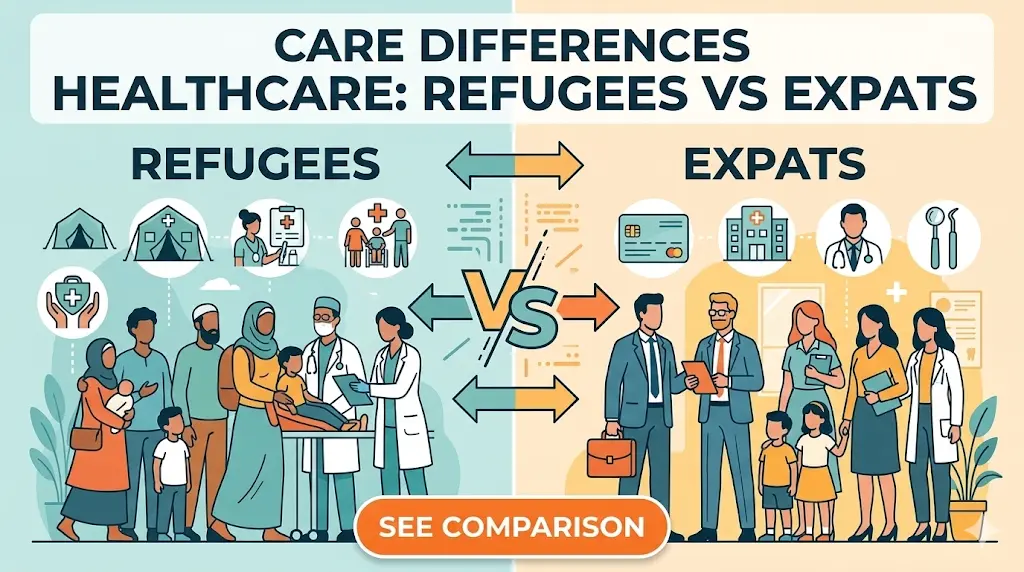
Navigating the German healthcare system can be complex. This guide explains the fundamental differences in medical access, legal rights, and insurance coverage between expats working in Germany and refugees seeking asylum, ensuring you understand your specific healthcare entitlements.
Disclosure: This post may contain affiliate links. We may earn a commission at no extra cost to you if you make a purchase through these links. Read full disclosure.
The German Healthcare System Foundation
Statutory vs Private Health Insurance
The bedrock of the German medical system is its dual-track insurance model. The vast majority of the population is covered by the Statutory Health Insurance (Gesetzliche Krankenversicherung or GKV). This system is based on the principle of solidarity, where contributions are tied to a percentage of your gross income rather than your personal health risks. The GKV covers all medically necessary treatments, hospital stays, and prescription medications with minimal out-of-pocket costs.
Running parallel to the statutory system is the Private Health Insurance (Private Krankenversicherung or PKV) sector. This option is generally reserved for high-earning employees, self-employed individuals, and civil servants. In the PKV system, premiums are calculated based on your age, health history, and the specific level of coverage you choose, rather than your income. Private patients often enjoy perks such as shorter waiting times for specialists, private hospital rooms, and access to chief physicians.
For internationals relocating to the country, deciding between these two pillars is a monumental choice that shapes your entire financial and medical future. You can find a deep comparative analysis of these options in our guide on Public vs Private Health Insurance: Which One Should You Choose?.
The Mandatory Insurance Requirement
A cornerstone of German law is the Krankenversicherungspflicht, which strictly mandates that every single person residing in Germany must possess adequate health insurance. This applies equally to German citizens, newly arrived expats, international students, and refugees. There is no legal way to permanently live in Germany without being integrated into a recognized health coverage framework.
For expats, you must typically prove you have compliant health insurance before your work or residence visa is even approved. Failing to secure insurance immediately upon arrival can result in massive back-payment penalties later on. Because the bureaucratic registration process can be overwhelming, many incoming professionals use specialized digital brokers like Feather Insurance to seamlessly set up their required health policies before they even board their flights.
Refugees and asylum seekers are also subject to mandatory care, but they do not actively shop for insurance providers upon arrival in the same way an expat does. Instead, the German state automatically assumes responsibility for their medical coverage through local social welfare structures. For a broader overview of how all residents interact with the medical framework, read Healthcare in Germany: A Comprehensive Guide for Expats.
Healthcare Access for Expats in Germany
Employee and Freelancer Coverage Options
Expats arriving in Germany for work generally have immediate, unrestricted access to the entire healthcare system from day one. If you are an employee earning below the mandatory insurance threshold (Jahresarbeitsentgeltgrenze), you are automatically enrolled in the statutory public system (GKV). The cost is split evenly between you and your employer, automatically deducted from your monthly paycheck. To understand how these exact deductions impact your take-home pay, review Understanding Your German Payslip: Gross vs Net Salary Explained.
If your salary exceeds the threshold, or if you operate as a freelancer (Freiberufler), you are granted the freedom to choose. You can remain in the public system as a voluntary member, or you can opt out entirely and purchase a private policy. Premium expat-focused private insurers like Ottonova offer comprehensive digital platforms, English-speaking concierges, and rapid reimbursement features, making the private sector highly attractive for healthy, high-earning expats.
Expats who choose digital-first providers like Feather Insurance or Ottonova often bypass the traditional, paper-heavy bureaucracy of the German medical system, allowing them to book appointments and submit claims entirely via their smartphones.
Overcoming Language and Bureaucratic Barriers
While expats possess the financial and legal right to access top-tier care, their primary hurdle is often practical: language. Navigating a German doctor’s office or hospital can be intimidating if you do not speak fluent German. Finding an English-speaking general practitioner (Hausarzt) is the critical first step to establishing your medical safety net. Your Hausarzt acts as your primary point of contact and issues referrals for specialized care.
Healthcare Access for Refugees and Asylum Seekers
The Asylum Seekers Benefits Act AsylbLG
Healthcare for refugees and asylum seekers in Germany operates under a completely different legal framework than that of expats or German citizens. Initially, their medical access is governed by the Asylum Seekers Benefits Act (Asylbewerberleistungsgesetz or AsylbLG).
Under Sections 4 and 6 of the AsylbLG, newly arrived asylum seekers are not immediately granted full statutory health insurance. Instead, they are legally entitled to a restricted scope of “basic medical care.” This explicitly covers the treatment of acute illnesses, pain relief, essential vaccinations, medically necessary preventive check-ups, and comprehensive care related to pregnancy and childbirth. However, treatments for chronic illnesses or complex therapies that are not deemed immediately life-threatening may be delayed or require special bureaucratic approval from the local social welfare office (Sozialamt).
The administrative process for receiving this care varies significantly depending on the municipality. In many regions, asylum seekers must physically visit the social welfare office every quarter to request a paper healthcare voucher (Krankenschein). They must present this voucher to the doctor before receiving treatment. In more progressive states and municipalities, authorities have transitioned to providing an electronic health card (elektronische Gesundheitskarte or eGK) right away, which drastically reduces the administrative burden and stigma for the patient.
Transitioning to the Regular Statutory System
The restricted healthcare access under the AsylbLG is not permanent. Recent legislative updates dictate that after a waiting period of generally 36 months in Germany, asylum seekers become entitled to “analogue benefits” (equivalent to standard statutory health insurance or GKV).
Once this 36-month threshold is reached, or immediately upon their asylum application being officially approved (granting them recognized refugee status), they are fully integrated into the regular German healthcare system. They receive a standard electronic health card (eGK) and have the exact same rights to comprehensive medical care, specialists, and therapies as a publicly insured expat or German citizen. The costs for their care shift from the local social welfare office directly to the statutory health insurance funds. To see the full scope of what this upgraded coverage entails, read Public Health Insurance gesetzliche Krankenkasse: What It Covers and Costs.
Key Differences and Financial Considerations
Comparing Costs and Out of Pocket Expenses
The financial mechanics of healthcare differ wildly between expats and refugees. For an expat in the public system, the monthly premium is a strict percentage of their gross income. If an expat opts for private insurance, they pay a fixed monthly premium and generally must pay their medical bills upfront before seeking reimbursement. If an expat needs to transfer funds internationally to cover a large private medical invoice, utilizing a platform like Wise ensures they get the real mid-market exchange rate, avoiding punitive hidden fees from traditional banks.
For asylum seekers under the AsylbLG, healthcare is entirely tax-funded. They do not pay monthly insurance premiums, nor do they typically face out-of-pocket co-pays for standard, approved acute treatments or necessary hospital stays. The local municipality or the state bears the total financial burden of their basic medical care.
However, because their initial coverage is restricted to “acute” needs, refugees may face barriers accessing non-essential therapies or over-the-counter wellness products that expats buy freely.
Access to Medications and Wellness Resources
Both expats and refugees must utilize the German pharmacy (Apotheke) system for medications. For expats, prescription drugs covered by the public system require a small co-pay (usually between €5 and €10), while over-the-counter (OTC) drugs for minor ailments like a cold are paid entirely out-of-pocket.
Refugees receive essential, prescribed acute medications free of charge via their healthcare voucher or eGK. However, for preventative care, immune-boosting supplements, or specific wellness products not covered by basic state care, refugees face financial limitations. Expats, possessing higher disposable incomes, frequently bypass local pharmacy markups for these non-essential items by ordering online. Utilizing platforms like iHerb, expats can easily source their preferred international vitamins, specialized dietary supplements, and holistic wellness products delivered directly to their door.
Summary Comparison Table
| Feature | Expats | Refugees (Initial 36 Months) | Refugees (Recognized / Post-36 Months) |
| Legal Framework | SGB V (Statutory) or VVG (Private) | AsylbLG (Asylum Seekers Benefits Act) | SGB XII or SGB II (Analogue Benefits) |
| Scope of Coverage | Comprehensive (All medically necessary treatments) | Restricted (Acute illnesses, pain, pregnancy) | Comprehensive (Equivalent to Statutory Insurance) |
| Access Method | Electronic Health Card (eGK) or Private Card | Paper Voucher (Krankenschein) or restricted eGK | Standard Electronic Health Card (eGK) |
| Funding Source | Income-based premiums or risk-based private premiums | Fully funded by Social Welfare Office (Sozialamt) | Fully funded by Jobcenter or Social Welfare Office |
| Provider Choice | Full freedom of choice among GKV/PKV doctors | Limited (Must often find doctors accepting vouchers) | Full freedom of choice among GKV doctors |
References
Primary sources official
- Federal Ministry of Health (BMG): Official guidelines on healthcare provision for asylum seekers and the legal transition periods under the AsylbLG. https://www.bundesgesundheitsministerium.de/themen/gesundheitswesen/gesundheitsversorgung-von-asylsuchenden.html
- Make it in Germany: The German government’s official portal for international professionals, detailing statutory and private health insurance requirements for incoming expats. https://www.make-it-in-germany.com/en/living-in-germany/money-insurance/health-insurance
Other helpful sources
- Robert Koch Institute (RKI): Epidemiological data and public health reports focusing on health monitoring and medical access for refugees in German reception centers. https://www.rki.de/EN/Home/homepage_node.html
- Finanztip: Germany’s leading independent consumer finance portal, offering deep breakdowns of statutory health insurance costs, the Krankenversicherungspflicht, and private insurance options. https://www.finanztip.de/
Disclaimer
The information provided in this article is for general informational and educational purposes only and does not constitute professional medical, legal, or financial advice. The German healthcare system, immigration laws, and the specific regulations within the Asylum Seekers Benefits Act (Asylbewerberleistungsgesetz) are highly complex and subject to continuous regional and federal legislative updates. The waiting periods for analogue benefits and the specific implementation of electronic health cards for refugees vary significantly by municipality and federal state. Always consult directly with a qualified legal advisor, a certified insurance broker, or the responsible social welfare office (Sozialamt) regarding your specific residency status and healthcare entitlements in Germany.