Breaking the B1 Plateau: Why Grammar Study Stalls and What Speaking Fixes
Ah, the infamous B1 plateau. If you’ve been living in Germany for a while, dutifully attending your language classes, perhaps even acing your grammar tests, only to find yourself still stumbling over sentences when speaking to a real German, you are absolutely not alone. It’s a classic expat experience: you can understand a fair bit, read signs, maybe even follow a simple TV show, but when it comes to expressing yourself spontaneously, the words just freeze in your throat. This guide is here to validate that very real frustration and show you why more grammar drills won't fix it, and how focusing on active speaking, especially with tools like iTalki, can finally break you through this seemingly impenetrable language barrier.
Disclosure: This post may contain affiliate links. We may earn a commission at no extra cost to you if you make a purchase through these links. Read full disclosure.
The B1 Plateau: A Universal Expat Experience
Anyone who’s tried to learn German to a conversational level in Germany knows this feeling. It’s that maddening point where you’ve moved beyond the absolute basics – you can order a beer, introduce yourself, and maybe even complain about the weather. You’ve put in the hours, you’ve memorized verb conjugations, and you understand the theory of Dativ and Akkusativ, but when a native speaker asks you an open-ended question, your mind goes blank, and your carefully constructed sentences fall apart faster than a budget flat-pack Möbel.
The Frustration of "Almost There"
This "almost there" feeling is arguably more frustrating than being a complete beginner. As a beginner, every new word or phrase is a victory. You expect to struggle, and people are generally more patient. But at B1, you know enough to realize how much you don't know how to say. You can follow the gist of a conversation but contribute very little. You might find yourself nodding along, smiling awkwardly, and hoping no one asks you a direct question that requires more than a simple "Ja" or "Nein." It feels like you’re constantly performing mental gymnastics, translating word-for-word in your head, only for the German speaker to have moved on two topics ago. This is where many expats start feeling isolated, even in bustling cities like Berlin or Munich.
You hear complex vocabulary in daily life, perhaps at your local Bürgeramt or in a conversation with a new Finding an Apartment in Germany: Best Websites and Tips for Expats neighbour, and you understand the concepts, but your active vocabulary for spontaneous speech feels woefully inadequate. The gap between what you know and what you can produce widens, leading to self-consciousness and a reluctance to even try. It’s a vicious cycle where fear of making mistakes prevents the practice needed to overcome that fear.
Why B1 is Such a Sticky Point
B1 is often described as the "threshold" level – it's where you gain a certain independence in the language. You can manage most situations when travelling, deal with routine tasks, and express personal opinions on familiar topics. However, it's also the point where the demands on spontaneous, fluent communication significantly increase. Below B1, you're building foundational grammar and vocabulary, often in controlled classroom settings. Above B1, towards B2 and C1, the expectation is for more fluid, complex, and nuanced conversation.
The jump from understanding grammatically correct, simple sentences to constructing them rapidly and accurately in real-time, while simultaneously dealing with German accents and colloquialisms, is massive. This is where many traditional language learning methods, heavily focused on grammar rules and exercises, start to falter. The sheer complexity of German grammar, with its cases, separable verbs, and intricate sentence structures, can feel overwhelming when you’re trying to piece it all together on the fly. You might know all the rules, but deploying them instantly under pressure is an entirely different skill.
The Grammar Trap: Why Book Learning Only Takes You So Far
Many of us approach language learning with the best intentions, believing that if we just master all the grammar rules, fluency will magically follow. We buy textbook after textbook, fill out countless exercises, and diligently highlight every new declension chart. While foundational grammar is undeniably important, particularly in a structured language like German, an over-reliance on this method can actually become a significant barrier at the B1 stage.
The Illusion of Grammatical Perfection
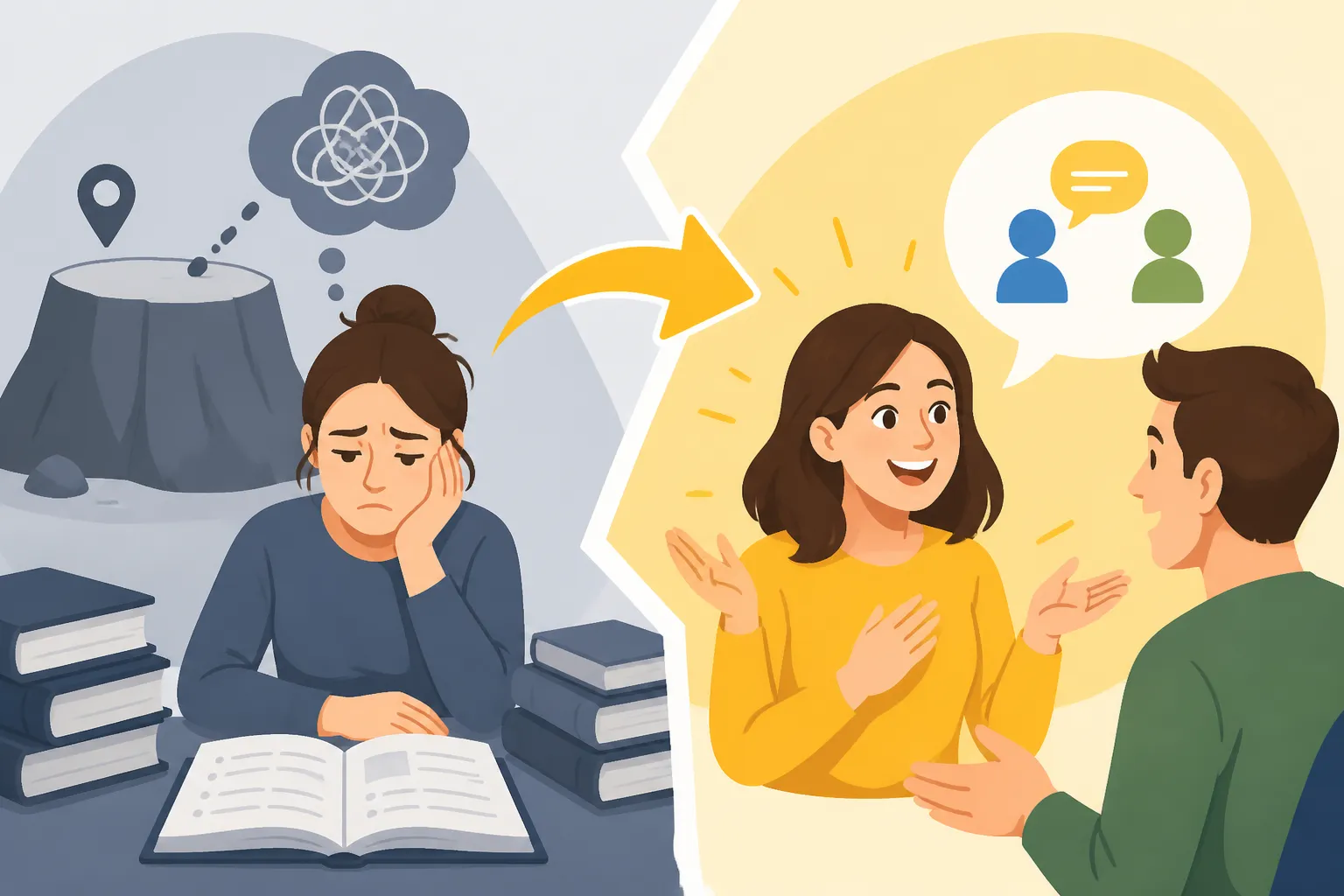
It's a common misconception that knowing all the grammar rules will make you fluent. You might be able to perfectly explain the difference between wegen and aufgrund or articulate why a certain verb takes the dative case. You might even score highly on written grammar tests. Yet, when you're faced with a real person asking you about your weekend plans, your mind races through endless grammatical checklists: Is it dative or accusative? Present perfect or simple past? Where does the separable prefix go? This internal monologue, this desperate attempt to construct a grammatically perfect sentence before you even open your mouth, is paralyzing.
The problem isn't that you don't know the rules; it's that you haven't had enough practice applying them in spontaneous, high-speed conversation. You're building a mansion of theoretical knowledge without ever living in it. Real conversation isn't about perfection; it's about communication. Germans, just like any native speakers, make grammatical errors themselves in casual speech. The obsession with being perfectly correct often leads to silence rather than fluent interaction, trapping you further in the B1 plateau.
The Limitations of Passive Input and Drills
Reading German books, watching German films, and listening to German podcasts are all incredibly valuable for language acquisition. They expand your vocabulary, expose you to natural sentence structures, and improve your comprehension. However, these are largely passive activities. You are receiving information, not actively producing it. It's like endlessly watching cooking shows without ever stepping into a kitchen yourself. You might learn the theory, but you won't learn to cook.
Similarly, traditional classroom drills, while useful for reinforcing specific grammar points, often lack the dynamic, unpredictable nature of real-life conversation. They typically involve filling in blanks, repeating phrases, or answering simple questions in a low-stakes environment. There's little pressure to improvise, adapt, or navigate unexpected turns in a dialogue. These structured exercises prepare you for a test, not for the messy, fluid reality of chatting with a German colleague during a coffee break or discussing a problem with your Understanding German Rental Contracts: Key Terms and Conditions landlord. The sheer gap between the controlled environment of a textbook exercise and the fast-paced exchange of ideas in German often leads to disappointment and a feeling of inadequacy when faced with real interaction.
The Speaking Solution: Activating Your German Knowledge
So, if endlessly drilling grammar isn't the silver bullet for breaking the B1 plateau, what is? The answer, my dear expats, lies in the simplest yet often most intimidating aspect of language learning: speaking. It's time to shift your focus from passive absorption to active production. It's time to make your brain work hard, not just to understand, but to generate.
From Passive Knowledge to Active Production
Think of it this way: your brain has a vast library of German words and grammar rules stored away. Reading and listening are like browsing the card catalog. Speaking, however, is like being asked to instantly retrieve specific books, arrange them into coherent paragraphs, and then deliver a compelling speech, all on the spot. This requires a different kind of mental muscle memory. You need practice retrieving vocabulary, conjugating verbs, and structuring sentences in real-time, without the luxury of pausing to consult a mental textbook.
This transition from passive knowledge to active production is where the magic happens. When you speak, you force your brain to engage in active recall, which is a much more powerful learning mechanism than passive recognition. You start to notice the gaps in your knowledge, not just in grammar rules, but in how you actually use them. These moments of struggle, of fumbling for the right word or phrase, are precisely where profound learning occurs. It builds pathways in your brain that make future retrieval faster and more automatic. Embrace these struggles; they are proof that you are growing.
The Power of Real Conversation
Real conversations are the ultimate training ground for language fluency. They are messy, unpredictable, and demand constant adaptation. Unlike textbook exercises, a real conversation doesn't wait for you to formulate the perfect sentence. You have to listen, process, and respond – often within seconds. This pressure, while initially daunting, is incredibly effective for activating your dormant German knowledge. It forces you to:
- Improvise: You won't always have the exact word you need. Conversation teaches you to paraphrase, use synonyms, or simplify your thoughts, which are essential skills for real-world communication.
- Deal with unpredictability: People don't follow scripts. They interrupt, change topics, and use colloquialisms. Real conversation teaches you to navigate this linguistic chaos.
- Build confidence: Every successful interaction, no matter how small, boosts your confidence and makes you more willing to speak again. This is crucial for overcoming the fear of mistakes that often plagues B1 learners.
- Internalize grammar: Instead of just memorizing rules, you start to feel how German sentences are constructed. The correct cases, verb positions, and prepositions begin to sound "right" through repeated use and correction in context.
This is precisely where methods that connect you directly with native German speakers become not just helpful, but absolutely critical.
Leveraging iTalki to Break Through the Plateau
When you're ready to make the decisive leap from understanding German to actively speaking it, one of the most effective tools at your disposal is an online language learning platform like iTalki. I've heard countless stories from expats here in Germany who've felt stuck, only to find their voice through consistent, personalized speaking practice, and many swear by platforms like iTalki. It truly is a game-changer for those grappling with the B1 plateau.
Tailored Practice on Your Terms
One of the biggest advantages of iTalki is its incredible flexibility and personalized approach. Unlike a traditional group class in a Volkshochschule (though those have their place, for sure!), where you might get only a few minutes of speaking time per lesson, iTalki connects you directly with native German speakers for one-on-one sessions. This means 100% of the speaking time is yours, and the entire lesson can be tailored to your specific needs.
- Diverse Tutors: iTalki offers both community tutors and professional teachers. Community tutors are native speakers who offer informal conversation practice, often at very affordable rates. Professional teachers have certifications and experience, providing more structured lessons, grammar explanations, and targeted exercises. You can find someone who perfectly matches your learning style and budget.
- Flexible Scheduling: Life in Germany as an expat can be hectic. Between work, Opening a Bank Account in Germany: Step-by-Step for Newcomers, and navigating the Ausländerbehörde, finding time for regular language practice can be tough. With iTalki, you can book lessons whenever it suits your schedule, whether it's an early morning chat before work or a late-night session.
- Customized Content: Do you struggle with a specific grammar point when speaking? Or perhaps you need to practice vocabulary related to your job or a specific administrative task, like understanding German Rental Contracts: Key Terms and Conditions? Your iTalki tutor can focus entirely on these areas. You can tell them exactly what you want to work on, ensuring that every minute of your lesson is productive and relevant to your goals. This level of personalization is incredibly difficult to achieve in a group setting.
Beyond the Textbook: Real-Life Scenarios with iTalki
The real power of iTalki lies in its ability to simulate real-life German interactions, but in a safe, supportive environment where making mistakes is encouraged, not feared. This is crucial for building the confidence needed to speak German in your daily life here.
- Role-Playing Everyday Situations: Imagine practicing how to Doctor’s Appointments in Germany: Making Appointments and Avoiding Long Waits or how to explain a problem at your German Dental Appointment: How to Book and What to Expect on Your Visit without the pressure of a real-world consequence. With an iTalki tutor, you can role-play these scenarios, getting immediate feedback on your vocabulary, pronunciation, and sentence structure. You can practice describing symptoms, asking questions about forms, or navigating the intricacies of German customer service interactions. This practical application solidifies your learning in a way no textbook ever could.
- Engaging in Natural Conversation: Beyond structured exercises, simply having free-flowing conversations with a native speaker on iTalki about topics you genuinely care about – whether it's your hobbies, current events, or even German Food Culture: Eating and Drinking as a Visitor – is immensely beneficial. This forces you to think on your feet, recall vocabulary, and construct sentences spontaneously. Your tutor can gently correct your errors, introduce new phrases, and explain cultural nuances that you might miss in a textbook or a casual chat with a German friend who might be too polite to correct you.
- Immediate and Targeted Feedback: One of the most common frustrations at the B1 level is not knowing why your sentences don't sound quite right. An iTalki teacher can provide instant, constructive feedback. They can pinpoint recurring grammatical errors, suggest more natural phrasing, and help you expand your vocabulary in context. This targeted correction is invaluable for breaking bad habits and forming correct linguistic patterns. This direct feedback is what helps you bridge the gap between B1 reading comprehension and a more fluid, confident C1 conversational style. It really is a powerful way to make significant strides in your speaking ability.
Integrating Speaking Practice into Your German Life
While structured lessons with iTalki are incredibly powerful, they are just one piece of the puzzle. To truly break through the B1 plateau and integrate German into your daily life, you need to actively seek out and create speaking opportunities everywhere you go. It’s about building a consistent habit and embracing every chance to open your mouth, even if it feels a little uncomfortable at first.
Beyond Formal Lessons: Everyday Opportunities
Once you start gaining confidence from your iTalki sessions, it’s time to take that courage out into the streets of Germany! Don't wait for the perfect moment; create your own.
- Small Talk in Daily Interactions: This is low-hanging fruit, but so many expats avoid it. Instead of just "Danke," try "Schönen Tag noch!" or ask a brief question at the bakery. Even simple exchanges with shopkeepers, cashiers, or your post person (who might be delivering your The Broadcast Fee Rundfunkbeitrag in Germany bill!) add up. It might feel awkward initially, but these small wins build your conversational muscles.
- Engage with Neighbors: Your German neighbors might seem reserved, but a friendly "Guten Morgen" or a brief chat about the weather can go a long way. This is particularly true if you live in a Hausgemeinschaft where you might share a laundry room or a garden. Don't be afraid to ask for help or offer it in German, even if it's just about the Waste Sorting in Germany Mülltrennung and Pfand system.
- Join Local Clubs and Groups: Germany has a fantastic club culture, from sports clubs (Staying Fit in Germany: Joining Gyms, Pools, and Sports Clubs) to hiking groups, choirs, or Stammtische (regular get-togethers). This is one of the absolute best ways to make friends and integrate into the local community. While intimidating at first, these environments provide natural, relaxed settings for conversation, forcing you to use your German in a variety of contexts. You’ll be talking about shared interests, which makes the conversation flow more easily. Check out local community centers or online platforms for groups in your area.
- Language Exchange Partners (Tandem): While iTalki provides paid, structured sessions, a tandem partner offers a free, reciprocal way to practice. You spend half the time speaking German and half speaking your native language. While these can be wonderful for Making Friends in Germany: Social Tips for Expats and cultural exchange, they can also be inconsistent or lack the structured correction of a paid tutor. However, they are still a great supplement to your learning, especially if you set clear expectations about correction and focus.
Creating a Speaking-Focused Routine
Consistency is key when it comes to language acquisition. Building a routine that prioritizes speaking will yield far greater results than sporadic bursts of intense study.
- Set Realistic Goals: Don't aim for overnight fluency. Commit to a certain number of iTalki lessons per week (even 2-3 short ones can make a huge difference!) and a certain number of informal interactions. Perhaps promise yourself to initiate at least one conversation in German every day, no matter how brief.
- Combine Formal and Informal Practice: Use your iTalki sessions to work on specific grammar points, expand your vocabulary, and get targeted feedback. Then, take what you learned and try to apply it in your everyday interactions. This cycle of learning, practicing, getting corrected, and then applying is incredibly effective.
- Don't Wait for Perfection: This is perhaps the most important piece of advice. Stop waiting until you feel ready or until your grammar is perfect. That day will never come. The only way to get better at speaking is by speaking. You will make mistakes. You will sound silly sometimes. That's part of the process, and every expat who has mastered German has been there. Living in Germany Without Speaking German (Yet): Tips to Get By is possible, but truly thriving requires letting go of the fear of imperfection.
- Embrace the Messiness: Real conversations are rarely polished. They involve pauses, hesitations, self-corrections, and imperfect sentences. This is natural! Allow yourself to be imperfect. Focus on getting your message across, even if it's not grammatically flawless. The fluency will come with practice, not perfectionism.
- Shadowing and Self-Talk: When you're alone, try describing your surroundings or narrating your actions in German. Listen to German podcasts or watch TV shows, then try to repeat phrases or sentences exactly as you hear them (this is called shadowing). This helps train your mouth and brain to produce German sounds and rhythm.
Beyond B1: Sustaining Your Language Journey in Germany
Breaking through the B1 plateau is a massive achievement, but it's not the end of your language learning journey. German, like any language, is a living, breathing entity that requires continuous engagement to maintain and improve. The key is to adopt a continuous growth mindset and to view language learning as an ongoing part of your life in Germany.
The Continuous Growth Mindset
You've faced the B1 wall and pushed past it with active speaking practice, likely accelerated by focused sessions on iTalki. Now, carry that momentum forward. Understand that language learning isn't a race to a finish line; it's a marathon with changing landscapes. There might be other plateaus at B2 or even C1, but by now you'll have the tools and the confidence to tackle them.
- Celebrate Small Victories: Acknowledge your progress. Remember when you couldn't articulate your feelings about a movie? Now you can! Each time you navigate a complex conversation at the Apotheke or successfully discuss a work project in German, give yourself a pat on the back. These small victories fuel your motivation.
- Perfection is a Myth: Even native speakers make mistakes. Focus on effective communication rather than flawless grammar. The goal is to express yourself clearly and confidently, to connect with people, and to participate fully in German society and culture. You’ll hear Germans say "Ich bin mir nicht sicher, ob das richtig ist" (I'm not sure if that's right) sometimes, and they're native speakers!
- Embrace Lifelong Learning: The German language is rich and nuanced. There will always be new vocabulary, idioms, and subtle cultural expressions to learn. Approach it with curiosity and an open mind, rather than seeing it as a never-ending chore.
Advanced Strategies for Fluency
To continue refining your German and pushing towards C1 and C2 levels, diversify your input and maintain consistent output. The foundation you built by prioritizing speaking will serve you well.
- Engage with Authentic Materials: Move beyond graded readers. Read German newspapers like Süddeutsche Zeitung or Frankfurter Allgemeine Zeitung, delve into contemporary German novels, or explore academic articles in your field. This exposes you to a wider range of vocabulary and complex sentence structures.
- Dive into German Media: Watch German documentaries, listen to podcasts on niche topics that genuinely interest you, or even tune into German radio debates. Immerse yourself in the nuances of spoken German, different regional accents, and the rhythm of natural conversation. Using translation apps can help if you get stuck, but try to infer meaning first. You'll find yourself needing Using Translation Apps in Germany: What Works Best less and less!
- Maintain Regular Speaking Practice: Don't abandon your dedicated speaking practice. As you advance, you might transition from community tutors to professional teachers on iTalki who can provide even more sophisticated feedback on stylistic choices, nuanced vocabulary, and advanced grammar structures. They can help you prepare for specific exams like German Language Certificates: TestDaF, DSH, and Goethe or refine your professional German for the workplace, relevant to topics like Work Culture in Germany: Etiquette, Hierarchy, and Office Norms.
- Seek Out Challenging Conversations: Actively participate in discussions at work, with friends, or in clubs. Don't shy away from complex or abstract topics. These are the conversations that will push your linguistic boundaries and force you to articulate more sophisticated thoughts in German.
- Consider Advanced Courses: If you thrive in a structured environment and wish to pursue official certification, look into advanced C1 or C2 courses at language schools. They can help polish your academic or professional German. Resources like Learning German: Top Language Schools and Resources for Expats can guide you to reputable institutions that offer these higher-level courses.
Remember, the goal is not just to speak German, but to live in German. By actively engaging with the language through consistent speaking practice, especially with a supportive platform like iTalki, you're not just learning vocabulary; you're building connections, deepening your understanding of German culture, and truly making Germany your home.
Here's a quick look at how various speaking practice methods stack up:
| Method | Pros | Cons | Best For |
|---|---|---|---|
| iTalki (Community Tutor) | Affordable, flexible, real conversation, low pressure, diverse topics | Less structured than pro teachers, might lack deep grammar explanation | Casual practice, building confidence, speaking freely, activating vocabulary |
| iTalki (Professional Teacher) | Structured lessons, targeted feedback, grammar explanation, tailored curriculum, exam prep | Higher cost than community tutors | Addressing specific weaknesses, preparing for exams, formal instruction, advanced topics |
| Language Exchange (Tandem Partner) | Free, reciprocal learning, cultural exchange, potential for friendship | Inconsistent, not always balanced (one person might talk more), can be hard to find good partners | Informal practice, making friends, cultural insights, casual conversation |
| Local Group Classes | Structured curriculum, group interaction, clear progression, social aspect | Less speaking time per person, fixed schedule, may be expensive, limited personalization | Systematic grammar review, social aspect, exam preparation, basic progression |
| Everyday Interactions | Authentic, practical, builds confidence for small tasks | Limited scope for deep conversation, not focused on correction, can be intimidating | Practicing basic phrases, navigating daily life (e.g., in a German Apotheke) |
Disclaimer
This article is for general informational purposes only and does not constitute professional advice. Laws, prices and regulations vary by location and change over time. Consult a qualified professional for guidance on your specific situation.