German Dental Appointment: How to Book and What to Expect on Your Visit
Navigating a German dental appointment can feel overwhelming for newly arrived expats. This guide explains how to find an English-speaking dentist, what to expect during your checkup, how the unique Bonusheft system works, and how to manage your insurance coverage effectively.
Disclosure: This post may contain affiliate links. We may earn a commission at no extra cost to you if you make a purchase through these links. Read full disclosure.
How to Find and Book a Dentist in Germany
Searching for an English Speaking Dentist
In Germany, a dentist is referred to as a Zahnarzt (or Zahnärztin for a female practitioner). One of the greatest advantages of the German healthcare system is that you have direct, unhindered access to dental care. You do not need a referral from your general practitioner to see a dentist, which is a structural difference from other medical specialists. For broader context on how primary care referrals work, read our guide on Finding a Doctor in Germany: How to Choose a Hausarzt.
Finding an English-speaking dentist is highly achievable, particularly in major expat hubs like Berlin, Munich, Frankfurt, and Hamburg. The German dental education system is globally integrated, and many practitioners attend international conferences or have trained abroad, resulting in excellent English proficiency. To locate a suitable clinic (Zahnarztpraxis), digital booking platforms like Doctolib and Jameda are your best resources. These platforms feature robust filtering options that allow you to specifically search for dentists who offer consultations in English, French, Spanish, or other languages.
Making the Appointment
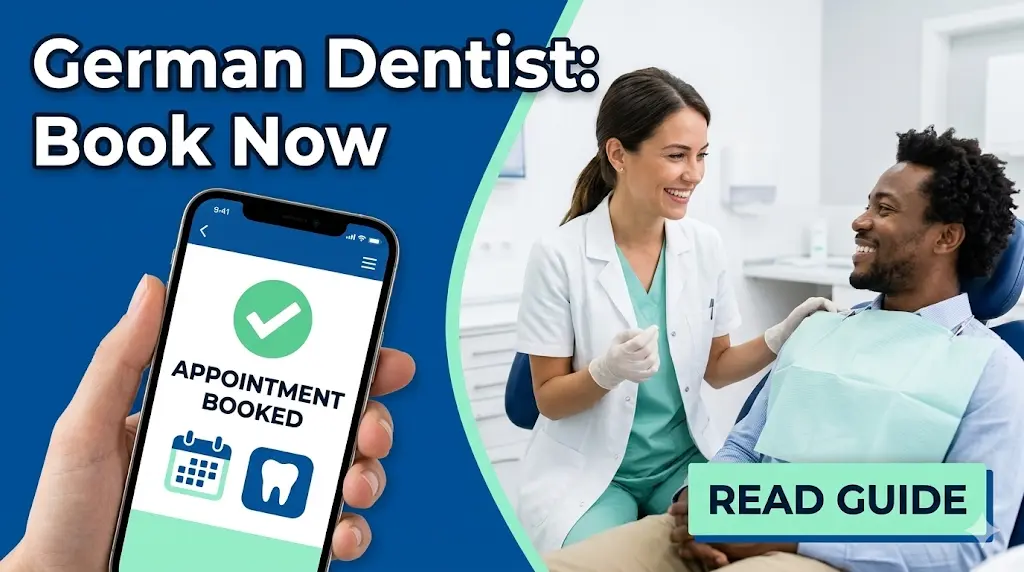
Once you have selected a clinic, you can typically book your initial appointment (Termin) directly online. However, if you choose a smaller, neighborhood clinic that does not use digital booking systems, you will need to call the reception desk.
When you call, it is important to note that the receptionist (Zahnmedizinische Fachangestellte or ZFA) might not speak fluent English. Learning a few basic German phrases is highly recommended. You can simply state, “Ich hätte gerne einen Termin für eine Kontrolluntersuchung” (I would like an appointment for a checkup). If you are experiencing acute pain, you should say, “Ich habe Zahnschmerzen. Haben Sie einen Notfalltermin?” (I have a toothache. Do you have an emergency appointment?)
If you suffer a severe dental trauma or unbearable pain outside of standard clinic hours, do not panic. Germany operates a robust dental emergency on-call service (Zahnärztlicher Notdienst) in every region.
What to Expect During Your Dental Visit
Arrival and Registration
When you arrive at the dental clinic, the registration process is highly streamlined. If you are enrolled in the statutory public health insurance system (Gesetzliche Krankenversicherung or GKV), you simply hand your electronic health card (Gesundheitskarte or eGK) to the receptionist. They will scan the chip, and the clinic will bill your insurance provider directly for all covered preventative services. You generally do not have to fill out any complex payment forms.
If you are a new patient, you will be handed an Anamnesebogen (medical history questionnaire). This form asks about your past surgeries, current medications, allergies, and lifestyle habits like smoking. Many modern clinics in expat-heavy areas provide this form in English on an iPad. If you are newly arrived in Germany and are struggling to set up your mandatory health coverage, utilizing English-first digital brokers like Feather Insurance ensures you have your health card ready before your first checkup. For a complete blueprint on setting up your administrative life abroad, explore Healthcare in Germany: A Comprehensive Guide for Expats.
The Checkup and Communication
German dentists are highly trained and tend to have a very direct, efficient communication style. During a standard checkup (Kontrolle), the dentist will examine your teeth and gums for cavities (Karies), plaque buildup, and signs of periodontal disease.
It is highly likely that the dentist will recommend a professional teeth cleaning (Professionelle Zahnreinigung or PZR). In Germany, a PZR is heavily emphasized as the cornerstone of preventative oral care. During this 45-to-60-minute session, a specialized dental hygienist uses ultrasound tools, specialized scaling instruments, and high-pressure air-polishing devices to remove all hard calculus and stains, finishing with a concentrated fluoride varnish.
If you prefer to maintain this clinic-level cleanliness at home using specific international whitening toothpastes, holistic fluoride-free options, or specialized dental wellness supplements that are difficult to find locally, expats frequently turn to borderless platforms. By ordering through iHerb, you can access a massive global catalog of specialized oral hygiene products. Keeping your bathroom cabinet stocked via iHerb ensures your daily routine is optimized between clinical visits.
The Bonusheft Explained
One of the most unique and critical components of German dental care is the Bonusheft (bonus booklet). This is a small, physical paper booklet that acts as your preventative dental passport.
Every time you attend your annual checkup, the receptionist will stamp your Bonusheft with the date and the clinic’s seal. This booklet is immensely important for publicly insured patients. If you ever need major, expensive dental work in the future—such as a crown, a bridge, or a prosthesis—your public health insurance will ask to see your Bonusheft. If you can prove that you have attended an annual checkup for five consecutive years, the public insurance increases its standard financial subsidy for the major procedure. If you have ten consecutive years of stamps, the subsidy increases even further. Guard this booklet carefully, as it translates directly into massive financial savings.
Understanding German Dental Costs and Insurance
Public vs Private Insurance Coverage
The financial reality of German dental care depends entirely on your health insurance tier. Under the statutory public system (GKV), routine preventative care is excellent. Public insurance fully covers two standard checkups per year, basic tartar removal (Zahnsteinentfernung), and standard amalgam (silver) fillings in the back teeth.
However, public insurance leaves massive financial gaps for high-end restorative work. If you want a tooth-colored composite resin filling (Kunststofffüllung), the public insurance only pays the base rate for amalgam, and you must pay the difference out of pocket (usually €50 to €100 per tooth). Furthermore, professional teeth cleanings (PZR) are generally considered private services, costing between €80 and €150 out of pocket, though some progressive public funds now subsidize a portion of it. For major prosthetics like crowns or implants, public insurance only pays a fixed subsidy (Festzuschuss), often leaving the patient covering 40% to 60% of a multi-thousand-euro bill. To understand these baseline limits fully, read Public Health Insurance gesetzliche Krankenkasse: What It Covers and Costs.
If you possess full private health insurance (Private Krankenversicherung or PKV), your coverage is dictated by your specific tariff. Premium expat-focused insurers like Ottonova offer comprehensive plans that frequently cover 80% to 100% of high-end composite fillings, professional cleanings, and complex implants. With a digital-first provider like Ottonova, you simply pay the dentist’s invoice upfront and upload it via their app for rapid reimbursement.
For expats bound to the public system, purchasing supplemental dental insurance (Zahnzusatzversicherung) is highly recommended. Expat advisory services like Feather Insurance offer excellent, English-language supplemental dental plans. For a relatively low monthly premium, these policies instantly cover professional teeth cleanings and drastically reduce your co-pays for premium fillings and crowns.
| Dental Service | Public Insurance (GKV) Coverage | Private / Supplemental Coverage | Estimated Out-of-Pocket (Public) |
| Routine Checkup | 100% Covered (2x per year) | 100% Covered | €0 |
| Professional Cleaning (PZR) | Usually Not Covered | 100% Covered | €80 – €150 |
| Amalgam Filling | 100% Covered | 100% Covered | €0 |
| Composite (White) Filling | Partially Covered | 80% – 100% Covered | €50 – €100 per tooth |
| Major Prosthetics (Crown/Implant) | Fixed Subsidy Only | 70% – 100% Covered | €500 – €2,000+ per tooth |
Paying Out of Pocket and Self Payers
Before commencing any major restorative work, a German dentist is legally required to issue a highly detailed cost estimate known as a Heil- und Kostenplan (HKP). This document outlines exactly what the statutory insurance will cover and exactly what your private co-payment will be. You must submit this plan to your insurer for approval before the treatment begins.
If you choose premium treatments without supplemental insurance, or if you are a tourist requiring emergency care, you act as a self-payer (Selbstzahler). The clinic will bill you directly based on the official private fee schedule for dentists (Gebührenordnung für Zahnärzte or GOZ).
If you receive a large dental invoice and need to transfer funds from your home country to pay it, using a standard international wire transfer through a legacy bank will trigger terrible exchange rates and high hidden fees. By utilizing a borderless financial platform like Wise, you can transfer the exact Euro amount to the dental clinic at the real mid-market exchange rate. Using Wise ensures your hard-earned money is spent purely on your dental health rather than punitive banking markups.
Finally, if your dental procedure requires complex surgery—such as the removal of impacted wisdom teeth—you may need to miss several days of work to recover.
References
Primary sources (official)
- Kassenzahnärztliche Bundesvereinigung (KZBV): The official National Association of Statutory Health Insurance Dentists, providing comprehensive guidelines on the Bonusheft, statutory benefits, and the Heil- und Kostenplan (HKP). https://www.kzbv.de/patienten/patient-und-krankenkasse/bonusheft/
- gesund.bund.de (Federal Ministry of Health): The national health portal offering patient-friendly English explanations on what public health insurance covers during a dental visit and preventative oral hygiene. https://gesund.bund.de/en/dental-care
Other helpful sources
- Make it in Germany: The official German government platform for international professionals, detailing how to navigate the broader healthcare system and the limitations of statutory insurance. https://www.make-it-in-germany.com/en/living-in-germany/health-healthcare
- Finanztip: Germany’s premier independent consumer finance portal, offering rigorous, analytical breakdowns of supplemental dental insurance (Zahnzusatzversicherung) and how to optimize your coverage. https://www.finanztip.de/krankenzusatzversicherung/zahnzusatzversicherung/
Disclaimer
The information provided in this article is for general informational and educational purposes only and does not constitute professional medical, dental, or financial advice. The specific coverage limits of the statutory health insurance system, the fixed subsidies (Festzuschüsse) for dental prosthetics, and the exact terms of supplemental plans from providers are highly complex and subject to continuous legislative updates. Always request a formal Heil- und Kostenplan from your dentist and consult directly with your health insurance provider or a certified insurance broker before commencing any major dental procedures in Germany.