Frankfurt to Heidelberg and Stuttgart: Southwest Connections
Alright, let's talk about travel. If you've spent any time living here in Germany, you know that the sheer joy of discovering new places often comes hand-in-hand with the head-scratching challenge of figuring out the best way to get there. Especially when you're looking to connect a bustling hub like Frankfurt to the charming, historic cities of Heidelberg and Stuttgart. This guide is going to walk you through how to master these southwest connections, making multi-city trips not just possible, but genuinely enjoyable, with a little help from a fantastic tool that makes comparing your options a breeze.
Disclosure: This post may contain affiliate links. We may earn a commission at no extra cost to you if you make a purchase through these links. Read full disclosure.
Why Explore Germany's Southwestern Gems?
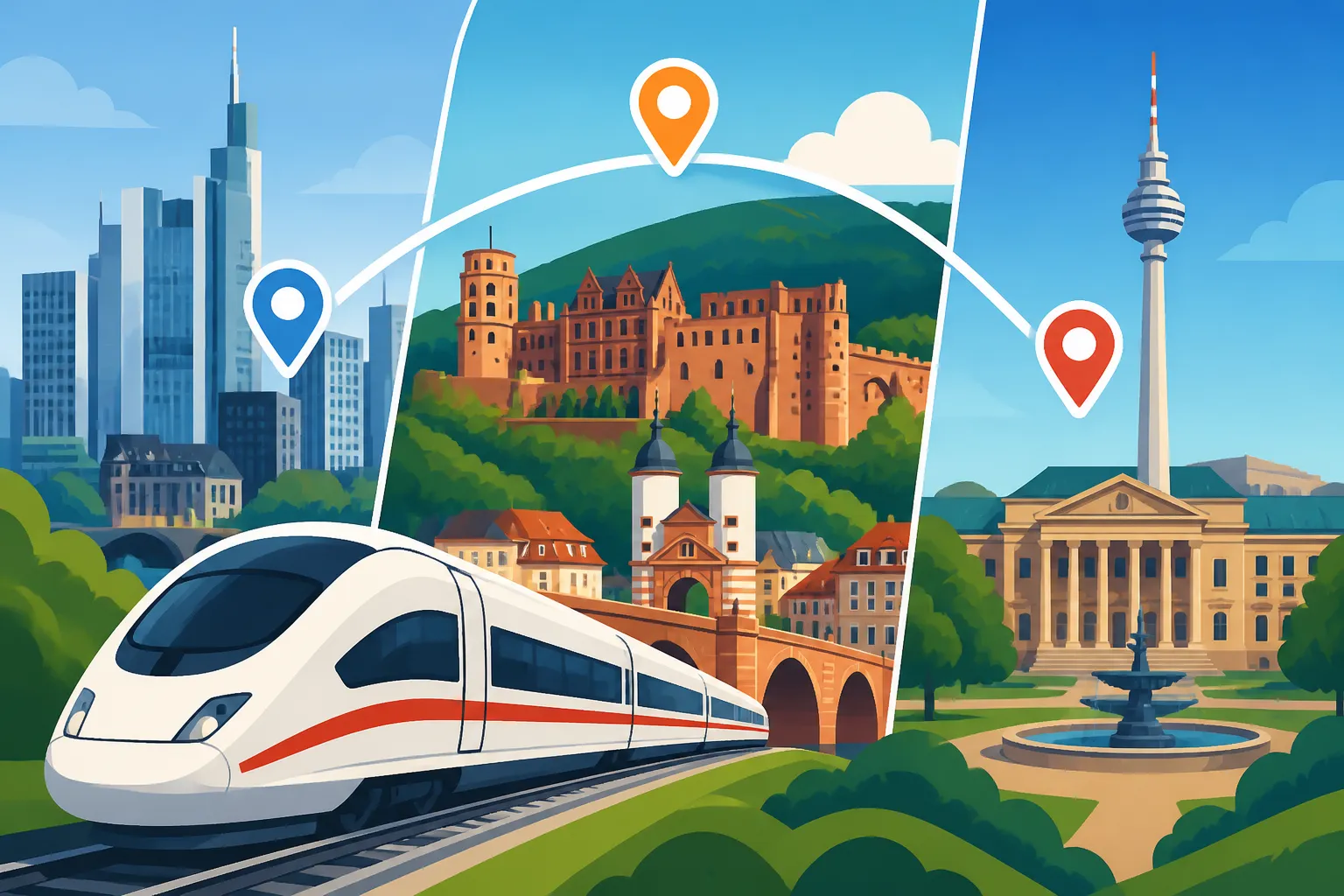
Frankfurt is undeniably a major international gateway, a financial powerhouse, and a city of impressive skyscrapers, often serving as the first stop for many expats. But Germany is so much more than its main airports and business districts. Just a stone's throw away, you'll find cultural treasures and vibrant cityscapes that offer a completely different flavor of German life. Heidelberg, with its romantic castle ruins and picturesque Old Town nestled along the Neckar River, feels like stepping into a postcard. Then there's Stuttgart, a city often unfairly overlooked, but it's a hub of innovation, automotive history (hello, Mercedes-Benz and Porsche museums!), and surrounded by lush vineyards, offering an intriguing blend of urban sophistication and natural beauty.
Making these connections isn't just about ticking off tourist spots; it's about experiencing the regional diversity that defines Germany. You might be craving a quiet weekend exploring ancient university towns, or perhaps you're keen to dive into the birthplace of the automobile. Maybe you're looking for a new spot for a family outing, or a romantic escape. These cities, while relatively close, offer distinct atmospheres and attractions that cater to every kind of traveler. The trick, for many of us expats, is cutting through the typical German bureaucracy and complicated transport options to actually get there without losing our minds (or our wallets).
Heidelberg: The Romantic Postcard
Heidelberg is where Germany’s heart-on-its-sleeve romance lives. Imagine a majestic, partially ruined castle perched above the Neckar River, a sprawling Old Town (Altstadt) with narrow cobbled streets, and the oldest university in Germany giving it a youthful, intellectual buzz. It’s a place that has inspired poets and philosophers for centuries, and for good reason. From Frankfurt, it’s a relatively short hop, making it an ideal day trip or an overnight stay to truly soak in the atmosphere. You can wander through the Heidelberg Castle, take a leisurely stroll across the Old Bridge, or climb the Philosopher's Walk for breathtaking views of the city. For those seeking to delve into the country's rich history, exploring places like Heidelberg is essential to understanding Germany's regions and where to go.
Stuttgart: Innovation, Green Hills, and Grapes
Stuttgart might not be on every tourist's radar, but it's a city that quietly impresses. Often associated with its automotive giants – Mercedes-Benz and Porsche – it's a paradise for car enthusiasts. Beyond that, Stuttgart is surprisingly green, featuring numerous parks, gardens, and even vineyards within the city limits. Yes, you heard that right, vineyards! The city is built into hills, offering fantastic viewpoints and a distinct, almost Mediterranean feel in some areas. It’s a city that combines modern architecture with historic squares, boasts excellent museums, and has a thriving culinary scene. Traveling to Stuttgart allows you to experience a different side of Germany, one that seamlessly blends industry with nature and culture.
Navigating the Transport Maze: Options for Your Journey
When you're looking to travel from Frankfurt to Heidelberg and then on to Stuttgart, you've got a few solid options, each with its own pros and cons regarding time, cost, and convenience. As an expat, you quickly learn that public transport here is generally efficient, but figuring out the best ticket, connections, or even which mode of transport is right for your specific journey can be a puzzle. This is where tools that simplify the comparison become incredibly valuable.
By Train: The Classic German Way
Ah, Deutsche Bahn. The backbone of German travel. Taking the train is often the quickest and most comfortable way to travel between these cities. High-speed ICE trains connect Frankfurt to Stuttgart directly, and regional trains or S-Bahn connections will get you to Heidelberg.
- Frankfurt to Heidelberg: You can take an ICE from Frankfurt (Main) Hauptbahnhof to Mannheim Hauptbahnhof, and then transfer to a regional train or S-Bahn for the short ride to Heidelberg Hauptbahnhof. The journey typically takes around an hour. Sometimes, you might find direct regional trains, which can be slightly slower but eliminate the transfer.
- Heidelberg to Stuttgart: From Heidelberg, you'll generally take a regional train to Stuttgart Hauptbahnhof, often with a connection in Mannheim or another regional hub. This leg usually takes about 1 to 1.5 hours.
- Frankfurt to Stuttgart (Direct): For a direct trip, an ICE train can whisk you from Frankfurt Hbf to Stuttgart Hbf in about 1.5 hours.
Pros of Train Travel: Speed, comfort (especially on ICE trains), central station locations, environmentally friendly. You can easily work or relax during the journey.
Cons of Train Travel: Can be expensive if not booked in advance ("Sparpreis" tickets are your friend!), occasional delays (it happens, even in Germany!), and navigating transfers can be tricky with heavy luggage. Knowing how to buy Deutsche Bahn tickets and save money is key here.
By Bus: The Budget-Friendly Alternative
Long-distance buses, primarily operated by FlixBus, have become a very popular and often much cheaper alternative to trains in Germany. They might take a bit longer, but the savings can be significant, especially if you're traveling on a tight budget or making last-minute plans.
- Frankfurt to Heidelberg: FlixBus offers direct connections. The journey usually takes around 1.5 to 2 hours, depending on traffic and specific stops.
- Heidelberg to Stuttgart: Again, FlixBus runs direct routes. This leg typically takes about 2 to 2.5 hours.
- Frankfurt to Stuttgart (Direct): You'll find direct bus services, usually taking around 2.5 to 3 hours.
Pros of Bus Travel: Cost-effective, especially for last-minute bookings; often has Wi-Fi and power outlets; comfortable modern coaches.
Cons of Bus Travel: Slower than trains, susceptible to traffic delays, bus stations might be slightly less central than train stations, and comfort can vary for longer journeys compared to an ICE. For those interested, Long-Distance Buses in Germany: FlixBus and Networks offers more details.
By Car: Freedom on the Autobahn
Renting a car gives you the ultimate flexibility, allowing you to explore at your own pace and visit charming smaller towns along the way that might be harder to reach by public transport. The distances aren't huge, making driving a viable option.
- Frankfurt to Heidelberg: Approximately 80-90 km, about an hour's drive on the A5.
- Heidelberg to Stuttgart: Approximately 120-130 km, about 1.5 hours' drive on the A5 and A8/A6.
- Frankfurt to Stuttgart: Approximately 200-210 km, about a 2-hour drive.
Pros of Car Travel: Flexibility, privacy, ability to stop off at scenic spots, convenient for carrying luggage. And yes, you can experience the Autobahn. If you're considering this, read up on Renting a Car and Driving on the Autobahn.
Cons of Car Travel: Cost of rental, fuel, and parking (which can be expensive and hard to find in city centers), dealing with German traffic laws and road signs, and designated driver duties.
Seamless Planning with Omio: Your Go-To Travel Companion
Now, you've seen the options, and perhaps your head is already spinning trying to compare schedules, prices, and connections. This is exactly where Omio comes in as an absolute lifesaver for expats and travelers in Germany. Instead of hopping between separate websites for Deutsche Bahn, FlixBus, and various car rental agencies, Omio brings all these options together in one single, intuitive platform. It’s like having a super-powered travel agent right in your pocket, stripping away the usual German bureaucracy that often makes travel planning feel like an Olympic sport.
Think about it: you want to go from Frankfurt to Heidelberg and then to Stuttgart. With Omio, you simply input your origin, destination, and dates, and voilà! – it presents you with a comprehensive list of available trains, buses, and even flights (though flights aren't typically practical for these short distances) from various providers. You can instantly see the journey times, prices, and even filtering options like "fastest" or "cheapest." This really streamlines the decision-making process, allowing you to choose what works best for your schedule and budget without any hidden surprises.
For us expats, who often juggle multiple languages and systems, Omio offers a wonderfully straightforward interface available in several languages, making it instantly accessible. No more deciphering German train operator jargon or navigating clunky booking systems. It's truly designed to put the power of choice directly into your hands, letting you compare the specifics of each journey side-by-side.
How Omio Simplifies Your Frankfurt, Heidelberg, Stuttgart Trip
Let’s walk through how Omio helps for this specific multi-city journey:
- Search & Compare: Open the Omio website or app. First, input "Frankfurt (Main)" to "Heidelberg." Instantly, you'll see all train and bus options. You can compare the fastest ICE-and-regional-train combo with a slower, direct bus, seeing exact prices and durations.
- Book the First Leg: Once you’ve picked your ideal connection to Heidelberg, you can book it directly through Omio. The tickets are usually delivered to your email or directly into the app, making them easy to access on your phone – no need to print!
- Plan the Second Leg: After enjoying Heidelberg, repeat the process. Input "Heidelberg" to "Stuttgart" into Omio. Again, you'll get a clear overview of all available trains and buses. Maybe you found the train too expensive for the first leg, but now a regional train is perfectly affordable for the second. Or perhaps you want to try a bus this time. Omio makes that comparison effortless.
- Integrated Experience: This seamless approach prevents you from having to bounce between different apps and websites, which is a major time-saver and stress-reducer. All your bookings can be managed through one platform. This is especially helpful if you’re trying to stitch together a complex itinerary or if you're simply not familiar with the local transport providers.
Omio is not just a booking platform; it's a travel planning tool that truly understands the expat struggle. It puts transparency and convenience first, making multi-city trips like Frankfurt to Heidelberg and Stuttgart much less daunting. So, before you start frantically searching for individual tickets or wrestling with public transport apps, give Omio a try. It genuinely makes a world of difference.
Essential Travel Tips for a Smooth Journey
Even with an excellent tool like Omio, a little bit of local knowledge and preparation can go a long way in ensuring your trip from Frankfurt to Heidelberg and Stuttgart is as smooth as possible. Having lived through my fair share of travel mishaps here, I can tell you that anticipating a few common expat challenges will make a huge difference.
Booking in Advance (Especially for Trains)
This is probably the single most important tip for train travel in Germany. Deutsche Bahn's "Sparpreis" (saver fare) tickets are significantly cheaper than flexible tickets, but they sell out quickly, especially on popular routes or during peak travel times. If your travel dates are fixed, booking through Omio as soon as you know your plans can save you a pretty penny. Even for buses, while last-minute options are more plentiful, booking ahead usually secures better prices.
Navigating Stations and Platforms
German train stations are generally well-signed, but they can be large and busy, especially Frankfurt Hauptbahnhof. Give yourself ample time to find your platform (Gleis) – don't cut it too close. Pay attention to the platform number on your ticket and always double-check the electronic display boards for any last-minute changes or delays. Often, different sections of a long train (e.g., ICE trains) split at certain stations, so ensure you're in the correct coach section for your final destination. For those who are newer to train travel here, using the DB Navigator App in Germany can provide real-time updates and platform information.
Luggage Considerations
If you're traveling with multiple bags, consider how easy they will be to manage on and off trains or buses. While trains offer overhead racks and luggage areas, getting them on and off quickly during short stops can be a hustle. Buses usually have dedicated luggage compartments under the bus. If you're driving, this is less of an issue, but remember parking can be a squeeze. Light and easily maneuverable luggage is always a plus!
Food and Drink on the Go
Most ICE trains have a Bordrestaurant (dining car) or a Bistro for snacks and drinks, but prices can be higher than at the station. Buses often allow food and drinks, but don't usually sell them onboard. It’s always a good idea to pack some snacks and a water bottle, especially for longer journeys. German train stations usually have plenty of bakeries and small shops where you can grab something before you board.
Understanding German Announcements
While many important announcements in major stations might be in English, smaller stations or less crucial information might only be in German. Keep an ear out for words like "Verspätung" (delay), "Gleiswechsel" (platform change), and "Anschlusszug" (connecting train). If in doubt, don't hesitate to ask a fellow passenger or station staff; most Germans are happy to help, even if they sometimes appear a bit reserved. Knowing some Survival German for Travelers can be incredibly helpful here.
Stay Connected
Having mobile data is crucial for navigating, checking schedules, and managing e-tickets. Consider getting a local SIM card or an eSIM if your phone supports it. Many trains and buses offer Wi-Fi, but it can be spotty. With Omio, having your tickets readily available on your phone means one less piece of paper to worry about and immediate access to your travel details, which is a huge convenience.
Explore Beyond the Main Station
Once you arrive in Heidelberg or Stuttgart, remember that the main train station (Hauptbahnhof) is often just a gateway. Most cities have excellent local public transport systems (trams, buses, S-Bahn, U-Bahn) to get you to your specific neighborhood or tourist attractions. Don't be afraid to hop on a local tram; it's part of the authentic German experience! You can find specific guides on Getting Around German Cities: U-Bahn, S-Bahn, Trams, and Buses to help you upon arrival.
By keeping these tips in mind and leveraging tools like Omio for your planning and booking, your journey through southwest Germany will be an enjoyable adventure rather than a bureaucratic headache. Happy travels!
Comparing Your Travel Options: A Quick Overview
To help you visualize the choices for your Frankfurt to Heidelberg and Stuttgart journey, here's a quick comparison of the main transport methods. Remember, these are averages, and actual times and costs can vary based on booking in advance, specific times of day, and traffic conditions. Omio will give you the most up-to-date and specific information for your chosen dates.
| Transport Method | Journey Time (Frankfurt to Heidelberg) | Journey Time (Heidelberg to Stuttgart) | Average Cost Range (One-Way) | Key Advantages | Key Disadvantages |
|---|---|---|---|---|---|
| Train | 1 hour (with transfer) | 1 – 1.5 hours (with transfer) | €15 – €40+ (Sparpreis) | Fastest, comfortable, central stations | Can be expensive last-minute, potential delays |
| Bus (FlixBus) | 1.5 – 2 hours | 2 – 2.5 hours | €8 – €25+ | Most budget-friendly, often direct | Slower, susceptible to traffic, bus stations might be less central |
| Car | ~1 hour | ~1.5 hours | Fuel + Rental (Variable) | Ultimate flexibility, door-to-door | Expensive (rental, fuel, parking), navigation, traffic |
Note: Costs are approximate and highly dependent on booking lead time and demand. Booking via Omio will provide real-time prices and allow for easy comparison across all modes.
Disclaimer
The information provided in this guide is for general informational purposes only and is based on typical experiences for expats living in Germany. While we strive to keep the information up-to-date and accurate, transport schedules, prices, visa regulations, and local laws can change frequently. Always check the latest official sources and specific service providers (like Omio, Deutsche Bahn, or FlixBus) for the most current information before making any travel plans or decisions. We cannot be held responsible for any inaccuracies or outdated information.