German Apprenticeships: Why Ausbildung Can Be an Alternative to University
Staring at a mountain of student debt while trying to navigate a foreign university system can feel like trying to climb the Zugspitze in flip-flops. I remember the paralyzing fear of not being academic enough for a German degree when I first arrived. This guide breaks down the Ausbildung, Germany’s secret weapon for career success without the university stress.
Disclosure: This post may contain affiliate links. We may earn a commission at no extra cost to you if you make a purchase through these links. Read full disclosure.
The Foundations of the German Dual Education System
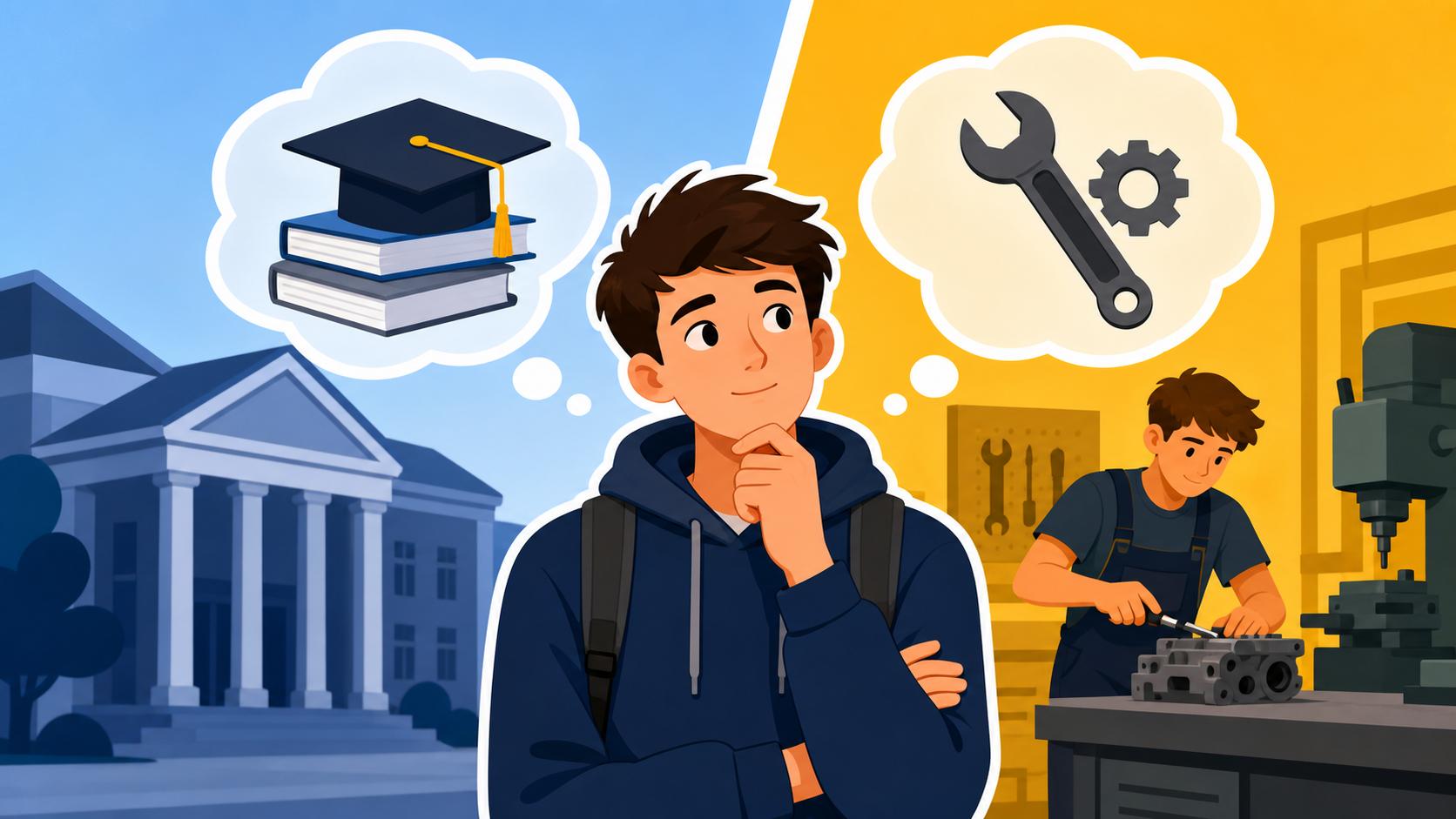
When most of us move to Germany, we bring our "university or bust" mentality. In many English-speaking countries, if you don't have a Bachelor’s degree, you're often relegated to low-paying service jobs. Germany, however, has spent decades perfecting a system called the "Duales System" (Dual System). It is the backbone of the German economy, and honestly, it’s one of the most brilliant things I’ve encountered here. It combines the theoretical knowledge you get in a classroom with the grit and reality of on-the-job training.
How the Dual System Actually Works
An Ausbildung usually lasts between two and three and a half years. During this time, your life is split into two distinct worlds. For a few days a week, or perhaps in blocks of several weeks at a time, you attend a vocational school known as a Berufsschule. Here, you learn the technical theory, the math, and the legal frameworks of your chosen profession. The rest of your time is spent at a real company, working as a trainee under the supervision of a mentor. This isn't just "making coffee" or "filing papers." You are integrated into the workflow, learning the actual tools of the trade.
The beauty of this is that the curriculum is standardized across the country. Whether you are doing an Ausbildung in a tiny village in Bavaria or a massive tech hub in Berlin, the final exam (Abschlussprüfung) administered by the Chamber of Commerce (IHK) or the Chamber of Skilled Crafts (HWK) is rigorous and respected. This ensures that when you finish, you aren't just a "junior" something; you are a qualified professional recognized by every employer in the nation. To get a head start on the broader context, I highly recommend reading about the German Education System: Universities, Vocational Training, and More Explained to see how this fits into the bigger picture.
The Legal Framework and Your Rights
As an Azubi (short for Auszubildender, or apprentice), you aren't just an employee; you are a student with a contract. This contract is sacred in Germany. It outlines exactly what you will be taught, your working hours, and your compensation. You are protected by specific labor laws that prevent companies from overworking you or using you for tasks unrelated to your training. If you are training to be an electrician, they can't spend three years making you paint walls.
Furthermore, you are entitled to vacation days—usually at least 24 to 30 days per year—and you are fully integrated into the social security system. This means your health insurance, pension contributions, and unemployment insurance are handled from day one. It provides a level of security that many university students simply don't have. If you're curious about how the medical side works during this time, check out our Healthcare in Germany: A Comprehensive Guide for Expats.
Why an Ausbildung Might Be Your Best Move
I’ve met countless expats who struggled through three years of a Master’s degree only to find they lacked the "practical experience" German employers crave. An Ausbildung flips that script. You graduate with three years of German work culture already under your belt. For many, this is far more valuable than a degree, especially in fields like IT, healthcare, or specialized trades.
Financial Independence from Day One
Unlike university, where you are constantly shelling out for semester fees and living costs, an Ausbildung pays you. You receive a monthly allowance called an Ausbildungsvergütung. While it’s not a CEO's salary, it has increased significantly in recent years. In your first year, you might earn between 600 and 1,200 Euros per month, depending on the industry. This amount usually increases every year of your training.
For many foreigners, this is the only way to afford life in Germany without a massive savings account or a Student Visa Blocked Account (Sperrkonto): What It Is and How To Set It Up. It allows you to pay your rent, buy your groceries, and perhaps even save a little, all while getting an education. It’s a "learn while you earn" model that is incredibly rare in other parts of the world. Even if you eventually want to go to university, starting with an Ausbildung gives you a financial and professional cushion.
Hands-On Experience vs Theoretical Overload
Let’s be honest: not everyone is meant to sit in a lecture hall for four hours listening to a professor drone on about abstract concepts. I certainly wasn't. Germany’s universities are notoriously theoretical. If you study Computer Science at a TU (Technical University), you might not write a "real" piece of production code for two years. If you do an Ausbildung as an Fachinformatiker, you are working on real servers and real client problems in your first month.
This practical focus makes you incredibly employable. German companies love apprentices because they don't have to "re-train" them on how to actually do the job once they graduate. You already know the company's software, the team's workflow, and the specific quirks of the industry. This often leads to a direct job offer from your training company the second you pass your exams. For those looking for Blue Collar Jobs in Germany: Opportunities in Trades for Foreign Workers, this is the absolute gold standard pathway.
Essential Requirements for International Applicants
Now, let's talk about the hurdles. Germany doesn't just hand out apprenticeships to anyone who asks. Because the system is so respected, the entry requirements are real. You need to prove you have the basic education to handle the schoolwork and the language skills to understand your boss.
Navigating the Language Barrier
This is the big one. Most Ausbildungen are conducted entirely in German. Your colleagues will speak German, your teachers will lecture in German, and your exams will be in German. Generally, you need at least a B1 level of German to even be considered, but for most technical or client-facing roles, a B2 is the realistic minimum. You have to be able to explain complex problems and understand safety instructions.
If your German isn't there yet, don't panic. You can use platforms like Lingoda to take intensive online classes that fit around your current schedule. I’ve found that Lingoda is particularly helpful for getting over the speaking anxiety that hits when you’re on a construction site or in a busy office. Additionally, for the more technical vocabulary you'll encounter, GermanPod101 offers great specialized lessons that go beyond "where is the library?" and into actual workplace communication. Using GermanPod101 to listen to native dialogues during your commute can drastically speed up your comprehension.
School Certificate Recognition
You also need to show that you’ve completed school in your home country. This usually means a high school diploma or equivalent. In Germany, they will categorize your foreign school leaving certificate as either a Hauptschulabschluss, Realschulabschluss, or Abitur. The level of your certificate will determine which apprenticeships you are eligible for. For example, becoming a doctor's assistant might only require a Realschulabschluss, while a high-end IT apprenticeship might prefer an Abitur.
The process of having your documents recognized is called "Anerkennung." It can be a bureaucratic headache involving certified translations and official stamps. If you're navigating this, looking into the Recognition Partnership Visa: Working While Validating Foreign Qualifications can be a lifesaver, as it allows you to enter Germany while the paperwork is still being finalized.
| Feature | Ausbildung (Apprenticeship) | Studium (University Degree) |
|---|---|---|
| Focus | Practical & Hands-on | Theoretical & Academic |
| Income | Paid monthly allowance | Typically unpaid (costs money) |
| Duration | 2 to 3.5 years | 3 to 5+ years |
| Language | Strictly German (B1/B2) | German or English |
| Job Security | High (often hired by company) | Variable (depends on field) |
| Qualification | State-certified Specialist | Bachelor’s or Master’s Degree |
The Step-by-Step Application Journey
Applying for an Ausbildung is much like applying for a job. You don't "enroll" like you do at a university; you get hired. This means you need a stellar application package that speaks the "German language" of recruitment.
Finding the Right Apprenticeship Opening
The hunt begins on sites like the IHK-Lehrstellenbörse or the HWK website. You can also find many listings on general job boards like Indeed or Stepstone. My advice? Don't just look at the massive corporations like Siemens or BMW. While they have great programs, they are also incredibly competitive. Some of the best training I’ve seen happens in "Mittelstand" companies—the medium-sized family businesses that are the true engines of German engineering.
When you're searching, pay attention to the start dates. Most Ausbildungen start in August or September. Large companies start recruiting up to a year in advance. If you’re looking in March for a September start, you might already be late for the big names. For more tips on the hunt, check out our guide on Writing a German-Style CV and Cover Letter: Tips for Success to make sure your resume doesn't end up in the bin.
Nailing the German-Style Application
A German application is a formal affair. You’ll need a "Lebenslauf" (CV) in table format, a "Anschreiben" (Cover Letter) that explains exactly why you want this specific trade, and copies of all your certificates. They love to see "Praktika" (internships). If you’ve spent even two weeks shadowing a plumber or helping out in a bakery, put it on there. It shows you know what the work actually involves.
During the interview, be prepared for direct questions. Germans value "Pünktlichkeit" (punctuality) and "Zuverlässigkeit" (reliability) above almost everything else. If your interview is at 9:00 AM, being there at 9:05 AM is a catastrophic failure. I’ve seen people lose spots just because they didn't take the time to learn the company's history. Practice your introduction using tools like Lingoda to ensure your flow is natural. It’s also helpful to use GermanPod101 to learn the specific "office speak" that can make you sound more professional and integrated.
Visas and Legalities for Non-EU Apprentices
If you are coming from outside the European Union, the visa process is your biggest boss battle. The German government has recently made this easier because they are desperate for skilled workers, but it still requires a lot of paperwork.
The Vocational Training Visa
To get a visa for an Ausbildung, you generally need a signed contract from a German company. Once you have that, you apply for a visa under Section 16a of the Residence Act. The embassy will check if your German skills are sufficient (usually B1) and if the Federal Employment Agency (ZAV) approves the position. The ZAV check is to ensure that the working conditions are fair and that the company is actually capable of training you.
For those who haven't found a spot yet, there is also a "Job Seeker" style visa specifically for finding an apprenticeship. This allows you to come to Germany for up to six months to interview and do short trial internships. This is a fantastic option if you have the savings to support yourself while you look. You can read more about this in our detailed post on the Vocational Training Visa (Ausbildung): Opportunities for Non-EU Students.
Financial Requirements and Blocked Accounts
Even though you get paid during an Ausbildung, the German government wants to make sure you can actually live on that wage. If your apprenticeship salary is lower than the required monthly minimum (which is currently around 900-1,000 Euros net, though this changes), you might have to prove you have the "gap" amount in a blocked account.
However, many apprenticeships in sectors like construction or nursing now pay enough to cover the visa requirements entirely. This is why it’s so important to research the Work Visas and Sponsorship: What Employers Need to Know to Hire Foreigners before you sign a contract. Make sure the numbers add up for the Ausländerbehörde (Foreigners' Office), or you'll find yourself in a loop of rejected applications.
Life After the Apprenticeship
The end of your Ausbildung is just the beginning. Once you have that certificate in your hand, you are a "Geselle" (journeyman). You are now a fully recognized professional, and your salary will jump significantly. But the German system offers even more paths for the ambitious.
From Apprentice to Master
In many trades, you can go on to become a "Meister" (Master). This requires further study and another set of exams, but it allows you to open your own business and, most importantly, train your own apprentices. In Germany, the title of "Meister" is held in incredibly high regard—often on par with a Master’s degree from a university. It is the pinnacle of the craft.
If you decide later that you do want to go to university, your Ausbildung isn't wasted time. Many universities will give you credit for your vocational training, and in some cases, a Meister title actually gives you the "Abitur" equivalent needed to enter university even if you didn't finish high school back home. It's a remarkably flexible system once you're inside it.
Long-term Residency and Career Growth
One of the biggest perks for us expats is that completing an Ausbildung in Germany significantly fast-tracks your path to permanent residency. The government wants to keep the people it has trained. If you work in your field for a couple of years after your graduation, you can often apply for a settlement permit much sooner than someone on a standard work visa.
The skills you learn are also portable. While the "Duales System" is uniquely German, the technical expertise of a German-trained technician or specialist is respected worldwide. Whether you stay in Germany or eventually move on, that IHK certificate is a badge of quality.
Disclaimer
The information provided in this article is for informational purposes only and does not constitute legal or professional advice. Immigration laws and educational requirements in Germany are subject to change, and we recommend consulting with official government sources or a qualified legal expert before making any major life decisions.