How to Switch From a Student Visa to a Work Visa in Germany
Graduating from a German university is a monumental achievement, but the high of the ceremony often crashes into the reality of an expiring residence permit. I remember sitting in my cramped student apartment in Munich, staring at my university certificate and then at my plastic residence card, realizing the clock was ticking. This guide solves the complex puzzle of transitioning from a student status to a professional work permit, ensuring you don't fall into the bureaucratic cracks.
Disclosure: This post may contain affiliate links. We may earn a commission at no extra cost to you if you make a purchase through these links. Read full disclosure.
The Post-Graduation Buffer: Utilizing the 18-Month Job Seeker Visa
Before you jump straight into a work visa, you need to understand the safety net Germany provides to its graduates. Once you finish your final exam—even before you have the physical diploma in hand—your status as a "student" legally shifts. This is where many expats panic, thinking they have to leave immediately. In reality, Germany offers an 18-month residence permit specifically designed for job seeking after graduation.
This 18-month window is incredibly generous compared to other countries. It allows you to work any job to support yourself—yes, even waiting tables or deliveries—while you hunt for a career-level position that matches your degree. I personally used this time to freelance and travel a bit before settling into a corporate role. It takes the immediate pressure off and gives you the legal right to stay while you polish your How to Write a German-Style CV (Lebenslauf).
To apply for this extension, you’ll need proof of graduation (a "Prüfungsbescheinigung" from your university office works if the degree isn't printed yet) and proof of financial means. If you need to show the authorities you have enough funds to support your search, using a service like Expatrio can help you set up the necessary financial documentation or transition your student health insurance into an expat-appropriate plan. They are particularly helpful for navigating the "finanzielle Mittel" requirement that often stumps new graduates.
Meeting the Criteria for the Switch to a Work Visa
Once you’ve landed that dream job offer, the real paperwork begins. You aren't just "updating" your card; you are changing the very legal basis of your stay in Germany. The most common path for graduates is the Residence Permit for Skilled Workers with Academic Training (Section 18b of the Residence Act). However, the requirements are strict, and the "Ausländerbehörde" will scrutinize your contract.
The most critical rule is the "Correlation Rule." Your new job must be related to your field of study. If you studied Mechanical Engineering, you cannot easily get a work visa to be a lead guitarist in a band or a marketing manager, unless you can prove a very specific overlap. The authorities want to see that the German taxpayer’s investment in your education is being utilized in the appropriate sector of the economy.
Beyond the job description, your salary must meet certain thresholds. If your salary is high enough, you might qualify for the EU Blue Card Germany: Eligibility, Benefits, and Application Process, which offers a faster track to The Settlement Permit (Niederlassungserlaubnis) in Germany. If your salary is below the Blue Card threshold but still meets the local "market rate" for your profession, you will likely fall under the standard Skilled Worker Visa. During this process, you must ensure all your foreign documents, such as birth certificates or previous degrees from home, are legally recognized. Using Lingoking for certified translations is a lifesaver here, as the German authorities are notorious for rejecting translations that aren't done by state-sworn translators.
The Step-by-Step Application Process and Document Checklist
The transition process is less of a sprint and more of a marathon through the German administrative landscape. You should start the process the moment you have a signed contract or even a formal letter of intent from your employer. Waiting until your student visa has only two days left is a recipe for a heart attack.
First, you must secure a "Termin" (appointment). We all know the struggle of refreshing the office website at 7:00 AM. If you can't find an appointment before your current visa expires, don't panic. As long as you have applied for the renewal or change before the expiry date, your current stay remains legal under what is known as a The Fiktionsbescheinigung: Bridging Your Permit in Germany. This temporary document is your best friend during the transition.
When you finally head to the office, you will need a specific set of documents. Missing even one can result in a "come back next month" dismissal. Here is what you generally need:
| Document Category | Requirement Details | Pro Tip |
|---|---|---|
| Passport & Photo | Valid for at least 6-12 months beyond application | Must be a recent "biometric" photo |
| Employment Contract | Signed by both parties | Ensure the "Probation Period" is clearly stated |
| Job Description | Form "Erklärung zum Beschäftigungsverhältnis" | Your employer must fill this out specifically |
| Proof of Degree | Your German University Diploma | Use Recognition of Foreign Qualifications in Germany (Anerkennung and Anabin) for non-German secondary degrees |
| Health Insurance | Proof of active coverage | Transitioning from student to worker often changes your premium |
| Rental Contract | Proof of current address (Anmeldung) | Ensure your square footage meets local requirements |
Throughout this phase, you might need to provide translated versions of non-German certificates. I’ve found that Lingoking is incredibly reliable for this because they understand the specific requirements of the German "Standesamt" and "Ausländerbehörde." Having a rejected translation can set your application back by weeks, so don't cut corners on the "beglaubigte Übersetzung."
Navigating the Federal Employment Agency Approval
One part of the process that happens "behind the scenes" is the approval from the Federal Employment Agency (Bundesagentur für Arbeit). For many work visas, the immigration office must ask the labor office if you are taking a job away from a qualified German or EU citizen (the "Vorrangprüfung") or if the conditions of your work are fair.
The good news for German university graduates is that you are often exempt from the "Priority Check." Since you hold a German degree, the state acknowledges your right to enter the labor market. However, they will still check if your salary matches what a German person would earn in the same role. They want to prevent "wage dumping." If your employer offers you €30,000 for a role that usually pays €50,000, the labor agency might veto your visa application to protect you (and the market).
If you find yourself waiting for weeks without an update, it’s usually because your file is sitting on a desk at the labor agency. You can sometimes speed this up by asking your employer to engage in the "Accelerated Procedure for Skilled Workers," though this involves an extra fee of €411. If you are worried about the financial transition during this waiting period, Expatrio offers resources and advice on managing your finances and ensuring your Health Insurance in Germany: Understanding Public vs Private Coverage is correctly set up for your new status as an employee.
Long-Term Planning: From Work Visa to Residency
Once that new "Aufenthaltstitel" (residence permit) is in your hand, you might feel like the journey is over. But as a veteran expat, I can tell you: this is just the beginning. Your work visa is the bridge to a much more stable life in Europe. After holding a work permit for a certain number of years (often only two years for German graduates), you become eligible for permanent residency.
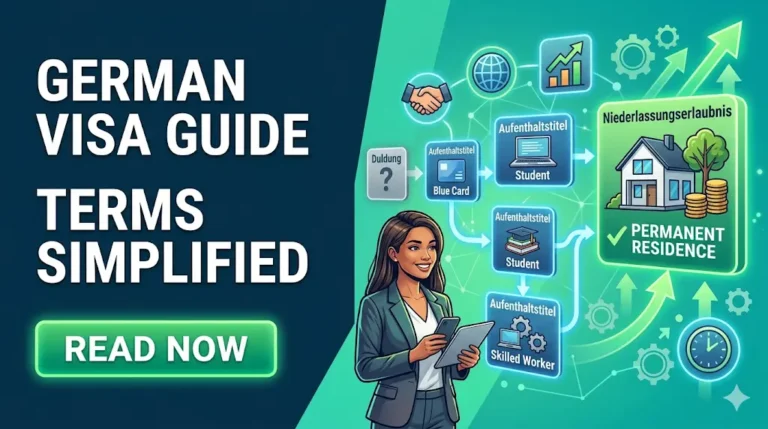
Permanent residency, or the "Niederlassungserlaubnis," is the ultimate goal for many. It means you no longer need the permission of the immigration office to change jobs or take a career break. It also puts you on the direct path toward German Citizenship (Einbürgerung): Requirements Overview, which has recently become much easier thanks to new dual citizenship laws.
As you move through your first year of work, keep every single payslip and every social security statement. Germany loves a paper trail. The transition from a student visa to a work visa is the hardest hurdle because it requires the most "proof" of your value to the country. Once you've proven you can study here and find a job here, the system starts to work with you rather than against you. Stay organized, use professional services like Lingoking for your paperwork and Expatrio for your insurance needs, and remember that How to Book an Appointment at the Ausländerbehörde is a skill every successful expat eventually masters.
Disclaimer
The information provided in this article is for informational purposes only and does not constitute legal advice. Immigration laws in Germany are subject to frequent changes, and individual cases can vary significantly based on personal circumstances. Always consult with the official website of the Federal Office for Migration and Refugees (BAMF) or a qualified legal professional before making any immigration-related decisions.