How to Visit the Rhine Castles From Frankfurt
Visiting the Rhine Valley from Frankfurt sounds like a dream until you are staring at a confusing digital display at the Hauptbahnhof, wondering which of the forty-plus castles actually allows you inside. It is incredibly easy to get overwhelmed by the logistics of river cruises and regional train schedules. This guide simplifies the journey, highlighting the best routes and transport hacks for a perfect day trip.
Disclosure: This post may contain affiliate links. We may earn a commission at no extra cost to you if you make a purchase through these links. Read full disclosure.
Getting There: Choosing Your Transport from Frankfurt
When I first moved here, I thought I could just "wing it" and hop on a train to the Rhine. I quickly realized that the valley is divided by a massive river with very few bridges. If you end up on the "wrong" side of the river, you might find yourself staring at the castle you wanted to visit from half a mile away with no way to cross. Choosing your transport method is the most critical decision you will make for this trip.
The Relaxed Way: Train and Ferry
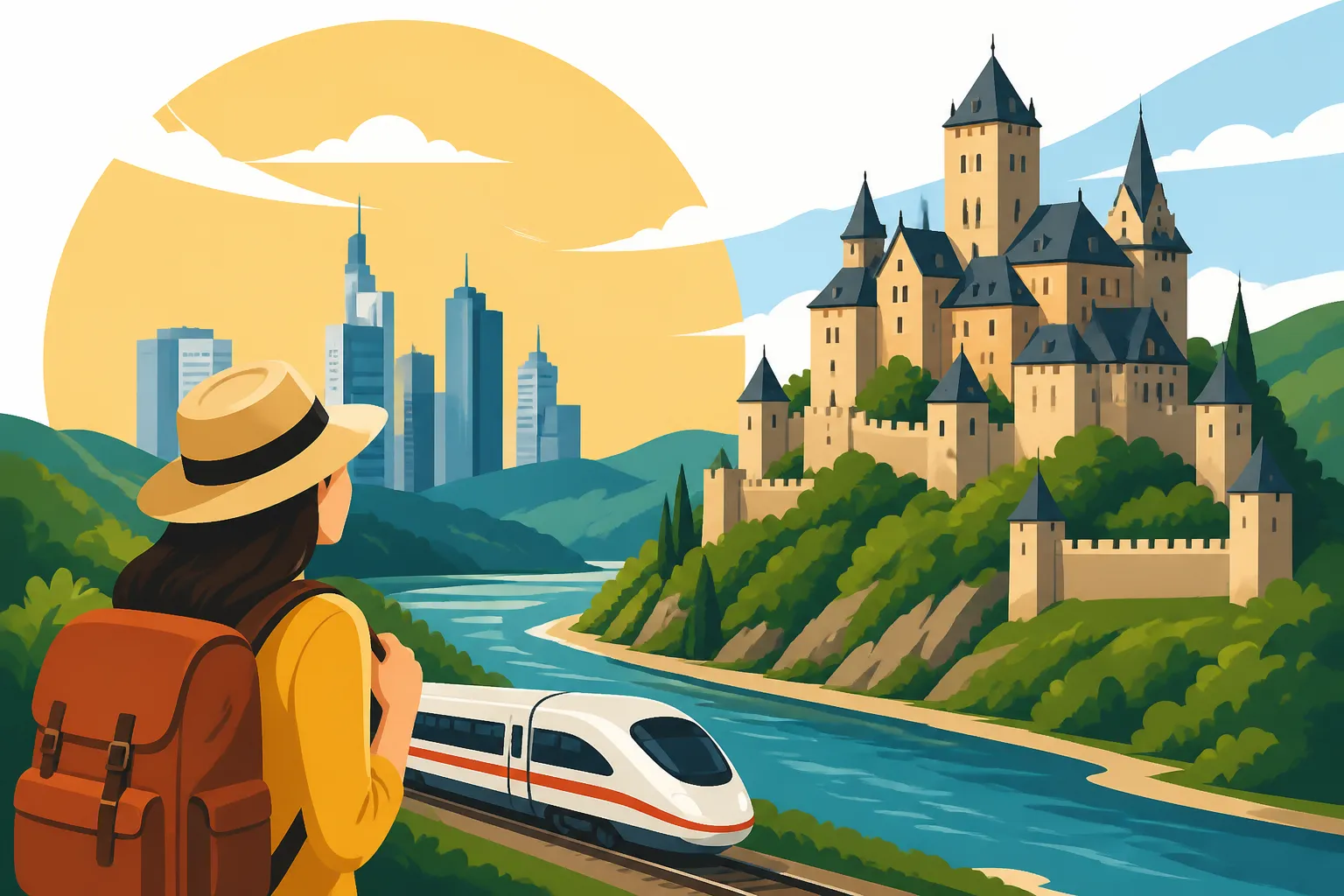
Taking the train is the quintessential expat experience. From Frankfurt Hauptbahnhof, you have two main choices: the "Right Rhine" (Rechte Rheinstrecke) via Wiesbaden and Rüdesheim, or the "Left Rhine" (Linke Rheinstrecke) via Mainz and Bingen. I almost always recommend taking the train to Bingen or Rüdesheim first. If you use a platform like Omio, you can easily compare the regional train prices against the occasional long-distance ICE that might save you twenty minutes but cost triple the price. For most, the regional RE2 or RB26 lines are the way to go.
Once you arrive in a riverside town, the real magic happens on the water. Many people use the Köln-Düsseldorfer (KD) cruise line to hop between towns. Before you go, it is worth researching How to Buy Deutsche Bahn Tickets and Save Money because your train ticket can sometimes offer discounts on the boat, or you might find that the regional "Schönes-Wochenende" style tickets cover your entire group for a fraction of the cost. If you are living here long-term, you should definitely check What Is the Deutschland-Ticket and Is It Worth It?) as it covers all the regional trains to the valley, making the transport cost essentially zero once you have the subscription.
The transition from train to boat is usually seamless, but keep an eye on the clock. German trains are famous for punctuality, but the regional lines in the Rhine Valley can occasionally suffer from "Personen im Gleis" (people on the tracks) or construction delays. Using Omio to check real-time updates for your return journey to Frankfurt is a life-saver when you are three glasses of Riesling deep in a Bacharach wine tavern.
The Independent Way: Renting a Car
If you want to see more than two castles in a single day, you really need a car. The castles are often perched high on cliffs, and while some have shuttle buses, others require a steep 30-minute hike from the train station. Driving allows you to hit the "Big Three" without being tied to a boat schedule that only runs a few times a day. You can find excellent rental deals through Booking.com, which often aggregates local providers at Frankfurt Airport or the city center.
Driving in this region is beautiful but requires focus. The roads are narrow, winding, and often tucked between the vineyards and the river. You should read up on How to Rent a Car in Germany as a Foreigner before you sign any contracts, especially regarding insurance and the "Vollkasko" (CDW) requirements. Once you are on the road, remember that while parts of the journey from Frankfurt involve the famous highway, you should check Is There Really No Speed Limit on the Autobahn?) to ensure you are following the local speed zones, which are strictly enforced by hidden cameras near the valley entrances.
Parking is the biggest "pain point" for drivers. Towns like Rüdesheim and St. Goar have very limited space. I always suggest looking for the "P+R" (Park and Ride) lots on the outskirts of the town rather than trying to squeeze into a spot right by the river. Many of these machines are old-school, so having coins ready is essential. This is one of those times where the classic advice Cash vs Card in Germany: What Visitors Should Know becomes very real—nothing ruins a mood like a parking meter that doesn't take Visa.
The Guided Way: Day Tours
Sometimes, you just don't want to deal with the stress of the Deutsche Bahn or navigating narrow German roads. This is where organized tours come in. I’ve had friends visit who used GetYourGuide to book a full-day "Rhine Valley Castles" tour starting right from Frankfurt. These tours usually include a bus ride, a short cruise, and a wine tasting. It is a "one and done" solution that handles all the navigation for you.
The benefit of using GetYourGuide is that you can read reviews specifically from other English speakers to see if the guide’s level of English is actually good or just "functional." These tours often get you into castles like Burg Rheinstein with pre-paid entry, skipping the ticket line which can get quite long on summer Saturdays. They also usually handle the "cross-river" logistics, using the small car ferries that can be a bit intimidating for first-time drivers to navigate on their own.
If you choose a tour, look for one that gives you at least two hours of "free time" in a town like Oberwesel or Bacharach. You don't want to be shuttled from bus to castle without ever sitting down for a coffee or a glass of local wine. The tours that offer a "Loreley" cruise are particularly popular because they pass the narrowest and most dangerous part of the river where the legendary siren supposedly lured sailors to their doom.
The Must-See Castles Near Frankfurt
With over 40 castles in the Upper Middle Rhine Valley, you cannot see them all. Trying to do so is a recipe for "castle fatigue," a very real condition where every stone wall starts to look identical. You need to be strategic. I’ve narrowed it down to three distinct experiences that give you the best "bang for your buck" and are reachable from Frankfurt within 90 minutes.
Burg Eltz: The Fairy Tale Legend
Technically, Burg Eltz is on the Moselle river, but most people visiting from Frankfurt treat it as part of their Rhine excursion. It is the castle you see on all the posters—the one with the red-timbered towers and the long stone bridge. It has been owned by the same family for over 800 years and has never been destroyed, which is a rarity in a region that has seen centuries of warfare.
Getting to Burg Eltz requires a bit of effort. If you aren't on a tour, you’ll likely take the train to Hatzenport and then a seasonal "Burgenbus." Alternatively, you can drive and park in the forest lot. The walk from the parking lot to the castle is magical; as you turn the final corner, the castle rises out of the valley like something from a Disney movie. If you’re feeling active, there is a "Dream Loop" hiking trail that takes about five hours and offers views most tourists never see.
Inside, the tour is mandatory. You’ll see the armory, the knights' hall, and the rod-iron kitchens. Note that photography is usually forbidden inside to protect the artifacts. If the stress of the hike or the crowds gives you a bit of a physical toll, it is good to know How to Find a Night Pharmacy (Notdienst Apotheke) in Germany just in case you need some basic remedies for the trip back, though the fresh forest air usually does the trick.
Marksburg: The Unconquered Fortress
Marksburg is the only hilltop castle on the Rhine that has never been destroyed. While the French "Sun King" Louis XIV leveled most of the other fortresses in the 17th century, Marksburg stood firm. Because of this, it feels much more "authentic" and lived-in than the romantic reconstructions you’ll find elsewhere. It is located above the town of Braubach.
The tour here is fantastic. You get to see the medieval herb garden, the wine cellar (which is massive, because water wasn't safe to drink back then), and the terrifying torture chamber. The climb up to the castle is steep, so wear sensible shoes. I once saw a tourist trying to navigate the medieval cobblestones in stilettos—it did not end well. This is a great place to see the practical side of medieval life, from how they cooked for hundreds of soldiers to how they defended the walls against invaders.
After your tour, I highly recommend heading down into Braubach for lunch. It is one of the less "touristy" towns compared to Rüdesheim. You can find some excellent German Regional Dishes Every Visitor Should Try like Spätzle or Sauerbraten in the local inns. Just remember to check the etiquette for Tipping in Germany: When, Where, and How Much before the bill comes, as it differs quite a bit from the North American system.
Rheinstein Castle: The Romantic Gem
If you want a castle that feels like a private residence, Burg Rheinstein is your best bet. It was one of the first castles to be rebuilt during the "Rhine Romanticism" period in the 19th century. It is smaller than the others but incredibly charming, with lush gardens, stained glass windows, and a "Burgundergarten" (Burgundy garden) that offers incredible views of the river below.
What makes Rheinstein special is its accessibility. It is a relatively easy walk from the Trechtingshausen train station. You can explore a lot of it on your own without a guided tour, which is great if you prefer to move at your own pace. It also has a lovely terrace café where you can sit and watch the massive barges struggle against the Rhine's current.
For those who fall in love with the atmosphere and don't want to return to the bustle of Frankfurt immediately, you can actually stay in some of these towns. Checking Booking.com for a "Pension" or a small boutique hotel in nearby Bacharach is a great way to turn a day trip into a romantic weekend. The valley takes on a completely different, quieter energy once the last day-tour bus leaves at 5:00 PM.
Planning Your Perfect Rhine Itinerary
The secret to a successful Rhine day trip is not doing too much. The river flows from south to north, and the most scenic part—the UNESCO World Heritage site—is the stretch between Bingen and Koblenz. If you try to start further south or end further north, you’ll spend too much time on the train and not enough time looking at ruins.
The Bingen to Rüdesheim Loop
A classic "starter" itinerary involves taking the train from Frankfurt to Bingen. From Bingen, you can catch a small passenger ferry across the river to Rüdesheim. This gives you a view of the "Mouse Tower" in the middle of the river. Once in Rüdesheim, you can walk the famous Drosselgasse, a narrow lane filled with wine taverns and live music. It’s touristy, sure, but it’s a fun atmosphere.
From Rüdesheim, take the cable car up to the Niederwald Monument. The view from the top is breathtaking, looking down over the vineyards and the silver ribbon of the Rhine. You can then hike through the forest to Jagdschloss Niederwald and take a different chairlift down into the town of Assmannshausen, famous for its red wine. From there, a boat can take you back to Bingen or further down the river.
If you are looking for a place to eat during this loop, try to avoid the places with menus in six languages right on the main drag. Use the tips in How to Find Authentic Restaurants in Germany (Not Tourist Traps) to find the places where the local vintners actually eat. Look for the "Straußwirtschaft" sign—it means a winegrower is serving their own wine and simple, home-cooked food for a limited time.
Comparison of Transport Options
| Feature | Regional Train | Rental Car | Organized Tour |
|---|---|---|---|
| Cost | Low (approx. €20-30) | Medium (€70+ plus fuel/parking) | High (€80-120 per person) |
| Flexibility | Moderate (tied to schedules) | High (go anywhere, anytime) | Low (fixed itinerary) |
| Views | Great from the window | Limited (driver must watch road) | Great (professional driver) |
| Ease of Use | Moderate (need to navigate DB) | Moderate (narrow roads/parking) | High (door-to-door service) |
| Best For | Budget travelers & expats | Families & photographers | First-time visitors |
Practical Tips for a Smooth Trip
After several years of taking visitors to the Rhine, I’ve learned that the small details can make or break the day. For instance, the weather in the valley can be quite different from Frankfurt. Because of the river and the hills, it can be significantly windier and cooler. Always bring a light jacket, even if Frankfurt is sweltering.
Timing is also everything. Most castles open at 9:00 AM or 10:00 AM and close their gates by 5:00 PM or 6:00 PM. If you arrive in the valley at noon, you’ll likely only have time for one castle tour and a quick lunch. I recommend leaving Frankfurt by 8:30 AM to maximize your day. If you find yourself running late, use GetYourGuide to see if there are any late-afternoon sunset cruises that can still give you the "castle view" from the water without needing to enter the buildings.
Finally, keep an eye on your connectivity. While Frankfurt has great 5G, the Rhine Valley has notorious "dead zones" between the hills. Download your maps and train tickets for offline use. If you are staying overnight and need to check in with work or family, Booking.com listings will tell you which hotels have reliable Wi-Fi, which is not always a guarantee in a half-timbered building from the year 1650.
Disclaimer
This guide is intended for informational purposes only. While every effort has been made to provide accurate and up-to-date information regarding transport, castle openings, and local regulations in Germany, details can change frequently. Always check official service providers like Deutsche Bahn or individual castle websites before your trip. The author is not responsible for any travel disruptions, price changes, or personal injury occurring during your visit.