Living in Stuttgart: Tips for Expats in Germany’s Automotive Capital
Finding an apartment in Stuttgart while navigating the suffocating summer heat of the valley and the notorious Swabian frugality is an intense initiation. I spent my first three weeks utterly baffled by the aggressive stairwell cleaning rosters my older neighbors strictly enforced upon me. This guide decodes Stuttgart’s unique neighborhoods, high-pressure corporate culture, and competitive housing market so you can successfully navigate Germany’s automotive heartland.
Disclosure: This post may contain affiliate links. We may earn a commission at no extra cost to you if you make a purchase through these links. Read full disclosure.
The Brutal Reality of Stuttgart Real Estate
High Competition in the Kessel The Cauldron
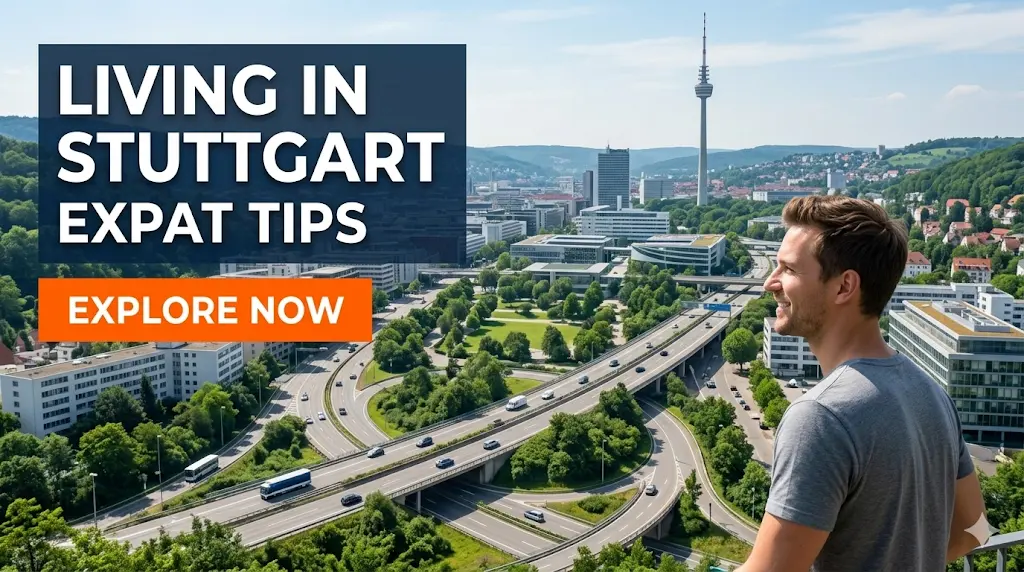
To understand the intense pressure of the Stuttgart housing market, you must first understand its geography. The city center is famously situated in a steep valley basin known affectionately and frustratingly as the Kessel (the cauldron). Because the city is geographically trapped by steep, vineyard-covered hills on three sides, there is virtually no physical space left to build new central housing. This severe restriction on supply, combined with a massive influx of highly paid engineers and executives, has driven rental prices to astronomical heights, frequently rivaling Munich and Frankfurt.
When an apartment in the Kessel is listed online, it is standard for landlords to receive hundreds of applications within the first hour. If you manage to secure a viewing, you will inevitably find yourself standing in a narrow stairwell alongside forty other desperate applicants holding pristine financial portfolios. Landlords here are deeply conservative and risk-averse. They demand a flawless SCHUFA credit score, three months of local payslips, and a permanent employment contract. For a newly arrived expat who lacks a local credit history and is still navigating their corporate probation period, competing against double-income German engineering couples feels like an insurmountable, profoundly demoralizing hurdle.
You cannot approach this market with casual optimism. You must treat every viewing as a formal job interview, arriving dressed professionally and armed with every conceivable piece of documentation. Understanding this brutal reality is the absolute first step, and thoroughly studying Finding an Apartment in Germany: Best Websites and Tips for Expats will help you build your application dossier before you even attempt to browse the local property portals.
The Furnished Versus Unfurnished Dilemma
A devastating shock for many expats relocating to Baden-Württemberg is the strict German interpretation of an “unfurnished” apartment. If you manage to sign a standard, long-term lease in a neighborhood like Stuttgart West or Süd, you are typically renting a bare, echoing concrete box. There are no light fixtures hanging from the ceilings, no closets in the bedrooms, and, most shockingly, absolutely no kitchen. You are entirely responsible for purchasing, transporting, and installing the kitchen block—including the sink, oven, countertops, and cabinets—at your own considerable expense.
For an international professional arriving on a two-year corporate rotation with Mercedes-Benz or Bosch, investing five to ten thousand euros into a custom-built kitchen that you might have to rip out or sell at a massive loss when you leave makes zero financial sense. Because of this absurd logistical hurdle, the most effective survival strategy is to bypass the permanent market initially. Booking a mid-term, fully equipped flat through Wunderflats allows you to walk into a ready-made home with high-speed internet, pots in the cupboards, and a bed to sleep in.
This approach buys you the essential time needed to pass your work probation and physically explore the city’s districts before committing to a massive financial undertaking. When you finally transition to a permanent, unfurnished flat, ordering your heavy power tools, light fixtures, and basic appliances from Amazon Germany is the fastest way to make a bare Stuttgart shell livable without hauling goods on the U-Bahn. For a deeper understanding of this financial crossroads, comparing the long-term costs in Furnished vs Unfurnished Apartments in Germany is highly recommended.
Kehrwoche and Swabian House Rules
Once you secure an apartment, you will instantly crash into one of the most infamous and rigidly enforced cultural traditions in southern Germany: the Schwäbische Kehrwoche (Swabian sweeping week). In many traditional Stuttgart apartment buildings, there is no hired cleaning service for the communal areas. Instead, a small wooden sign that reads “Kehrwoche” is passed from door to door on a weekly rotating basis. When the sign hangs on your door, you are legally and socially obligated to sweep and mop the communal stairwell, clean the shared windows, and shovel snow from the sidewalk.
Expats often underestimate how seriously the Swabians take this duty. If you do a poor job, skip your week, or leave streaks on the stairs, your older neighbors will not hesitate to knock on your door and aggressively publicly reprimand you. The Kehrwoche is a deeply ingrained symbol of communal responsibility and civic pride. It is not just about cleanliness; it is a test of whether you respect the established order of the building. To survive this initiation, proactively ordering high-quality, heavy-duty cleaning supplies and a proper snow shovel from Amazon Germany ensures you meet the exacting standards of your Swabian neighbors.
The strictness extends to general house rules (Hausordnung) as well. Stuttgart observes the legally mandated quiet hours (Ruhezeiten) with religious fervor. Vacuuming your apartment, drilling a hole in the wall, or running a noisy washing machine on a Sunday or after 22:00 on a weekday is considered a massive social offense that can quickly result in the police being called. Understanding and adhering to these non-negotiable civic boundaries is a core pillar of Living in Germany: Essential Guide to Daily Life for New Expats.
Decoding Stuttgart Neighborhoods
Stuttgart West and Süd for Urban Charm
Stuttgart West is widely considered the most desirable, densely populated, and architecturally stunning district in the city. Because it largely escaped the heavy bombing of World War II, it boasts an incredible array of preserved nineteenth-century architecture and beautiful old-build (Altbau) apartments. The neighborhood is tightly packed into the valley, creating a highly walkable, vibrant atmosphere filled with independent cafes, boutique shops, and excellent local restaurants. It is the absolute holy grail for young professionals and affluent expats who want an urban lifestyle.
Directly adjacent is Stuttgart Süd, which centers around the vibrant Marienplatz. This area has rapidly gentrified into the city’s hipster and alternative epicenter. Marienplatz buzzes with energy year-round, serving as the primary outdoor living room for the neighborhood. On warm summer evenings, the square is packed with locals drinking beer, eating gelato, and catching the famous “Zacke” (the rack railway) that climbs the steep hills.
However, because these western and southern districts are universally beloved, the vacancy rate is practically zero, and the rents are astronomically high. Parking in these areas is also a daily nightmare; the streets are incredibly narrow, and securing a resident parking permit does not guarantee you will ever find a space within a mile of your front door. If you prioritize a bustling neighborhood feel over automotive convenience, these districts are unparalleled.
Bad Cannstatt and Degerloch for Space and Tradition
If you venture outside the immediate Kessel, the atmosphere of the city shifts dramatically. Bad Cannstatt, located along the Neckar River, is technically the oldest part of Stuttgart and possesses a fiercely independent, working-class identity. It is famous for its massive mineral baths (Mineralbäder), the Wilhelma zoo, and hosting the Cannstatter Wasen (the massive local beer festival). The rents here are slightly more approachable, and the transit connections into the central city are excellent.
Conversely, Degerloch is situated high up on the hills overlooking the valley. It is an affluent, highly manicured, and deeply quiet suburban district favored by established expat families, corporate executives, and wealthy locals. Because it sits above the Kessel, residents of Degerloch escape the stifling summer heat and the trapped winter smog that plagues the city center. It offers beautiful, sprawling villas, excellent international schools, and immediate access to massive forests for weekend hiking.
Because these hillside districts are heavily favored by affluent expats and corporate relocation agencies, the available rental stock is often handled exclusively by premium brokers. Many transitioning families use Wunderflats to secure upscale, family-sized interim housing in Degerloch while they search for a permanent villa or large apartment.
Commuter Towns and the Speckgürtel
For a massive portion of the expat population in Stuttgart, living in the city center makes very little logistical sense. The major corporate headquarters—like Mercedes-Benz in Sindelfingen, Porsche in Zuffenhausen, and Bosch in Gerlingen—are located in the sprawling suburban ring known as the Speckgürtel (the bacon belt).
Many international engineers and executives choose to live directly in these commuter towns, such as Böblingen, Sindelfingen, or Esslingen am Neckar. Living in the Speckgürtel offers drastically more living space for your money, easier access to parking, and a microscopic commute. Esslingen, in particular, is a stunning medieval town with intact half-timbered houses that offers an incredibly high quality of life without the suffocating density of the Kessel.
The primary drawback to suburban life is the requirement to own a car and the potential for social isolation. The nightlife and culinary diversity in the commuter towns are highly limited compared to central Stuttgart. Deciding whether to endure a brutal daily commute into the suburbs for work, or to embrace suburban life and commute into the city for socializing, is a massive lifestyle choice that requires careful budgeting, a process detailed in Cost of Living in Germany: Budgeting Guide for Expats.
Career Opportunities and the Swabian Mentality
The Automotive and Engineering Powerhouse
Stuttgart is the undisputed engineering and automotive capital of Europe. It is the birthplace of the automobile, and the economy is overwhelmingly dominated by high-tech manufacturing, precision engineering, and automotive development. If you are relocating for a senior role at Mercedes-Benz, Porsche, Bosch, or Mahle, you are entering a corporate environment that is highly structured, incredibly lucrative, and intensely demanding.
Because these corporations are global titans, the professional environment in their headquarters is highly international. The working language in many of the engineering and development departments is entirely English. For a highly skilled technical expat, finding a lucrative job here without speaking a word of the local language is entirely possible, and the relocation packages are often incredibly generous.
However, the corporate culture in Stuttgart tends to be much more conservative, formal, and hierarchical than the chaotic, hoodie-wearing startup scene of Berlin. You are expected to adhere to traditional business etiquette, strict punctuality, and clear hierarchical boundaries.
Understanding the Schaffe Schaffe Häusle Baue Ethos
You cannot live in Stuttgart without understanding the fundamental cultural ethos of the Swabian people (Schwaben). The defining regional motto is Schaffe, schaffe, Häusle baue (Work, work, build a little house). This phrase encapsulates the intense, generational dedication to extreme industriousness, thriftiness, and the ultimate goal of achieving secure, debt-free homeownership.
Swabians are fiercely proud of their reputation for hard work and financial prudence. They do not value flashy displays of wealth. A local CEO might earn millions but will proudly drive a ten-year-old mid-range car and brag about buying their groceries at a discount supermarket. Frugality is a virtue here, not a sign of poverty.
For expats coming from cultures that celebrate conspicuous consumption or prioritize a relaxed work-life balance, the Swabian intensity can feel overwhelming and deeply judgmental. If you spend lavishly or complain about hard work, you will quietly lose the respect of your local peers.
The Language Barrier and Swabian Dialect
While the massive corporate bubbles of Stuttgart operate in English, attempting to build a long-term life in Baden-Württemberg without learning the language will leave you permanently isolated on the fringes of society. You must learn Hochdeutsch (Standard German) to deal with the immigration office, the tax authorities, and your landlord.
However, in Stuttgart and the surrounding villages, you will also be bombarded by Schwäbisch (the Swabian dialect). Swabian is not merely an accent; it features entirely different vocabulary, massive vowel shifts, and a heavy reliance on adding “-le” to the end of words to make them diminutive (e.g., a small house is a Häusle, a bit is ein bissle). It is notoriously difficult for even native German speakers from other regions to understand.
You are not expected to speak Swabian—in fact, attempting to fake the dialect as an expat is often viewed as highly embarrassing—but you must train your ear to understand it if you want to converse with local tradespeople, bakery staff, or the older generation.
Managing Your Finances and Cost of Living
Salaries Versus the Local Premium
The career opportunities in Stuttgart are staggering, and the salaries reflect the city’s elite industrial status. If you are an engineer or a management consultant, your compensation package will likely be significantly higher than what you would be offered for the exact same role in eastern or northern Germany.
However, this high income is aggressively offset by what locals call the “Stuttgart Premium.” Absolutely everything costs more here. A simple lunch, a monthly gym membership, and your basic grocery run will all demand a larger portion of your paycheck. The warm rent (Warmmiete)—which includes your base rent plus the estimated costs for heating, water, and building maintenance—can easily consume forty percent of a standard net salary.
You must conduct a ruthless audit of your finances before accepting a job offer in the Swabian capital. A salary that seems luxurious on paper can quickly evaporate when faced with the local reality of high taxation and premium pricing.
Budgeting for Groceries and Daily Expenses
Surviving the high costs of Stuttgart requires adopting local, pragmatic Swabian budgeting habits quickly. The most fundamental lifestyle change for expats is abandoning the convenience of eating out multiple times a week. Dining at restaurants in Stuttgart is a luxury, not a daily baseline. To protect your savings, you must embrace the culture of cooking at home.
Groceries in Germany are notoriously affordable compared to the rest of Western Europe, largely due to the fierce price wars between discount supermarket giants like Aldi, Lidl, and Penny. Learning to do your primary shopping at these discounters, and supplementing with fresh produce from the local neighborhood markets (Wochenmärkte), will drastically reduce your monthly expenditure.
For heavy, non-perishable pantry staples, cleaning supplies, or specialized international ingredients that are impossible to find in standard Swabian supermarkets, utilizing bulk delivery from Amazon Germany is a massive money and time saver. It frees you from having to lug heavy laundry detergent on the U-Bahn, allowing you to focus your local shopping on fresh Swabian pretzels (Brezeln) and local cuts of meat.
Transportation and the Stau Problem
Owning a car in central Stuttgart is a deeply frustrating and expensive liability, which is deeply ironic for the automotive capital of Germany. The topography of the Kessel creates massive logistical bottlenecks. The city is universally infamous across Germany for its horrendous traffic jams (Stau). Commuting by car into the city center during rush hour is an exercise in extreme psychological torture.
Furthermore, because the city sits in a valley, it traps car exhaust and industrial pollution. During the winter months, the city frequently triggers a Feinstaubalarm (fine dust alarm), urging residents to leave their cars at home and use public transit to prevent the air quality from reaching toxic levels. Environmental zones are strictly enforced, and older diesel vehicles are entirely banned from the city center.
To survive, you must master the Verkehrs- und Tarifverbund Stuttgart (VVS). The integrated public transit network of S-Bahns, U-Bahns, and buses is highly efficient, though the ticket pricing structure across the various regional zones can be confusing for newcomers.
Lifestyle Nature and Integration
Escaping to the Vineyards and Black Forest
The single greatest lifestyle advantage of living in Stuttgart is its immediate, profound connection to nature. Stuttgart is unique among major German cities because it is heavily agricultural; it is one of the only major European metropolises to have commercial vineyards operating directly within the city limits. You can take the U-Bahn to the end of the line and immediately begin hiking through steep, terraced vineyards that offer breathtaking views of the valley.
Wine culture is deeply ingrained here. During the late summer and autumn, locals flock to Besenwirtschaften (broom taverns)—temporary, informal wine taverns operated by local vintners directly out of their homes or barns, signaled only by a broom hanging over the door. Drinking local Trollinger wine in a rustic barn is the quintessential Swabian weekend experience.
Beyond the city limits, Stuttgart serves as the ultimate gateway to the Black Forest (Schwarzwald) and the Swabian Jura (Schwäbische Alb). Within a forty-minute drive, you can be hiking through dense, ancient pine forests, exploring medieval castle ruins, or skiing in the winter. This immediate access to world-class nature provides a vital release valve for the high-pressure, corporate environment of the city.
The Cannstatter Volksfest and Local Traditions
While Munich grabs all the international headlines for Oktoberfest, Stuttgart hosts the second-largest beer festival in the world: the Cannstatter Volksfest (often simply referred to as the Wasen). For many seasoned expats and locals, the Wasen actually offers a superior experience. It attracts millions of visitors annually, but the crowd is overwhelmingly domestic rather than international, resulting in a much more authentic, slightly less chaotic atmosphere.
The Wasen operates on very similar principles to Oktoberfest: massive beer tents, incredible fairground rides, and people dressed in regional Tracht (Lederhosen and Dirndls). However, the beer served is local to Stuttgart, and the culinary specialties lean heavily into Swabian culture, meaning you will find incredible Maultaschen (heavy meat-filled dumplings) alongside the standard roasted chicken.
Because the Wasen does not have the massive global tourist pull of Munich, securing table reservations in the tents is significantly easier, and you are far more likely to end up drinking beer with actual locals. It is a mandatory calendar event that defines the autumn season in the region.
Breaking the Ice and Making Local Friends
The “Coconut” culture is arguably at its thickest in Swabia. The locals have a very hard, polite, but deeply private exterior. They do not engage in superficial small talk, and they are famously skeptical of outsiders (including Germans from other federal states, whom they jokingly refer to as Neigschmeckte). You might work alongside a Swabian colleague for three years before they invite you to their home for coffee.
However, once you crack that hard outer shell, the interior is incredibly warm and fiercely loyal. A Swabian friend will help you move your heavy furniture, fix your car, and fiercely defend you. You cannot force this integration; you must be patient and participate actively in the community.
Joining local sports clubs (Vereine), participating in community hiking groups, or simply showing up consistently to the same local bakery and politely speaking broken German are the most effective methods to build trust.
Comparison Table: Stuttgart Neighborhoods
To help you strategize your housing hunt, here is a quick breakdown of the primary expat destinations in and around the city.
| Neighborhood / Area | Primary Vibe | Average Rent Cost | Target Expat Demographic |
| Stuttgart West | Classic Altbau, highly walkable, dense | Very High | Young professionals, high-earners |
| Stuttgart Süd | Hipster, Marienplatz energy, trendy | High | Creatives, singles, social expats |
| Bad Cannstatt | Working-class roots, mineral baths, Wasen | Medium to High | Budget-conscious expats, families |
| Degerloch | Affluent, quiet, above the smog | Astronomical | Corporate executives, wealthy families |
| Sindelfingen / Böblingen | Suburban, automotive hubs, spacious | Medium | Engineers, corporate expats with families |
| Esslingen am Neckar | Medieval charm, quiet, beautiful | Medium to High | Families, history lovers, commuters |
References
Primary sources (official)
- Landeshauptstadt Stuttgart (Official City Portal in English): https://www.stuttgart.de/en/
- VVS (Verkehrs- und Tarifverbund Stuttgart) Official English Site: https://en.vvs.de/
Other helpful sources
- Welcome Center Stuttgart: https://welcome.region-stuttgart.de/en/
Disclaimer
The housing market conditions, living costs, and cultural observations detailed in this guide are based on widespread expat experiences and the current realities of residing in Stuttgart and the surrounding region. Rent prices, VVS transit zones, and bureaucratic procedures are highly volatile and subject to constant change by local authorities. Always verify current visa requirements, municipal registration laws, and rental agreements directly through the official stuttgart.de service portal before finalizing your relocation budget or signing legally binding lease contracts.