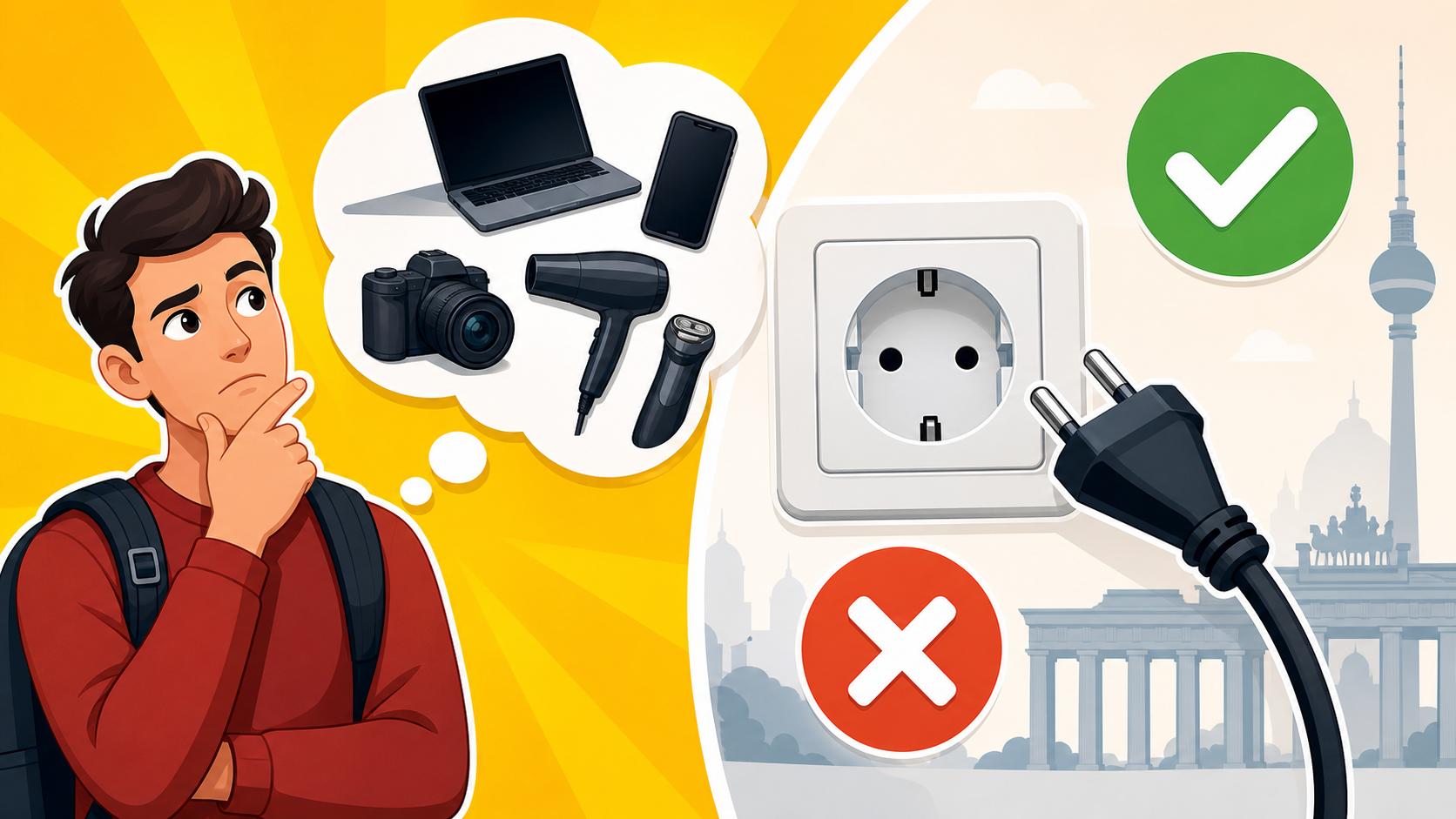
Using Electronics from Home: Will Your Devices Work in Germany?
You arrive in your new Berlin flat, exhausted from the flight, and reach for your favorite high-end hair dryer to freshen up, only to realize the plug doesn't fit the wall. I’ll never forget my first week in Munich when I tried to force a North American blender into a cheap travel adapter; the smell of burning plastic was my first real lesson in German engineering. This guide breaks down exactly which of your electronics will survive the move to Germany and which are better left behind.
Disclosure: This post may contain affiliate links. We may earn a commission at no extra cost to you if you make a purchase through these links. Read full disclosure.
Understanding the German Electrical Standard: Voltage and Hertz
The first hurdle you will face isn't the physical shape of the plug, but the invisible power surging through the wires. In Germany, the standard voltage is 230V, and the frequency is 50Hz. If you are coming from North America or parts of South America and Asia where 110V-120V is the norm, this is a massive difference. Plugging a 110V device directly into a German outlet is a recipe for a blown fuse, a dead device, or even a small fire in your apartment.
When I first moved here, I assumed a simple plastic adapter was all I needed for everything. I was wrong. You must check the "Input" label on every single power brick and electronic device you own. If it says "Input: 100-240V, 50/60Hz," you are in the clear; the device is dual-voltage and can handle the German grid. If it only says "110V," do not bring it. While you could technically use a heavy-duty voltage transformer, they are bulky, expensive, and often fail over long-term use. This is especially important if you are calculating your Cost of Living in Germany: Breakdown of Expenses (Rent, Food, Transport) and deciding whether to ship your current household goods or buy new ones.
The frequency—measured in Hertz—is another silent killer for certain items. Germany uses 50Hz, while many other countries use 60Hz. Even if a device can handle the voltage, the frequency difference can affect anything with a motor or a clock. An American alarm clock might lose several minutes every hour, and a 60Hz blender motor might run slower and hotter until it eventually burns out. If you are moving into one of the Furnished vs Unfurnished Apartments in Germany: Pros and Cons, you might find that many of these basic appliances are already provided, saving you the headache of technical compatibility.
Plugs and Sockets: Meet the Type C and F Schuko
Even if your device is dual-voltage, you still need to get the electricity from the wall into the machine. Germany uses two primary plug types: Type C and Type F. Type C, often called the "Europlug," is the flat, two-pole plug used for low-power devices like phone chargers and lamps. It is ungrounded and fits into almost any socket in Continental Europe. Type F, known locally as the "Schuko" (short for Schutz-Kontakt), is the beefier, round plug with two pins and two earth clips on the side.
The Schuko system is actually quite brilliant and reflects the German obsession with safety. When you plug a Type F device into the wall, the grounding clips make contact before the power pins do, protecting you from potential shocks. If you are Moving Furniture and Belongings: Tips for an Easy Move to Germany, you might be tempted to bring power strips from home and just put an adapter on the end. Please, do not do this. Power strips from 110V countries are not designed to handle 230V loads, and the lack of proper grounding through a travel adapter can be dangerous.
I highly recommend buying local power strips once you arrive. You can find high-quality, surge-protected strips on Amazon Germany for a few euros. This ensures that your expensive electronics are properly grounded according to local standards. If you have already started Opening a Bank Account in Germany: Best Banks for Expats, you will find that most local retailers and online shops make it very easy to order these essentials during your first few days in the country.
Adapters vs. Converters: Making the Right Choice
There is a common misconception among newcomers that "adapters" and "converters" are the same thing. They are not, and confusing them can be an expensive mistake. An adapter is a simple plastic device that changes the physical shape of your plug so it can slide into a German socket. It does nothing to the voltage. These are perfect for your dual-voltage items like laptops, tablets, and modern smartphone chargers.
A converter or transformer, on the other hand, is designed to step down the 230V German power to 110V. Small, travel-sized converters are often marketed for hair dryers, but in my experience, they are notoriously unreliable for high-wattage items. If you have a high-end desktop PC or a specialized piece of laboratory equipment that isn't dual-voltage, you will need a heavy, high-quality step-down transformer. These look like small car batteries and are quite heavy.
Before you invest in transformers, check the Cost of Utilities in Germany: Average Prices for Electricity, Gas, Water. You might find that running older, inefficient appliances from home through a transformer actually ends up costing you more in the long run than simply buying a modern, energy-efficient version locally. Furthermore, if you are living in a temporary rental through Wunderflats, the apartment will likely already be equipped with German-standard appliances, so you really only need to worry about your personal gadgets like laptops and cameras.
Category-by-Category Compatibility Guide
To make your packing list easier, I have broken down common household electronics based on how well they typically transition to the German grid. Most modern "smart" tech is built for a global market, but older or "dumb" appliances are much more localized.
| Device Category | Usually Dual Voltage? | Recommendation |
|---|---|---|
| Laptops & Tablets | Yes (99%) | Use a simple plug adapter. |
| Smartphones & Kindles | Yes | Use an adapter or a local USB-C brick. |
| Hair Dryers & Irons | No | Buy new in Germany; they will likely melt. |
| Kitchen Mixers/Blenders | No | Leave at home; motors often fail. |
| Desktop PCs | Often (Check switch) | Check the PSU for a 115V/230V toggle. |
| Gaming Consoles | Mostly (Check label) | PS5/Xbox Series X are usually fine; check older units. |
| Electric Toothbrushes | Often | Check the base of the charging stand. |
| Television Sets | No | Different tuners and voltages; buy locally. |
When it comes to beauty tools like flat irons or curling wands, I strongly advise against bringing them if they aren't explicitly dual-voltage. Germany's 230V will make an American 110V hair straightener reach double its intended temperature almost instantly. I have seen friends ruin their hair and their favorite tools within seconds. You can easily find replacements on Amazon Germany or at local retailers like MediaMarkt or Saturn. If you are staying in a professionally managed apartment from Wunderflats, check the listing or ask the landlord; many of these "lifestyle" electronics are provided in the higher-end furnished units.
For those with a collection of rechargeable batteries or power tools, the same logic applies. Most modern chargers for camera batteries or cordless drills are dual-voltage, but you must read the fine print on the charging brick. If you bring a non-compatible charger and it fries your battery, you’ll have a hard time finding a replacement for a niche foreign model. This is where a more specialized Household Appliance Guide: Voltage, Adapters, and Buying Electronics in Germany can be a lifesaver during your first month of setup.
Sourcing and Replacing Electronics Locally
Once you realize that your favorite coffee maker or toaster isn't coming with you, you'll need to know where to shop. Germany has a very robust electronics market. For the best prices and widest selection, Amazon Germany is the go-to for most expats because you can easily compare energy ratings and read reviews. In Germany, appliances are rated on an A to G scale for energy efficiency. Since electricity is relatively expensive here, buying an "A" rated appliance can save you a significant amount over several years.
If you prefer to see things in person, chains like MediaMarkt and Saturn are found in almost every major city and shopping mall. For smaller items like adapters, cables, or basic kitchen gadgets, drugstores like Rossmann or DM often have a small "Technik" aisle that can be very handy in a pinch. If you are setting up a more permanent home and need to protect your new investments, don't forget to look into Home Insurance in Germany: Do You Need Haftpflicht and Hausrat?, as some policies cover electrical damage from power surges.
Another great way to save money and stay sustainable is to look at the second-hand market. Platforms like eBay Kleinanzeigen (now just called Kleinanzeigen) are massive in Germany. You can find nearly new German-standard appliances for a fraction of the retail price. Just make sure that when you are eventually done with these items, you follow the German Recycling System Explained: How to Sort Trash and Recycle Properly, as electronics (Elektroschrott) cannot be thrown in the regular household bin.
Final Advice for Your Electronic Transition
Moving to a new country is stressful enough without having to worry about your laptop exploding or your phone not charging. My best piece of advice is to be ruthless during your packing phase. If an item is older than five years, high-wattage, and not dual-voltage, it is almost certainly not worth the shipping weight or the risk of using a transformer.
Focus on bringing your high-value portables—laptops, cameras, and phones—and buy everything else once you land. If you've booked a furnished place through Wunderflats, you'll have the luxury of time to slowly figure out what else you need. You can order a few Schuko power strips on Amazon Germany before you even arrive, so they are waiting for you at your new address. This small bit of preparation will allow you to plug in your essential gadgets the moment you walk through the door, letting you focus on more important things, like finding the best local bakery.
Disclaimer
This guide is intended for informational purposes only. Electrical standards and safety regulations can change, and improper use of electrical devices can result in injury or property damage. Always consult the manufacturer's manual for your specific devices and consider hiring a qualified electrician for any major household installations in Germany.