Understanding German Pharmacies vs Drugstores: Where to Get What
Navigating the German health landscape requires mastering the distinction between an Apotheke and a Drogerie. While one is a highly regulated medical institution for prescriptions and advice, the other is a retail hub for wellness, beauty, and household staples.
Disclosure: This post may contain affiliate links. We may earn a commission at no extra cost to you if you make a purchase through these links. Read full disclosure.
The Fundamental Split: Apotheke vs Drogerie
Defining the German Pharmacy (Apotheke)
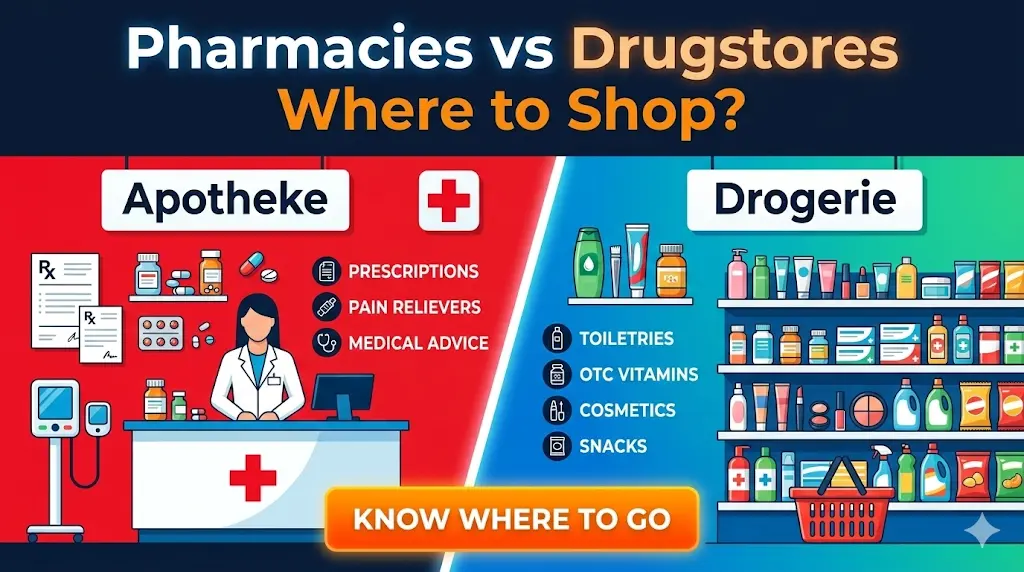
The Apotheke is a cornerstone of the healthcare system in Germany. Unlike in many other countries where pharmacies are often tucked into the back of a large supermarket, a German pharmacy is a standalone, specialized medical facility. Legally, every Apotheke must be owned and operated by a licensed pharmacist; there are no corporate “chains” in the traditional sense, though you will see common branding symbols. The most recognizable of these is the large, stylized red “A” with a white chalice and snake, which glows on almost every street corner in German cities.
In Germany, there is a clear distinction between pharmacies and drugstores, and understanding this difference helps residents obtain the correct products and medical advice. Pharmacists are trained healthcare professionals who provide guidance on medication use, possible side effects, and interactions. Over-the-counter medicines for common conditions such as pain, allergies, or colds are also sold exclusively in pharmacies.
Drugstores, commonly represented by chains like dm-drogerie markt and Rossmann, focus primarily on personal care and wellness products. These stores sell items such as cosmetics, skincare products, vitamins, baby supplies, and household goods. However, they do not sell prescription medicines or most medical treatments. If you need professional medical advice or medication for health conditions, visiting a pharmacy is necessary. Drugstores are better suited for everyday health, hygiene, and beauty products.
An Apotheke is the only place in Germany where you can legally obtain prescription medication (verschreibungspflichtig) and most high-dose over-the-counter (OTC) drugs. It is a space designed for clinical safety rather than browsing. When you walk into a pharmacy, you are entering an environment where medical expertise is the primary product. This structure ensures that every time you receive medication, a qualified professional has verified the dosage and checked for potential interactions with other treatments you might be taking. For a broader look at how these institutions fit into your general medical journey, consult our guide on Navigating Medical Care in Germany: Doctors, Hospitals, and Pharmacies.
Defining the German Drugstore (Drogerie)
The Drogerie is essentially a health and beauty store that operates as a high-frequency retail outlet. The landscape is dominated by massive national chains such as dm, Rossmann, and Müller. Unlike pharmacies, these stores are self-service; you grab a cart, walk through aisles of shampoo, cosmetics, and organic snacks, and pay at a standard supermarket-style checkout. The staff are helpful retail associates but are not medically trained to give advice on illnesses.
While the word “drugstore” is the standard translation for Drogerie, it is misleading for many English speakers. You will not find “drugs” here in the sense of medicine. A Drogerie is where you go for your daily personal hygiene needs, baby supplies, eco-friendly cleaning products, and low-dose nutritional supplements. It is the place for lifestyle wellness rather than medical intervention. If you are setting up your household for the first time, a trip to dm or Rossmann is as essential as registering your address.
Why the Distinction Exists: Safety and Law
The sharp divide between these two types of stores is rooted in strict German pharmaceutical laws (Arzneimittelgesetz). The German government believes that any substance capable of significantly altering bodily functions should be dispensed only under the supervision of a pharmacist. This is why even “mild” medications like 400mg ibuprofen or paracetamol are strictly apothekenpflichtig (pharmacy-only).
This regulatory wall ensures that patients don’t accidentally overdose on common painkillers or combine conflicting medications. While it may seem inconvenient to have to visit a separate store just for a headache pill, it maintains one of the highest levels of patient safety in Europe. For expats, understanding this legal wall is the first step in Healthcare in Germany: A Comprehensive Guide for Expats. If your health concerns require more than a drugstore fix, ensuring you have the right insurance via Feather Insurance or Ottonova allows you to access the necessary medical channels without financial stress.
Shopping at an Apotheke: Medicine and Professional Advice
Behind the Counter Culture: Self Service vs Counseling
The most striking feature of a German Apotheke is that almost everything is behind the counter. While the front area may have some high-end dermacosmetics, herbal teas, or lozenges, the “real” medicine is stored in large automated drawer systems or shelving units behind the pharmacist. You cannot simply grab a box of aspirin off a shelf and take it to the register. Every transaction begins with a conversation at the counter.
This “counseling requirement” is a legal obligation. Even for non-prescription items, the pharmacist is supposed to ask about your symptoms and explain the correct usage. This is particularly helpful for newcomers who may not be familiar with German brand names. If you describe your symptoms, the pharmacist can recommend a localized equivalent to a medicine you used back home. For those managing their own wellness and looking for international brands not typically found in an Apotheke, many expats find that ordering through iHerb provides a wider variety of trusted global products.
Prescription Systems: e-Rezept and Paper Slips
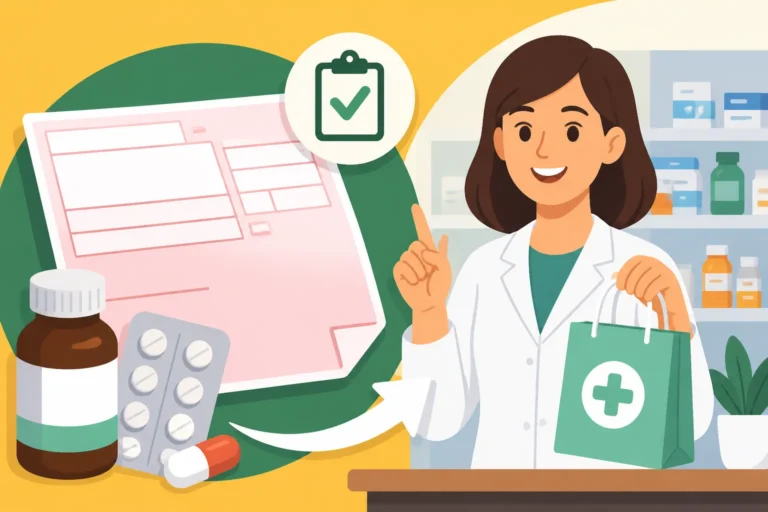
As of January 2024, Germany has fully embraced the digital age with the e-Rezept (electronic prescription). If you are enrolled in a Public Health Insurance (gesetzliche Krankenkasse): What It Covers and Costs, your doctor no longer gives you a pink paper slip for most meds. Instead, the prescription is saved digitally on your Electronic Health Card (eGK). You simply hand your card to the pharmacist, they scan it, and your prescription appears on their screen.
However, paper prescriptions still exist. Private patients, for example, usually receive blue or white paper slips, which they pay for upfront and then submit to their insurer for reimbursement. There are also green slips, which are recommendations for OTC drugs that you must pay for yourself, and yellow slips for strictly regulated narcotics. Mastering this system is a key part of How to Get Health Insurance in Germany: Step-by-Step for Newcomers, as your health card is your primary key to the pharmacy system.
The Apothecary’s Advice: Beyond Dispensing Pills
A German pharmacist is more than a dispenser; they are a frontline health consultant. Many pharmacies offer additional services such as blood pressure monitoring, cholesterol testing, and even basic flu vaccinations during the winter months. They are also experts in “Magistral formulations,” meaning they can custom-mix creams or solutions prescribed by your doctor.
If you have a minor ailment like a localized skin rash or a seasonal cough, the pharmacist can often provide a solution that saves you a trip to the Finding a Doctor (Hausarzt) in Germany: How to Choose and Register. They can also check for drug-drug interactions if you are taking multiple medications. For expats who travel frequently, pharmacists can provide advice on travel vaccinations, which is a major focus in our guide on Vaccinations in Germany: Recommended Shots for Adults and Children.
Shopping at a Drogerie: Wellness, Beauty, and Home
Top Chains: dm, Rossmann, and Müller
When you need to stock up on daily essentials, you will likely choose between the “Big Three.” dm (Drogerie Markt) is perhaps the most beloved for its massive range of organic food and high-quality private labels like Balea and Alverde. Rossmann is often slightly more focused on beauty and hygiene, frequently offering competitive discounts. Müller is usually the largest of the three, often including an entire floor for toys, stationery, and even a perfume department.
These stores are the ultimate convenience hubs. Because they operate on high volume, prices for shampoo, toothpaste, and diapers are significantly lower than in many other European countries. Many expats make a weekly “dm run” to stock up on everything from vegan milk to eco-friendly laundry detergent. If you are a freelancer or student managing a tight budget, these stores are your best friend for non-medical health needs.
What You CAN Get: Skincare, Vitamins, and Household Staples
The Drogerie aisles are packed with wellness products that don’t quite reach the level of “medicine.” You can find:
- Vitamins and Supplements: Low-dose magnesium, Vitamin D, and multivitamins are available in effervescent tablets or capsules.
- First Aid: Band-aids, disinfectants for external use, and basic athletic tape.
- Beauty and Hygiene: Everything from high-end makeup to specialized shampoos for sensitive scalps.
- Baby Care: A massive selection of diapers, organic baby food, and gentle skin creams.
- Organic Food: Most drugstores have an extensive “Bio” section with nuts, grains, and healthy snacks.
For those focusing on Healthy Living in Germany: Wellness, Fitness, and Mental Health Guide, the Drogerie is where you build your daily wellness routine. However, for specialized nutritional support or higher-potency supplements, checking iHerb is often a smart move to compare options and prices internationally.
What You CANNOT Get: The Ibuprofen Hard Line
The most frequent point of confusion for expats is the “painkiller wall.” In the US or UK, you can buy ibuprofen or paracetamol at a convenience store or supermarket. In Germany, this is strictly forbidden. You will not find even a low-dose aspirin at dm or Rossmann.
If you ask a drugstore employee where the painkillers are, they will point you to the nearest Apotheke. This rule also applies to certain cough syrups, medicated nasal sprays, and any antifungal treatments for skin or nails. If it has an active pharmaceutical ingredient, it belongs in the pharmacy. This distinction is crucial to remember if you develop a sudden toothache or fever on a Sunday, as you will need to find a pharmacy providing Medical Emergencies: What to Do and Where to Go in Germany support.
Costs, Insurance, and Reimbursements
Public Insurance Co-payments (Zuzahlung)
For those in the public system, medication is heavily subsidized but rarely free. You are required to pay a statutory co-payment (Zuzahlung) for prescription drugs. This fee is generally 10% of the drug’s price, with a minimum of €5 and a maximum of €10 per package. Children under 18 are usually exempt from these fees.
The pharmacy handles this billing digitally using your health card. They tell you the co-pay amount at the counter, and you pay it directly. The rest of the cost is billed to your sickness fund. Understanding these small out-of-pocket costs is vital for your financial planning, as explained in Public Health Insurance (gesetzliche Krankenkasse): What It Covers and Costs.
Private Insurance and the Pay and Claim Model
If you are privately insured through a provider like Ottonova, the experience is different. You will receive a paper prescription, pay the full retail price at the pharmacy, and receive a detailed receipt. You then upload a photo of this receipt to your insurance app for reimbursement.
This requires you to have a small “buffer” of cash or a reliable bank account to front the costs. Utilizing a modern, multi-currency account like Wise is an excellent way for expats to manage these domestic medical payments while keeping their international finances organized. Digital-first private insurers often reimburse within days, minimizing the time your money is “out of pocket.”
Over the Counter Pricing: Why it Varies
While prescription drug prices are strictly regulated and the same at every pharmacy, OTC drug prices are not. This means a pack of cold medicine might cost €6 in one Apotheke and €9 in another. Online pharmacies (Online-Apotheken) often offer significant discounts of up to 50% on these non-prescription items.
For non-urgent needs, ordering your OTC kits online is a great way to save money. However, for an acute infection, the immediate advice and proximity of your neighborhood pharmacy are worth the extra couple of euros. If you are a student on a budget, these savings can add up, as noted in Health Insurance for Students in Germany: Affordable Options and Requirements.
Accessing Medication After-Hours
The Notdienst System: 24/7 Rotations
Standard retail hours in Germany are relatively strict; most pharmacies close by 6:30 PM or 8:00 PM and are closed all day Sunday. However, to ensure 24/7 access to medicine, pharmacies take turns participating in an emergency rotation called the Notdienst.
Every pharmacy will have a digital sign or a printed list in its window indicating the nearest Notdienst-Apotheke currently on duty. You can also find the live list on aponet.de. This ensures that no matter where you are, a pharmacy is open within a reasonable driving or walking distance.
Emergency Fees and Security Windows
When you visit an emergency pharmacy at night or on a Sunday, you won’t usually be allowed inside the shop. Instead, you will ring a bell at a small security window (Notdienstklappe). You speak to the pharmacist through the window, and they bring your medication to you.
Be aware that there is a flat-rate emergency fee (Notdienstgebühr), which is currently €2.50. This fee applies to the entire visit, not per item. If your doctor has marked your prescription as an “emergency,” your insurance might cover this fee, but in most cases, you simply pay it out of pocket. For short-term visitors, knowing where the nearest Notdienst is located is as important as having Travel Health Insurance: What Expats Need for Schengen Visa & Short Trips.
Comparative Summary: Where to Get What
To help you decide where to go for your specific needs, refer to the table below:
| Product / Service | Apotheke (Pharmacy) | Drogerie (dm, Rossmann) |
| Prescription Meds | YES (Only location) | NO |
| Ibuprofen / Paracetamol | YES (400mg+) | NO |
| Professional Advice | YES (Medical Doctor Level) | NO (Retail support) |
| Skincare / Cosmetics | YES (Medical brands) | YES (Mass market & Bio) |
| Vitamins / Supplements | YES (High dose/Medical) | YES (Daily wellness) |
| Baby Formula / Diapers | YES (Specialized/Late night) | YES (Full range/Cheaper) |
| Organic Food / Snacks | Minimal | Extensive |
| Cleaning Products | NO | YES |
Conclusion
Mastering the difference between the Apotheke and the Drogerie is a vital survival skill for life in Germany. By recognizing that the pharmacy is a clinical resource for medicine and the drugstore is a retail hub for wellness, you can efficiently manage your health and your household budget.
Whether you are redeeming an e-Rezept with your public health card or stocking up on eco-friendly soaps at dm, the German system is designed to provide high-quality care and convenience at every level. Stay proactive with your preventative care, leverage your insurance benefits, and you will navigate the German medical world with absolute confidence.
References
Primary sources (official)
- ABDA – Federal Union of German Associations of Pharmacists: https://www.abda.de/en/
- Aponet.de – Official Emergency Pharmacy Finder: https://www.aponet.de/apotheke/notdienstsuche
Other helpful sources
- Make it in Germany – Healthcare Overview: https://www.make-it-in-germany.com/en/living-in-germany/money-insurance/healthcare
- European Commission – Health Care in Germany: https://ec.europa.eu/social/main.jsp?catId=559
Disclaimer
The information provided in this article is for general informational and educational purposes only and does not constitute professional medical, legal, or financial advice. German pharmacy and drugstore regulations, pricing, and insurance co-payment structures are subject to continuous legislative updates. Always consult directly with a qualified medical professional, a licensed pharmacist, or your insurance provider regarding your specific health needs and legal obligations in Germany.