Where to Stay in Stuttgart: City Centre and the Surrounding Valleys
You find a hotel listed as “central Stuttgart” and book it. Then you arrive to a long detour around the station construction, a steep uphill walk with your suitcase, and a room that holds the summer heat. Stuttgart sits in a bowl-shaped valley, and the wrong base costs you time and sweat. This guide explains where to stay in the city centre and the surrounding valleys, and how to book the right place.
Disclosure: This post may contain affiliate links. We may earn a commission at no extra cost to you if you make a purchase through these links. Read full disclosure.
Understanding Stuttgart’s Layout Before You Book
My first trip to Stuttgart went wrong in a very specific way. I booked a lovely guesthouse that the map showed as “1.5 km from the centre.” It was. It was also about a hundred vertical metres above the centre, at the top of a set of public staircases the locals call Stäffele. On day one I found it charming. By day three I was planning my evenings around not climbing back up. Nobody had told me that in Stuttgart, distance on a flat map is only half the story.
Once you understand the city’s shape, choosing accommodation gets much easier. Stuttgart rewards people who plan their base around transit lines and elevation, not just kilometres.
Why the Talkessel Changes Everything
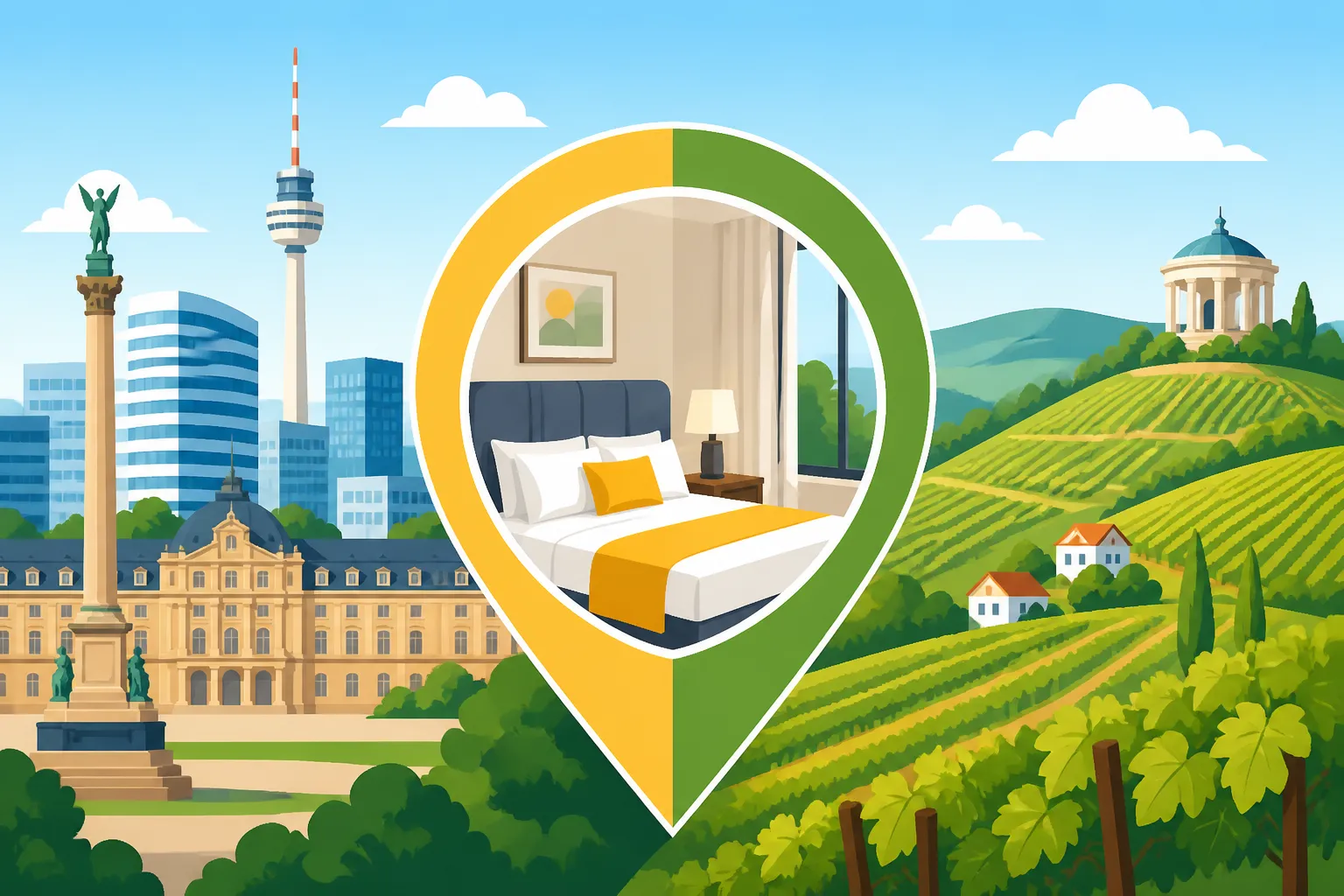
The heart of Stuttgart sits in what Germans call the Talkessel, a basin enclosed by wooded hills and vineyards on almost every side. The flat bottom holds the shopping streets, the palaces, the museums and the main station. The slopes climb steeply in every direction and are lined with villas, apartment blocks and those famous staircases. The Neckar river runs along the eastern edge, past Bad Cannstatt, rather than through the middle of town as many visitors expect.
This shape has three practical consequences for your stay. First, “close to the centre” can mean flat and easy, or it can mean a hillside you climb at the end of every day. Second, the basin traps heat in summer. A top-floor room without air conditioning can stay warm long after sunset, so read the Air Conditioning in German Hotels: Why It’s Rarer Than You Expect guide before booking a July or August trip. Third, the hills give you the city’s best views and quietest streets. If you don’t mind a tram ride, a hillside base can be a real upgrade.
Picture two travellers on the same budget. One books a compact room right on the flat grid near Königstraße and walks everywhere. The other books a bigger apartment up in the Killesberg or Degerloch area and rides the U-Bahn down each morning. Neither is wrong. The mistake is booking the second option while expecting the first experience.
The Station Area, the Airport and the Messe
The main station, Stuttgart Hauptbahnhof, has been a long-running construction zone. Walking routes around it can be indirect and confusing for first-time visitors. Hotels marketed as “next to the station” are genuinely convenient for trains, but arriving on foot at night with luggage may involve a detour you didn’t expect. When you scan reviews, look for recent comments about the walk from the platforms rather than trusting the distance figure alone.
The airport is south of the city on the Filder plateau. The S-Bahn lines S2 and S3 run from it into the centre via Vaihingen. Right next to the airport sits Messe Stuttgart, the big exhibition centre. That one fact explains a lot about Stuttgart hotel pricing. When a major trade fair is on, rooms near the airport, in Leinfelden-Echterdingen and along the S-Bahn line fill up fast, and prices across the city rise with them. I’ll come back to timing later. For now, know that a business traveller heading to the Messe and a tourist heading to the museums need very different bases.
Getting around is straightforward once you’re settled. The regional transport network combines S-Bahn trains, U-Bahn light rail lines that run partly on the surface, and buses under one ticketing system. If you’re new to how German city transit works, the Getting Around German Cities: U-Bahn, S-Bahn, Trams, and Buses guide covers tickets and etiquette. One local quirk worth knowing is the Zahnradbahn, a rack railway nicknamed “Zacke.” It climbs from Marienplatz in Stuttgart-Süd up to Degerloch. It’s a commuter line, a sightseeing ride and a practical way to reach a hillside base, all at once.
City Centre Neighbourhoods Compared
Stuttgart’s inner districts each have a distinct personality. Pick the one that matches what you actually plan to do, and the city feels small and easy. Pick the wrong one, and you’ll spend half your trip commuting.
Mitte and the Königstraße Grid
Stuttgart-Mitte is the obvious choice for a first visit, and for good reason. Königstraße, the long pedestrian shopping street, runs from near the station to Schlossplatz. Schlossplatz is the grand square framed by the Neues Schloss and the Königsbau colonnade. The Altes Schloss, the Württemberg State Museum, the Staatsgalerie and the Kunstmuseum are all within easy walking distance. So are the Markthalle with its gourmet stalls and the Marktplatz where the town hall stands.
The Bohnenviertel, the “bean quarter,” sits on the edge of Mitte near Leonhardsplatz. It’s one of the few corners of old Stuttgart that survived wartime bombing in any recognisable form. Narrow streets, small wine taverns, galleries and independent shops make it a warm, characterful place to stay. Accommodation here tends toward small boutique hotels and apartments rather than big chains.
The trade-offs are predictable. Mitte has the highest concentration of hotels, so you get choice, but the busiest streets can be loud at night and on weekends. Rooms in older buildings can be compact. If you’re a light sleeper, look for listings that mention courtyard-facing rooms, or check reviews for complaints about street noise. A room above the Königstraße crowds is lively in the evening and less charming at six in the morning when delivery vans arrive.
Mitte suits short city breaks of two to four days, museum-focused trips, Christmas market visits and anyone without a car. Driving in the centre is stressful, and parking is limited and often in paid garages. If you are driving, the Parking at German Hotels: Umweltzone Stickers and Paid Garages guide explains the low-emission zone sticker, which matters across Stuttgart.
Stuttgart-West and Stuttgart-Süd
These are my personal favourites for anyone staying more than a few nights. Stuttgart-West is a dense residential district of handsome late-nineteenth-century apartment buildings, small squares and neighbourhood cafés. It feels like the city locals actually live in. Feuersee, with its church reflected in a small lake, is a lovely landmark. The streets around Bismarckplatz and Schwabstraße are full of bakeries, wine bars and little restaurants. The S-Bahn stops at Feuersee and Schwabstraße, so the centre is a few minutes away.
Stuttgart-Süd centres on Marienplatz, a lively square with cafés and the lower station of the rack railway. Tübinger Straße links it to the centre with a steady run of bars and restaurants. Further south, Heslach climbs into the hills. Süd has a slightly younger, creative feel, and it’s easy to walk into Mitte while sleeping somewhere calmer.
Most accommodation in these districts is apartments, holiday flats and smaller guesthouses rather than large hotels. That’s good news for families and longer stays, because you get a kitchen and more space. Before you book a holiday flat, read the Ferienwohnungen in Germany: Reading the Listing and the Cleaning Fee guide. Cleaning fees and check-in arrangements work differently from hotels. One practical warning applies to both districts: the further you go from the flat central streets, the steeper they get. “Stuttgart-West” can mean a gentle walk or a serious climb, so check the address against the map’s terrain view.
Bad Cannstatt and the Neckar Side
Bad Cannstatt is technically part of Stuttgart, but it feels like its own town. It’s older than Stuttgart itself, with a compact historic centre, mineral springs and a riverside setting along the Neckar. Its mineral baths are a real attraction. After a day of walking, soaking in naturally carbonated mineral water is an experience you won’t forget. The Wilhelma, Stuttgart’s combined zoological and botanical garden, sits on the edge of Bad Cannstatt next to the large Rosensteinpark.
This district is also home to the Cannstatter Wasen, the fairground that hosts the big autumn Cannstatter Volksfest and the spring Frühlingsfest. If you’re coming for either, staying in Bad Cannstatt means you can walk home instead of fighting for a place on the packed trains. For context on how these fairs work, see the Local Folk Festivals (Volksfeste) in Germany guide. The Mercedes-Benz Museum is close by too, a short walk from the Neckarpark area with its own S-Bahn stop.
Bad Cannstatt is often a little better value than Mitte. It’s flat, well connected by S-Bahn and U-Bahn, and has a more local, everyday character. The downsides are that it can feel quiet in the evenings outside festival time, and during festival weeks it becomes the most crowded and expensive part of the city. Book early or avoid it, depending on why you’re coming.
Zuffenhausen, Vaihingen and the Outer Districts
A few outer districts make sense for specific trips. Zuffenhausen, in the north, is home to the Porsche Museum, right by the Neuwirtshaus/Porscheplatz S-Bahn stop on the S6. Car enthusiasts sometimes stay nearby, though for most visitors it’s an easy day trip from the centre rather than a base.
Vaihingen, to the southwest, hosts a large university campus and many offices. It sits on the S-Bahn line between the centre and the airport, which makes it a smart compromise for trade fair visitors who want to reach both the Messe and the city. Degerloch, on the hill to the south, gives you leafy calm, the Fernsehturm TV tower with its sweeping views, and the rack railway down to Marienplatz. It’s ideal for hikers and anyone who wants green space more than nightlife.
The common thread: outer districts work well when you have a clear reason to be there, and less well as a generic “cheaper Stuttgart” option. A cheap room that adds forty minutes of travel each way is no bargain on a short trip.
| District | Best For | Getting Around | Main Trade-Off |
|---|---|---|---|
| Mitte | First visits, museums, Christmas market | Walk almost everywhere | Street noise, compact rooms |
| Bohnenviertel | Character, wine taverns, boutique stays | Walk to Mitte | Limited room choice |
| Stuttgart-West | Longer stays, local café life | S-Bahn Feuersee and Schwabstraße | Some streets are steep |
| Stuttgart-Süd | Couples, food, rack railway access | Walk or U-Bahn to Mitte | Mostly apartments, few big hotels |
| Bad Cannstatt | Volksfest, mineral baths, Wilhelma | S-Bahn and U-Bahn | Very crowded in festival weeks |
| Vaihingen | Trade fair visitors, airport access | S-Bahn to centre and airport | Quiet and office-heavy |
| Degerloch | Views, hiking, calm nights | U-Bahn or rack railway | Uphill from everything |
| Zuffenhausen | Porsche Museum visits | S6 into the centre | Little to do in the evening |
Staying in the Surrounding Valleys
Many visitors miss this option entirely. The countryside around Stuttgart is full of vineyards, half-timbered towns and river valleys, and much of it sits on direct S-Bahn lines. Staying in a valley town can give you a calmer, more scenic trip, sometimes at a gentler price than central Stuttgart. The city is still a short train ride away.
The trick is choosing a town on a direct line, so you’re never stuck waiting for a bus at the end of the evening. Every valley town below has a direct S-Bahn or regional rail connection to Stuttgart.
The Remstal for Wine and Quiet
The Rems valley runs east from Stuttgart. It’s one of the most rewarding wine landscapes in Württemberg. The S2 S-Bahn line runs through it from Waiblingen to Weinstadt, Remshalden and Schorndorf. That means you can sleep surrounded by vineyards and still reach Stuttgart’s centre easily.
Schorndorf, at the far end, has a charming market square ringed with half-timbered houses, and it’s the birthplace of Gottlieb Daimler. Weinstadt is a cluster of wine villages rather than a single town. It’s perfect if your idea of a holiday involves a wine trail walk in the afternoon and dinner at a family-run Besenwirtschaft, the seasonal wine taverns that winemakers open in their own homes or barns. Waiblingen has a pretty old town of its own and is closer to the city.
Accommodation in the Remstal leans toward family-run Gasthöfe, small hotels and holiday flats, often with a winery attached or just down the road. This suits couples, slow travellers and anyone who wants an active trip with hiking or cycling. It suits people planning big city nights out less well, because the last trains back are a constraint. You’ll want to check them before committing to late plans.
Esslingen and the Neckar Valley
Esslingen am Neckar, southeast of Stuttgart on the S1 line, is probably the best all-round valley base. Its medieval old town is a genuine highlight: half-timbered houses, an old town hall with an astronomical clock, a covered bridge-and-canal setting, and a castle wall climbing the vineyard slope above town. In December its medieval Christmas market is a big draw in its own right, with costumed traders and torch-lit lanes. Many people find it more atmospheric than the larger markets in the city.
Esslingen has a good range of hotels, guesthouses and apartments. It also has enough restaurants and bars that you don’t feel cut off in the evening. The ride into Stuttgart’s centre is quick, so you can combine a museum morning in the city with a relaxed riverside evening in town. For families who want a walkable, safe-feeling base with character, it’s hard to beat.
Further up the Neckar valley, towns such as Plochingen sit at transport junctions. Plochingen is useful if you plan onward trips into the Swabian Jura or toward Tübingen, though it has less charm of its own. If your trip extends southwest, the Stuttgart to Freiburg and the Southwest: Regional Ticketing Explained guide covers how regional rail tickets work across Baden-Württemberg.
Ludwigsburg, Marbach and the Northern Towns
North of Stuttgart, Ludwigsburg is a baroque planned city built around one of the largest palaces in Germany, the Residenzschloss. The palace grounds include the Blühendes Barock gardens, and the town’s arcaded market square hosts a much-loved baroque-themed Christmas market. Ludwigsburg is on the S4 and S5 lines and regional trains, so it’s well connected. It has enough hotels to give you real choice. For anyone interested in history and architecture, it’s an excellent base.
Marbach am Neckar, at the end of the S4, is a small, pretty town best known as the birthplace of the poet Friedrich Schiller. It’s home to the German Literature Archive and its museum. It’s quiet, scenic and well suited to a peaceful few nights.
Besigheim, reachable by regional train via Bietigheim, sits where the Enz meets the Neckar. Steep terraced vineyards rise above the rivers, and the old town is crowned with medieval towers. It’s one of the most photogenic small towns in the region, and a wonderful choice if you want wine, views and silence more than nightlife.
| Valley Base | Rail Link to Stuttgart | Atmosphere | Ideal Traveller |
|---|---|---|---|
| Esslingen am Neckar | S1 | Medieval old town, lively evenings | Families, Christmas market fans |
| Ludwigsburg | S4, S5 and regional trains | Baroque palace city | History and architecture lovers |
| Weinstadt | S2 | Wine villages and trails | Couples, wine tourists, hikers |
| Schorndorf | S2 | Half-timbered market town | Slow travellers |
| Marbach am Neckar | S4 | Quiet literary town | Peace and culture seekers |
| Besigheim | Regional train via Bietigheim | Vineyard terraces and towers | Photographers, wine lovers |
If Stuttgart is one stop on a longer journey through Baden-Württemberg, compare these valley towns with other regional bases in the Where to Stay in the Black Forest: Which Valley or Town to Base In guide and Where to Stay in Heidelberg and Freiburg: University Town Bases. Many travellers split a week between Stuttgart’s surroundings and one of those regions.
Booking Stuttgart Smartly on Booking.com
You’ve chosen a district or valley town. Now you need to secure the right room at a sensible rate. I’ve booked Stuttgart stays for myself, for visiting family and for colleagues heading to trade fairs, and Booking.com is the tool I keep coming back to. It shows city-centre hotels, valley Gasthöfe and holiday flats side by side on one map. It lets you filter by the things that matter in this hilly, event-heavy city. And it’s usually clear about cancellation terms before you pay.
Timing Around Trade Fairs, the Wasen and Christmas
Stuttgart is not a city with one predictable high season. Prices and availability swing sharply around a handful of recurring events, and the Messe drives the biggest spikes. When a major trade fair is running, business travellers absorb huge numbers of rooms across the airport area, the S-Bahn corridor and the city centre. Leisure travellers who don’t check the fair calendar are often shocked. The Trade Fair Bookings: Why Messe Weeks Triple Hotel Rates and How to Plan guide explains this pattern in detail. If you’re travelling by train during those weeks, see Trade Fair Weeks: How Messe Dates Distort Transport Prices too.
The Cannstatter Volksfest in autumn and the Frühlingsfest in spring fill Bad Cannstatt and much of the city. The Stuttgart Wine Village, the Weindorf, draws crowds to Marktplatz and Schillerplatz in late summer. The Christmas market in Advent, one of the largest and oldest in Germany, famous for its decorated stall rooftops, brings weekend crowds from all over the region. On festival weekends, the valley towns become especially valuable. They often still have rooms when the centre is booked out, and the S-Bahn gets you to the action quickly.
Here’s how I handle it. When I first search on Booking.com, I check a few different dates around my preferred ones. If prices jump sharply for one week compared with the week before or after, a fair or festival is almost always the cause. If my dates are flexible, I simply shift by a few days. If they’re fixed, I book early with a free cancellation rate and keep watching.
Filters and Listing Details That Matter in Stuttgart
Stuttgart’s geography makes some listing details far more important here than in a flat city. These are the things I always check before confirming a room.
- Distance to an S-Bahn or U-Bahn stop, not just to the centre. A place 400 metres from Schwabstraße station beats one 1 km from Schlossplatz with no nearby stop. Use the map view on Booking.com to see exactly where the property sits relative to transit lines.
- Terrain. Zoom into the address and check whether it’s on the valley floor or a slope. Reviews mentioning “steep,” “stairs” or “uphill” are worth taking seriously if you have heavy luggage, small children or mobility needs.
- Air conditioning or fans in summer. The basin traps heat. Filter for air conditioning if you’re visiting in the warm months, and read reviews from summer stays specifically.
- Lift access. Many older buildings in West and Süd have no lift. Upper-floor apartments mean carrying bags up several flights.
- Parking and the low-emission zone. If you’re driving, filter for parking and confirm whether it’s on-site or a nearby garage, and whether you must reserve it.
- Kitchen facilities for stays longer than a few nights, especially for families.
- Recent reviews about noise, particularly for Mitte, the station area and Bad Cannstatt during festivals.
Room descriptions in Germany can be confusing. A “double room” may have two mattresses pushed together on one frame, and room categories vary in what they include. The Reading German Hotel Listings: Room Types, Bed Sizes, and Terms Decoded guide helps you decode them. Also expect to show ID or fill in a short registration form at check-in. This is standard practice in Germany, explained in Why German Hotels Ask for Your Passport: Meldeschein Registration Explained.
On cancellation, I lean toward flexible rates for Stuttgart because of the event swings. If a fair announcement pushes prices up, a refundable booking protects you. If prices fall, you can rebook. The Refundable vs Non-Refundable Rates in Germany: When the Discount Is Worth It guide walks through when the cheaper non-refundable rate is a sensible gamble. Booking.com shows the cancellation deadline clearly on each rate, so compare the actual cut-off dates, not just the labels.
A Step-by-Step Booking Routine
This is the routine I give friends planning their first Stuttgart trip. It takes about twenty minutes and saves a lot of regret.
- Decide what kind of trip you’re taking: museum-focused city break, festival visit, trade fair, wine and hiking trip, or a longer slow stay.
- Match that trip to a base using the two tables above. Mitte or the Bohnenviertel for short city breaks. West or Süd for longer stays. Bad Cannstatt for the Wasen. Vaihingen for the Messe. Esslingen, Ludwigsburg or the Remstal for scenery and calm.
- Search your dates on Booking.com and also check the week before and after. A big price difference signals an event, so adjust if you can.
- Switch to the map view and limit your search to the area around your chosen S-Bahn or U-Bahn stations.
- Apply the filters that matter for your trip: air conditioning in summer, a lift, parking, a kitchen, and free cancellation.
- Read the most recent reviews and look for comments about hills, stairs, noise, station construction and summer heat.
- Check the listing for any extra charges, such as cleaning fees for holiday flats, and confirm check-in times and key handover arrangements.
- Book a flexible rate first, then revisit the search a few weeks later. If a better option appears, rebook before the cancellation deadline.
- Message the property through Booking.com if you’re arriving late, need parking, or have questions about stairs or luggage. Smaller Gasthöfe in the valleys especially appreciate the heads-up.
- Save the property’s location and nearest station in your phone so you can find your way after dark, particularly around the main station construction.
One final story. A friend of mine came to Stuttgart for the Christmas market a couple of years after my staircase adventure. She did everything on this list. She stayed in Esslingen, rode the S1 into the city for the big market one evening, and spent the next night at Esslingen’s medieval market, a few minutes’ walk from her hotel. She told me later it was the most relaxed Christmas trip she’d ever taken. No crowded hotel lobby, no hillside climb, no taxi queues. That’s what a well-chosen Stuttgart base gives you.
If you’re also thinking about staying in Stuttgart longer than a holiday, the Living in Stuttgart: Tips for Expats in Germany’s Automotive Capital guide covers neighbourhoods from a resident’s point of view. For a trip, the formula is simple. Choose your base by transit line and terrain, check the event calendar, and use Booking.com to compare city and valley options on one map with flexible cancellation. Start your search now, and give yourself the Stuttgart trip that the hills and vineyards deserve.
Disclaimer
This article is for general informational purposes only and does not constitute professional advice. Laws, prices and regulations vary by location and change over time. Consult a qualified professional for guidance on your specific situation.