Setting Up a Phone Plan in Germany: Prepaid vs Contract
Trying to rent an apartment or open a bank account without a local German phone number is a classic catch-22 that catches every expat off guard. I remember staring blankly at a mandatory phone number field on a rental application, realizing my international number simply would not work. This guide breaks down exactly how to secure a German mobile plan, comparing flexible prepaid options against binding postpaid contracts.
Disclosure: This post may contain affiliate links. We may earn a commission at no extra cost to you if you make a purchase through these links. Read full disclosure.
Navigating the German Mobile Network Landscape
The Big Three Network Providers
When you first arrive in Germany and begin evaluating your mobile connectivity options, you will quickly discover that the entire country’s infrastructure is built upon three primary network operators: Deutsche Telekom, Vodafone, and Telefónica (commonly known as O2). Every single mobile plan you purchase, regardless of the brand name printed on the SIM card, will ultimately route your calls and data through one of these three physical networks. Understanding the hierarchy of these networks is the foundational step in choosing a plan that will not leave you frustrated.
Deutsche Telekom is historically the former state monopoly and is universally recognized as having the most robust, far-reaching, and reliable network in the country, particularly when you venture outside of major urban centers. However, this premium quality comes with a noticeably premium price tag. Vodafone occupies the middle ground, offering highly competitive data speeds and solid coverage in cities and along major transit routes, often at a slightly more palatable price point than Telekom.
Telefónica, operating as O2, is traditionally the most budget-friendly of the main operators. While their 4G and 5G networks in dense urban areas like Berlin, Munich, and Hamburg are generally excellent, their rural coverage has historically lagged behind the other two. If you rarely leave the city center, O2 is a highly cost-effective choice. However, if you plan on exploring the countryside, you might experience frustrating drops in service. Understanding these nuances is just as critical as Internet and Mobile Phone Plans in Germany: Getting Connected Fast when establishing your new life.
Discount Providers and Mobile Virtual Network Operators
While the big three own the physical cell towers, the German market is absolutely flooded with Mobile Virtual Network Operators. These are discount brands that lease bandwidth from Telekom, Vodafone, or O2 and resell it to consumers at significantly lower rates. Brands like Congstar (which uses the Telekom network), Otelo (Vodafone), and Aldi Talk (O2) are incredibly popular among locals and expats alike because they offer the exact same network coverage as the parent companies but strip away the expensive marketing and physical retail store overhead.
For expats, these discount providers are often the holy grail of mobile plans. They provide straightforward, no-frills connectivity without demanding you commit to an expensive, multi-year ecosystem. You can often purchase starter kits for these discount networks directly at supermarket checkouts, electronics stores, or gas stations. If you want to hit the ground running, you can even purchase prepaid starter SIMs and unlocked, dual-SIM budget smartphones directly through Amazon Germany and have them delivered to your temporary accommodation before you even navigate the local shops.
The primary trade-off with discount providers is customer service. If you encounter a billing issue or a technical glitch with a premium Telekom contract, you can walk into a physical store and speak to an employee. With a discount provider, you are almost entirely reliant on online portals, chatbots, or incredibly hard-to-reach telephone hotlines, which are rarely staffed by English-speaking representatives. This makes independent troubleshooting a mandatory skill.
Network Coverage Challenges in Rural Germany
A jarring reality check for many expats moving to a country renowned for engineering and efficiency is the state of the German mobile internet infrastructure outside of metropolitan bubbles. Germans affectionately and frustratingly refer to these frequent dead zones as a Funkloch. As soon as you step off the S-Bahn and venture into the forests, mountains, or even just a small village nestled between hills, it is highly common for your signal to drop entirely.
This is a critical factor if you are choosing to live in a quieter, suburban, or rural area. You cannot simply assume that because a provider offers 5G in Frankfurt, they will provide a stable 4G connection in a village thirty kilometers away. Before signing any contract or buying a prepaid SIM, you must check the specific coverage maps provided by the network operators for your exact home and work addresses.
Furthermore, traveling across the country frequently exposes these infrastructure gaps. Taking a high-speed ICE train from Berlin to Munich will inevitably result in your phone dropping calls and losing internet access multiple times as the train speeds through rural corridors and tunnels. If your daily commute involves extensive regional rail travel, referencing resources like Transportation in Germany: Using Trains, Buses, and Trams Like a Local can help you understand the routes, but you must still prepare for intermittent connectivity and download your entertainment or work documents offline in advance.
Understanding Prepaid Phone Plans in Germany
The Flexibility and Freedom of Prepaid
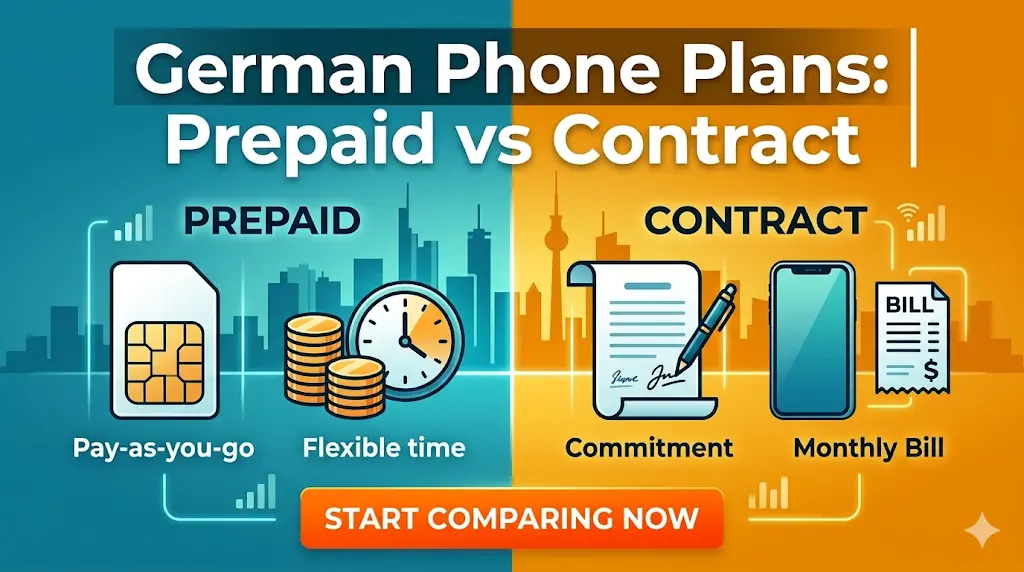
For the vast majority of newcomers, starting with a prepaid plan is the most logical, low-risk strategy. A prepaid plan operates exactly as the name suggests: you load a monetary balance onto your account in advance, and your usage is deducted from that pool. The absolute greatest advantage of this system is the complete lack of a minimum contract duration. You are not locked into a two-year commitment, meaning you can switch providers next month if you discover the network coverage in your specific apartment is terrible.
Another massive benefit for newly arrived expats is that prepaid SIM cards generally bypass the stringent German credit check system. Securing a long-term postpaid contract almost always requires a positive credit history. If you have just arrived, you simply do not exist in the local financial database yet, making All About SCHUFA: Building Credit as a Foreigner in Germany a hurdle you have not cleared. Prepaid providers do not care about your credit score; they only care that you have paid for your data upfront.
This flexibility makes prepaid the perfect companion for the transitional phase of your move. If you are staying in a fully furnished, short-term rental booked through a platform like Wunderflats while you search for permanent housing, a prepaid SIM ensures you are reachable for apartment viewings and job interviews without tying your mobile plan to a temporary address or an unestablished bank account.
Registration and Identity Verification Laws
While buying a prepaid SIM card is financially accessible, activating it introduces you to your first major hurdle of German bureaucracy. Due to anti-terrorism and security legislation, anonymous SIM cards are strictly illegal in Germany. Every single mobile number must be explicitly tied to a verified human identity. You cannot simply buy a SIM at a supermarket, put it in your phone, and start calling. You must complete an identity verification process.
The two most common methods for this are PostIdent and VideoIdent. VideoIdent allows you to verify your identity through your smartphone camera by showing your passport to an agent via a specialized app. However, this system frequently fails for expats. The software often struggles to recognize the holographic security features on non-European passports, and the agents rarely speak English, leading to deeply frustrating, aborted verification attempts.
If VideoIdent fails, your fallback is the PostIdent procedure. This involves taking your physical passport, your unactivated SIM card, and a specific barcode document generated by the mobile provider to a local Deutsche Post branch. A postal worker will manually verify your identity and send the confirmation to the mobile provider.
Recharging Your Balance and Managing Costs
Managing a prepaid account requires a slightly more proactive approach to your finances than a set-it-and-forget-it monthly direct debit. When your prepaid balance runs out, your outgoing calls and data are immediately cut off, though you can generally still receive incoming calls and texts for a limited time. To avoid being stranded without Google Maps or the ability to translate a menu, you must monitor your data usage closely.
Recharging your balance is straightforward. You can purchase physical top-up vouchers at almost every supermarket checkout counter, gas station, and kiosk in the country. These receipts print a long numerical code that you type into your phone’s keypad to credit your account. Alternatively, most providers offer intuitive smartphone apps that allow you to link a PayPal account or a credit card for instant digital top-ups.
To bridge the gap between complete manual control and total automation, most modern prepaid providers allow you to set up an automatic SEPA direct debit from your newly opened German bank account. Once your balance drops below a certain threshold, or on a specific day of the month, it automatically pulls the required funds to renew your monthly data package.
Committing to a Long Term Mobile Contract
The Perks of Postpaid Contracts
Once you have secured a permanent address, passed your work probation period, and established a local bank account, upgrading to a postpaid contract becomes a highly viable and often attractive option. Postpaid contracts generally offer significantly larger data allowances than their prepaid counterparts. If you regularly consume streaming media on your commute or rely heavily on cloud-based work applications away from Wi-Fi, a robust postpaid plan is often the only way to avoid aggressive data throttling.
Beyond sheer data volume, postpaid customers frequently enjoy prioritized network access. During times of massive network congestion—such as standing in a crowded stadium or attending a massive street festival—the network towers will silently prioritize the data packets of premium contract holders over discount prepaid users. This means your messages will send and your maps will load while others stare at spinning loading wheels.
Furthermore, signing a long-term contract often opens the door to lucrative bundling discounts. If you use the same provider for your home DSL or fiber optic internet connection as you do for your mobile phone, companies will frequently discount your monthly bill by ten to fifteen euros or permanently double your mobile data allowance. If you are deeply integrated into the local system, leveraging these bundles is a smart strategy often highlighted in Cost of Living in Germany: Budgeting Guide for Expats.
Unlocking the Fine Print of Minimum Terms
The greatest danger of a German mobile contract lies in the fine print. Traditionally, the vast majority of postpaid mobile contracts in Germany enforce a strict, unbreakable twenty-four-month minimum term. When you sign that digital document, you are legally committing to paying that monthly fee for two full years. Breaking this contract early simply because you found a cheaper deal elsewhere is virtually impossible.
Historically, these contracts also featured predatory automatic renewal clauses. If you failed to submit a formal, written cancellation letter exactly three months before the end of your two-year term, the contract would automatically extend for another full year. Fortunately, consumer protection laws were heavily updated in late 2021. Now, after your initial twenty-four-month term expires, the contract automatically converts into a rolling monthly contract, allowing you to cancel with just one month’s notice at any time.
Despite these improved laws, you must still remain hyper-vigilant. Providers often lure you in with promotional pricing that explicitly states “15 Euros per month for the first six months, then 35 Euros per month thereafter.” You must calculate the total cost of ownership over the full two years, not just the attractive entry price. Additionally, to even be approved for these contracts, the provider will run a hard background check against your financial history.
Hardware Subsidies and Getting a New Phone
A major draw of signing a long-term contract is the opportunity to acquire a flagship smartphone—like the latest iPhone or Samsung Galaxy—for a drastically reduced upfront cost, sometimes as low as one euro. The provider subsidizes the cost of the physical hardware, and you essentially pay off the remaining balance of the device hidden within an inflated monthly tariff over the course of the twenty-four months.
While getting a thousand-euro phone for virtually nothing upfront feels like a victory, the mathematical reality is rarely in the consumer’s favor. If you calculate the total cost of the contract with the phone included, versus buying a SIM-only contract and purchasing the device independently, you almost always end up paying more for the subsidized option. Furthermore, devices tied to contracts are sometimes locked to that specific network, complicating international travel.
A much savvier financial move for expats is to secure a cheap, SIM-only plan with a discount provider, and purchase an unlocked, dual-SIM smartphone outright from Amazon Germany. A dual-SIM phone is an absolute game-changer for international residents, allowing you to keep your home country’s SIM card active for banking verification texts while using your German SIM for local data and calls simultaneously. You can also order heavy-duty cases and fast-charging power banks from Amazon Germany to ensure your independent hardware survives the rigors of daily travel.
Comparing Costs Data Allowances and Roaming
To clarify the general landscape of mobile pricing, here is a breakdown of what you can typically expect to encounter when choosing between different plan structures.
| Feature | Discount Prepaid (e.g., Aldi Talk) | Standard Postpaid (e.g., O2) | Premium Postpaid (e.g., Telekom) |
| Average Monthly Cost | €8 – €15 | €20 – €35 | €40 – €80+ |
| Typical Data Allowance | 5GB – 15GB | 20GB – 50GB | 50GB – Unlimited |
| Network Priority | Low | Medium | High |
| Contract Duration | 4 Weeks / Rolling | 24 Months | 24 Months |
| Credit Check Required? | No | Yes | Yes |
Analyzing Monthly Budgets and Hidden Fees
When budgeting for your mobile expenses, you must look past the heavily advertised monthly rate and account for immediate, hidden setup fees. Almost all postpaid contracts, and even some prepaid starter kits, mandate a one-time activation fee known as an Anschlusspreis. This fee can range anywhere from ten to forty euros, essentially wiping out any immediate savings you thought you secured through a promotional offer. Providers frequently run weekend flash sales waiving this fee, so patience pays off.
Another historical shock for expats from Asia or North America is how remarkably stingy German data packages used to be. While the market has improved significantly, data is still relatively expensive per gigabyte compared to neighboring countries like France or Poland. You must accurately audit your data usage before committing.
Furthermore, carefully review your itemized bills for accidental premium subscriptions. It is frustratingly easy to inadvertently click a banner ad or respond to a premium SMS that silently subscribes you to a weekly third-party service for ringtones or gaming portals, draining your prepaid balance or inflating your postpaid invoice before you even notice.
EU Roaming Regulations for Expats
One of the most universally beloved bureaucratic achievements of the European Union is the implementation of “Roam Like at Home” legislation. By law, any mobile plan purchased in Germany—whether it is a five-euro prepaid SIM or an eighty-euro premium contract—must allow you to use your standard domestic data, minutes, and texts across all twenty-seven EU member states at no additional extra cost.
If you are spending a weekend in Paris, skiing in Austria, or attending a conference in Spain, your German phone will seamlessly connect to the local networks, and you can browse the internet exactly as if you were sitting in Berlin.
However, there is a strict Fair Use Policy designed to prevent people from permanently utilizing cheap SIM cards from one country while living in another. If the provider detects that you have spent more time abroad than in Germany over a rolling four-month period, they have the legal right to apply data surcharges. More importantly, you must be explicitly aware that Switzerland and the United Kingdom are outside this EU regulation for many providers; answering a quick phone call in Zurich without checking your specific plan’s terms can result in astronomical roaming charges.
Throttling and Unlimited Data Myths
The concept of “unlimited data” in Germany requires careful definition. The vast majority of standard plans operate on a hard data cap. Once you consume your allotted twenty gigabytes, your internet access is not entirely severed, but it is subjected to Drosselung (throttling). The provider will artificially restrict your data speed down to a maximum of 64 kilobits per second. At this speed, modern websites will fail to load, social media is unusable, and you will barely be able to send a text-only WhatsApp message.
True, genuinely unthrottled, unlimited data plans do exist, but they are generally restricted to the premium postpaid tiers of Telekom, Vodafone, and O2, and they frequently cost upwards of sixty to eighty euros per month. Unless you are using your smartphone as a dedicated hotspot to run a remote business from a campervan, the financial math for these true unlimited plans rarely makes sense for a standard expat lifestyle.
Instead of hunting for unlimited data, expats should focus on strategic Wi-Fi utilization. Ensuring your permanent residence has a stable, high-speed connection and utilizing secure Wi-Fi at your workplace severely reduces the burden on your mobile data plan. Most providers do not offer data roll-over (where unused data carries into the next month), meaning you pay for your cap whether you use it or not.
The Administrative Reality of Canceling a Contract
Notice Periods and Automatic Renewals
If there is one administrative task you must master in Germany, it is the art of the timely cancellation (Kündigung). As mentioned regarding the 2021 law changes, you now only need to provide one month’s notice to cancel a rolling contract after your initial minimum term has expired. However, if you are actively inside a twenty-four-month contract and wish to terminate it exactly on the two-year mark, you must still be proactive.
Do not wait until the twenty-third month to attempt a cancellation. The most effective, anxiety-reducing strategy utilized by seasoned expats is to sign up for a two-year contract, wait one week for the service to successfully activate, and then immediately submit a formal cancellation letter requesting termination at the “next possible date” (zum nächstmöglichen Zeitpunkt), which will automatically be scheduled for the end of the two-year term.
Never rely on an informal phone call to cancel a German contract. Customer service representatives are trained to aggressively retain you, and a phone call leaves no legal paper trail. Always cancel via the provider’s official online portal utilizing the mandatory cancellation button, or send a physical, registered letter (Einschreiben).
Special Cancellation Rights When Leaving Germany
A terrifying scenario for many expats on limited work contracts is the thought of leaving Germany but continuing to be billed for a mobile phone they can no longer use. German telecommunications law includes a vital provision known as the Sonderkündigungsrecht (special right of cancellation). This law explicitly dictates that if you permanently relocate to a country outside of your provider’s coverage zone, you are legally entitled to break your contract prematurely.
However, invoking this right requires ironclad bureaucratic proof. You cannot simply email your provider and say you are moving to Canada. You must provide them with your official Abmeldebescheinigung—the official deregistration certificate issued by the local citizen’s office proving you are no longer a resident of Germany.
Even with this special right, the provider is still legally entitled to charge you a final penalty fee, which is strictly capped by law at a maximum of three months’ basic base fee. Therefore, you must initiate this cancellation process as soon as you have a confirmed departure date, rather than waiting until you are already at the airport.
Transferring Your Number to a New Provider
In Germany, your mobile phone number is your personal property, not the property of the network provider. When you decide to cancel your expensive Telekom contract and switch to a budget-friendly Aldi Talk prepaid plan, you have the absolute right to take your phone number with you. This process is known as Rufnummernmitnahme (number porting).
Thanks to recent updates in telecommunications regulations, porting your number to a new provider is now entirely free of charge by law. The old provider cannot penalize you for taking your digits. The key to a successful transfer is timing. You must explicitly request an “Opt-In” from your current provider, signaling that your number is released for transfer, and then provide that exact number and your matching personal details to the new provider during the signup process.
If your name or birthdate on the new application differs even slightly from the old contract (e.g., omitting a middle name), the automated porting system will reject the transfer immediately. When executed correctly, the transfer happens overnight on a specified date, ensuring you wake up with a new network provider but the exact same phone number, preventing you from having to update your contact information with your bank, your landlord, and your friends.
References
Primary sources (official)
- Bundesnetzagentur – Mobile Number Portability: https://www.bundesnetzagentur.de/EN/Vportal/Telecommunications/NumberPortability/start.html
- Bundesministerium für Umwelt, Naturschutz, nukleare Sicherheit und Verbraucherschutz (BMUV) – Fair Consumer Contracts Act: https://www.bmuv.de/en/law/act-for-fair-consumer-contracts
Other helpful sources
- Verbraucherzentrale – Canceling Mobile Phone Contracts: https://www.verbraucherzentrale.de/wissen/digitale-welt/mobilfunk-und-festnetz/handyvertrag-kuendigen-so-machen-sie-es-richtig-21743
Disclaimer
The pricing structures, legal regulations, and contract terms detailed in this guide are accurate at the time of publication but are subject to constant change by telecommunications providers and the German government. Always thoroughly read the specific terms and conditions (AGB) of any contract before signing, and verify current roaming policies and cancellation notice periods directly with your chosen provider to avoid unexpected charges.