Best Ways to Travel Inside German Cities: U-Bahn, S-Bahn, Buses Explained
Navigating German public transport for the first time can feel like trying to solve a high-stakes puzzle while a platform full of commuters watches you struggle. I still remember the cold sweat I broke out in during my first week in Hamburg, staring at a ticket machine that seemed to speak a dialect of "bureaucracy" rather than German. This guide simplifies the maze of U-Bahn, S-Bahn, and buses so you can commute like a local from day one.
Disclosure: This post may contain affiliate links. We may earn a commission at no extra cost to you if you make a purchase through these links. Read full disclosure.
Understanding the German Transit Alphabet: U-Bahn vs S-Bahn
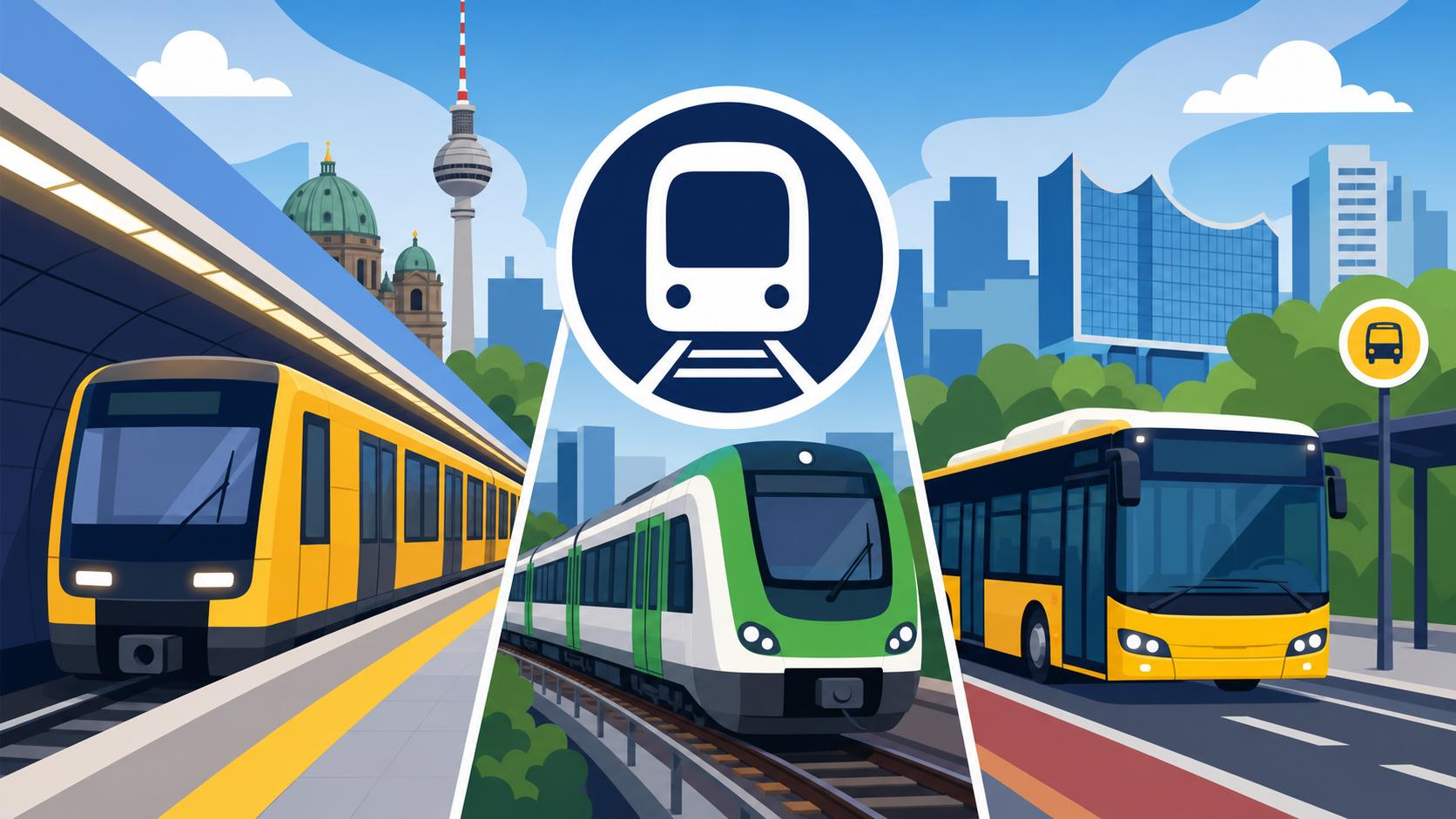
When you first arrive in a major German city, the map will look like a bowl of multi-colored spaghetti. The two most prominent letters you will see are "U" and "S." While they both run on tracks and often share the same stations, they serve very different purposes in your daily life. Understanding this distinction is the first step toward mastering your new environment, especially if you are still Settling in Quickly: A Newcomer’s Checklist for Your First Weeks in Germany.
The U-Bahn: The City Pulse
The U-Bahn, or Untergrundbahn, is the classic subway. It stays mostly within the city center and the inner-city neighborhoods. If you are living in a centrally located flat, perhaps one of the stylish furnished options from Wunderflats, the U-Bahn will likely be your best friend. These trains are frequent—usually arriving every 5 to 10 minutes—and the stations are closer together.
Because U-Bahn lines are managed by the city’s specific transit authority (like the BVG in Berlin or the MVG in Munich), they are meticulously timed to keep the urban core moving. One thing I learned the hard way is that U-Bahn stations are often deep underground. If you’re running late, those three flights of stairs can be a workout. However, they are incredibly reliable during the winter months because they are sheltered from the snow and ice that can occasionally delay surface-level transport.
The S-Bahn: Connecting the Suburbs
The S-Bahn, or Stadtschnellbahn, is a different beast. These trains connect the city center to the outer suburbs and even neighboring towns. They are run by Deutsche Bahn (the national rail company), which means they look and feel a bit more like "real" trains compared to the smaller U-Bahn carriages. If you are looking at Housing in Germany: Renting, Buying, and Finding Your Home as an Expat, you might find more affordable options further out, making the S-Bahn your primary mode of transport.
The S-Bahn has fewer stops and travels at much higher speeds. This makes it ideal for crossing the city quickly. For example, in Berlin, the "Ringbahn" (the S41 and S42 lines) circles the entire city center. If you need to get from the north to the south, the S-Bahn will always beat the U-Bahn. A word of warning from my own experience: because the S-Bahn often runs above ground, it is more susceptible to weather delays and "Signalstörungen" (signal failures). Always have a backup route in mind.
The Bus and Tram Network: Filling the Gaps
While the trains are the skeleton of German city travel, the buses and trams are the muscle. They reach the corners of the neighborhood that the tracks simply don't touch. If you’ve just moved in and are ordering heavy household essentials from Amazon Germany, you might find yourself relying on a bus to get those final few blocks to your front door if you aren't using a delivery service.
Navigating the Bus System
Buses in Germany are impressively punctual. Most stops have digital displays showing exactly how many minutes until the next arrival. In many cities, you enter through the front door and show your ticket to the driver, though this rule has relaxed in places like Berlin. If you are still figuring out the Cost of Living in Germany: Budgeting Guide for Expats, remember that buses are often the most cost-effective way to get around if you don't need the speed of the train.
One hyper-local tip: look out for "N" buses. These are "Nachtbusse" (night buses). In many cities, the U-Bahn shuts down for a few hours in the middle of the night on weekdays. The night bus network takes over, following similar routes to the trains. It saved me more than once after a late dinner with friends when I realized the last train had already departed.
The Charm of the Tram (Straßenbahn)
In cities like Berlin, Munich, and especially in the East (like Leipzig or Dresden), trams are a vital part of the landscape. They offer a "scenic" commute, gliding along the streets. They are generally faster than buses because they often have their own dedicated lanes, but they are slower than the U-Bahn. Trams are fantastic for short hops between neighborhoods. If you are exploring Living in Berlin: Expat Guide to Neighborhoods and Lifestyle, you’ll notice that the eastern part of the city is dominated by trams, while the west relies more on buses—a lingering quirk of the city's divided history.
Ticketing Systems, Zones, and the Dreaded Validation
This is where most expats lose their minds. German cities are divided into zones (usually A, B, and C). A is the dead center, B is the rest of the city, and C is the surrounding metropolitan area (including the airport in many cases). Buying a ticket for the wrong zone is the same as having no ticket at all in the eyes of the law.
Choosing the Right Ticket
Before you even step onto a platform, you need to know which ticket suits your journey. If you’re just going three stops on the bus, a "Kurzstrecke" (short trip) ticket is much cheaper. If you’re spending the day sightseeing or looking for apartments, a "Tageskarte" (day ticket) is almost always a better value than two single trips.
| Ticket Type | Best Used For | Typical Duration/Limit |
|---|---|---|
| Kurzstrecke | Very short trips (e.g., 3 stops) | 20 minutes / Limited stops |
| Einzelfahrschein | A single journey in one direction | 90 to 120 minutes |
| Tageskarte | Unlimited travel for one person | Valid until 3:00 AM the next day |
| Gruppentageskarte | Up to 5 people traveling together | Valid until 3:00 AM the next day |
| Deutschland-Ticket | All local transit across Germany | Monthly subscription |
The "Entwerten" Rule: Don't Forget to Stamp
In many German cities (though not all, so check local signs!), a ticket purchased from a machine on the platform is not valid until it is "entwertet" (validated). You have to stick it into a small yellow or red box on the platform or inside the bus/tram to get a time stamp. I once saw a fellow expat get fined €60 despite holding a valid, paid-for ticket, simply because they hadn't stamped it. It felt harsh, but the rules are the rules here.
If you are setting up your Banking and Insurance in Germany: Guide to Financial Services for Foreigners, consider linking your account to a transit app like the DB Navigator or the local city app (like BVG Fahrinfo). Buying digital tickets often skips the need for physical validation, which removes a huge layer of stress.
The Deutschland-Ticket: A Game Changer for Expats
As of 2023, the German government introduced the Deutschland-Ticket (or D-Ticket). For €63 a month (the price since January 2026), you get unlimited travel on all local and regional transport across the entire country. This includes every U-Bahn, S-Bahn, bus, tram, and even regional trains (RB and RE lines). It does not include high-speed trains like the ICE or IC.
For most expats, this is the absolute best solution. It eliminates the need to understand zones or worry about validation. It’s a subscription model, usually managed via a smartphone app. If you are planning on Living in Munich: Expat Guide to the Bavarian Capital but want to take weekend trips to nearby lakes or mountains, this ticket pays for itself in just a few days. Just remember it is a rolling subscription, so you must cancel it by the 10th of the month if you don't want it for the following month.
Etiquette and Cultural Norms on Public Transport
Germans take their public transport etiquette seriously. To avoid the "death stare" from a local grandmother, there are a few unwritten (and some written) rules you should follow. These are just as important as the German Culture & Etiquette: A Guide to Social Life and Customs you'll navigate in the office.
The Rule of Silence and Space
Generally, German trains are quiet. While it’s not a library, loud phone conversations or playing music without headphones (which you can easily find on Amazon Germany if you forgot yours) is highly frowned upon. People value their "Feierabend" (post-work evening) peace. Also, always let people off the train before you attempt to board. Stand to the side of the doors—blocking the exit is a guaranteed way to get a stern "Entschuldigung!" from a departing passenger.
The "Kontrolleur": Ticket Inspections
Ticket inspectors in Germany are almost always in plain clothes. They don’t wear uniforms because they don't want you to spot them and hop off the train. They will wait until the doors close, then pull out a small ID badge and say, "Die Fahrausweise, bitte" (Tickets, please).
If you don't have a valid ticket, the fine is usually €60, and they will take your ID details. There is no "I’m a tourist/new here" excuse that works. They have heard it all. If you have a personalized monthly pass (like the D-Ticket) but simply forgot your phone or card, you can usually take your valid pass to a service center later and reduce the fine to a small processing fee (around €7).
Accessibility and Traveling with Extras
German transit is generally very accessible, but it varies by city and age of the station. Most major hubs have elevators, though they are notoriously prone to being "außer Betrieb" (out of service).
Bikes and Dogs
You can take your bike on the S-Bahn and U-Bahn, but you usually need a separate "Fahrradticket" (bike ticket). Also, be aware of "Sperrzeiten" (blocked times) during rush hour, when bikes are banned to make room for commuters. Dogs are also welcome! Small dogs in carriers travel free, while larger dogs usually require a child-priced ticket and must wear a muzzle in some jurisdictions.
If you are moving into your new home and need to transport small pieces of furniture, you can take them on the train as long as they don't block the aisles. However, for a full move, don't try to use the U-Bahn; it’s a quick way to make enemies. Stick to professional services when you are first Settling in Quickly: A Newcomer’s Checklist for Your First Weeks in Germany.
Final Tips for a Smooth Journey
- Download the Apps: DB Navigator is the gold standard for regional travel, and local apps like BVG (Berlin) or HVV (Hamburg) are essential for real-time local updates.
- Check for Construction: "Schienenersatzverkehr" (SEV) is a word you will learn to hate. It means the train line is closed for repairs, and a replacement bus is running instead. These are always slower and more crowded.
- Stand on the Right: On escalators, the rule is "Rechts stehen, links gehen" (Stand on the right, walk on the left).
Public transport in Germany is a marvel of engineering and efficiency, but it requires a little bit of homework. Once you’ve mastered the difference between the U-Bahn and S-Bahn and have your D-Ticket safely on your phone, the entire city—and the country—is yours to explore. Whether you are commuting from a cozy Wunderflats apartment or heading to the store for some German essentials, you’ll find that the "Spaghetti" map eventually starts to make perfect sense.
Disclaimer
This guide is for informational purposes only. Transit rules, ticket prices, and regulations in Germany change frequently. Always check the official website of the local transit authority (such as BVG, MVG, or Deutsche Bahn) for the most current information and legal requirements.