How to Track Your German Residence Permit Application Status Online
Submit your paperwork to the immigration office and then absolute silence. Handing over my passport and waiting months with zero updates gave me daily anxiety attacks, terrified that my documents were lost. This guide explains how to track your German residence permit online, what those cryptic letters mean, and what to do when the system inevitably goes dark.
Disclosure: This post may contain affiliate links. We may earn a commission at no extra cost to you if you make a purchase through these links. Read full disclosure.
The Reality of the Auslaenderbehoerde Black Hole
Before you start frantically refreshing a webpage, you must understand how the German immigration machine physically works. When you sit down with a caseworker at the Ausländerbehörde (Foreigners’ Authority), they do not manufacture your plastic card in the back room.
The Federal Printing Office Pipeline
Your local caseworker’s only job is to evaluate your dossier, make a legal decision, and hit “approve.” Once they do, your biometric data is securely transmitted to the Bundesdruckerei (Federal Printing Office) located in Berlin. This central federal facility is responsible for manufacturing every single passport, ID card, and Elektronischer Aufenthaltstitel (electronic residence permit, or eAT) for the entire country.
This creates a massive logistical bottleneck. Even if your local caseworker approves your file within ten minutes of you leaving the office, it generally takes four to eight weeks for the Bundesdruckerei to print the card and physically mail it back to your local municipal office. During this central manufacturing phase, your local caseworker literally has no updates to give you. They are waiting for the mail just like you are. Managing your expectations during this radio silence is a core survival strategy explored in Understanding the German Immigration Terminology: From Aufenthaltstitel to Niederlassungserlaubnis.
The Fiktionsbescheinigung Safety Net
The terror of the waiting game usually peaks when your current visa is days away from expiring, and your new card hasn’t arrived. If you submitted your application for a renewal before your current permit expired, you are legally protected.
The caseworker should have issued you a Fiktionsbescheinigung (Fiction Certificate). This bridging document creates a legal fiction, extending your current residency rights, work permissions, and employer ties until the new card is ready for pickup. As long as you have this document in your wallet, the online tracking status of your plastic card is a matter of convenience, not a legal emergency. Knowing exactly how to leverage this document is thoroughly detailed in German Visa and Residence Permit Renewal: How Early Should You Apply?.
How to Actually Track Your Status Online
Unlike tracking a package with a universal tracking number, tracking an eAT is highly localized. Because Germany operates on a heavily decentralized federal system, there is no single, nationwide tracking portal.
Municipal eAT Tracking Portals
The ability to check your status online depends entirely on the specific city where you registered your address. Major hubs like Berlin, Frankfurt, and Munich have developed dedicated online tools to reduce the volume of people calling their offices.
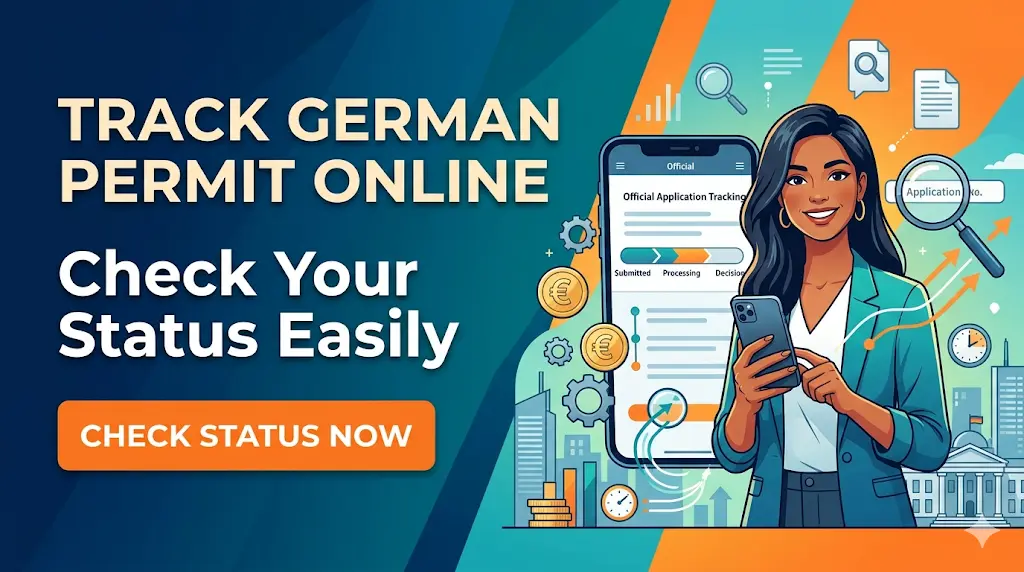
When you complete your in-person appointment, the caseworker will usually hand you a receipt or a confirmation document containing a transaction number, a barcode, or an application reference number. If your city offers online tracking, you can navigate to the local Ausländerbehörde website, enter this reference number along with your date of birth or passport number, and check the status.
However, do not expect a highly detailed, step-by-step progress bar. The municipal portals usually only display two statuses: “In Processing” (meaning it is still at the Bundesdruckerei) or “Ready for Collection” (meaning the physical card has arrived back at the local office). If your city does not offer a digital portal, you are entirely reliant on the postal system.
Deciphering the PIN Letter
About two to four weeks after your successful appointment, you will likely find a highly secure, sealed envelope in your physical mailbox containing a PIN, a PUK, and a blocking password. This is the PIN-Brief.
Receiving this letter is the ultimate unofficial tracking update. This letter is automatically generated and mailed to your registered address by the Bundesdruckerei the moment they finish manufacturing your card. It contains the security codes needed to activate the digital identity functions embedded in your new plastic card’s RFID chip.
This is the most critical expat trap: Receiving the PIN letter does not mean your residence permit is ready to be picked up. The PIN letter is mailed directly to your house, but the actual plastic card is mailed securely to the Ausländerbehörde. The card usually arrives at the local office about one to two weeks after you receive the PIN letter. Do not rush to the immigration office clutching your PIN letter without an explicit collection appointment; they will turn you away.
| Application Stage | What it Means | How to Verify |
| Submission | File is with local caseworker | Appointment receipt |
| Bundesdruckerei Processing | Card is being manufactured in Berlin | Local online portal (“Processing”) |
| PIN Letter Received | Card is printed and in transit to local office | Physical letter in your mailbox |
| Ready for Collection | Card is at the Ausländerbehörde | Local online portal / Email invitation |
What to Do When Online Tracking Fails
Sometimes, the online portal says “Processing” for twelve weeks, the PIN letter never arrives, and your Fiktionsbescheinigung is about to expire. When the system breaks down, you must take proactive, bureaucratic steps to protect your status.
Formulating the Perfect Contact Request
Do not blind-call the immigration office. The phone lines are notoriously unstaffed, and calling repeatedly will not speed up your file. You must establish a digital paper trail.
Navigate to your local Ausländerbehörde website and locate their official contact form. When filling it out, include your passport number, your transaction number, your exact date of birth, and the specific legal paragraph you applied under—a vital piece of information you can decode using Understanding German Residence Permit Labels 18 19c etc. State clearly and politely that it has been over eight weeks since your appointment and you are requesting a status update on your Elektronischer Aufenthaltstitel. Take a screenshot of the confirmation page once you hit submit. This screenshot serves as legal proof that you attempted to contact them before any temporary bridging documents expired.
Preventing Caseworker Delays with Bulletproof Documentation
The most common reason an application disappears into the black hole is that the caseworker paused it because a document was missing or invalid. German bureaucrats will rarely email you immediately to ask for a missing file; they simply push your folder to the side and wait for you to follow up.
You can proactively prevent these agonizing delays by ensuring your initial dossier is flawless. If you submitted foreign civil documents, such as a marriage certificate or a university diploma, the caseworker will halt the process if they cannot read it. Utilizing Lingoking to provide legally sworn, certified translations of your documents guarantees the caseworker can instantly verify your background. Because Lingoking uses court-approved translators, there is no ambiguity for the official, meaning your file keeps moving.
Similarly, if you are applying for a freelance visa or extending a job seeker permit, the caseworker might pause your file to scrutinize your financial solvency. If you utilize Expatrio to secure your mandatory blocked account, you bypass this scrutiny. The official Expatrio confirmation PDF is instantly recognized by immigration authorities nationwide as absolute proof of your financial stability, preventing unnecessary audits of your savings accounts. Understanding how to leverage these financial proofs is deeply explored in Job Seeker Visa: Your Ticket to Finding Work in Germany.
Finally, the fastest way to get your application permanently stalled is by showing up with inadequate health insurance. To ensure your file goes straight to the Bundesdruckerei without a hiccup, use Feather Insurance. Because Feather Insurance issues the exact localized, German-language policy confirmations the immigration office demands, your caseworker can instantly check off the mandatory health coverage box. Figuring out exactly which tier of insurance to bring to your appointment is a crucial survival skill detailed in Public vs Private Health Insurance in Germany: Which is Right for You?.
Tracking Your Initial Visa vs Residence Permit
It is vital to distinguish between tracking your initial entry visa and tracking your domestic residence permit. The processes and authorities are entirely different.
The Embassy Phase (National D-Visa)
Before you ever move to Germany, you apply for a National D-Visa at the German embassy or consulate in your home country. You do not track this through a German municipal website.
Instead, you usually track this through the third-party service provider that handled your biometric intake, such as VFS Global or TLScontact. They will provide a specific tracking number on your application receipt. This tracking only tells you if your passport is ready to be collected; it does not give you granular updates on the internal security checks happening between the embassy and the Federal Employment Agency. To ensure this initial entry phase goes smoothly, having Lingoking translate your foundational documents and securing your initial Expatrio blocked account before you ever book the embassy interview is mandatory.
The Local Registration Phase
Once you secure the entry visa and land in Germany, that sticker in your passport is only valid for 90 days to six months. You must convert it into the physical plastic eAT card.
Before you can even apply for the eAT, you must complete your local address registration (Anmeldung). If you track your visa status and realize your card is taking too long, check to make sure your Anmeldung is still valid. If you moved apartments while your residence permit was being processed and failed to update your address at the citizens’ office, the Bundesdruckerei will mail your PIN letter to your old address, and it will be returned to sender, freezing your entire application process. Maintaining absolute consistency in your local registration data is a foundational rule explained in German Bureaucracy 101: Understanding the Anmeldung, Schufa, and Tax ID.
Navigating the German immigration tracking system requires immense patience. By ensuring your translations are certified, your Feather Insurance is compliant, and your physical mailbox is properly labeled with your legal name, you eliminate the most common points of failure and ensure your plastic card arrives as quickly as the bureaucracy allows. Understanding how these various permits actually function once they arrive is the final step, decoded in Understanding the Different Types of German Visas and Residence Permits.
References
Primary sources (official)
- Federal Office for Migration and Refugees (BAMF) – The electronic residence title (eAT): The official federal explanation of the eAT card, its embedded chip functions, and the central role of the Federal Printing Office in its manufacturing. https://www.bamf.de/EN/Themen/MigrationAufenthalt/ZuwandererDrittstaaten/Migrathek/eAufenthaltstitel/eaufenthaltstitel-node.html
- German Federal Ministry of the Interior – PIN Letter: The official portal detailing exactly what the PIN, PUK, and blocking password letter is, how it is generated, and why it is mailed to your registered address. https://www.personalausweisportal.de/Webs/PA/EN/citizens/german-id-card/PIN-PUK-blocking-password/pin-puk-blocking-password-node.html
Other helpful sources
- Berlin.de – Immigration Office Services: The official municipal portal for Berlin, demonstrating an example of a localized digital appointment and tracking system for expats residing in the capital. https://www.berlin.de/einwanderung/en/services/appointments/
- All About Berlin – The Fiktionsbescheinigung: A highly practical expat guide explaining exactly how the fiction certificate protects your legal status and allows you to continue working while waiting for the eAT to be printed. https://allaboutberlin.com/guides/fiktionsbescheinigung
Disclaimer
The information provided in this article is for general informational and educational purposes only and does not constitute professional legal or immigration advice. The availability of online tracking for residence permits (Elektronischer Aufenthaltstitel) varies completely by municipality, and processing times at the Federal Printing Office (Bundesdruckerei) fluctuate heavily throughout the year. Receiving a PIN letter does not legally authorize you to pick up your residence permit without an explicit appointment from the local Ausländerbehörde. Always consult a certified German immigration lawyer (Fachanwalt für Ausländerrecht) if your current visa or bridging document is about to expire without a resolution.