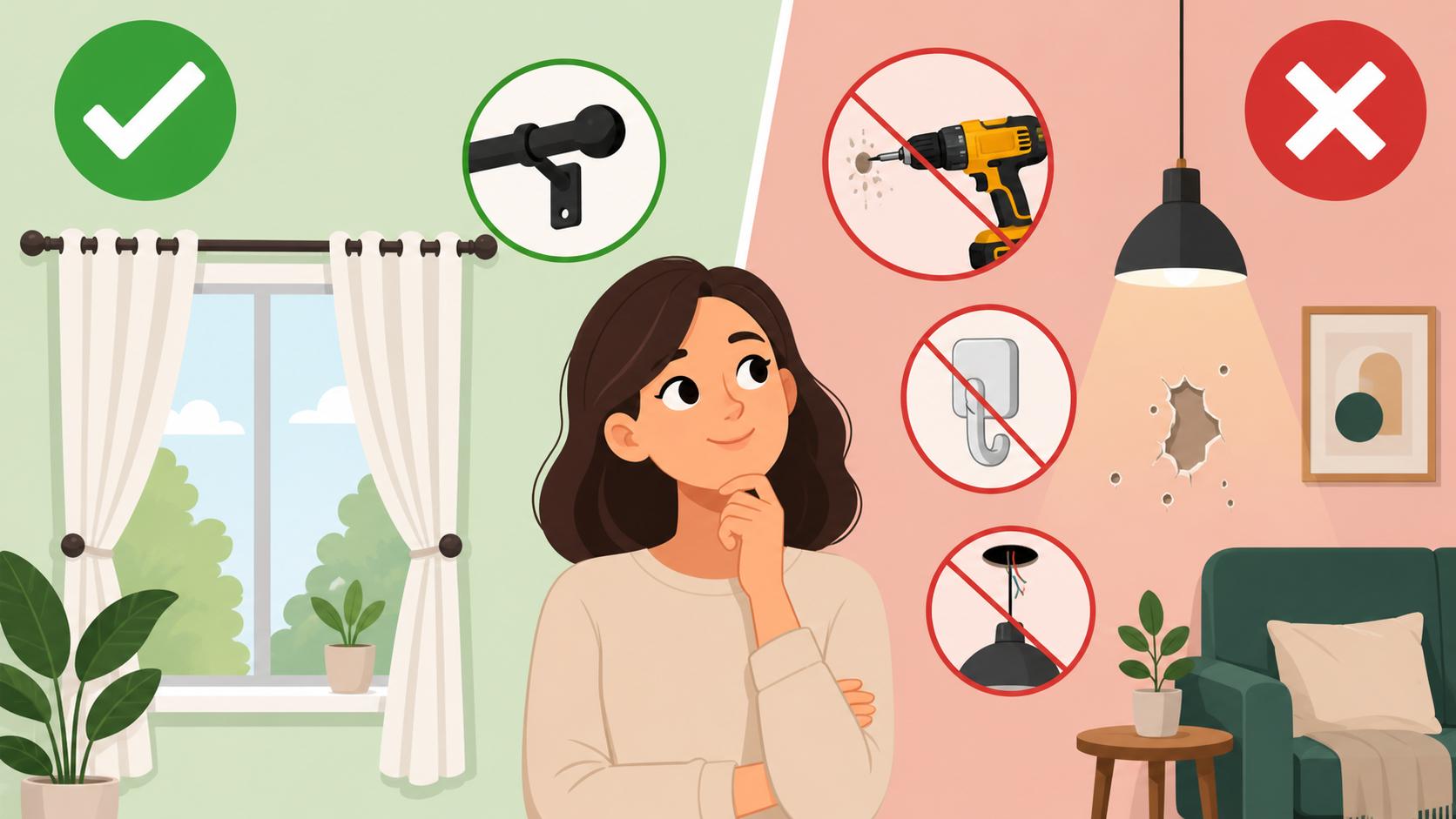
Installing Curtains & Fixtures: What You Can and Can’t Do in Rentals
Walking into your new German apartment for the first time is often a traumatic experience for expats accustomed to "move-in ready" homes. I remember standing in my first Berlin flat, staring at bare concrete walls and wires dangling from the ceiling, wondering if the previous tenant had been robbed of their light bulbs and curtain rods. This guide solves the mystery of the "naked" German rental and explains exactly how to install fixtures without losing your deposit.
Disclosure: This post may contain affiliate links. We may earn a commission at no extra cost to you if you make a purchase through these links. Read full disclosure.
The German Rental Reality: Bare Walls and Bare Bullets
When you sign a standard rental contract in Germany, you are usually entering into a long-term relationship with a space that is intentionally left as a blank canvas. Unlike many other countries where "unfurnished" still includes basic light fixtures, curtain rails, and sometimes even a kitchen, a German unfurnished flat is truly empty. You are essentially renting the shell of a building.
The reason behind this stems from the German philosophy of tenant autonomy. Tenants here often stay in the same apartment for decades, and the law allows them to customize their living space to an extraordinary degree. However, this freedom comes with the responsibility of "Rückbau"—the requirement to return the apartment to its exact original state when you leave. If you are overwhelmed by the thought of buying every single lamp and rod, you might want to consider Furnished vs Unfurnished Apartments in Germany: Pros and Cons before committing to a long-term lease. For those who want to avoid the DIY struggle entirely, platforms like Wunderflats offer fully equipped apartments where the curtains are already hung and the lights actually work.
It is vital to understand that while you have the right to make "cosmetic changes," you are generally prohibited from making structural ones. Installing a curtain rod is a cosmetic change; knocking down a non-load-bearing wall to create an "open concept" kitchen is a structural change that requires written permission from the Vermieter (landlord). Understanding these boundaries is the first step in German Tenant Rights and Laws: What Expats Need to Know.
Installing Curtains and Blinds without Losing Your Deposit
Windows are the soul of a home, but in Germany, they are also a legal minefield. Most German windows are high-quality, tilt-and-turn (Dreh-Kipp) units made of uPVC or wood. They are incredibly efficient at keeping out the cold, but they are also expensive to replace.
Drilling into Walls vs. Window Frames
The golden rule of German renting is this: Never, under any circumstances, drill a hole into the window frame itself. Whether the frame is plastic, aluminum, or wood, drilling into it usually destroys the vacuum seal or the structural integrity of the frame. If you do this, your landlord can legally claim your entire security deposit to replace the entire window unit upon your departure. To learn more about protecting your funds, see Security Deposits (Kaution) in Germany: Getting It Back and Protecting Yourself.
Instead, you should always aim for the masonry surrounding the window. This is considered a standard use of the apartment. When you move out, you simply fill the holes with a bit of plaster (Moltofill), sand it down, and paint over it. If you’re looking for the right drill bits or wall plugs (Dübel) for German stone or concrete walls, you can find a massive selection on Amazon Germany that will be delivered right to your door.
No-Drill Alternatives for Renters
If the thought of handling a power drill in an Altbau (old building) where the walls crumble like cake gives you anxiety, there are plenty of "no-drill" solutions. Tension rods (Klemmstangen) are very popular in Germany for lightweight curtains. These rods use spring-loaded tension to stay inside the window reveal.
For heavier curtains or blackout blinds, "Klemmfix" systems are a lifesaver. These are brackets that hook over the top of the window sash, allowing you to hang blinds without a single hole. You can find various Klemmfix options on Amazon Germany that fit standard German window dimensions. If you are staying in a short-term rental from Wunderflats, these no-drill options are perfect because they leave absolutely zero trace when you move to your next destination.
A Comparison of Installation Methods
| Method | Best For | Difficulty | Risk to Deposit |
|---|---|---|---|
| Wall Drilling | Heavy curtains, long-term stays | Moderate | Low (if patched) |
| Klemmfix Brackets | Roller blinds, pleated blinds | Easy | Zero |
| Tension Rods | Sheer curtains, cafe curtains | Very Easy | Zero |
| Adhesive Hooks | Lightweight decor, fairy lights | Easy | Moderate (can peel paint) |
Fixtures, Fittings, and the Famous Missing Kitchen
Nothing illustrates the "DIY" nature of German living better than the lighting and kitchen situation. In a standard rental, you will walk into a room and see three wires (black/brown, blue, and yellow/green) sticking out of a hole in the ceiling. This is where you are expected to install your own Lampen.
Dealing with the Lüsterklemme
Installing a light fixture involves connecting these wires to a small plastic connector called a Lüsterklemme. While this is a standard task for most Germans, it can be intimidating for newcomers. Safety is paramount here. You must turn off the electricity at the circuit breaker (Sicherungskasten) before touching any wires. If you are unsure about the voltage or the types of bulbs needed, check out the Household Appliance Guide: Voltage, Adapters, and Buying Electronics in Germany.
When you move out, you cannot simply leave your expensive designer lamps behind and expect the landlord to pay for them. You must take them with you and, crucially, you must leave a basic "construction bulb" and a socket (Baufassung) so the next tenant isn't left in total darkness. If you need to stock up on these basic sockets or need a voltage tester, Amazon Germany is the most reliable source for quick shipping.
The Kitchen Challenge
In many German cities, it is common to rent an apartment that has no kitchen at all—no cabinets, no sink, no stove. You are expected to bring your own or buy the previous tenant's kitchen (Abstand). This is one of the biggest culture shocks for expats. For a deep dive into how to manage this, read Unfurnished Apartments in Germany: Dealing with Kitchens and Light Fixtures.
If you do install your own kitchen, you must ensure that all plumbing and electrical work is done to code. While you can do much of the cabinetry yourself, German insurance often requires a certified professional to connect a stovetop to the high-voltage (starkstrom) outlet. If you choose a Wunderflats apartment, the kitchen will be fully equipped with everything from a dishwasher to a corkscrew, saving you thousands of Euros in initial investment and the headache of Understanding German Rental Contracts: Key Terms and Conditions.
Returning the Apartment to its Original State (Rückbau)
In Germany, the phrase "original state" is taken very literally. If you painted a feature wall a trendy navy blue, you would almost certainly have to paint it back to a neutral white before handing over the keys. This process is often governed by "Schönheitsreparaturen" clauses in your contract.
Patching Holes and Repainting
Every hole you drilled for a shelf, a picture frame, or a curtain rod must be filled. The standard procedure is to remove the plastic Dübel (using a screw or pliers), fill the hole with a filler like Moltofill, and let it dry. Once dry, you may need to apply a small dab of paint. Be careful: even if you use the "same" white paint, it might look different from the aged paint on the rest of the wall. Sometimes, the landlord will insist that the entire room be repainted to ensure a uniform look.
If you've been living in an apartment from Wunderflats, the cleaning and maintenance are usually handled or clearly outlined in the service agreement, making the exit much smoother. However, for a traditional long-term lease, you need to be meticulous. Use a high-quality white paint from Amazon Germany to ensure good coverage, as cheap paint often requires three coats to cover a darker color.
The Handover Protocol (Übergabeprotokoll)
The most important document you will sign in your German rental life is the Apartment Handover Protocol: Documenting Condition When Moving In/Out. When you move in, you must note every scratch, every missing tile, and every existing hole. If you don't, you may be blamed for them when you leave.
When you move out, the landlord will walk through the apartment with this document. If they find holes that weren't there before or fixtures that weren't properly removed, they will deduct the cost of a professional handyman from your deposit. To avoid this, many expats hire a Maler (painter) to do a professional "refresh" of the apartment in the final week of the lease. This is often cheaper than the deductions the landlord might make.
When Can You Actually Drill?
Keep in mind that DIY in Germany is also subject to noise regulations. You cannot spend your Sunday drilling holes for your new IKEA shelves. Sundays and public holidays are Ruhetage (quiet days), and drilling is strictly forbidden. Even on weekdays, you should respect the Mittagsruhe (lunchtime quiet period) usually between 1:00 PM and 3:00 PM, and definitely stop all noise by 8:00 PM or 10:00 PM depending on your house rules. For more on this, read Neighborhood Noise Rules: Understanding Ruhezeit (Quiet Hours) in Germany.
Summary Table: What You Can and Can't Do
| Action | Allowed? | Conditions |
|---|---|---|
| Drilling into Masonry | Yes | Must be patched and painted upon exit. |
| Drilling into Window Frames | No | Will likely result in total loss of deposit. |
| Painting Walls | Yes | Usually must be returned to white/neutral. |
| Installing a Kitchen | Yes | Must be professionally connected (electrical/gas). |
| Changing Light Fixtures | Yes | Must leave basic sockets when moving out. |
| Changing Flooring | Maybe | Requires written permission from the landlord. |
| Removing Internal Doors | Yes | Doors must be stored safely and re-hung at move-out. |
Navigating the transition into a German home can be a steep learning curve, but once you understand the "empty shell" culture, it becomes an opportunity to truly make the space your own. Whether you're sourcing your tool kit from Amazon Germany or choosing the convenience of a Wunderflats home, knowing your rights and responsibilities will ensure your German adventure starts with a cozy, well-lit home rather than a legal dispute. For more cultural insights, don't miss our guide on Why Are German Apartments Often Unfurnished? Understanding the Culture.
Disclaimer
This article is intended for informational purposes only and does not constitute legal advice. Rental laws in Germany can vary by state and individual contract. Always consult with a legal professional or a tenant association (Mieterverein) regarding your specific situation and contract terms before making significant changes to a rental property.