The Broadcast Fee (Rundfunkbeitrag) in Germany
You’ve just finished the exhausting process of finding an apartment and finally got your hands on that precious registration certificate. Then, a few weeks later, a plain, official-looking letter arrives in your mailbox from the "Beitragsservice." I remember staring at my first blue-and-white envelope, feeling that familiar spike of German bureaucratic anxiety before realizing it was the infamous "TV tax." This guide will walk you through exactly how to handle the Rundfunkbeitrag so you can stop worrying about the letters and get back to enjoying your new life.
Disclosure: This post may contain affiliate links. We may earn a commission at no extra cost to you if you make a purchase through these links. Read full disclosure.
The Reality of the German Broadcast Fee
Let’s be completely honest: the Rundfunkbeitrag, often still referred to by its old name "GEZ," is one of those things that almost every expat in Germany loves to complain about. It doesn't matter if you don't own a television, if you don't listen to the radio, or if your German is currently only at the "I can order a Döner" level—if you live here and have an apartment, you generally have to pay. It is a mandatory contribution that funds public broadcasting, including channels like ARD and ZDF, as well as various radio stations and digital offerings.
The system is based on a "one apartment, one fee" rule. This was a major shift from years ago when people were charged per device. Back then, if you had a car radio and a phone, you paid differently. Today, the authorities don't care if you have ten 4K screens or absolutely zero electronics; the fee is tied to the dwelling itself. This is often a point of major frustration for newcomers who feel it is unfair to pay for services they do not consume. However, understanding the logic—providing a baseline of independent, non-commercial news and cultural programming—helps some expats swallow the pill, even if it remains a bitter one.
When you first arrive, you might be busy setting up your digital life with an eSIM for Germany via Airalo to stay connected while you wait for a permanent router. During this transition, that first letter from the Beitragsservice will likely find you. It’s important to realize that the local registration office (Bürgeramt) automatically notifies the Beitragsservice when you complete your Registering Your Address (Anmeldung): Step-by-Step Guide. You don’t have to go looking for them; they will find you.
Navigating the One Apartment One Fee Rule
The core principle of the modern broadcast fee is simplicity, though it often feels anything but simple when you’re living in a shared flat or a temporary rental. The rule states that for every household, only one person needs to pay the fee. This monthly amount, currently €18.36, covers everyone living under that roof, regardless of their relationship or how many people are actually in the apartment.
If you are living alone, the process is straightforward: you receive the letter, you register, and you pay. However, the waters get muddy when you move into Flatshares (WGs) in Germany: How to Find and Live in a Shared Apartment. In a WG, only one roommate needs to have a "Beitragsnummer" (account number) and pay the full amount. The others simply need to tell the Beitragsservice the name and account number of the person who is already paying. I’ve seen countless roommates accidentally pay double because they didn't communicate. Always ask your flatmates, "Who is paying the GEZ?" before you fill out any forms.
For those staying in short-term furnished accommodation, perhaps found through platforms like Wunderflats, you need to check your rental contract carefully. Some "all-inclusive" rents actually include the broadcast fee, meaning the landlord or the primary tenant pays it for the apartment. If that’s the case, you still need to respond to the Beitragsservice letter by providing the landlord's account number. If it isn’t included, you are responsible for the fee for the duration of your stay. Failing to clarify this early on can lead to a mountain of back-payments a year down the line.
Shared Apartment Scenarios
Managing the fee in a shared environment requires a bit of social coordination. If you are the one who registers, you’ll be the one whose bank account is debited. You then have to chase your roommates for their share of the €18.36. I highly recommend setting up a standing order or using a splitting app to ensure you aren’t left footing the bill for a roommate who "forgot."
If you move into a flat where someone is already paying, do not ignore the letter you receive in your own name. If you ignore it, the Beitragsservice will eventually register you automatically and start sending bills. Instead, use the online portal to "deregister" or "respond" by stating that the fee is already being paid for this address. You will need the 9-digit Beitragsnummer of your roommate to complete this. It is one of the more logical parts of the system, but it requires proactive communication to avoid Understanding German Bills and Letters: Decoding Official Mail that look like debt collection notices.
How to Register and Manage Your Account
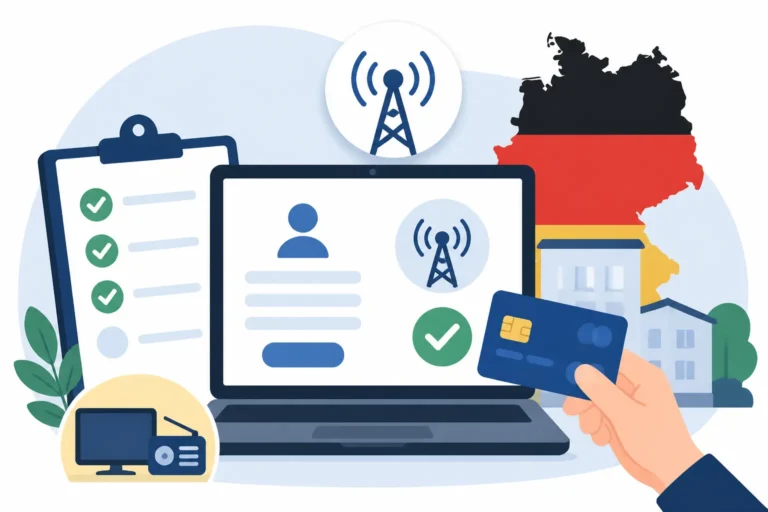
Once you have received your invitation to register (the "Aufforderung zur Anmeldung"), you should head to the official Rundfunkbeitrag website. While the site is primarily in German, most modern browsers do a decent job of translating the fields. You will be asked for your personal details, your address, and how you want to pay.
You generally have two options for payment: a SEPA direct debit (Lastschrift) or a bank transfer (Überweisung). I personally prefer the direct debit because it means I never have to worry about missing a payment and dealing with late fees. To set this up, you'll need to have your banking details ready. If you haven't done so yet, make sure you've followed the steps for Opening a Bank Account in Germany: Step-by-Step for Newcomers so you have a local IBAN.
| Payment Frequency | Total Amount | Benefit |
|---|---|---|
| Quarterly (Middle of 3 months) | €55.08 | The standard "default" option. |
| Quarterly (In advance) | €55.08 | Good for those who like to stay ahead. |
| Half-Yearly (In advance) | €110.16 | Reduces the number of transactions. |
| Yearly (In advance) | €220.32 | Set it and forget it for the whole year. |
After you register, you will receive a confirmation letter with your own 9-digit Beitragsnummer. Keep this number safe! You will need it every time you move house, change roommates, or eventually leave the country. I keep a digital copy of mine in a "German Bureaucracy" folder on my phone because you never know when you'll need to prove you're a "good payer" to a new landlord.
Understanding Exemptions and Reductions
Not everyone in Germany is required to pay the full €18.36. There are specific groups who can apply for either a total exemption or a reduction of the fee. The most common group seeking exemptions are students. However, simply being a student is not enough. To be exempt, you must be receiving BAföG (the German state student financial aid). If you are an international student on a scholarship or living on savings, you generally still have to pay, which can be a significant hit to your Cost of Living in Germany: Budgeting Guide for Expats.
If you are a student, it is worth looking into Health Insurance for Students in Germany: Affordable Options and Requirements to ensure your overall budget is optimized, as the broadcast fee is one of those non-negotiable fixed costs. Other groups eligible for exemptions include recipients of social benefits like Bürgergeld (formerly Hartz IV), or people who receive certain types of disability benefits.
For those with severe visual or hearing impairments, a reduction to one-third of the fee (currently €6.12 per month) is possible. The application for exemption or reduction must be done separately; it doesn't happen automatically when you register for the fee. You will need to provide certified proof, such as your BAföG notice or a disability pass. I've seen many people wait months to apply for an exemption only to realize they could have saved hundreds of euros if they had filed the paperwork on day one.
The Student "WG" Strategy
If you are a student and you live with other students, the "one fee per household" rule becomes a strategic tool. If one roommate receives BAföG and gets an exemption, that exemption only applies to them. It does not exempt the entire apartment if there are other roommates who do not receive BAföG. In that case, the non-exempt roommates must still pay the fee for the household. However, if everyone in the WG is an exempt BAföG recipient, then no one in the apartment has to pay. This is a rare but beautiful scenario for a student budget.
What Happens if You Don't Pay?
I’ve met many expats who decided to "test the system" by ignoring the letters. They figure that since they don't have a TV and didn't sign a contract, they aren't obligated to pay. This is a dangerous game to play in Germany. The Rundfunkbeitrag is legally classified as a "Beitrag" (contribution), not a private contract. By living in a registered apartment, you are legally obligated to contribute.
If you ignore the initial letters, you will eventually receive a "Festsetzungsbescheid." This is a formal notice that sets your debt in stone. If you continue to ignore these, the Beitragsservice will add late fees and administrative penalties. Eventually, they can and will involve a bailiff or initiate a "Kontopfändung"—where they literally take the money directly from your bank account.
Furthermore, unpaid debts to the Beitragsservice can potentially impact your SCHUFA score. While they don't report every late payment, a full-blown enforcement action is a matter of public record and can make Finding an Apartment in Germany: Best Websites and Tips for Expats significantly harder in the future. It is much easier to just pay the fee or find a roommate to share it with than to deal with the long-term consequences of a bureaucratic standoff. If you’re buying a new tablet or computer from Amazon Germany to stream your favorite shows, just remember that the fee covers the "possibility" of access, regardless of the hardware you choose.
Moving House or Leaving Germany
One of the most important things to remember about the broadcast fee is that it follows your address registration. If you move within Germany, you must notify the Beitragsservice of your new address. You don't get a new account number; your existing Beitragsnummer just moves with you. You can do this easily online. If you forget, you might end up paying for your old apartment while the new tenant is also paying, or worse, you might accumulate debt at your new address without realizing it.
The process of Understanding German Rental Contracts: Key Terms and Conditions often mentions the tenant's responsibility for the broadcast fee. When you move out, ensure you do a proper "Ummeldung" (change of registration). If you are moving in with a partner who is already paying, you should "deregister" your old account by citing that you are moving into an apartment where a fee is already being paid.
When the time comes to say goodbye to Deutschland, don't forget the broadcast fee in the chaos of packing. You must explicitly deregister (abmelden) from the Beitragsservice. This is not done automatically when you do your Abmeldung: Deregistering When You Leave Germany and Why It Matters at the Bürgeramt, though you will need your Abmeldung certificate as proof to stop the payments. If you don't deregister, the bills will keep coming, and if you ever return to Germany years later, you might find a very unpleasant surprise waiting for you in the form of years of back-taxes and fines.
Step-by-Step Moving Checklist
To make your life easier during a move, follow this simple sequence:
- Complete your move-in or move-out at the local Bürgeramt.
- If moving within Germany, use the online portal to update your address under your current Beitragsnummer.
- If moving in with someone, find out their Beitragsnummer and use the "moving together" option on the website to close your account.
- If leaving Germany, upload a scan of your Abmeldung certificate to the Beitragsservice website to officially end your obligation.
Dealing with Technicalities and Special Cases
There are a few "edge cases" that often confuse people. For instance, what if you have a second home? If you are a high-flying professional with an apartment in Berlin and a weekend cottage in the Black Forest, you used to have to pay twice. However, a ruling by the Federal Constitutional Court changed this. You can now apply for an exemption for your secondary residence, provided you are already paying the full fee for your primary residence.
Another common question involves home offices. If you are a freelancer or have a dedicated business space that is separate from your living area, you might be subject to additional fees for your business. However, if your home office is just a desk in your living room, your standard household fee covers it. For those just starting their career, staying organized with their How to Get an Anmeldung Appointment at the Bürgeramt and subsequent broadcast fee paperwork is essential to keeping their business finances clear.
Finally, keep in mind that the "Beitragsservice" is not a government agency in the traditional sense, but a joint organization of the public broadcasters. They are famously rigid. If you receive a letter that seems incorrect—perhaps they are asking for money for a period when you weren't even in the country—don't just throw it away. Gather your proof (like your entry visa or your previous country's residency proof) and send a polite but firm explanation through their contact form.
Summary Table of Key Information
| Topic | Quick Fact | Action Needed |
|---|---|---|
| The Cost | €18.36 per month | Set up a SEPA direct debit to avoid missing payments. |
| The Rule | One fee per household/apartment | Communicate with roommates to ensure only one person pays. |
| The Trigger | Address registration (Anmeldung) | Expect a letter about 4-8 weeks after registering. |
| Exemptions | BAföG, social benefits, certain disabilities | Apply separately with certified proof; it's not automatic. |
| Moving | Address must be updated online | Keep your Beitragsnummer; it stays with you for life. |
| Leaving | Abmeldung certificate required | Explicitly deregister online to stop the billing cycle. |
Navigating the German broadcast fee is less about the money and more about the "Ordnung" (order). Once you've set up your account and integrated it into your monthly budget, it becomes just another small part of the German experience—like recycling your Pfand bottles or respecting the Sunday quiet hours. It might feel frustrating at first, but once the paperwork is sorted, you can relax and enjoy the fact that you're officially part of the system.
Disclaimer
This article is intended for informational purposes only and does not constitute legal or financial advice. While every effort has been made to ensure the accuracy of the information provided, laws and fees in Germany are subject to change. Always consult the official website of the Beitragsservice or a qualified legal professional for the most up-to-date and specific guidance regarding your personal situation.