Staying Safe in Germany: Common-Sense Tips for Travelers
Your phone vanishes from your jacket pocket on a packed U-Bahn platform. Or you stand at a ticket machine at midnight, unsure whether the man “helping” you is genuine. Germany is one of Europe’s safer destinations, but tourists still get caught out by petty crime, confusing rules and emergency numbers they never memorised. This guide covers the practical habits that keep a trip smooth.
Disclosure: This post may contain affiliate links. We may earn a commission at no extra cost to you if you make a purchase through these links. Read full disclosure.
How Safe Germany Really Feels on the Ground
I remember my first winter in Berlin. I had arrived braced for something gritty and slightly dangerous, the version of the city from films and late-night documentaries. What I actually found was a place where parents let ten-year-olds ride the tram alone. People also left bikes locked outside overnight, sometimes losing a wheel. I felt far safer walking home at 2 a.m. than I ever did in parts of my home city. Germany has its problems, though, and pretending otherwise does visitors no favours. The trick is knowing which risks are real and which are just noise.
Low Violent Crime, Plenty of Petty Crime
The honest summary is this: violent crime against tourists is uncommon, and petty crime is very common. You are unlikely to be mugged at knifepoint in Munich’s Altstadt. You are reasonably likely to meet a pickpocket at Cologne Hauptbahnhof during a busy Saturday or a match day. The risks that actually ruin trips are small, boring and preventable: a stolen wallet, a bike theft, a fine for riding public transport without a valid ticket, or a sprained ankle on a mountain trail you underestimated.
Think of a typical scenario. Sarah, visiting from Toronto, spends three days in Hamburg without a single problem. On her last morning she leaves her backpack hanging on her chair at a busy café near the Jungfernstieg while she studies a map. Ten minutes later, the bag is gone. Nobody threatened her, and nobody noticed anything. That is what crime looks like for most visitors here: quiet, opportunistic and over in seconds.
This is good news, because petty crime responds very well to simple habits. You don’t need to be paranoid. You do need to drop the relaxed autopilot that sets in when a country feels orderly and calm. Germany’s tidiness can lull people into carelessness, and professional thieves know it.
The Neighbourhoods With a Reputation
Every German city has a few areas that locals mention with a raised eyebrow. They are usually busy transport hubs or nightlife strips rather than residential no-go zones. In Berlin, Kottbusser Tor, Görlitzer Park and parts of Alexanderplatz come up often. They are associated with drug dealing, pickpocketing and the occasional late-night scuffle. Frankfurt’s Bahnhofsviertel, right next to the main station, has a visible drug scene that shocks first-time visitors. Hamburg’s Reeperbahn in St. Pauli is a famous party mile that gets rowdy on weekend nights.
Here is the nuance, though. Many of these places are also full of great restaurants, bars and ordinary people living their lives. I have eaten some of the best food of my life a few streets from Frankfurt Hauptbahnhof. The Bahnhofsviertel in daylight feels very different from the same streets at 3 a.m. Walking through these areas is not dangerous in itself. Lingering, looking lost, flashing an expensive phone or engaging with dealers is where problems start.
My rule of thumb is to treat these areas the way a local does. Walk with purpose, keep valuables out of sight and don’t accept offers from strangers. Move on if a situation feels off. If you are choosing where to stay, the location question deserves real thought. For a broader view of how each city feels day to day, the neighbourhood sections of Germany’s Great Cities: Berlin, Munich, Hamburg, and Beyond are a good starting point.
Emergency Numbers and Getting Help Fast
The single most useful thing you can do before landing is memorise two numbers. They are different numbers for different services, and mixing them up wastes precious seconds. I have watched a panicked visitor at a train station dial the wrong one while trying to report a theft. The operator redirected her politely, but it added stress to an already awful moment.
112 Versus 110 and Why the Difference Matters
In Germany, 112 reaches the fire brigade and the ambulance or rescue service. It is free and works from any phone. Call it if someone has collapsed, is badly injured, can’t breathe, or if there is a fire. The operator coordinates the Rettungsdienst, the rescue service, and sends the right vehicle.
The police are a separate number: 110. Call it if you are being threatened, witness a crime in progress, have been assaulted, or need officers to come to you urgently. A stolen wallet you discover hours later is not usually a 110 emergency. You would report that at a police station, which I explain below.
Picture two situations. In the first, you are on the Reeperbahn and a man in your group falls, hits his head and isn’t responding. That is 112, because you need an ambulance. In the second, someone is aggressively following you and refusing to leave you alone. That is 110, because you need the police. If a situation involves both, such as an assault that leaves someone injured, call 112 for the injury. The control centres do communicate with each other, but starting with the right number gets help moving faster. For a fuller rundown, including poison control, see Emergency Numbers in Germany: Calling 112, Poison Control, and More.
Non-Emergency Medical Help and Pharmacies
Not every health problem needs an ambulance. For an illness that can’t wait until Monday but isn’t life-threatening, Germany has a medical on-call service on 116117. Think of a fever that won’t break on a Saturday night, or an ear infection while the clinics are closed. It can point you to an on-duty doctor or an out-of-hours practice. I explain how that line works in The 116117 Medical On-Call Service in Germany Explained.
For minor complaints, the Apotheke, or pharmacy, is your friend. German pharmacists are highly trained and can advise on blisters, upset stomachs, colds and insect bites. Look for the red Gothic “A” sign. Pharmacies rotate a night and weekend emergency service called Notdienst, and every pharmacy posts the address of the nearest on-duty branch in its window.
| Number or Service | What It Reaches | Use It When |
|---|---|---|
| 112 | Fire brigade and ambulance or rescue service | Fire, serious injury, collapse, breathing difficulty, any life-threatening medical emergency |
| 110 | Police | Crime in progress, threats, assault, danger to your personal safety |
| 116117 | Medical on-call service | Urgent but not life-threatening illness outside normal practice hours |
| Apotheke Notdienst | Rotating night and weekend pharmacy | Medicine or advice after hours for minor complaints |
Talking to the Police as a Foreigner
German police officers are generally professional and approachable, and many in big cities speak decent English. You will meet two main types. Local or state police, the Polizei, handle most street-level issues. The federal police, the Bundespolizei, patrol major train stations and airports. If something happens at Munich Hauptbahnhof or Frankfurt Airport, a Bundespolizei office is usually close by inside the station.
To report a non-urgent crime like a stolen phone or wallet, go to the nearest Polizeirevier or Polizeiwache, the local station. Ask to file an Anzeige, a police report. Bring your ID and any details you remember, and ask for a copy or reference number. Your insurer will almost certainly want that document if you plan to claim. Some German states also offer online reporting, though the interface may only be in German.
Carry your passport or national ID, or at least a good copy plus another photo ID. Officers can ask to see identification, and producing it calmly makes any interaction smoother. Be polite, answer clearly and don’t joke around. German officials tend to take things literally, and sarcasm rarely translates well.
Pickpockets, Scams, and Money Safety
If something goes wrong on your trip, statistically it will probably be here. Pickpocketing and small scams are the bread and butter of crime against tourists in Germany. The silver lining is that once you recognise the patterns, you will spot them everywhere.
Where Pickpockets Work
Pickpockets go where crowds are dense, distracted and carrying valuables. In practice that means main train stations, U-Bahn and S-Bahn platforms during rush hour, and the doors of crowded trains as people push on and off. Tourist magnets like Marienplatz in Munich, the area around Cologne Cathedral and Berlin’s Brandenburg Gate are prime spots. So are escalators, Christmas markets and anywhere people stop to take photos.
You will often hear announcements on public transport warning “Achtung Taschendiebe”, which means beware of pickpockets. Take them seriously. A common technique involves one person creating a distraction, perhaps by bumping into you, dropping coins or asking a question. An accomplice lifts your phone from a back pocket or opens a bag zip. Another classic move happens as the train doors close. A thief grabs a phone from someone’s hand and steps off the train just before the doors shut, leaving the victim trapped inside as the train pulls away.
Mark, a visitor I met in a hostel in Berlin, lost his phone exactly this way at Warschauer Straße. He was scrolling for directions right by the door. Someone snatched it and stepped onto the platform, and the doors closed behind them. The whole thing took perhaps two seconds. The lesson is simple: step away from the doors and keep your phone in a front pocket or a zipped bag when you’re near them.
The Classic Scams
Germany’s scams are not especially creative, but they are persistent. The most widespread is the fake petition. Someone approaches you with a clipboard, often claiming to collect signatures for deaf or disabled people. You sign, then they demand a “donation”. While you’re distracted, a partner may go for your bag. Simply say “Nein, danke” and keep walking.
The shell game, known locally as Hütchenspiel, has turned up for years on busy spots like Berlin’s Oberbaumbrücke and near major attractions. A crowd gathers around someone moving cups or matchboxes over a ball. The “winners” in the crowd are part of the team, and you will never win. Groups of onlookers here are also ideal cover for pickpockets.
Then there are fake police officers. Someone in plain clothes flashes a badge and asks to check your wallet for “counterfeit money” or “drug money”. Real German police don’t ask tourists to hand over wallets for inspection on the street. If in doubt, offer to walk with them to the nearest police station or call 110 to verify. A genuine officer won’t object.
Watch out for the ticket machine “helper” too. At a station, someone offers to help you buy a ticket, then sells you an already-used one or pockets your change. Buy tickets yourself from machines, staffed counters or official apps.
Protecting Cash, Cards and Documents
Germany still uses more cash than many visitors expect, so you will probably carry some. Split your money: a small amount in an easy-to-reach pocket for daily spending, with the rest elsewhere. Keep at least one backup card separate from your main wallet, perhaps in your accommodation’s safe or a hidden pocket. If you lose everything, you won’t be stranded.
Use ATMs inside bank branches or attached to them, preferably during daylight. Avoid standalone machines in dark corners, and cover the keypad as you type your PIN. Decline the offer to be charged in your home currency at ATMs and card terminals, which is a cost issue rather than a safety one. I cover the practical side of payments in Money for Travel in Germany: Cash, Cards, and ATMs.
Your passport is the most painful thing to lose. Scan it and email yourself a copy, and keep a photo on your phone. Many travellers carry only a copy during the day and lock the original away, though officers may still ask for an original ID. If the worst happens, the steps are in What to Do If You Lose Your Passport in Germany.
Getting Around Without Getting Hurt
Transport is where many visitors hit their first real culture shock. Germany’s roads and paths are orderly, but they follow rules that locals take very seriously, and ignoring them can get you hurt or fined.
Bike Lanes, Red Lights and the Art of Crossing
The most dangerous thing many tourists do in German cities is wander into a bike lane. In Berlin, Munich, Hamburg and especially Münster, cycle paths are often painted red or marked with a different paving stone. They run right alongside the pavement. Cyclists move fast and expect a clear path, and they will ring their bells furiously, or simply crash into you, if you’re standing there taking photos. Before you step anywhere, look down and check whether you are standing on a bike lane.
Germans are famously reluctant to cross on a red pedestrian light, even on an empty street. Part of this is setting an example for children, and part is that jaywalking can technically earn a fine. More importantly, drivers and cyclists don’t expect you there. If you are curious about the etiquette, How to Cross the Street in Germany (Jaywalking Norms) goes into the social side of it.
If you rent a bike, follow traffic rules carefully. Use lights after dark, ride on the right and use hand signals. Never ride on the pavement unless it’s clearly marked for bikes. Lock the bike frame, not just a wheel, to something solid, because bike theft is extremely common in student cities. For route ideas and bike-sharing basics, see Cycling in German Cities: Bikes and Bike-Sharing.
Public Transport: Tickets, Inspectors and Late-Night Rides
German public transport usually works on trust. There are often no barriers, and you simply board. That makes it easy to ride without a valid ticket by accident, and inspectors, called Kontrolleure, ride in plain clothes. They board quietly, then show an ID and ask for tickets. If you don’t have a valid one, you will be charged an increased fare on the spot, and pleading tourist ignorance rarely helps.
Many tickets also need to be validated, or stamped, in a small machine on the platform or on board before you ride. An unstamped paper ticket is treated as invalid. When in doubt, buy through an official app, which avoids the stamping question entirely. Check which zones your ticket covers too, especially for airport trips.
Late at night, public transport remains broadly safe, and night buses and some U-Bahn lines run through the weekend in big cities. Sit near the driver on buses, or in carriages with other passengers on trains. Avoid empty cars where a rowdy group is drinking. If someone bothers you, move, and use the emergency intercom found on platforms and in many trains if needed.
Taxis, Ride Apps and Driving
Official German taxis are usually cream or beige with a lit “TAXI” sign on the roof. They are metered and well regulated. Take them from official ranks outside stations and airports, or book through a reputable app. Be wary of unmarked cars whose drivers approach you inside arrival halls offering a ride.
If you are driving, the Autobahn has a fearsome reputation, but safety mostly comes down to discipline. Keep right except when overtaking, never pass on the right, and check mirrors constantly, because cars approach at very high speeds on unrestricted stretches. Form a Rettungsgasse, an emergency corridor, whenever traffic slows to a jam. On a multi-lane road, vehicles in the leftmost lane move left, and everyone else moves right, leaving a gap for emergency vehicles. Drivers who fail to do this can be fined, and it can genuinely save lives.
Nightlife, Festivals and the Great Outdoors
Germany rewards people who go out and explore, whether that means a techno club in Friedrichshain, a beer tent in Munich or a ridge walk in the Bavarian Alps. Each of these comes with its own set of risks, mostly related to alcohol, crowds and overconfidence.
Nights Out in the Big Cities
Berlin’s club scene is legendary, and Hamburg, Cologne and Leipzig all have lively nightlife. Clubs are mostly well run, with professional door staff and awareness teams at bigger venues. The risks are the usual ones: drink spiking, theft from coats and bags, and bad decisions after too much alcohol.
Never leave your drink unattended, and accept drinks only from the bar or from people you know. Arrange how you will get home before you go out, and stick with your group. Many venues have staff trained to help if you feel unwell or unsafe, sometimes called an awareness team. In some cities, campaigns like “Ist Luisa hier?” let women discreetly ask bar staff for help by asking for “Luisa”. For the cultural side of going out, Nightlife in Germany: Berlin and the Club Scene gives you the lay of the land.
Drugs are a real presence around some nightlife areas. Regardless of how relaxed a scene looks, buying from street dealers carries legal, health and personal safety risks, and the substances can be unpredictable. My advice is simple: don’t.
Oktoberfest, Christmas Markets and Big Crowds
Oktoberfest is joyful, enormous and a little chaotic. The beer is strong and served in one-litre mugs, and many visitors badly underestimate it. People get injured falling on benches, getting into fights or being hit by flying mugs. Eat properly, drink water between beers, and know where your group meets if you get separated. Keep your phone and wallet zipped, because crowded tents are perfect for pickpockets.
Christmas markets bring their own risks. Crowds are dense, the lighting is low, and everyone is distracted by mulled wine and gingerbread. Wear a cross-body bag worn in front, and keep gloves on your hands rather than in pockets where valuables sit. Large public events in Germany often have visible police presence and security barriers. Respect any bag checks without fuss. There’s more detail in How to Stay Safe at German Festivals and Markets.
Ticks, Rivers, Mountains and Weather
Outdoors, the most underrated risk is the tick. In forests and long grass, especially in southern Germany, ticks can carry Lyme disease and tick-borne encephalitis, known as TBE or FSME. Wear long trousers on hikes and check your body thoroughly afterwards. Remove any tick promptly with tweezers or a tick card from the pharmacy.
Rivers deserve far more respect than visitors give them. The Rhine looks calm but has powerful currents and heavy shipping traffic, and swimming in it is dangerous outside designated spots. Munich’s Isar is beautiful and popular for summer swimming. But its glacial water is cold, the current changes quickly, and water levels can rise after storms. Swim only where locals swim, never alone, and never after drinking.
In the Alps around Garmisch-Partenkirchen, the Zugspitze and Berchtesgaden, weather turns fast. A sunny morning can become a thunderstorm by early afternoon. Start early, check the forecast, carry layers and water, and turn back if conditions change. Stick to marked trails and tell someone your route. Mountain rescue in Germany is reached through 112, but reaching you takes time. Gear advice lives in What to Pack for Hiking in the German Alps.
For weather and public alerts, two official apps are worth installing: WarnWetter from the national weather service, and NINA, the federal warning app. They send alerts about severe storms, flooding, heat and other emergencies, and both are designed for the public. Summer heatwaves happen more often than people expect, and many older buildings lack air conditioning, so plan for shade and water on hot days.
Planning Ahead So Small Problems Stay Small
Most travel safety happens before you leave home. The visitors who handle problems best aren’t necessarily the most street-smart. They are the ones who prepared well enough that a lost wallet becomes an annoyance rather than a crisis.
Booking Smartly: Where You Stay and How You Move
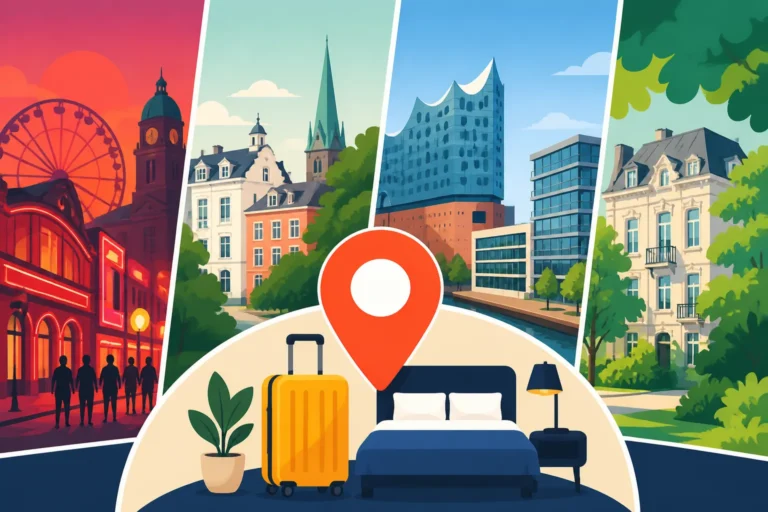
Your accommodation choice shapes how safe your trip feels. When I help friends plan visits, I tell them to read reviews for mentions of the area at night, not just the room itself. On Booking.com, sorting by location and reading recent guest comments often reveals more than photos do. Look for notes like “great area, felt safe walking back late” or “loud drunk crowds outside on weekends”. Staying a few U-Bahn stops from a main station is often quieter than staying right next to it, with almost no loss in convenience.
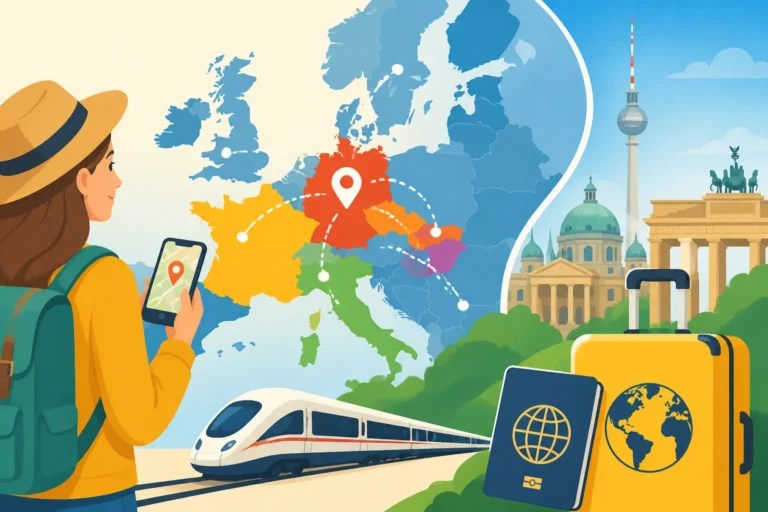
For getting between cities, the safest habit is buying tickets through official or well-known channels instead of from strangers at stations. Comparison platforms like Omio let you look at trains and long-distance buses side by side and keep tickets on your phone. That means fewer paper tickets to lose and no fumbling at a machine while someone hovers nearby. Whatever you use, check that the ticket shows your name where required, and know whether you need a seat reservation.
Guided activities can make unfamiliar or physically demanding outings safer, such as a first Alpine hike, a night walk through a city or a river trip. Booking through a reputable platform such as GetYourGuide gives you reviews and clearer cancellation terms. You also get a known operator rather than someone who approached you on the street. A guide who knows the local terrain, weather patterns and crowd hotspots is a genuine safety asset, not just a convenience.
Insurance, Documents and Staying Connected
Travel insurance is the safety net people resent paying for until they need it. A night in a German hospital, a cancelled train connection that forces an extra hotel night, or a stolen laptop can all become expensive. Check what your policy covers for medical treatment, theft and adventurous activities like skiing or via ferrata routes. Remember that most insurers want a police report for theft claims. I break down the options in Travel Insurance for Trips to and Within Germany.
Staying connected is a safety issue too. A working phone means maps, translation, emergency calls and the ability to reach your accommodation. Arrange data before you land, either through your home provider or a local or travel eSIM. Then you are never wandering a station at night trying to find Wi-Fi. See Mobile Data and eSIMs for Travel in Germany for how to set that up. Keep a small power bank charged, as a dead phone at midnight is one of the most common avoidable problems I hear about.
Write down a few essentials on paper and keep them separate from your phone. Include your accommodation address, your embassy’s contact details, a card-blocking hotline from your bank, and a contact person back home. If your phone is stolen, you won’t remember any of it.
A Pre-Trip and On-Arrival Safety Checklist
Here is the routine I recommend to every friend who visits. It takes very little time and covers most of what goes wrong.
- Memorise the two key numbers: 112 for the fire brigade and ambulance or rescue service, and 110 for the police.
- Scan your passport, insurance documents and cards, then store copies in your email or cloud storage.
- Split your money and cards so that no single loss leaves you without access to funds.
- Install the WarnWetter and NINA apps, plus your city’s official public transport app.
- Arrange mobile data before arrival and pack a charged power bank.
- Read recent reviews of your accommodation’s surroundings, focusing on how the area feels at night.
- On arrival, note the nearest pharmacy and police station to where you are staying.
- Learn to spot bike lanes on day one, and keep off them when walking.
- Buy and, where needed, validate a ticket before every public transport ride.
- On crowded platforms, trains and markets, keep phones and wallets in front pockets or zipped bags, and stand away from train doors.
- Before any hike or swim, check the weather and conditions, tell someone your plan, and turn back when in doubt.
- If something is stolen, go to a police station to file an Anzeige and keep the reference for your insurer.
None of this is about being fearful. Germany is a wonderful, largely safe country, and the overwhelming majority of visitors leave with nothing worse than sore feet and a camera roll full of half-timbered houses. Treat the obvious risks with respect, learn the handful of local rules that matter, and you can relax into the trip with confidence.
Disclaimer
This article is for general informational purposes only and does not constitute professional advice. Laws, prices and regulations vary by location and change over time. Consult a qualified professional for guidance on your specific situation.