Germany’s Great Cities: Berlin, Munich, Hamburg, and Beyond
Trying to figure out which German city to visit—or move to—often feels like being handed a 500-page menu where everything looks both delicious and slightly intimidating. I remember my first week in Berlin, standing at Alexanderplatz, clutching a paper map and feeling completely overwhelmed by the sheer scale and the confusing array of S-Bahn lines. This guide cuts through that noise, offering a veteran's perspective on the unique souls of Germany’s major hubs and the practical realities of navigating them.
Disclosure: This post may contain affiliate links. We may earn a commission at no extra cost to you if you make a purchase through these links. Read full disclosure.
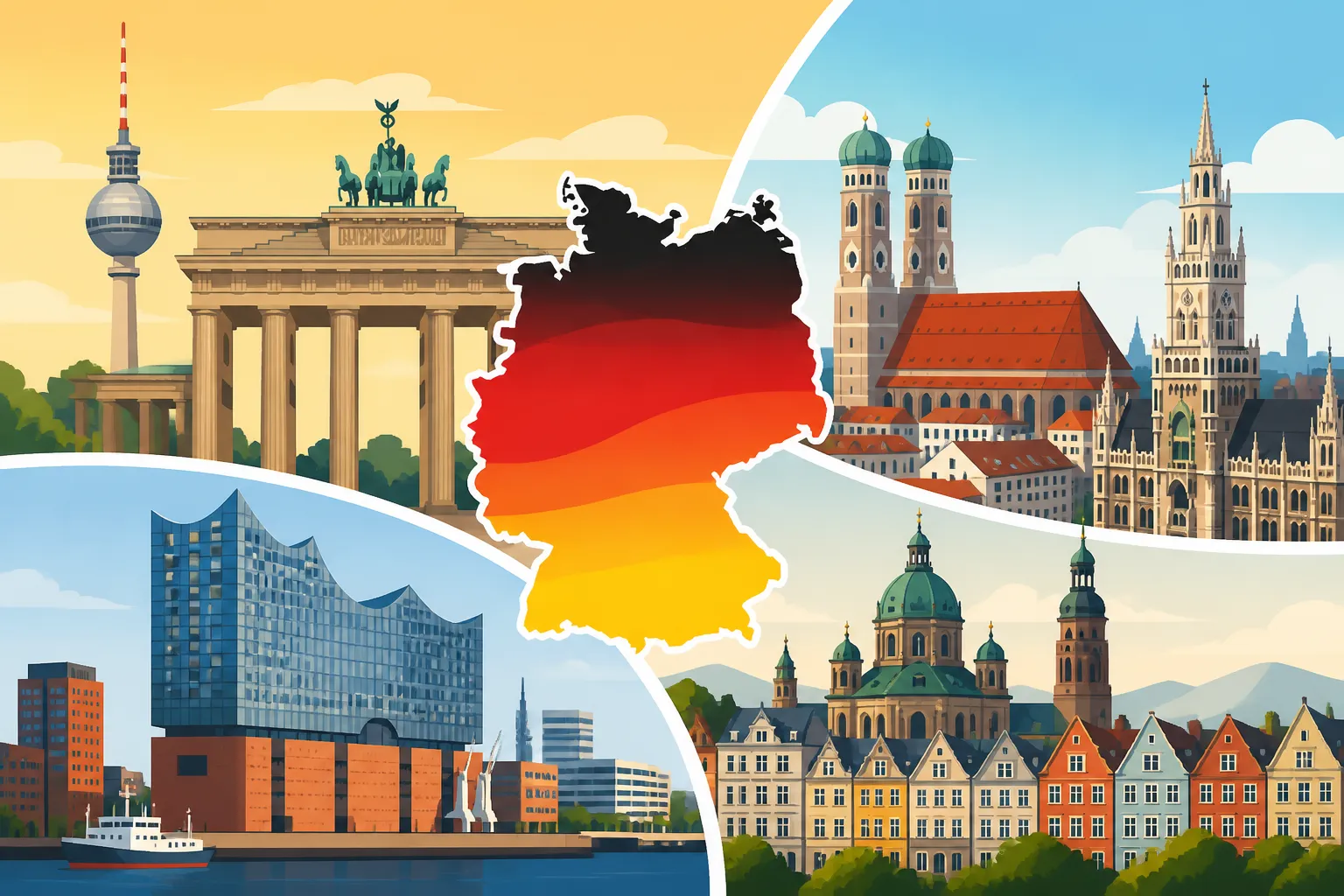
The Big Three: Berlin, Munich, and Hamburg
Berlin: The Gritty, Historical Heart
Berlin is a city that doesn't just have history; it wears it on its sleeve like a badge of honor. When you first arrive, the city might feel a bit disjointed. Unlike Paris or London, Berlin doesn't have one single "center." Instead, it is a collection of distinct neighborhoods, or Kieze, each with its own personality. I’ve spent years living here, and I still find corners in Neukölln or Wedding that surprise me with their hidden cafes and backyard art galleries. The city is defined by its scars, from the preserved stretches of the Wall to the bullet holes still visible on some facades in Mitte.
Living here as an expat or visiting as a tourist requires a certain level of "Berlin Zen." You have to embrace the Berliner Schnauze—a notoriously direct, sometimes gruff way of communicating that can feel like rudeness but is actually just honesty. For those looking to dive deep into the layers of the past, using a service like GetYourGuide can help you find specialized tours of Cold War bunkers or street art walks that you’d never find on your own. It’s a city that rewards the curious and those who aren't afraid of a little grit.
From a practical standpoint, Berlin is arguably the most "English-friendly" city in the country. You can survive here for years without fluent German, though I wouldn't recommend it if you want to truly integrate. The nightlife is legendary, but it’s the Sunday flea markets at Mauerpark and the sprawling greenery of Tiergarten that make it livable. If you're planning a visit, check out Berlin for First-Time Visitors: Neighborhoods and Highlights to get a head start on where to base yourself.
Munich: Beer, Tradition, and Alpine Proximity
Munich is the Germany you probably imagined before you got here: Lederhosen, massive beer steins, and pristine streets. It is the wealthy, polished cousin to Berlin’s rebellious teenager. I’ve found that Munich offers a much higher "quality of life" in the traditional sense. Everything works, the streets are clean, and the crime rate is incredibly low. However, that comes with a price tag. Finding an apartment here is a competitive sport, and the cost of a meal out will definitely be higher than in the north or east.
The heart of the city is Marienplatz, but the soul is in the beer gardens. Whether it’s the Chinese Tower in the Englischer Garten or the Augustiner-Keller, these are the places where social barriers dissolve over a Maß of Helles. If you're visiting in late September, you’ll need to prepare well in advance; I highly recommend reading Oktoberfest in Munich: A First-Timer's Guide to avoid being the tourist who shows up without a table reservation. For accommodation during these peak times, Booking.com is usually your best bet for finding something that isn't two hours away by train.
Beyond the beer, Munich is the gateway to the Alps. On a clear day, you can see the mountains from the city, and within an hour, you can be hiking around the Tegernsee or skiing in Garmisch-Partenkirchen. This proximity to nature is what keeps most expats here despite the high costs. It’s a city that values tradition, so expect a slower pace on Sundays and a more conservative social vibe than the capital.
Hamburg: The Gateway to the World
Hamburg often gets overlooked by people rushing between Berlin and Munich, which is a massive mistake. As a port city, it has an openness and a maritime flair that makes it feel distinct from any other German metropolis. The Elbe river is the city’s lifeblood, and the Speicherstadt—the historic warehouse district—is a UNESCO World Heritage site that looks stunning at sunset. I always tell newcomers to take the public ferry (Line 62) instead of an expensive harbor cruise; it’s included in your transit ticket and gives you the same incredible views of the container terminals.
The Reeperbahn in St. Pauli is famous for its red-light district and Beatles history, but the city is so much more than its "Sinfull Mile." The Sternschanze neighborhood offers a hip, alternative vibe with independent boutiques and some of the best coffee in the country. Hamburgers (the people, not the food) are known for being a bit "cool" or reserved at first—it’s that Hanseatic heritage—but once you make a friend here, they are incredibly loyal.
Logistically, Hamburg is a breeze to get to. If you are coming from Berlin or further south, using Omio to compare ICE train prices versus long-distance buses can save you a fortune, especially if you book a few weeks out. The city is also surprisingly green, with the Alster lake right in the center providing space for sailing, rowing, and jogging. For a deeper look at the northern lifestyle, see Hamburg City Guide: Harbor, Music, and Nightlife for specific recommendations on where to eat and explore.
The Financial and Cultural Powerhouses of the West
Frankfurt: More than Just a Finance Hub
Frankfurt is often unfairly labeled as a boring business city. Yes, it has the only real skyscraper skyline in Germany and is the home of the European Central Bank, but beneath the glass and steel lies a city with a rich medieval history and a surprisingly cozy vibe. The Römerberg is the reconstructed heart of the old town, and it’s where you’ll find that classic German architecture that feels like it’s straight out of a storybook.
One of my favorite things about Frankfurt is the "Ebbelwoi" (apple wine) culture in the Sachsenhausen district. You sit at long communal tables in traditional taverns, drinking tart cider out of ribbed glasses called Geripptes. It’s the ultimate social equalizer. Frankfurt is also one of the most international cities in Europe, with over half the population having an international background. This makes it a very easy place for expats to land, as English is widely spoken in professional and social circles.
The city's central location makes it the ultimate transit hub. You can get anywhere in Europe from Frankfurt Airport or the Hauptbahnhof within a few hours. If you’re staying for a few days, I suggest looking into Best Day Trips From Frankfurt to see how easy it is to visit the Rhine Valley or the fairy-tale town of Heidelberg.
Cologne: Carnival, Cathedrals, and Rhineland Spirit
If you want to experience the friendliest people in Germany, go to Cologne. The Kölner are famous for their "live and let live" attitude and their infectious humor. The city was heavily bombed in WWII, so the architecture is a mix of 1950s functionalism and stunning Romanesque churches. Dominating everything is the Kölner Dom, a Gothic masterpiece that literally takes your breath away when you step out of the train station. For the best experience, check out How to See Cologne Cathedral and the Old Town before you go.
Cologne is also the capital of German Carnival. If you are in the city on the 11th of November or in the week leading up to Ash Wednesday, be prepared for total chaos—in the best way possible. Everyone is in costume, and the city shuts down for a massive street party. In daily life, the social scene revolves around the Brauhaus. Here, you drink Kölsch—a light, crisp beer served in small 0.2L glasses. Don't be surprised when the waiter (called a Köbes) brings you a new beer without you asking; they’ll keep them coming until you place your coaster on top of your glass.
Düsseldorf: Fashion, Art, and the Altbier
Just a short train ride north of Cologne is its rival city, Düsseldorf. While Cologne is seen as the "fun" sibling, Düsseldorf is the "fashionable" one. The Königsallee (or "Kö") is one of the most luxury-dense shopping streets in Europe. But the city isn't just for the wealthy; it has a massive art scene and is home to the world-renowned Kunstakademie. It also boasts the largest Japanese community in Germany, meaning you can find world-class ramen and sushi in the "Little Tokyo" area around Immermannstraße.
The Altstadt (Old Town) is nicknamed the "longest bar in the world" because of the hundreds of pubs packed into a small area. Here, you drink Altbier, a dark, top-fermented beer that is the pride of the city. The rivalry between Cologne (Kölsch) and Düsseldorf (Altbier) is legendary; never try to order a Kölsch in Düsseldorf unless you want a very stern lecture from your waiter.
Hidden Gems: The "Beyond" of the German Cityscape
Leipzig: The "New Berlin" of the East
For the last decade, everyone has been calling Leipzig "Hypezig." It has attracted a massive wave of young creatives and students who were priced out of Berlin. The result is a city that feels vibrant, experimental, and incredibly affordable. The Spinnerei, a former cotton mill turned into an art complex, is a must-see. Leipzig also has a massive musical heritage; Bach spent most of his life here, and you can still hear the world-famous Thomanerchor perform at St. Thomas Church.
The city is surrounded by a network of artificial lakes created from former open-cast mines. In the summer, the entire city seems to migrate to the Cospudener See for swimming and BBQ. It’s a perfect mix of urban grit and natural beauty. If you're interested in exploring the former East Germany more deeply, Saxony and the East: Dresden, Leipzig, and Beyond provides a great roadmap for this region.
Dresden: The Jewel of the Elbe
Dresden is arguably the most beautiful city in Germany. Known as "Florence on the Elbe," its skyline is a masterpiece of Baroque architecture. The Frauenkirche, which lay in ruins for decades as a war memorial before being painstakingly rebuilt, is a symbol of the city’s resilience. The Zwinger palace and the Semperoper are equally stunning.
However, Dresden is a city of two halves. The Altstadt is where the monuments are, but the Neustadt across the river is where the life is. The Neustadt is filled with street art, quirky bars, and some of the best nightlife in the east. It’s a fascinating contrast between old-world European elegance and modern counter-culture.
Stuttgart: Automotive Excellence and Vineyards
Stuttgart is often dismissed as a "car city" because it’s the home of Mercedes-Benz and Porsche. While the museums for these brands are world-class, the city has a lot more to offer. Uniquely for a major German city, Stuttgart is built in a valley (the Kessel) and is surrounded by steep hillsides covered in vineyards. You can literally hike through wine country without leaving the city limits.
The "Stäffele"—the historic outdoor staircases built to help workers reach the vineyards—provide incredible viewpoints over the city. Stuttgart is also the heart of Swabia, a region known for its distinct dialect and delicious food like Maultaschen (think giant German ravioli). It’s a wealthy, industrious city, but one that knows how to enjoy a glass of local Riesling at a "Besenwirtschaft" (a seasonal wine tavern).
Master Comparison of Germany's Major Cities
| City | Primary Vibe | Best For | Must-Try Local Specialty |
|---|---|---|---|
| Berlin | Raw, historical, edgy | Nightlife, history buffs, startups | Currywurst |
| Munich | Traditional, posh, outdoorsy | Beer gardens, mountain access, families | Weisswurst & Pretzel |
| Hamburg | Maritime, cool, diverse | Harbor views, music lovers, shopping | Fischbrötchen |
| Frankfurt | Global, high-paced, central | Finance, international networking, travel hub | Handkäs mit Musik & Apfelwein |
| Cologne | Friendly, festive, Romanesque | Carnival, cathedral fans, social butterflies | Kölsch beer |
| Leipzig | Creative, affordable, green | Students, artists, lake life | Leipziger Lerchen (pastry) |
| Stuttgart | Industrious, scenic, wine-heavy | Car enthusiasts, hikers, wine lovers | Maultaschen |
Navigating the German Urban Jungle
Mastering the Public Transit System
In Germany, the car might be king of the Autobahn, but within cities, the Öffis (public transport) are your best friend. Every major city uses a combination of U-Bahn (underground), S-Bahn (suburban trains), Trams, and Buses. The most important thing for a newcomer to understand is that the system is based on trust—there are no turnstiles. You buy a ticket and, in most cities, you must "validate" it in a little machine on the platform or inside the bus/tram before you board.
If you are caught without a validated ticket by a plain-clothes inspector, you will face a "Schwarzfahren" (black riding) fine, usually around €60, and "I’m a tourist" rarely works as an excuse. If you're visiting Berlin, I highly recommend reading How to Use the Berlin U-Bahn and S-Bahn as a Visitor because the zones (A, B, and C) can be tricky. For those staying longer, the "Deutschland-Ticket" for €49 a month offers unlimited regional and local transit across the entire country—it is the single best value in German history.
Sunday Closures and the "Ruhezeit" Reality
This is the biggest culture shock for expats and tourists alike: on Sundays, Germany shuts down. With very few exceptions (like cafes, restaurants, and pharmacies inside train stations), every supermarket and retail shop is closed. I still occasionally forget and end up with an empty fridge on a Sunday morning, forcing a "rescue mission" to the local gas station.
Along with Sunday closures comes the concept of Ruhezeit (quiet time). In most apartment buildings, you are legally forbidden from making loud noises (like vacuuming, drilling, or playing loud music) between 10 PM and 7 AM, and all day on Sundays. It might seem restrictive, but once you live here, you start to cherish the enforced peace. To understand the legalities of your building better, check Neighborhood Noise Rules: Understanding Ruhezeit (Quiet Hours) in Germany.
Cash, Cards, and Digital Payments
"Nur Bares ist Wahres" (Only cash is true) used to be the German national motto. While the pandemic accelerated the acceptance of card payments, Germany is still surprisingly cash-heavy compared to the UK or the Nordics. You will still find many "Kneipen" (local pubs) and small bakeries that only accept cash or a "Girocard" (a local German debit card) rather than Visa or Mastercard.
Always carry at least €20–€50 in cash just in case. ATMs (Geldautomaten) are everywhere, but be careful of the private "Euronet" machines which charge high fees; stick to bank-affiliated ATMs like Sparkasse or Deutsche Bank. For more on managing your money, see Using Cash vs Card in Germany: Is Germany Going Cashless?.
Cultural Nuances and Social Etiquette
The Art of the Direct Conversation
One of the things I love most about Germany—though it took time to get used to—is the directness. If a German thinks your idea is bad, they will tell you it is bad. It isn’t meant as a personal attack; it’s seen as efficient and honest. In the workplace or social settings, there is very little "small talk" or sugar-coating. If you ask "How are you?", be prepared for a 10-minute honest answer about their recent back pain or stress at work.
Decoding the "Sie" vs. "Du" Barrier
German has two ways of saying "you": the formal Sie and the informal du. As a rule of thumb, use Sie for anyone in a professional setting, older people, or people in authority (like doctors or police). Use du for friends, family, and young people. In places like Berlin, people are much quicker to jump to du, but in a city like Munich, the Sie remains a mark of respect. When in doubt, wait for the other person to offer the "du"—usually with the phrase "Wir können uns duzen."
Tipping and Dining Out Like a Local
Tipping in Germany is not the 20% standard you see in the US, but it’s also not "non-existent" like in Japan. The standard is to "round up" or add about 5–10%. If your bill is €18.50, you might say "Zwanzig" (twenty) as you hand over the cash. Crucially, you don't leave the money on the table; you tell the waiter the total amount you want to pay (including the tip) as you pay them. If you're using Booking.com to find hotel restaurants or local bistros, keep this in mind. For a full breakdown, check Tipping and Service Charges in Germany: Who and How Much to Tip.
Logistics: Moving Between Cities Seamlessly
The Deutsche Bahn Experience: ICE vs. Regional
The ICE (InterCity Express) is the pride of the German rail network. These sleek white trains can reach speeds of 300 km/h, making the trip from Berlin to Munich in under four hours. They are incredibly comfortable, with onboard bistros and (mostly) working Wi-Fi. However, they can be expensive if you buy on the day.
Regional trains (RB, RE) are slower and stop at more stations, but they are significantly cheaper and covered by the €49 Deutschland-Ticket. If you are planning a multi-city trip, I highly recommend using the DB Navigator app. It’s the gold standard for European transit apps and will give you real-time updates on delays (which, fair warning, are more common than the "German efficiency" stereotype suggests). To save money, read How to Buy Deutsche Bahn Tickets and Save Money for tips on "Sparpreis" deals.
Booking Smart: Platforms and Apps
When I’m planning a trip within Germany, I usually start with Omio. It allows you to see the train, bus, and flight options all on one screen. Sometimes a FlixBus is only 15 minutes slower than a regional train but costs a third of the price. For accommodation, I find that Booking.com has the best inventory of local Pensionen (guest houses), which offer a more authentic (and often cheaper) experience than international hotel chains.
Accommodation Strategy: Where to Stay
In German cities, the area around the Hauptbahnhof (Main Station) is often the most convenient but can also be the "seedier" part of town. While Germany is very safe overall, these areas can be loud and gritty. I usually recommend staying one or two S-Bahn stops away from the main station to find quieter, more charming neighborhoods. For example, in Berlin, look at Charlottenburg or Prenzlauer Berg instead of Mitte. In Munich, the Haidhausen district is a beautiful alternative to the busy center.
Disclaimer
The information provided in this guide is based on personal experience and current regulations as of the time of writing. While we strive for hyper-local accuracy, city rules, transit prices, and cultural norms can evolve. Always check official government websites or local transit authorities for the most up-to-date information before making travel or relocation plans.