Outdoor Adventures and Nature in Germany
Finding your footing in a new country often means navigating a labyrinth of paperwork and city streets, leaving you feeling disconnected from the natural world. I remember spent my first three months in a cramped Berlin sublet, staring at grey U-Bahn walls and wondering if "wild Germany" was just a myth found in Grimm’s fairy tales. This guide solves that disconnect by mapping out the country’s most breathtaking landscapes and providing the practical expat wisdom you need to conquer the great outdoors.
Disclosure: This post may contain affiliate links. We may earn a commission at no extra cost to you if you make a purchase through these links. Read full disclosure.
The Geographic Diversity of Germany’s Natural Landscapes
Germany is far more than just the Black Forest and the Alps, though those are magnificent. To truly understand the outdoor potential here, you have to look at the country in three distinct bands. Each region offers a different flavor of adventure, and as someone who has lived in both the flat north and the mountainous south, I can tell you that your gear list will change drastically depending on where you go. From the windswept dunes of the Baltic to the jagged limestone peaks of the Bavarian border, the variety is staggering.
The Rugged North: Baltic and North Sea Coasts
In the north, the landscape is defined by the horizon. The North Sea is famous for its Wadden Sea (Wattenmeer), a UNESCO World Heritage site where the tide recedes so far you can literally walk between islands. I’ll never forget my first "Wattwanderung"—walking on the seabed in mud up to my ankles, feeling the strange pulse of the ocean floor. It’s an otherworldly experience, but it requires a guide because the tide comes back faster than you think.
On the other side, the Baltic Coast (Ostsee) offers white sandy beaches and dramatic chalk cliffs, particularly on the island of Rügen. This area is perfect for those who enjoy coastal hiking and cycling without the intense vertical gain of the south. The air is salty and crisp, and the "Sturm" (storm) season in autumn is a sight to behold. If you’re planning a trip up here, using Booking.com to find a traditional thatched-roof cottage is the best way to soak in the local "Fischbrötchen" lifestyle.
The Heart of Germany: Central Uplands and Harz Mountains
Moving into the center of the country, you hit the "Mittelgebirge" or Central Uplands. This is the Germany of legends. The Harz Mountains, once split by the Iron Curtain, are now a haven for hikers and mountain bikers. The Brocken, the highest peak in the north, is often shrouded in mist, giving rise to centuries of folklore about witches and spirits. It’s a moderate climb, but the weather can turn in an instant—a lesson I learned the hard way when a sunny morning turned into a freezing fog by noon.
Further east, you’ll find Saxon Switzerland (Sächsische Schweiz). Don’t let the name fool you; it’s in Saxony, near Dresden, and it features bizarre sandstone pillars that look like they belong in a fantasy movie. The Bastei Bridge is the iconic shot everyone wants, but the real magic is in the deep, fern-covered gorges. For more specialized trips like rock climbing or guided photography tours in these ravines, I often check GetYourGuide for local experts who know the hidden "Boofen" (legal cave camping spots).
The Majestic South: Alpine Peaks and Crystal Lakes
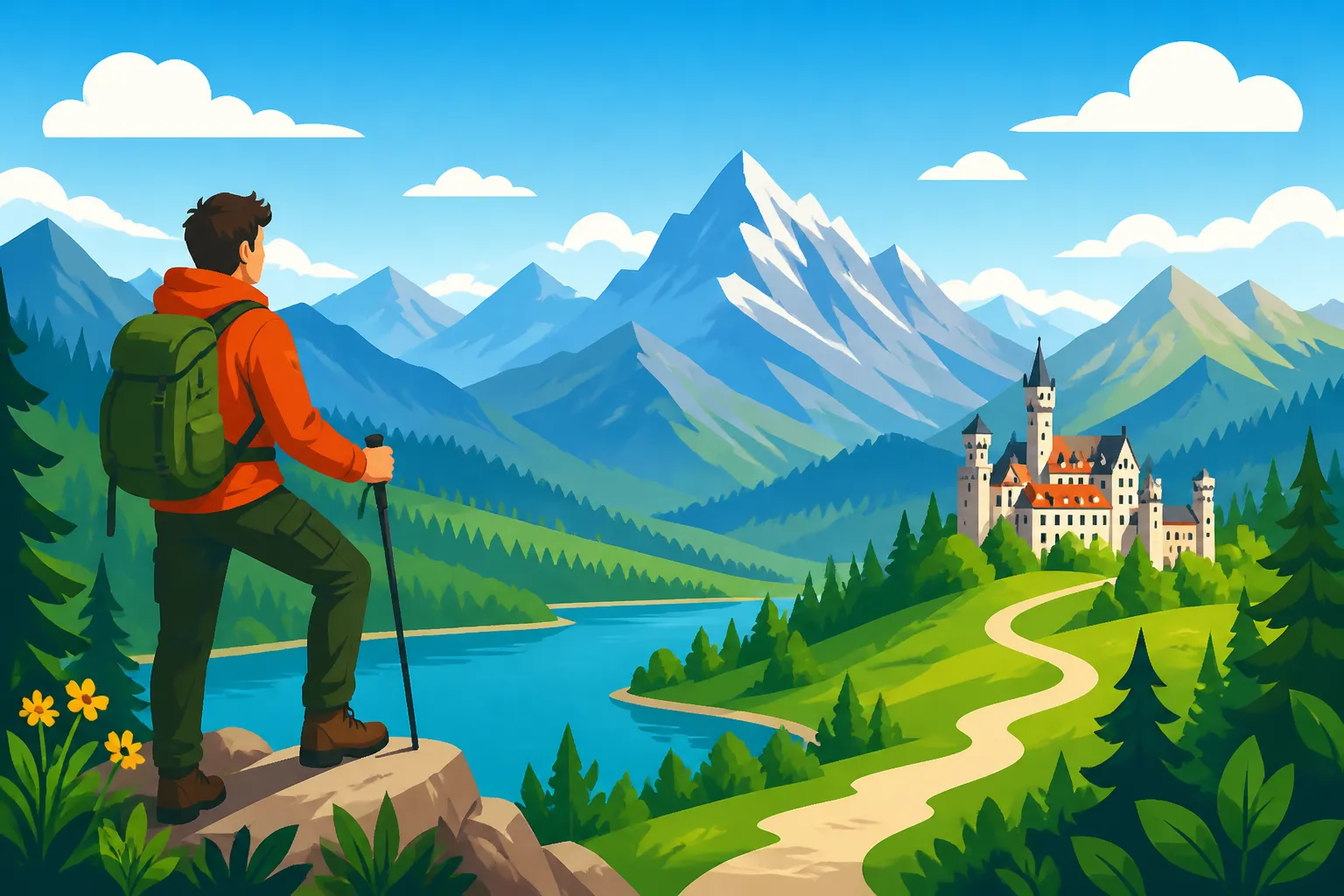
Then, of course, there is the south. The Bavarian Alps are the crown jewel for any outdoor enthusiast. This is where you find The German Alps: Garmisch, Zugspitze, and Berchtesgaden, home to Germany's highest peak, the Zugspitze. The scale here is different. You aren't just walking; you are ascending. The lakes here, like Eibsee or Königssee, are so clear they look like polished emeralds.
Living in the south taught me the importance of timing. The hiking season in the high Alps is surprisingly short, often only running from late June to October. Outside of that, you’re looking at snow gear and serious mountaineering. If you’re coming from Munich or Stuttgart, I highly recommend using Omio to book your regional train tickets early; the "Bayerische Regiobahn" gets incredibly crowded on sunny weekends, and having your ticket sorted on your phone saves a lot of stress at the platform.
Hiking Culture: More Than Just a Walk in the Woods
In Germany, hiking (Wandern) is a national sport, a philosophy, and a social ritual all rolled into one. When I first arrived, I thought my old sneakers and a plastic water bottle would suffice. I was wrong. To hike like a German is to embrace a level of preparation that borders on professional. You will see 80-year-olds with carbon-fiber trekking poles overtaking you on a steep incline, and they will always offer a cheerful "Servus" or "Grüß Gott" as they pass.
Essential Gear and the Wanderschuh Mentality
The first thing you need to invest in is a proper pair of "Wanderschuhe" (hiking boots). Germans take footwear seriously. In many mountain regions, you won’t even be allowed on certain guided tours if your ankles aren't supported. I’ve seen people turned away from difficult trails because they were wearing "Turnschuhe" (sneakers). It’s not just about elitism; it’s about the "Haftpflicht" (liability) culture—nobody wants to be responsible for a twisted ankle on a remote ridge.
Beyond boots, you’ll need "Funktionskleidung" (functional clothing). The goal is to look like you’re ready to summit Everest, even if you’re just going for a Sunday stroll. Layers are key. The weather in the Central Uplands can be "wechselhaft" (changeable), and you’ll want a high-quality "Regenjacke" (rain jacket) tucked in your bag. Exploring Hiking in Germany: The Black Forest, Alps, and Beyond will give you a deeper look at the specific gear requirements for different terrains.
Navigating the Trails: Signage and Komoot
One of the greatest joys of Outdoor Adventures and Nature in Germany is the trail marking system. The "Deutscher Wanderverband" maintains hundreds of thousands of kilometers of trails. You’ll see small painted symbols on trees—a blue cross, a yellow circle, or a red leaf—each corresponding to a specific route. It’s incredibly rare to get truly lost if you keep your eyes peeled for these markers.
However, modern expats usually rely on Komoot. It’s the go-to app here for planning routes. You can filter by fitness level, surface type (gravel vs. asphalt), and "highlights" added by other users. I always download my maps for offline use because cell service in the deep forests of the Thuringian Woods or the Eifel is notoriously "schlecht" (bad). Being prepared for a digital blackout is part of the "I've-been-there" wisdom I give every newcomer.
The Hütten Experience: Food and Overnight Stays
The best part of German hiking isn’t the exercise; it’s the "Hütte" (hut). Scattered throughout the mountains are alpine huts managed by the "Deutscher Alpenverein" (DAV). These aren't just shelters; they are rustic restaurants serving "Kaiserschmarrn" (shredded pancakes) and "Linseneintopf" (lentil stew). Sitting on a wooden bench with a cold Radler after a 1,000-meter climb is a spiritual experience.
If you want to stay overnight, you need to book weeks—sometimes months—in advance. Many huts now use online booking systems, but some still require a phone call in German. If you’re a DAV member, you get a massive discount on the "Matratzenlager" (dormitory-style sleeping). Just remember to bring a "Hüttenschlafsack" (a thin silk or cotton sleeping bag liner); it’s mandatory for hygiene reasons. For those who prefer a bit more comfort, finding a nearby "Gasthof" on Booking.com is a great alternative to the communal snoring of a mountain hut.
Water Adventures: Lakes, Rivers, and the Coast
When the summer heat hits the German cities, the collective exodus to the water begins. Germany is a land of ten thousand lakes, and "See-Kultur" is a massive part of expat life. Whether it’s the "Freibad" (outdoor pool) or a wild forest lake, being near water is how Germans survive the humid July afternoons.
The Best Lakes for Swimming and Stand-Up Paddling
If you’re in Berlin, you’ll soon learn that the Wannsee and Schlachtensee are the city’s lungs. In the south, the Starnberger See and Ammersee offer views of the Alps while you swim. Stand-Up Paddling (SUP) has exploded in popularity here. Most major lakes have rental stations where you can grab a board for €15 an hour. I’ve spent many evenings paddling out into the middle of the Chiemsee to watch the sunset, and it’s one of the few times Germany feels truly quiet.
One thing to keep in mind is the "DLRG" (German Life Saving Society) flags. If you see a red and yellow flag, the beach is monitored. If it’s just red, stay out of the water. Also, be aware that many Germans enjoy "FKK" (Freikörperkultur)—nudism. Don't be shocked if you stumble upon a designated nude beach at the lake; it’s a perfectly normal, non-sexual part of the culture here.
Kayaking and Canoeing on Germany’s River Arteries
For a different perspective, take to the rivers. The Spreewald, a biosphere reserve south of Berlin, is a labyrinth of small canals that you can navigate by canoe. It’s like a green Venice, minus the gondolas and plus a lot of pickles (the local specialty). You can book multi-day canoe trips through GetYourGuide, where they’ll even transport your luggage between campsites.
The Altmühltal in Bavaria is another favorite for families because the current is gentle and the scenery is dotted with medieval castles. If you're interested in combining history with your paddle, check out Germany's Best Castles: Neuschwanstein and Beyond for ideas on where to stop. Just be sure to check the water levels before you go; in dry summers, some of the smaller rivers can become too shallow for canoes.
Windsurfing and Sailing in the North
The northern coasts are the domain of the windsurfers and kiters. Fehmarn and Sankt Peter-Ording are world-class spots. The wind is consistent, and the community is incredibly welcoming to foreigners. If you’re a beginner, there are countless "Wassersportschulen" along the Baltic. I recommend taking a weekend course to get your "Grundschein" (basic license), which many rental places require before they’ll let you take out high-end gear.
| Activity | Top Region | Best Time | Skill Level |
|---|---|---|---|
| Alpine Hiking | Upper Bavaria | June – Sept | Moderate to High |
| Mudflat Walking | North Sea Coast | May – Sept | Easy (but guided) |
| Canoeing | Spreewald | April – Oct | Easy |
| Rock Climbing | Saxon Switzerland | May – Oct | High |
| Cycling | Elbe River Path | May – Sept | Easy |
| Skiing | Garmisch | Dec – March | Moderate |
Cycling Germany: From City Paths to Cross-Country Tours
Germany is a cycling paradise. The infrastructure here puts most other countries to shame. From the moment I stepped off the plane, I realized that a bike isn't just for exercise—it’s a primary mode of transport. But beyond the city commute, the "Radwanderweg" (cycle touring) network is where the real adventure lies.
Long-Distance Cycle Routes (Fernradwege)
There are over 200 long-distance cycle paths in Germany. The Elberadweg, which follows the Elbe River from the Czech border to the North Sea, is consistently voted the most popular. It’s mostly flat, paved, and passes through stunning cities like Dresden and Hamburg. You can do sections of it or spend two weeks doing the whole thing.
Another gem is the Moselradweg, which winds through vineyards and past half-timbered villages. If you’re worried about the logistics of carrying gear, many expats use Omio to find "Fahrrad-Ticket" options on trains, allowing you to cycle one way and take the train back. Just remember that during peak summer, bike spaces on "ICE" trains must be reserved in advance, and they sell out fast! You can find more details on these routes in the Cycling Routes in Germany: The Rhine, Elbe, and More guide.
Mountain Biking and Bike Parks
If you prefer dirt to asphalt, the Harz Mountains and the Black Forest offer world-class mountain biking. In recent years, "Bike Parks" with lift access have popped up everywhere. Winterberg in the Sauerland is a mecca for downhill riders. I’m more of a cross-country rider myself, and I love the trails around Freiburg. The "Green City" has a massive MTB community, and the trails are perfectly maintained by local clubs.
When mountain biking, please stick to the "2-meter rule" in Baden-Württemberg, which technically prohibits cycling on paths narrower than two meters. While it’s a point of contention and often ignored, being aware of it helps you navigate interactions with hikers, who can sometimes be quite protective of "their" trails.
City Cycling Etiquette and Rules
Cycling in German cities like Münster or Berlin requires a thick skin. There is a hierarchy on the road, and as a cyclist, you are expected to follow the rules of the "StVO" (traffic regulations) strictly. This means having working lights, a bell, and reflectors. I once got a €20 fine for a broken tail light on a clear evening—the police don't play around when it comes to "Verkehrssicherheit."
Also, learn the hand signals. If you’re turning, stick your arm out clearly. If you stop suddenly without signaling, expect a "Meckern" (complaint) from the person behind you. It’s all part of the charm. If you’re new to the country and haven't sorted your own wheels yet, you can often find great rentals or even bike-friendly hotels on Booking.com.
Winter Sports: Beyond the Ski Resorts
When the first snow falls, the mountains transform. While Germany might not have the massive interconnected ski circuits of France or Austria, it has a "Gemütlichkeit" (cooziness) that is hard to beat. Winter here is about more than just downhill speed; it’s about embracing the "Stille" (silence) of the snow-covered woods.
Downhill Skiing and Snowboarding in the Alps
Garmisch-Partenkirchen is the epicenter of German skiing. The "Kandahar" run is legendary, but there are plenty of blue and red runs for mortals like us. The Fellhorn/Kanzelwand area near Oberstdorf is another great spot that straddles the border with Austria. For expats living in the north, the Harz offers some small ski hills like Braunlage, though they are highly dependent on "Kunstschnee" (artificial snow) these days.
Skiing here is a full-day affair that ends with "Après-Ski." But unlike the wild parties in Tyrol, German Après-Ski often involves a nice "Glühwein" by a roaring fire. If you’re planning a ski weekend, use Omio to look for the "Schnee-Express" trains that run from major cities directly to the slopes—it's much better than fighting the "Stau" (traffic jams) on the A8 motorway.
Cross-Country Skiing (Langlauf) and Winter Hiking
If you want a workout without the lift tickets, "Langlauf" is the way to go. The Black Forest has hundreds of kilometers of groomed "Loipen" (tracks). It’s incredibly peaceful and much cheaper than downhill skiing. Most towns will have a local shop where you can rent the gear for the day.
Winter hiking is also a huge thing. Many "Wanderwege" are specifically cleared of deep snow so you can walk them with just good boots. I love the contrast of the dark pine trees against the white snow in the Bavarian Forest. It’s a great way to stay active during the "Dunkelheit" (darkness) of a German winter. You might even find it helps with Dealing with Seasonal Affective Disorder: Coping with Dark Winters in Germany.
Tobogganing: The Hidden German Passion
Never underestimate the German love for "Rodeln" (tobogganing). It’s not just for kids. In places like the Wallberg near Tegernsee, there are dedicated sledding runs that are several kilometers long. You take a cable car up, rent a sturdy wooden "Hörnerschlitten," and fly down the mountain. It’s exhilarating and, honestly, a bit terrifying at times. Just make sure to wear a helmet—the "I've-been-there" advice here is that those wooden sleds go much faster than the plastic ones from your childhood.
Practical Tips for the German Outdoors
Before you head out into the wild, there are a few "administrative" and cultural quirks you need to know. Germany is a country of rules, and those rules extend into the forest. Respecting them isn't just about being a good guest; it’s about preserving the very nature you’re there to enjoy.
Weather Preparation: Dealing with Wechselhaft Skies
The German weather forecast is a suggestion, not a guarantee. We have a saying: "Es gibt kein schlechtes Wetter, nur schlechte Kleidung" (There is no bad weather, only bad clothing). Always check the "Regenradar" app before you head out. Even if the sun is shining in Munich, the mountains can be experiencing a "Föhn" wind or a sudden thunderstorm.
If you’re heading to the coast, the wind chill is the real enemy. Even in summer, a "Nordseekrise" can make 20 degrees feel like 12. Always pack a windbreaker. And if you’re staying fit through the winter, check out Staying Fit in Germany: Joining Gyms, Pools, and Sports Clubs for indoor alternatives when the "Schmuddelwetter" (nasty weather) gets too intense.
Respecting the Rules: Conservation and Waldknigge
The "Waldknigge" (forest etiquette) is an unwritten code. Don't leave trash—not even organic waste like banana peels, which take forever to decompose in the cold mountain air. Stick to the paths to protect ground-nesting birds and rare flora. In many National Parks, like the Berchtesgaden National Park, leaving the trail can result in a hefty fine from the "Ranger."
Wild camping is generally "verboten" (forbidden) in Germany. While "biwakieren" (emergency sleeping without a tent) is a grey area in some states, you should generally stick to designated "Campingplätze." If you’re looking for a more "wild" feel, look for "Trekking-Camps" in the Palatinate Forest or the Eifel, which allow legal tent camping in remote spots for a small fee.
Using Public Transport to Reach the Wild
You do not need a car to explore Outdoor Adventures and Nature in Germany. The "Deutschland-Ticket" (the €49 monthly pass) has been a game-changer for expats. You can take any regional train, bus, or tram in the country. This means you can hop on a "Regional-Express" from Berlin and be in the heart of the Spreewald in an hour.
For longer trips where you want the speed of an "ICE" train, Omio is my favorite tool for comparing prices and booking. Many trailhead locations are served by "Wanderbusse" (hiker buses) that only run during the season. Always check the "DB Navigator" app for the last bus back—missing it can mean a very expensive taxi ride or an unplanned night under the stars. For those who do prefer to drive, make sure your paperwork is in order by reading Car Registration and Insurance in Germany: What Expats Need to Do.
Medical Preparedness in the Wild
Nature is beautiful, but it has its risks. In Germany, the biggest tiny threat is the "Zecke" (tick). Southern Germany is a high-risk area for TBE (Tick-borne encephalitis) and Lyme disease. I always check my legs after a hike, even if I stayed on the path. You should definitely read Mosquitoes and Ticks: Preventing Bites and Diseases (Lyme, TBE) in Germany before your first summer outing.
If you do have an accident, the emergency number is 112. Mountain rescue ("Bergwacht") is professional and fast, but it can be expensive if you aren't insured. This is why many expats join the DAV (Alpine Club), as the membership includes mountain rescue insurance. For more general advice on staying safe, see Health Tips for Travelers: Staying Healthy During Trips Around Europe.
Final Thoughts on Exploring Germany
The transition from a "city expat" to an "outdoor expat" was the moment I truly started calling Germany home. There is something about the silence of the Eifel or the raw power of the Zugspitze that puts all the bureaucratic stress into perspective. Whether you’re booking a guided rock-climbing tour on GetYourGuide, finding a cozy basecamp on Booking.com, or navigating the rail network with Omio, the tools are all there. All you have to do is lace up those boots and take the first step.
Disclaimer
The information provided in this guide is for informational purposes only and reflects the personal experiences and research of the author. Travel conditions, local laws, and safety regulations in Germany can change frequently. Always check official government websites, local weather reports, and trail conditions before embarking on any outdoor adventure. The author and publisher are not responsible for any injury, loss, or inconvenience sustained by anyone using the information in this article. Ensure you have appropriate health and accident insurance coverage for outdoor activities.