Dusseldorf, Cologne, and Hamburg Airport Connections Compared
Your plane lands at Düsseldorf, Cologne Bonn or Hamburg, and the arrivals hall offers rows of ticket machines, three train types and signs only half in English. Meanwhile your onward train to Amsterdam or Berlin leaves in ninety minutes. This guide compares how each airport connects to its city and the wider rail network, and how to book it all calmly.
Disclosure: This post may contain affiliate links. We may earn a commission at no extra cost to you if you make a purchase through these links. Read full disclosure.
I have flown in and out of all three airports more times than I can count. I have stood at the wrong platform at Düsseldorf, missed the airport branch of the Hamburg S-Bahn, and once paid for a taxi into Cologne because I panicked at a machine. You do not need to repeat any of that.
How the Three Airports Compare at a Glance
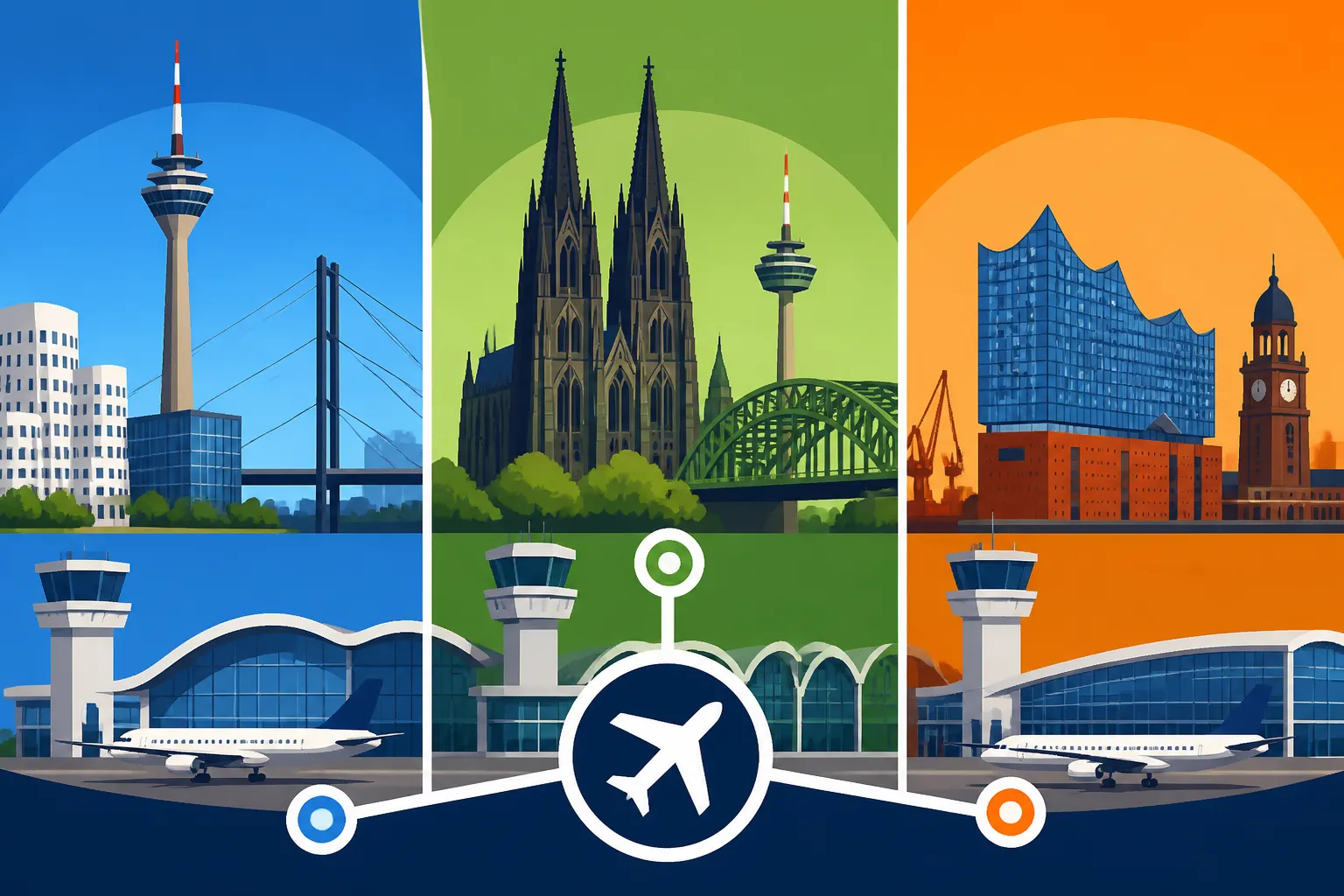
These airports look alike on a route map, but they behave very differently once you are standing in the terminal. Düsseldorf is a long-distance rail hub with a monorail in front of it. Cologne Bonn has a station under the terminal that mixes regional trains with some long-distance services. Hamburg keeps things simple, with one S-Bahn line and very little to confuse you.
| Feature | Düsseldorf Airport | Cologne Bonn Airport | Hamburg Airport |
|---|---|---|---|
| Station location | S-Bahn under the terminal, long-distance station reached by SkyTrain | Underground station directly below the terminals | S-Bahn station directly below the terminals |
| Main rail link to city | S-Bahn and regional trains to Düsseldorf Hbf | S-Bahn and regional trains to Köln Hbf | S1 to Hamburg Hbf |
| Long-distance trains at airport | Yes, frequent ICE and IC stops | Some ICE services | No, change at Hamburg Hbf |
| Useful bus link | Local buses to surrounding towns | Express bus SB60 to Bonn | Local buses, rail is usually better |
| Regional transport association | VRR | VRS | HVV |
| Biggest beginner trap | Going to the terminal S-Bahn when you need the long-distance station | Boarding a train toward Troisdorf instead of Cologne | Boarding the wrong half of a splitting S1 train |
| Best for | Onward travel across the Rhine-Ruhr and to the Netherlands | Quick access to both Cologne and Bonn | A straightforward ride into the city centre |
If you are flying into Frankfurt instead, its setup works much like Düsseldorf’s. Frankfurt Airport Transfers: Long-Distance Rail Direct From the Terminal covers that model in detail.
Why the Station Layout Matters More Than the Distance
Most first-timers fixate on how far the airport is from the city. In practice, the layout of the station decides how stressful your arrival will be. A short distance means little if you spend twenty minutes hunting for the right platform with two suitcases.
At Hamburg, the station sits right under the terminal and only one line serves it. At Düsseldorf you face a real choice between two stations. Cologne Bonn sits in between, with one station but several train types going in different directions.
Why One Search Tool Saves You From the Guesswork
This is where Omio earned a permanent spot on my phone. You type in “Düsseldorf Airport” and your real destination, whether that is Essen, Utrecht or a small town in the Sauerland. Omio then shows you the rail and bus options side by side, in English, with the changes spelled out.
For a newcomer, that matters more than any single fare. You see straight away that you need the long-distance station, or that you change at Köln Hbf, before you have left the baggage hall.
Düsseldorf Airport: The Rhine-Ruhr Rail Hub
Düsseldorf Airport punches well above its size for rail connections. That is excellent news if you are heading to Dortmund, Bochum, Duisburg or across the border. It can be confusing if you just want the Altstadt and do not know which of the two stations to use.
Terminal S-Bahn Station Versus the Long-Distance Station
There are two stations, and mixing them up is the classic mistake.
- The S-Bahn station sits directly below the terminal. The S11 runs from here into Düsseldorf Hbf and on toward Neuss and Cologne. It is the gentle option if you are staying in the centre and are in no hurry.
- The long-distance station, Düsseldorf Flughafen, sits a short ride away. You reach it on the SkyTrain, the elevated driverless shuttle you see from the departures level. ICE, IC and many regional express trains stop here.
- From the long-distance station, regional trains often reach Düsseldorf Hbf faster than the S-Bahn, and ICE trains continue to Cologne, Frankfurt, the Ruhr and beyond.
One expat friend landed with her toddler and headed confidently to the terminal S-Bahn station. Her ticket was for an ICE to Hamm. She found out on the platform, rode the SkyTrain back with a pram, and caught her train with seconds to spare. Check the departure station on your ticket before you start walking.
Booking Onward Travel From Düsseldorf
This is where I would point anyone toward Omio first. Düsseldorf Airport is a jumping-off point for the whole Rhine-Ruhr region and for trips to the Netherlands. Searching from the airport itself, rather than from Düsseldorf Hbf, shows you departures from the long-distance station that skip the city entirely.
Say you are going to Essen for a work meeting. A search might surface a direct regional express from the airport station, saving you a pointless trip into the centre and back out. If you are continuing to Cologne or Frankfurt, see Frankfurt to Cologne and Dusseldorf: The Rhine Corridor Priced Out for how that corridor behaves.
Note that “Düsseldorf Weeze” is not Düsseldorf Airport. It sits far out near the Dutch border. Budget airlines love that naming trick, and Hahn, Weeze, and Memmingen: Budget Airports That Aren’t Where They Claim explains how to get out of it.
Where You Are Actually Going in Düsseldorf
If you are staying in the city, your district shapes which train makes sense. The Altstadt and Pempelfort sit close to the Hbf. The Medienhafen is better reached with a tram connection after you arrive. Where to Stay in Dusseldorf: Altstadt, Medienhafen, and Pempelfort breaks down which base works best when you are arriving by air.
Cologne Bonn Airport: Two Cities, One Station
Cologne Bonn Airport serves two cities at once. That makes it convenient, but it also means trains leave the same platforms in different directions. The station is underground, right below the terminals, and you walk down from arrivals without leaving the building.
Getting From Cologne Bonn Airport to Köln Hbf
The airport loop is the key to understanding this station. Trains enter the airport on a curve and leave in two directions. One heads toward Cologne, the other toward Troisdorf and the Siegburg area.
- Look for S-Bahn and regional trains showing Köln Hbf or Köln Messe/Deutz on the display.
- Check the platform display carefully, because a train on the same platform a few minutes later may be heading the other way.
- Ride into Cologne in roughly a quarter of an hour and step out next to the cathedral at Köln Hbf.
- If you are staying across the river, consider getting off at Köln Messe/Deutz, which is often closer to trade fair hotels.
Choosing a neighbourhood before you land helps here. Where to Stay in Cologne: Altstadt, Belgisches Viertel, and Ehrenfeld covers the main options and how they connect to the Hbf.
Getting From the Airport to Bonn
Bonn often confuses people, because there is no single obvious train. The express bus SB60 runs from outside the terminal to Bonn Hbf and is my usual choice when I visit friends in the old government quarter. Rail is possible too, usually with a change.
This is a great example of where Omio is useful, because it shows the bus and the train options together. You can see straight away whether the direct bus or a rail connection suits your arrival time and luggage better.
Trade Fair Weeks at Koelnmesse
Cologne hosts huge trade fairs, and during those weeks the airport trains are packed with lanyard-wearing crowds. Hotel prices and train demand both jump. Book onward long-distance trains early rather than assuming you can buy a seat at the machine. Trade Fair Weeks: How Messe Dates Distort Transport Prices explains the pattern.
Hamburg Airport: Simple, With One Hidden Trap
Hamburg is the friendliest of the three for a first arrival. The S-Bahn station sits under the terminals, one line serves it, and the ride to the Hauptbahnhof is straightforward. There is still one trap that catches almost every newcomer at least once.
Riding the S1 Into the City
The S1 takes you from the airport to Hamburg Hbf in under half an hour, passing through the northern districts on the way.
- Follow the S-Bahn signs down from the terminal.
- Buy a ticket from the HVV machine on the platform, or have your booking ready on your phone, before boarding.
- Board any S1 heading into the city and ride to Hamburg Hbf, or to Jungfernstieg if you are staying near the Alster.
- Change at Hamburg Hbf for ICE trains to Berlin, Copenhagen, Bremen or Hannover.
Getting into the city is easy. The trap appears when you go back to the airport.
The Ohlsdorf Split on the Way Back
On the return trip, S1 trains heading north are often coupled together and split at Ohlsdorf. One half continues to the airport, and the other heads toward Poppenbüttel. If you are sitting in the wrong half, you will watch the airport disappear while you glide toward the suburbs.
I learned this on a grey Sunday with a flight to catch. The fix is simple. Check the display on the platform and the signs inside the carriage, and sit in the part marked for the airport, which German signs label Flughafen. If in doubt, ask someone with a suitcase. Hamburgers are usually happy to help.
Continuing Beyond Hamburg
Hamburg Airport has no long-distance trains, so everything onward goes through Hamburg Hbf. That is busy but manageable. When I plan a trip from the airport to Lübeck, Bremen or Kiel, I enter the airport as my starting point in Omio. It then builds the S1 leg and the onward train into one journey, so I am not juggling two apps on a crowded concourse.
For trips across the north, Hamburg to Bremen and Hannover: Northern Regional Ticketing goes deeper into the regional fare rules. If you have not chosen a base yet, Where to Stay in Hamburg: St. Pauli, Altona, HafenCity, and Eimsbuttel compares the districts most visitors pick.
Tickets, Luggage and Booking Without Stress
Each airport sits inside a different regional transport association, and that is the root of most ticket confusion. A ticket bought in the Düsseldorf area does not automatically make sense in Hamburg. Here is how I would handle it as a visitor or new resident.
Local Tickets Versus Long-Distance Bookings
There are really two kinds of journey from these airports.
| Journey type | What you need | Smartest approach |
|---|---|---|
| Airport to city centre only | A local single ticket for the regional association | Ticket machine on the platform, or a pass you already hold |
| Airport to another German city | A long-distance or regional rail ticket covering the full trip | Search the whole journey from the airport in Omio |
| Airport to a neighbouring country | A cross-border rail or bus ticket | Compare train and bus in Omio and book in English |
| Airport to a smaller town nearby | Regional train or bus, sometimes with a change | Check combined options before leaving the terminal |
If you already hold a Deutschland-Ticket, it covers the S-Bahn and regional trains from all three airports, but not ICE or IC services. The Deutschlandticket: What It Covers, What It Doesn’t, and Who It Suits explains where that line sits.
Why I Book Onward Journeys With Omio
I have tried most of the options available. Some German booking sites switch back to German halfway through checkout, and some reject foreign cards at the last step. Omio keeps the whole process in English and shows trains and buses from different operators in one place. Your ticket then sits on your phone, ready to show to the conductor.
Imagine you land at Cologne Bonn and need to get to Maastricht. Rail might mean a change in Aachen, while a long-distance bus might go direct. Omio puts both on one screen with journey times, so you choose based on your energy level and luggage, not on guesswork. It does not replace the platform machine for a quick hop into the centre, but for anything beyond the city limits it is the tool I reach for first.
If foreign card declines have burned you before, Paying for German Transport With a Foreign Card: Declines and Fixes covers the common causes. For a wider look at English-friendly platforms, see Booking German Transport in English: Sites That Work and Sites That Don’t.
Luggage, Delays and Your Plan B
All three airport stations have lifts, but they can be slow at peak times, and some regional trains have steps up from the platform. Travel as light as you reasonably can. Luggage and Bike Rules on German Trains and Buses covers bikes, skis and oversized bags.
Delays happen, especially on the busy Rhine-Ruhr lines around Düsseldorf and Cologne. My rule is to leave a generous buffer between landing and any fixed onward train. If something does go wrong, check the platform display, listen for announcements, and look up your options again in the app rather than queuing at a service desk. DB Strikes and Delays: Your Rights, Compensation, and Rebooking explains what you can claim if a disruption wrecks your connection.
My Arrival Routine at Any of the Three Airports
- Before you fly, search your full journey from the airport to your real destination in Omio and save the booking to your phone.
- Note which station your train leaves from, especially at Düsseldorf.
- After landing, follow the train or S-Bahn signs before stopping for coffee, so you know where the platform is.
- Confirm the direction on the platform display at Cologne Bonn, and check which half of the train you are in at Hamburg on the way back.
- Keep a small buffer in your plan, and check the app again if anything changes.
Arriving in a new country is tiring enough without fighting with ticket machines. Choose your airport with its connections in mind, learn its one quirk, and let Omio handle the onward booking. Then you can spend those first hours enjoying the Rhine or the harbour instead of staring at a departure board.
Disclaimer
This article is for general informational purposes only and does not constitute professional advice. Laws, prices and regulations vary by location and change over time. Consult a qualified professional for guidance on your specific situation.