Hahn, Weeze, and Memmingen: Budget Airports That Aren’t Where They Claim
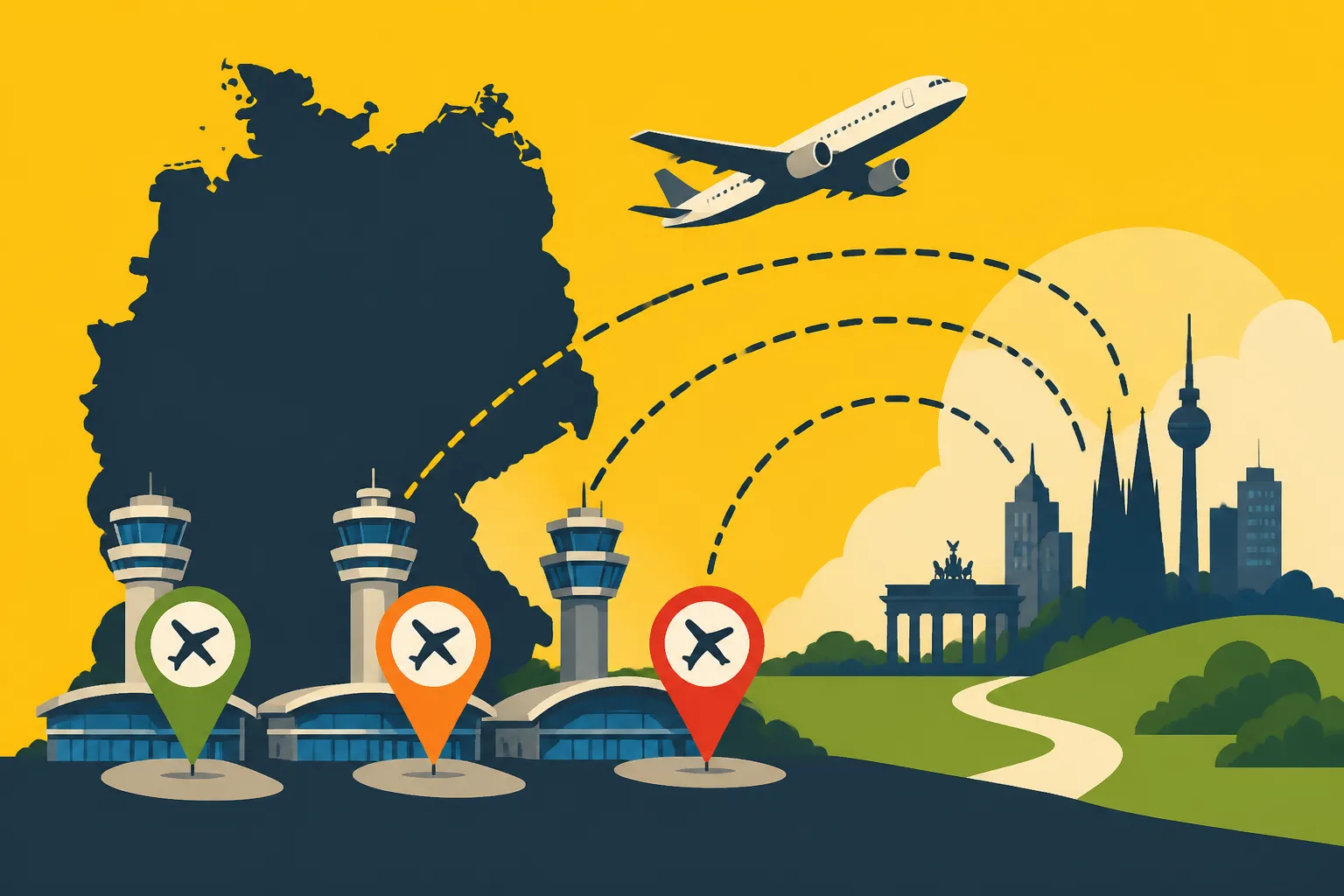
You land at “Frankfurt-Hahn,” step outside, and see fields, forest and a car park. Frankfurt is far away, behind a long bus ride you never budgeted for. This happens to thousands of travellers every week. This guide explains where Hahn, Weeze and Memmingen actually are, what the onward journey really costs, and how to book that last leg before you fly.
Disclosure: This post may contain affiliate links. We may earn a commission at no extra cost to you if you make a purchase through these links. Read full disclosure.
Why These Three Airports Catch Travellers Out
I learned this the hard way. My first winter in Germany, I booked a flight to “Düsseldorf Weeze” for a friend’s birthday. I assumed it was like London Gatwick, a bit outside the city but basically Düsseldorf. I landed after dark next to the Dutch border. The shuttle bus had a queue and the cash machine was out of order. I reached the party in time for leftover cake.
Here is what you need to know so the same thing doesn’t happen to you.
The Naming Game Budget Airlines Play
Low-cost carriers like Ryanair and Wizz Air keep fares low by flying into secondary airports, where landing charges and turnaround costs are much lower than at the big hubs. To make those airports easier to sell, the airport or the airline often attaches the name of the nearest famous city.
So a former military airfield in the Hunsrück hills becomes “Frankfurt-Hahn.” The Niederrhein airport near the town of Weeze is sold as “Düsseldorf Weeze.” Memmingen, in the Bavarian Allgäu, shows up as “Memmingen/Munich West” or simply as a Munich option on search results.
None of this is technically a lie. Each airport does have a bus link to the city in its name. But on a booking screen, the big city name is what you notice, and the distance is what you miss.
German travellers know this. Many locals treat these airports as cheap gateways to their own region, not the big city. A family from Trier might use Hahn because it is closer than Frankfurt. Someone from Nijmegen might use Weeze. A skier heading to Oberstdorf might use Memmingen. The airports work well for those people. The trouble starts when a visitor with a city-centre hotel books one without checking a map.
How Far These Airports Really Are
The distances below are road distances to the city each airport is commonly linked with. They won’t change, so they are the most useful numbers to know before you book.
| Airport | Marketed Association | Actual Location | Approximate Road Distance to Named City | Closer To |
|---|---|---|---|---|
| Hahn | Frankfurt | Hunsrück hills, Rhineland-Palatinate | Around 120 km from Frankfurt | Mosel valley, Trier, Koblenz, Mainz |
| Weeze | Düsseldorf | Lower Rhine, near the Dutch border | Around 75 km from Düsseldorf | Kevelaer, Goch, Kleve, Nijmegen, Venlo |
| Memmingen | Munich | Allgäu region, Bavaria | Around 110 km from Munich | Allgäu, Lake Constance, Ulm, Füssen |
For comparison, Frankfurt’s main airport sits right at the edge of the city with its own long-distance rail station. Munich’s main airport has a direct S-Bahn link. These are different kinds of airports. If you want a sense of how easy the main hubs are, see How to Get From Frankfurt Airport to the City Center and How to Get From Munich Airport to the City Center.
From all three budget airports, you are looking at a road journey of well over an hour, often closer to two hours. Add waiting for the bus, a delayed flight or a missed connection, and your “city break” loses half a day.
The Real Cost of a Cheap Fare
This is where the maths can trip you up. Here is a typical example.
Say you find a flight for EUR 19.99. The airport bus to the city typically costs EUR 15-25 one way. That brings your real one-way cost to about EUR 35-45 per person, before checked bags, seat fees or a taxi from the city bus stop to your hotel.
| Cost Item | Typical Amount Per Person, One Way |
|---|---|
| Budget flight fare | EUR 19.99 |
| Airport bus to the named city | EUR 15-25 |
| Combined real cost | About EUR 35-45 |
| Not included above | Bags, seat selection, local transport or taxi to your accommodation |
Sometimes EUR 35-45 is still a great deal compared with flying into a main hub. Sometimes it isn’t, especially once bags and time are added. Do the full sum before you click “book.” The bag side of the calculation is covered in Lufthansa, Eurowings, and Ryanair Within Germany: Total Cost With Bags.
The bigger hidden cost is time. Two hours on a bus each way is four hours of a weekend gone. For a family with tired kids, that matters more than the fare difference.
Hahn, Weeze and Memmingen: Airport by Airport
Each airport has its own situation, quirks and best uses. Here is what I would tell a friend about each.
Frankfurt-Hahn: Deep in the Hunsrück
Hahn is the most remote of the three. The airport is surrounded by forested upland, small villages and wind turbines. No train station is anywhere nearby. In practice, you depend on buses.
Coaches run from Hahn to Frankfurt, typically stopping at the main station area. Depending on demand and season, there are also connections to cities like Mainz, Koblenz, Trier and Luxembourg. Timetables usually match the flight schedule, but they are only as good as the flights. If your evening flight is delayed and you land after the last coach has left, your options shrink quickly. A taxi to Frankfurt is a big expense. Some travellers end up in a nearby village guesthouse.
Who Hahn actually suits: Hahn is well placed for the Mosel wine country. Towns like Traben-Trarbach and Bernkastel-Kues are much closer to Hahn than Frankfurt is. If your trip is about vineyards, riverside villages and slow travel, Hahn can be a smart choice.
A realistic scenario: Priya flies into Hahn on a Friday evening for a weekend in Frankfurt. Her flight lands late. She has prebooked a coach timed for the scheduled arrival, but the flight is delayed. Because she checked the full evening timetable in advance, she knows there is one more departure later that night. She makes it, tired but fine. Without that knowledge, she would have been standing outside the terminal with no backup plan.
Weeze: The Lower Rhine and the Dutch Border
Weeze sits in the flat, green Lower Rhine countryside, close enough to the Netherlands that you can see Dutch number plates in the car park. It is less isolated than Hahn because there are two ways out.
The first is a direct coach to Düsseldorf. This is the simplest option if you have luggage and want one seat to the city.
The second route is to take a local bus from the airport to Weeze station, then a regional train toward Düsseldorf. This takes a bit more effort, with a change and a short wait. But regional trains run on a regular pattern, which gives you more flexibility if your flight is delayed. If you hold a Deutschland-Ticket, the regional train leg can be part of your plan. Read What Is the Deutschland-Ticket and Is It Worth It? to see whether it makes sense for your trip.
Who Weeze suits: Weeze is handy for the Lower Rhine itself. It also works for Dutch cities like Nijmegen and Venlo. If you are visiting family around Krefeld or Duisburg, the regional train makes Weeze less painful than its reputation suggests. For a comparison with the region’s main airports, see Dusseldorf, Cologne, and Hamburg Airport Connections Compared.
A realistic scenario: Tom and his partner land at Weeze with two big suitcases on a Sunday afternoon, heading to an apartment in Düsseldorf’s Pempelfort. The direct coach is the obvious choice for them. Dragging bags onto a local bus, then a platform, then a train would be miserable. A solo traveller with a backpack might happily choose the bus-and-train combination for the flexibility.
Memmingen: The Allgäu Gateway
Memmingen is the friendliest of the three, in my experience. The terminal is small, the town of Memmingen is pleasant, and the airport is close to some of Bavaria’s best scenery.
There are again two main options. A dedicated airport coach runs to Munich. Or you take a short local connection into Memmingen town and catch a regional train toward Munich, usually with a change along the way. Like at Weeze, the train option gives you a backup if the coach timing doesn’t work.
Who Memmingen suits: If your real destination is the Allgäu, it often beats Munich’s main airport. That includes Füssen and Neuschwanstein, Oberstdorf, Kempten, Lindau and Lake Constance. Ulm is also within reach. People heading to Munich itself should think carefully, especially for a short stay.
A realistic scenario: Lena, visiting from abroad, wants two days hiking in the Allgäu and one day in Munich. She flies into Memmingen and heads straight into the mountains, avoiding Munich traffic entirely. On her last day she takes the regional train to Munich and flies home from the main airport. She picked the remote airport for the right reasons and turned its location into an advantage.
| Feature | Hahn | Weeze | Memmingen |
|---|---|---|---|
| Rail station at the airport | No | No | No |
| Main onward option | Coach | Coach, or local bus plus regional train | Coach, or local connection plus regional train |
| Backup if the last coach is missed | Very limited | Regional trains from Weeze station | Regional trains from Memmingen |
| Best for | Mosel, Trier, Koblenz | Lower Rhine, Dutch border towns | Allgäu, Lake Constance, Füssen |
| Least suited to | Short Frankfurt city breaks | Late arrivals with heavy luggage | Quick Munich-only trips |
How to Plan the Onward Journey With Omio
The biggest mistake I see is people treating the flight and the ground transport as separate decisions. They book the flight, land, and then search for a way out while standing in the arrivals hall on patchy mobile data. That is backwards.
What works is to compare the whole door-to-door journey before you commit to the flight. This is where Omio earns its place on my phone. It shows trains, buses and flights side by side for the same route, so you can see the airport coach, the regional train option and other routes in one search, in English. You aren’t juggling an airport website, a coach operator’s site and the Deutsche Bahn app separately.
Step-by-Step: Booking the Full Journey
- Check the map before the fare. Before booking any flight to Hahn, Weeze or Memmingen, look up the airport’s real location relative to your accommodation. If the airport is closer to your actual destination than the main hub, good. If it’s two hours from your hotel, factor that in.
- Search the ground leg on Omio first. Enter the airport as your starting point and your city or town as the destination. Look at all the coach and train options that show up. Note the departure times across the day, especially the last ones in the evening.
- Match the timetable to your flight. Compare your flight’s scheduled arrival with the onward departures. Leave a realistic buffer for baggage reclaim, passport checks if you are arriving from outside Schengen, and the walk to the bus stop. Then identify a second, later option in case of delay.
- Do the full cost sum. Add the flight fare, bags, and the onward ticket shown on Omio. Using the example above, a EUR 19.99 fare plus a EUR 15-25 bus comes to about EUR 35-45 one way. Compare that total, and the time, with flying into a main airport.
- Book the ground leg once the flight is confirmed. On popular weekend and holiday dates, coaches can fill up. Booking the onward leg through Omio as soon as your flight is fixed means you aren’t scrambling at the airport. You’ll have the ticket on your phone, ready to show the driver.
- Save offline copies. Mobile signal can be weak in rural areas. Screenshot your ticket and the timetable, or download them, before you fly.
- Recheck on travel day. Look at your booking in Omio before you leave for your departure airport. Timetables and stop locations can change, and it is far easier to adjust from home than from a bus shelter in the Hunsrück.
If you are unsure which booking sites handle English and foreign cards well, see Booking German Transport in English: Sites That Work and Sites That Don’t. Card issues come up a lot in Germany. If yours gets declined, Paying for German Transport With a Foreign Card: Declines and Fixes walks through the usual fixes.
What to Do About Late Arrivals
Late flights are the danger zone at all three airports. Budget airlines often schedule the last rotation of the day for late evening, and any delay pushes you past the final coach.
My rules for late arrivals:
- Know the absolute last departure, not just the one matching your flight. When you search on Omio, scroll to the very end of the evening timetable.
- Have a plan B for Hahn. With no rail backup, consider booking a refundable room near the airport or in a nearby town for late arrivals. If something goes wrong, How to Find Last-Minute Accommodation in Germany has practical tips.
- At Weeze and Memmingen, check the regional trains. The local connection to the station plus a regional train can rescue you even after the coach has gone, as long as the local link is still running.
- Don’t count on taxis. Rural taxis may need to be called ahead, and the fare to a big city is painful.
Combining Coaches and Trains Smartly
Sometimes the best route isn’t the airport’s flagship coach at all. From Weeze, a train might get you closer to Krefeld or Duisburg than the Düsseldorf coach would. From Memmingen, a regional train to Kempten or Lindau might suit your trip better than the Munich coach. From Hahn, a coach to Koblenz or Trier might drop you right where you want to be.
Omio is useful here because it shows connections you might not think to look for. Instead of assuming you have to go to the city in the airport’s name, search for your actual final destination and see what comes up. For a broader look at intercity coaches in Germany, see Long-Distance Buses in Germany: FlixBus and Networks.
Should You Fly Into a Remote Budget Airport?
I won’t pretend these airports are always a bad idea. I have used all three on purpose and been happy. The key is choosing them for the right reasons.
When a Remote Airport Is Worth It
Pros:
- Your real destination is nearby. Hahn for the Mosel, Weeze for the Lower Rhine and Dutch border, Memmingen for the Allgäu. In these cases, the “remote” airport may be the closest one.
- The route only exists there. Some direct budget routes from smaller European cities only fly to these airports. The alternative might be a connection through a hub.
- Smaller terminals. Security queues and walking distances at these airports are often shorter than at Frankfurt or Munich.
- You have time. On a slow trip, a two-hour coach ride through the countryside isn’t the end of the world.
Cons:
- The fare advantage shrinks. Once you add the onward ticket, a EUR 19.99 fare becomes about EUR 35-45, plus extras.
- Hours lost on the road. On a short city break, a long transfer each way eats into your trip.
- Fragile late-night connections. Especially at Hahn, a delay can leave you stranded.
- Fewer services. Limited food, shops and transport options, particularly late at night.
A Quick Decision Checklist
Before booking, ask yourself:
- Is my accommodation closer to this airport or to the main hub?
- What is the total door-to-door cost, including the onward leg and bags?
- How many hours does the transfer add, each way?
- What happens if my flight lands late? Is there a backup?
- Have I searched the full journey on Omio, comparing coach, train and alternative airports in one view?
If your answers point toward the remote airport, book it with confidence and lock in the ground transfer straight away. If they point toward the hub, the slightly higher fare is often money well spent. For a wider look at how the pieces fit together, see Getting Around Germany: Trains, Buses, Flights, and Car Hire.
These airports aren’t a scam. They are a trade-off, and the information you need is easy to miss on a booking screen. Check the map, do the full sum, and plan your arrival with Omio before you fly.
Disclaimer
This article is for general informational purposes only and does not constitute professional advice. Laws, prices and regulations vary by location and change over time. Consult a qualified professional for guidance on your specific situation.