How to Greet People in Germany: Handshake Norms
Walking into a room in Germany can feel like stepping onto a social minefield where the wrong hand gesture or an averted gaze can mark you as untrustworthy or impolite before you even speak. This guide solves the "greeting anxiety" many expats and travelers face by breaking down the precise mechanics, cultural expectations, and regional variations of the German handshake.
Disclosure: This post may contain affiliate links. We may earn a commission at no extra cost to you if you make a purchase through these links. Read full disclosure.
The Cultural Weight of the German Handshake
To understand why Germans are so particular about how they say hello, you have to realize that a handshake here is more than just a polite gesture; it is a mini-contract. It establishes presence, acknowledges the other person’s status, and serves as a literal "bridge" between two individuals. When I first moved to Berlin, I made the mistake of giving a casual, wave-style greeting to a group of locals. The silence that followed was deafening. I quickly learned that in Germany, if you haven't shaken someone's hand in a formal or semi-formal setting, you haven't truly "arrived" in the conversation.
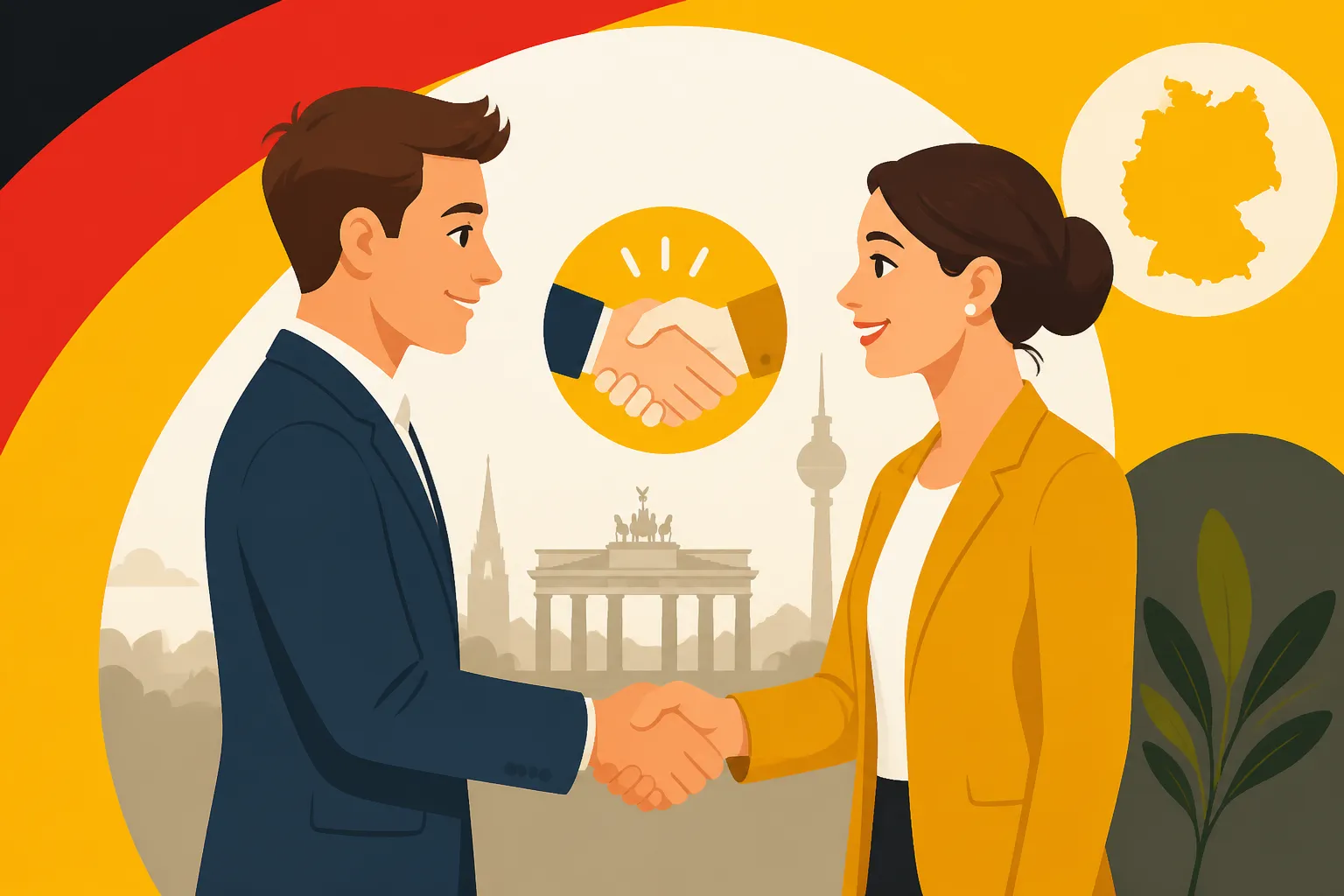
The German handshake is characterized by three main pillars: firmness, eye contact, and individual attention. Unlike some cultures where a light touch is preferred, a "limp" handshake in Germany is often interpreted as a lack of character or confidence. Conversely, you don't want to engage in a bone-crushing contest. The goal is a steady, brief, and confident squeeze. It signifies that you are present, focused, and reliable.
If you are traveling through different cities using Omio to book your trains, you will notice that this standard holds true from the boardrooms of Frankfurt to the small-town guesthouses of the Black Forest. Whether you are checking into a boutique hotel found on Booking.com or meeting a local guide for a tour arranged via GetYourGuide, the initial physical contact sets the tone for your entire interaction.
The Power of Eye Contact
Perhaps more important than the grip itself is the eye contact. In many cultures, direct eye contact can be seen as aggressive or confrontational. In Germany, it is the exact opposite. If you look at the floor or glance over the person’s shoulder while shaking their hand, it is viewed as a sign that you are hiding something or that you are not giving the person the respect they deserve.
I remember a specific instance where a colleague from abroad was introduced to my German department head. The colleague looked at the hand instead of the face during the shake. Later, the department head asked me if the newcomer was "quite shy or perhaps uninterested." To avoid this, make sure your eyes meet theirs the moment your hands touch. Hold the gaze for the duration of the shake—usually about two to three seconds—and offer a slight, professional nod. This is a foundational part of German Etiquette: Do’s and Don’ts in Social and Professional Settings.
Navigating Social Hierarchy and Initiation
One of the most confusing aspects for newcomers is knowing who should extend their hand first. Germany is a society that respects both professional hierarchy and social seniority. Generally, the person with the higher "rank" or the older person should be the one to initiate the handshake. If you are a junior employee meeting a senior partner, wait half a second to see if they extend their hand.
However, if you are the guest entering a space—such as a dinner party or a business meeting—you are often expected to greet the host first. In a professional context, the host will usually take the lead to make you feel welcome. If you are exploring the country and participating in activities like those offered by GetYourGuide, your instructor or guide will often initiate the greeting to establish their role as your point of contact.
The "Individual Greeting" Rule
In many English-speaking countries, it is perfectly acceptable to walk into a room of ten people, wave your hand, and say, "Hi everyone!" In Germany, this is often seen as lazy or even slightly rude in smaller groups. If there are fewer than ten or twelve people, the expectation is that you will go around the circle and shake every single person’s hand individually.
This can feel incredibly tedious the first few times you do it. You might find yourself saying "Guten Tag" ten times in a row, but this persistence is a hallmark of German Culture & Etiquette: A Guide to Social Life and Customs. It shows that you recognize each person as an individual and aren't just treating the group as a faceless collective. If you are staying at a smaller pension or guesthouse booked through Booking.com, taking the time to shake the hands of the family owners individually can go a long way in securing that famous (if slightly guarded) German hospitality.
Formal vs. Informal Greetings: Du and Sie
Handshaking is inextricably linked to the language you use. Germany famously has two versions of "you": the formal Sie and the informal du. The handshake is the standard for both, but the verbal accompaniment changes significantly.
When you are shaking hands with someone you don't know well, or someone in a professional setting, you should always use the formal greeting. "Guten Tag, Herr [Surname]" is the safest bet. Even if you are a traveler who only knows a few Survival German for Travelers: Key Phrases to Learn First, using the formal title shows you have done your homework.
Transitioning to the Informal
The transition from a formal handshake to a more casual greeting (or from Sie to du) is a significant social milestone. Traditionally, the older person or the person of higher status must "offer" the du. Until that happens, keep the handshake firm and the language formal.
Interestingly, even among friends who use du, the handshake remains the go-to greeting. While you might see younger generations in Berlin or Hamburg opting for a quick hug or a cheek-to-cheek "air kiss," the handshake is never wrong. It is the safe "middle ground" of German social life. If you're looking to integrate more deeply into local circles, understanding these nuances is key to Making Friends in Germany: Social Tips for Expats.
| Setting | Type of Greeting | Verbal Accompaniment | Eye Contact |
|---|---|---|---|
| Business Meeting | Very Firm Handshake | "Sehr erfreut" / "Guten Tag" | Constant & Direct |
| Casual Party | Firm Handshake | "Hallo" / "Freut mich" | Friendly but Direct |
| Meeting Elders | Respectful, Firm Handshake | "Guten Tag, Frau/Herr…" | Soft but Steady |
| Service Industry | Professional Handshake | "Guten Tag" | Brief & Clear |
| Regional/South | Firm Handshake | "Grüß Gott" / "Servus" | Direct |
Regional Variations: From Moin to Servus
While the physical act of shaking hands is fairly universal across the country, the words spoken during the shake change as you travel. If you are using Omio to traverse the country from the North Sea to the Alps, you will need to adjust your vocabulary to match the local "vibe."
In Northern Germany—cities like Hamburg, Kiel, or Bremen—you will hear a lot of "Moin." It’s a short, efficient greeting that can be used at any time of day. A Northern handshake is often exactly like the weather: crisp, direct, and no-nonsense. Don't expect a lot of small talk following the handshake here; they prefer to get straight to the point.
In the South, particularly in Bavaria and Baden-Württemberg, the atmosphere is often a bit more traditional. You’ll frequently hear "Grüß Gott" (God greet you) or the more casual "Servus." The handshake remains firm, but there’s often a bit more warmth in the eyes. This is a great place to practice your German Language and Everyday Communication for Visitors because Southerners generally appreciate it when foreigners try to adopt local customs.
To Hug or Not to Hug?
The "Expat Hug" is a well-documented phenomenon where foreigners try to force a level of physical intimacy that Germans aren't always ready for. As a rule of thumb: do not hug a German unless they initiate it, or unless you have known them for a long time and have already transitioned to the du form of address.
Germans value their personal space (their Privatsphäre). A handshake maintains a respectful distance—roughly an arm's length—while still acknowledging the other person. A hug, on the other hand, crashes through that barrier. I have seen many well-meaning expats go in for a hug only to have the German recipient stiffen up like a board. It makes the rest of the interaction incredibly awkward.
If you are unsure, stick to the handshake. Even at a birthday party or a casual "Stammtisch" (regular's table) at a pub, a handshake is perfectly acceptable and never offensive. As you learn more about Du or Sie? Navigating Formal and Informal German Address, you will begin to develop a "gut feeling" for when a handshake can be upgraded to a hug.
Common Pitfalls and How to Avoid Them
Even with the best intentions, it's easy to make a mistake. One of the most common pitfalls is the "gloved" handshake. In the winter, Germany gets quite cold, and everyone wears gloves. However, it is considered very impolite to shake someone’s hand while wearing a glove. You must always remove your right glove before extending your hand. It’s a sign of respect and transparency.
Another common error is shaking hands across a table or over an obstacle. If you are seated and someone approaches to greet you, the polite thing to do is to stand up. Shaking hands while sitting down can be seen as a sign of laziness or a lack of respect, especially if the other person is standing. If there is a table between you, try to move to the side so there is nothing blocking the physical connection.
Handling the "No-Handshake" Situations
In a post-pandemic world, some people are still hesitant about physical contact. If you extend your hand and the other person hesitates or offers a "fist bump" instead, don't take it personally. Simply follow their lead with a smile. The core principle of the German greeting is the acknowledgment of the person, not just the physical skin-to-skin contact. If a handshake isn't possible, maintain that strong eye contact and give a slightly more pronounced nod to show you are still following the rules of German Culture & Etiquette: A Guide to Social Life and Customs.
Summary of the Perfect German Greeting
To wrap it all up, let's look at the "checklist" for a perfect greeting:
- Stand up if you are currently sitting down.
- Remove your glove if you are wearing one.
- Step forward to close the gap to about an arm's length.
- Extend your right hand (even if you are left-handed).
- Lock eyes with the person and do not look away.
- Give a firm, brief squeeze (1-2 pumps).
- Speak clearly: "Guten Tag, [Name]" or "Freut mich."
- Repeat for every individual person in the immediate circle.
Mastering this simple ritual will do more for your social integration in Germany than almost any other single habit. It shows that you aren't just a visitor, but someone who respects the local way of life. Whether you’re meeting a new landlord for an apartment you found on a local portal or simply saying hello to a new neighbor, the handshake is your first—and most important—tool for success.
Disclaimer
This guide is intended for informational purposes only. Cultural norms can vary significantly based on specific regions, social circles, and individual preferences. While these "rules" reflect general German etiquette, always observe the behavior of those around you and adapt accordingly. The author and publisher are not responsible for any social misunderstandings or consequences arising from the use of this information.