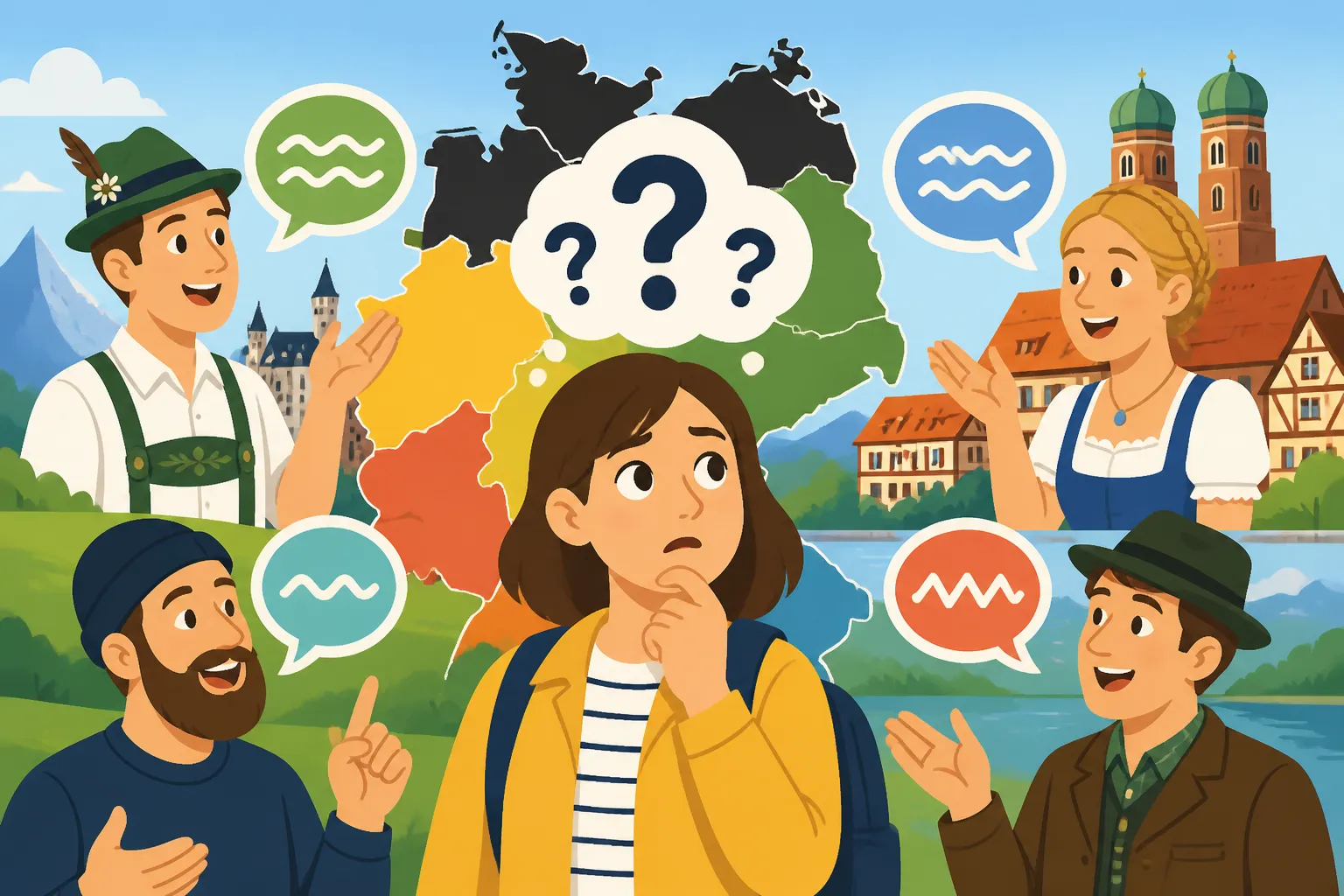
How to Handle German Dialects as a Visitor
You spent months practicing your "Ich möchte bitte…" and perfecting your "ch" sounds, only to arrive in a quaint village in the Black Forest or a bustling beer hall in Munich and realize you cannot understand a single word of the local conversation. This guide solves the common frustration of "dialect shock" by providing realistic strategies to navigate Germany's linguistic diversity with confidence.
Disclosure: This post may contain affiliate links. We may earn a commission at no extra cost to you if you make a purchase through these links. Read full disclosure.
The Reality of the German Dialect Map
When you first arrive in Germany, you likely have a firm grasp of Hochdeutsch, or Standard German. This is the language of news anchors, textbooks, and government officials. However, once you step outside the major urban centers of the north, you quickly realize that German is not a monolithic language. It is a vibrant, sometimes chaotic patchwork of regional dialects that have evolved over centuries. For a visitor, this can feel like a personal failure—you think your German is bad, but in reality, you are just encountering a version of the language that wasn't in your grammar book.
The transition from the classroom to the real world is often where the most significant culture shock occurs. I remember my first trip to a small town in Upper Bavaria; I felt like I had accidentally crossed the border into a completely different country. The vowels were rounded in ways I didn't recognize, and common words like "Guten Tag" were replaced with "Grüß Gott." This isn't just about pronunciation; it’s about regional identity. Understanding that these dialects exist is the first step toward not letting them ruin your travel experience.
Why Standard German Is Not Always the Default
In theory, almost every German can speak and understand Standard German. It is the language used in schools and workplaces. However, in casual settings—cafés, local markets, or family-run guesthouses—the regional dialect is the language of the heart. It is warmer, more familiar, and deeply rooted in the local culture. When you are Visiting Germany in Summer: Festivals and Long Days, you are much more likely to encounter these dialects because locals are in a celebratory, relaxed mood where the formal constraints of Hochdeutsch are cast aside.
For the visitor, this means you might encounter a "barrier of comfort." A shopkeeper might know how to speak standard German but may instinctively answer you in their regional accent. It is rarely an act of rudeness; rather, it is a reflection of their daily reality. Recognizing this allows you to lower your defenses. Instead of getting frustrated, you can view it as an opportunity to experience an authentic slice of German life that many tourists miss.
The Major Dialect Families You Will Encounter
Broadly speaking, Germany is divided into Low German (Plattdeutsch) in the north and High German (which includes Central and Upper German) in the south. The "Benrath Line" is the linguistic boundary that separates these two worlds. In the north, the language is often described as sounding a bit more like English or Dutch, with hard consonants and a rhythmic flow. If you are Living in Hamburg: A Guide to Germany’s Port City for Newcomers, you might hear "moin" instead of "hallo," a greeting that works 24 hours a day.
As you move south into the Central German regions—think Frankfurt or Cologne—the dialects become more melodic but also more distinct in their vocabulary. Then, you hit the Upper German dialects like Bavarian and Swabian. These are the ones that typically give travelers the most trouble. They are thick, heavy on the "sch" sounds, and often drop the ends of words entirely. Whether you are using Omio to book a high-speed train across the country or renting a car to explore the valleys, you will notice the language shifting almost every fifty kilometers.
Practical Strategies for the Confused Traveler
Navigating a conversation when you don't understand the dialect requires a mix of humility, humor, and a few pre-planned linguistic "escape hatches." The most important thing to remember is that you are the guest, and most Germans are incredibly patient if they see you are making an effort. If you find yourself staring blankly at a waiter in a rural "Gasthof," do not panic. Take a breath and use your eyes before you use your ears.
Non-verbal communication in Germany is quite standardized, even if the spoken language isn't. Observe the gestures, the tone of voice, and the context of the situation. If you are at a bakery and the clerk says something unintelligible while pointing at a loaf of bread, she is likely asking if you want it sliced or wrapped. Many of the Common Cultural Surprises for First-Time Visitors to Germany stem from these small interactions where the "what" is obvious even if the "how" (the language) is a mystery.
Decoding Context and Non-Verbal Cues
Context is your best friend when your vocabulary fails you. When you are Ordering Food and Drinks in German: A Practical Phrasebook, the environment dictates 90% of the conversation. In a restaurant, the flow is predictable: greeting, drink order, main course, "was everything okay?", and the bill. If a server uses a dialect-heavy phrase like "Passt’s?", they are simply asking if everything is to your satisfaction. You don't need to understand the grammar to know that a nod and a "Ja, danke" is the correct response.
I often tell newcomers to look at the "energy" of the speaker. In Berlin, the local "Berliner Schnauze" can sound aggressive or blunt to the uninitiated, but it’s often just a form of dry, local humor. In the south, the tone is often more "gemütlich" (cozy and relaxed). By matching the local energy, you build a bridge that transcends specific words. If you are using GetYourGuide to book a local food tour, your guide will likely be an expert at "translating" these cultural vibes for you, which is a great way to ease into the linguistic landscape.
Essential Phrases to Gently Pivot to Standard German
There is no shame in asking a local to speak Standard German. In fact, most will take it as a compliment that you are trying to use your Hochdeutsch skills. The key is how you ask. Instead of saying "I don't understand," try a more specific request like, "Könnten Sie das bitte auf Hochdeutsch sagen?" (Could you please say that in Standard German?). This signals that you do speak the language, just not their specific regional version.
If you are a beginner, the phrase "Ich lerne noch Deutsch" (I am still learning German) is a magic wand. It immediately softens the interaction. Most locals will then switch to either a very clear version of Standard German or, if they see you struggling significantly, English. This is particularly helpful when you are Finding a Doctor (Hausarzt) in Germany: How to Choose and Register, where clear communication is vital for your health and safety.
Regional Highlights: A Survival Guide for Travelers
To truly handle German dialects, it helps to know the "Big Hits"—the regional variations you are most likely to encounter on a standard tourist itinerary. Each region has its own linguistic quirks that serve as a badge of honor for the locals. Knowing even two or three regional words can transform you from a generic tourist into a "sympathischer Gast" (a likable guest).
When you are Bavaria for Travelers: Munich, the Alps, and Beyond, you are in the heart of dialect country. Here, "Bayerisch" isn't just a way of speaking; it's a way of life. It’s important to realize that the dialect changes even within Bavaria. A person from Munich sounds very different from someone in the deep forest of the Oberpfalz. However, the basics remain the same: round your vowels, be prepared for "servus" as a greeting and a goodbye, and don't be surprised if "ja" sounds more like "joa."
Navigating Bavarian and Swabian
Bavarian is famous for its "softening" of consonants. "Tag" might sound like "Dog," and the "r" is often rolled or swallowed. If you are staying in a local pension booked through Booking.com, your host might greet you with "Griaß di" (standard: Grüß dich). It sounds daunting, but it’s essentially just a compressed version of the greeting you already know. The Swabian dialect (found around Stuttgart and Lake Constance) is known for its “sch” sound. They love to add "-le" to the end of words to make them smaller or cuter—like "Spätzle" or "Brezele."
Understanding these diminutives is a key part of German Dining Etiquette: Eating Out, Tipping, and Table Manners. If someone offers you a "Versucherle," they are offering you a small sample or taste of something. It is a warm, inviting dialect once you get past the initial thicket of "sch" sounds. Swabians are also notoriously proud of their dialect, so showing that you recognize a few words can go a long way in building rapport.
Understanding Low German and Berliner Schnauze
In the north, particularly along the coast, you may encounter Plattdeutsch. While less common in the big cities today, it still influences the way people speak. It is much more guttural and shares many similarities with Dutch and Low Scots. If you are exploring Northern Germany and the Coast: Hamburg, the Baltic, and North Sea, you will hear people say "Tschüss" with a very sharp, quick ending. The "moin moin" you hear in the morning is actually used all day long; "moin" actually comes from a word meaning "beautiful" or "good," not "morning."
Then there is Berlin. The "Berliner Schnauze" (Berlin Snout) is less of a dialect and more of an accent combined with a very specific attitude. It involves changing "g" to "j" (so "gut" becomes "jut") and "ich" to "icke." It’s fast, witty, and can feel a bit dismissive. However, it is rarely meant to be mean. If you are in the capital and someone gives you a blunt answer, they are treating you like a local. It is part of the charm of Berlin for First-Time Visitors: Neighborhoods and Highlights.
Leveraging Technology and Planning Your Trip
In the modern age, you don't have to face these linguistic hurdles alone. Technology has advanced to the point where your smartphone can act as a bridge between your textbook German and the local reality. However, technology should be used as a supplement, not a replacement for human interaction. The goal is to use these tools to lower your anxiety so you can focus on the experience.
When planning your route, consider how language might change your travel pace. If you are sticking to the "Intercity Express" (ICE) lines, you will mostly hear Standard German announcements. But once you switch to regional trains or buses to reach Germany's Most Beautiful Small Towns to Visit, you are entering the "Dialect Zone." Using platforms like Omio allows you to see these regional connections clearly, giving you a mental map of where you might need to sharpen your listening skills.
Digital Tools to Help You Translate Accents
While Google Translate is the industry standard, it often struggles with heavy regional dialects. For Germany, apps like DeepL are generally considered more accurate for nuance. Some specialized apps even exist to translate specific dialects like Bavarian into Hochdeutsch. However, the most useful "tech" is often just the voice-to-text feature on your phone. If you truly cannot understand a written sign or a menu item, a quick photo-translate can save the day.
Keep in mind that in many rural areas where dialects are strongest, cell service can be spotty. It is a good idea to download offline maps and language packs before you head out. This is essential for Hiking in Germany: The Black Forest, Alps, and Beyond, where you might need to ask a local for directions and find yourself with zero bars of signal. Having a few basic regional terms saved in your notes can be a lifesaver.
Comparison of Common Regional Terms
| Standard German (Hochdeutsch) | Bavarian (Bayerisch) | Northern German (Platt) | Meaning |
|---|---|---|---|
| Guten Tag | Grüß Gott / Servus | Moin | Good Day / Hello |
| Brötchen | Semmel | Rundstück | Bread Roll |
| Tschüss | Pfiat di | Tschüss (short) | Goodbye |
| Ein bisschen | A bisserl | En betten | A little bit |
| Mädchen | Madl | Deern | Girl |
| Braten | Brodn | Braden | Roast (meat) |
Coordinating Travel to Diverse Regions
To get a full taste of Germany's linguistic diversity, you should try to visit at least two distinct regions. A trip that combines the "Schnauze" of Berlin with the "Gemütlichkeit" of Munich provides a perfect contrast. When you are Visiting Germany in Winter: Christmas Markets and Snow, these regional differences become even more apparent through local songs, traditional foods, and festive greetings.
Use Booking.com to find stays in smaller towns where the dialect is more likely to be spoken. These "Pensionen" often offer a more intimate look at local life than large international hotels. Similarly, booking local experiences through GetYourGuide can put you in touch with guides who are passionate about their regional heritage and can explain the "why" behind the local way of speaking.
Disclaimer
This guide is for informational purposes only and is based on the personal experiences of expats and travelers. Language norms and the prevalence of dialects can vary significantly even within small geographic areas. While we strive for accuracy, regional linguistic trends are constantly evolving. Always approach local interactions with respect and patience.
Summary Table of Regional Greetings
| Region | Primary Greeting | Best Response | Context |
|---|---|---|---|
| Bavaria | Grüß Gott | Grüß Gott | Formal/General |
| Northern Germany | Moin | Moin | Anytime, very casual |
| Swabia (SW) | Ade | Ade | Goodbye specifically |
| Berlin | Juten Tach | Juten Tach | Casual/Street |
| Rhineland | Juten Morjen | Juten Morjen | Morning/General |
| Saxony | Guden Dach | Guden Dach | Very soft "D" sounds |
By understanding that German dialects are a source of local pride rather than a barrier to communication, you can navigate your trip with much less stress. Keep your "Hochdeutsch" as your foundation, but don't be afraid to sprinkle in a "Servus" or a "Moin" when the situation calls for it. Happy travels—or as they say in Bavaria, "Pfiad eich!"