The German Alps: Garmisch, Zugspitze, and Berchtesgaden
You’ve finally booked that Alpine trip, and then the questions start. Garmisch or Berchtesgaden? Cogwheel train or cable car to the Zugspitze? Can you reach any of it without a car? Many first-timers lose half a day to bad logistics or fog. This guide compares both regions, explains each summit route and covers the practical details that make an Alpine trip work.
Disclosure: This post may contain affiliate links. We may earn a commission at no extra cost to you if you make a purchase through these links. Read full disclosure.
Choosing Your Base: Garmisch-Partenkirchen or Berchtesgaden
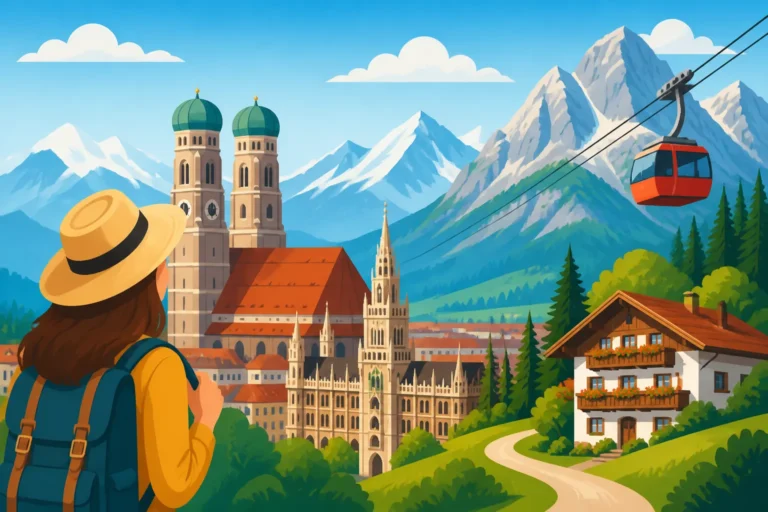
The German Alps are a narrow band along Bavaria’s southern border, but their two most famous corners feel very different. Garmisch-Partenkirchen sits southwest of Munich below the Wetterstein range and the Zugspitze. Berchtesgaden is tucked into the far southeastern corner, almost surrounded by Austria and closer to Salzburg than to Munich. On my first trip I tried to do both in one long weekend. I spent more time on regional trains than on mountains, and I don’t recommend it.
What Garmisch-Partenkirchen Feels Like on the Ground
Garmisch-Partenkirchen is two old market towns merged into one resort. Locals still notice the difference. Partenkirchen keeps the older feel, with Ludwigstrasse lined with painted facades in the traditional Lüftlmalerei style. Garmisch is busier and more commercial, and it has most of the hotels, outdoor shops and restaurants. Walking between the two takes about twenty minutes, and the change in atmosphere is noticeable.
The town is set up for active travellers. Several mountain lifts start within a short bus ride of the station, hiking trails begin at the edge of town, and the Zugspitze looms over everything. If your idea of a holiday is getting up high every day and coming back to a proper Bavarian dinner, Garmisch suits you. Mittenwald, the violin-making village, and Oberammergau, known for its painted houses and woodcarving, are both easy excursions.
The downside is crowds. On sunny summer weekends and during school holidays, the Zugspitze queues, the Partnachklamm gorge and the Eibsee shoreline can feel more like a theme park than a mountain village. If you hate crowds, aim for weekdays and early starts.
What Berchtesgaden Offers That Garmisch Does Not
Berchtesgaden is quieter, more spread out and, for many travellers, more beautiful. The Watzmann massif dominates the skyline. The Berchtesgaden National Park protects much of the surrounding land, so the valleys feel less developed than around Garmisch. The main attraction is the Königssee, a narrow, emerald lake between steep rock walls that you can only cross by quiet electric boat.
Berchtesgaden also has historical weight that Garmisch lacks. The Obersalzberg above town was a Nazi leadership retreat, and the documentation centre there deals with that history seriously. The Kehlsteinhaus, known in English as the Eagle’s Nest, sits on a ridge above it. Add the old salt mine and the town works well for families and history-minded visitors as well as hikers.
The trade-off is access. Berchtesgaden is a longer, more awkward journey from Munich, and the sights are spread across the valley, so you depend on buses or a car. If you are coming from Austria, the town makes even more sense. The Salzburg connection is easy, and many visitors combine the two; for the Salzburg side, see How to Visit Salzburg From Munich for the Day.
Comparing the Two Alpine Bases Side by Side
| Factor | Garmisch-Partenkirchen | Berchtesgaden |
|---|---|---|
| Location | Southwest of Munich, Wetterstein range | Far southeast, near Salzburg |
| Signature sight | Zugspitze summit | Königssee and St. Bartholomä |
| Rail access from Munich | Direct regional trains, simple | Usually a change in Freilassing |
| Atmosphere | Lively resort town | Quieter, national park feel |
| Best for | Peak-bagging, skiing, active trips | Lakes, history, gentler hiking |
| Rainy day options | Museums, thermal pool, nearby villages | Salt mine, documentation centre |
| Crowd pressure | High at weekends and holidays | High at the Königssee in summer |
| Car needed | Rarely | Helpful but not essential |
For a broader regional overview before deciding, Bavaria for Travelers: Munich, the Alps, and Beyond covers how the Alpine strip fits with the rest of the state.
Reaching the Zugspitze: Germany’s Highest Summit
At 2,962 metres, the Zugspitze is the highest point in Germany, and the summit sits right on the Austrian border. You can stand on a terrace in Bavaria and look straight into Tyrol. There are three main ways up without climbing: the cogwheel train, the cable car from the Eibsee, and the Tyrolean cable car from Ehrwald on the Austrian side. Most visitors combine two of them, going up one way and down the other.
The Cogwheel Train Route via Zugspitzplatt
The Bayerische Zugspitzbahn is a rack railway that leaves from its own station right beside the main Garmisch-Partenkirchen station. It climbs through Grainau and past the Eibsee before entering a long tunnel inside the mountain. It comes out on the Zugspitzplatt, a high glacier plateau where the ski area and the Sonnalpin restaurant are. From there, the short Gletscherbahn cable car takes you up to the summit station.
This is the slower option, but I think it is the more interesting one. The ride feels like a journey, kids love the tunnel, and you can get off on the plateau to walk around in the snow before going higher. The chapel of Mariä Heimsuchung, Germany’s highest church, sits on the plateau. If the summit is in cloud but the plateau is clear, you still get a real high-mountain experience.
One important point for budget travellers: the Deutschland-Ticket covers regional trains to Garmisch but not the Zugspitzbahn. The mountain railways are private and priced separately. Check the operator’s own website for current combined summit tickets, family options and seasonal rules.
The Cable Car From Eibsee
The Seilbahn Zugspitze starts at the Eibsee, a lake at the foot of the north face. It rises in one dramatic sweep to the summit station, with a famously steep final section. The ride takes minutes instead of the train’s long climb. It is the right choice if you are short on time or simply want the view of the rock face rushing past your window.
You can reach the Eibsee valley station by the cogwheel train, by regional bus from Garmisch, or by car, though the car park fills on good days. A popular loop is to take the cogwheel train up through the plateau and come down by cable car, then walk part of the Eibsee shoreline before catching the train or bus back. That way you see both routes and the lake in one day.
If you want to earn the summit on foot, the Reintal and Höllental routes are serious undertakings. The Höllental involves glacier and via ferrata sections. See How to Hike the Zugspitze or Reach Its Summit for the routes in detail.
Weather, Altitude, and the Summit Reality
The Zugspitze sees low cloud often, and a clear morning in Garmisch can turn white at the top by midday. Before you buy tickets, check the live summit webcams. The operator publishes them, and locals check them before deciding whether to go up. If the cameras show nothing but grey, postpone. The plateau and summit are cold even in August, so bring a warm layer, gloves in shoulder season, and sunglasses for the glare off the snow.
Altitude affects some visitors. Going from valley level to almost three thousand metres in under an hour can cause headaches or light-headedness. Move slowly, drink water, and come down if you feel unwell. The summit terrace has the restaurant, the golden summit cross on a short rocky scramble, and the border crossing point. Expect to share it with crowds on clear days.
Beyond the Summit: Garmisch Day Plans
Many visitors arrive, ride up the Zugspitze, and leave. That’s a shame, because the lower valleys and second-tier peaks around Garmisch are often more rewarding and much less crowded. Plan at least one day here without the summit, especially if the weather is unsettled.
Partnachklamm and the Olympic Ski Jump
The Partnachklamm is a narrow gorge cut by the Partnach river, with a path carved into the rock walls, sometimes through short tunnels, right beside the roaring water. Expect spray and dripping walls, so wear a rain jacket even on a dry day. In winter, icicles hang from the walls. It’s one of the most memorable short walks in the Bavarian Alps.
The walk to the gorge starts at the Olympic ski stadium, whose huge ski jump is visible from much of town and still hosts the New Year ski jumping event. From the stadium it is a gentle walk up the valley road to the gorge entrance, where there is a fee. Afterwards you can climb up to the Graseck area or carry on to mountain inns in the valley above for lunch.
A practical tip: arrive early in summer. By late morning, tour groups and families fill the narrow path, and you will shuffle along in a queue. At opening time you might have stretches of the gorge almost to yourself.
Alpspitze, Eibsee, and Easy Lake Walks
The Alpspitzbahn cable car takes you to the Osterfelderkopf, where the AlpspiX viewing platform reaches out over the drop. It’s two steel arms with glass ends hanging above the Höllental valley. From the top station, well-marked trails lead to the Kreuzeck and back down, or around the high Alpine basin with a view of the Alpspitze’s distinctive pyramid. For many families, this is the best mountain day in Garmisch: high, dramatic, but manageable.
The Eibsee itself deserves time. A loop trail circles the lake, mostly flat with a few small climbs. The water changes from turquoise to deep green depending on the light. You can rent rowing boats in season, and the small islands make good picnic spots. Locals swim in summer, and the water stays cold even then.
If you have a car or are happy with buses, Schloss Linderhof and the Ettal Monastery are a short drive north. Neuschwanstein is reachable for a longer day. To plan multi-day hiking and mountain routes around the region, How to Plan a First Trip to the German Alps covers pacing and route choice.
Berchtesgaden in Depth
Berchtesgaden rewards slow travel. The town itself is compact and pretty, with a royal palace, painted buildings and a small market square. But you come for what surrounds it. Plan two full days minimum, ideally three.
Königssee and the Boat to St. Bartholomä
The Königssee boats leave from the village of Schönau am Königssee, a short bus ride from Berchtesgaden station. The fleet is electric, so the lake stays quiet and clean. Partway across, the boatman stops below the Echowand and plays a short tune on the flugelhorn. The notes bounce off the cliffs. Everybody knows it’s coming, and it still gives you goosebumps.
The first main stop is St. Bartholomä, the red-domed pilgrimage church on a small peninsula below the Watzmann’s east face. There is a historic inn serving smoked fish caught in the lake. From here you can walk to the Eiskapelle, a snowfield at the base of the cliffs. Treat it as a viewpoint only, because entering the ice cave below is dangerous and people have been killed by collapses.
In the warmer months, boats continue to Salet at the southern end. A short walk from there brings you to the Obersee, a smaller, wilder lake with the Röthbach waterfall dropping down the wall beyond. This is the calmer, more photogenic part of the trip. Check the return times carefully. The last boats fill up, and nobody wants to be stranded. For more detail on timing and walking options, see How to Visit Berchtesgaden and Königssee.
The Kehlsteinhaus and Dokumentation Obersalzberg
The Kehlsteinhaus sits on a rocky ridge high above the valley, reached by a road closed to private cars. Special buses run from the Obersalzberg bus terminal up the mountain road. A tunnel then leads to a brass-lined lift that rises through the rock to the building. It usually opens only in the warmer months, depending on snow. On a clear day the view over the Berchtesgaden valley, the Königssee and towards Salzburg is extraordinary.
Many visitors arrive knowing only the nickname, so it helps to understand the context. The building was a gift to Hitler for his fiftieth birthday. Today it is a restaurant, with information boards rather than a museum. Visit the Dokumentation Obersalzberg first, near the bus terminal. It explains how the area became a second seat of Nazi power, and it puts what you see on the ridge in its proper context. Treat both places respectfully. It’s not a place for jokey photos.
Guided tours are an option if you want historical commentary without researching it yourself. Platforms like GetYourGuide list Obersalzberg and Eagle’s Nest tours from both Berchtesgaden and Salzburg. These are useful if you are coming from Austria and want transport handled. Compare what each tour actually includes, because some cover only transport and leave the interpretation to you.
The Salt Mine and Rainy Day Options
The Salzbergwerk Berchtesgaden has been worked for centuries and still produces salt. The visitor tour puts you in miners’ overalls, sends you underground on a small train, and takes you down wooden miners’ slides between levels. There’s a light show on an underground salt lake, crossed by raft. It is family-friendly, takes about an hour, and runs whatever the weather. That makes it the default rainy-day plan, so expect queues on wet days.
Other wet-weather options include the Watzmann Therme thermal pool, the Haus der Berge national park visitor centre with excellent displays on Alpine ecology, and the Königliches Schloss in town. When the weather clears, the Jenner cable car from Schönau gives superb views down to the Königssee. The Rossfeld Panoramastraße, a high toll road along the Austrian border, is spectacular if you have a car.
Getting There and Getting Around Without Stress
Both regions are reachable by public transport, which is one of Germany’s great strengths. But the details matter, and a missed connection in a small Alpine station can cost you an hour.
Trains From Munich and Salzburg
Garmisch-Partenkirchen is straightforward. Regional trains run directly from Munich Hauptbahnhof, and the journey takes roughly an hour and a half through the lake district and foothills. Sit on the left-hand side heading south for the better mountain views as you get closer. Trains continue towards Mittenwald and Innsbruck, which makes a Garmisch-Tyrol combination easy.
Berchtesgaden usually means a change at Freilassing on the Munich-Salzburg line, then a branch line into the valley. From Salzburg there is also a frequent regional bus that is often faster and more convenient than the train. Once in Berchtesgaden, the RVO regional buses connect the station with Schönau, Obersalzberg and the salt mine. Many accommodations issue a guest card that may include local bus travel. Ask your host what yours covers.
When comparing train and bus options, especially across the Austrian border, an aggregator like Omio is useful for seeing schedules and journey times side by side. Deutsche Bahn’s own app remains the most accurate source for live delays and platform changes. For the details of regional tickets and connections, read Reaching Alpine Resort Towns by Rail: Tickets, Changes, and Journey Times.
Booking Accommodation and Tours in Peak Season
In July, August, around Christmas and during ski season, both towns fill up. Family-run Pensionen and Gasthöfe give you the most character. Many offer generous breakfasts, and hosts are happy to suggest hikes that suit the day’s weather. Holiday apartments make sense for longer stays or groups. Booking.com is a convenient way to compare availability across both towns, but small properties sometimes offer better terms when you contact them directly. Read the cancellation policy before you commit, because mountain weather can upend plans.
Expect a local visitor tax, known as Kurtaxe, added per person per night. It funds the guest card and local services. Room sizes in traditional houses can be small, and lifts are rare in older buildings. If you are travelling with older relatives or heavy luggage, ask about this. To figure out which village or town suits your style, see Where to Stay in the German Alps: Which Resort Town Suits Your Trip.
If you want to sleep higher, mountain huts are an unforgettable experience. You get bunk rooms, hearty food and sunrise above the clouds. They work on their own booking systems and have their own etiquette, so read Berghutten and Mountain Huts: How Booking Works in the German Alps before turning up with a rucksack and good intentions.
Practical Mountain Know-How for Visitors
The German Alps are well developed and well signposted, which can make visitors careless. The mountains here still kill people every year, usually people who misjudged the weather, the terrain or their own fitness.
Seasons and When to Go
Summer, roughly late June to early September, is the main season for hiking, lakes and the Kehlsteinhaus. It is also when afternoon thunderstorms build. Locals start early and aim to be off exposed ridges by early afternoon. September and early October are my favourite: clearer air, fewer crowds, autumn colours and still-open huts, though some lifts start reducing operations.
Winter brings skiing on the Zugspitzplatt and in the Garmisch Classic area, cross-country trails in the valleys, and a snowy Königssee with a reduced boat schedule. Late autumn and spring have gaps between seasons when lifts close for maintenance and huts shut. Check opening calendars before you travel. For skiing specifically, see Where Can You Ski in Germany and When?.
Safety, Packing, and Insurance
Pack for a mountain, even if you are only taking a cable car. Basic gear:
- Sturdy shoes with grip.
- A waterproof shell and a warm layer.
- Sun protection and water.
- A charged phone with offline maps.
Trail signs in Bavaria show walking times rather than distances, and they are calibrated for fit walkers, so add a margin. The European emergency number 112 works throughout the region. Mountain rescue, the Bergwacht, is highly skilled but can be expensive if a helicopter is involved. For a full checklist, see What to Pack for Hiking in the German Alps.
That brings us to insurance, the item most visitors never think about until it’s too late. Many standard travel policies exclude or limit Alpine activities, helicopter rescue or off-piste skiing. Read the small print before you go, not after. Two guides explain the details: Skiing in the Bavarian Alps: Rescue Costs and What Policies Exclude and Hiking and Via Ferrata in the Alps: The Clauses That Void Your Cover.
Finally, respect local customs. Greet hikers with “Servus” or “Grüß Gott”. Stay on marked paths in the national park. Keep dogs on a lead where livestock graze. Take your rubbish down with you. Good manners go a long way in the Bavarian mountains.
Disclaimer
This article is for general informational purposes only and does not constitute professional advice. Laws, prices and regulations vary by location and change over time. Consult a qualified professional for guidance on your specific situation.