What Is the Deutschland-Ticket and Is It Worth It?
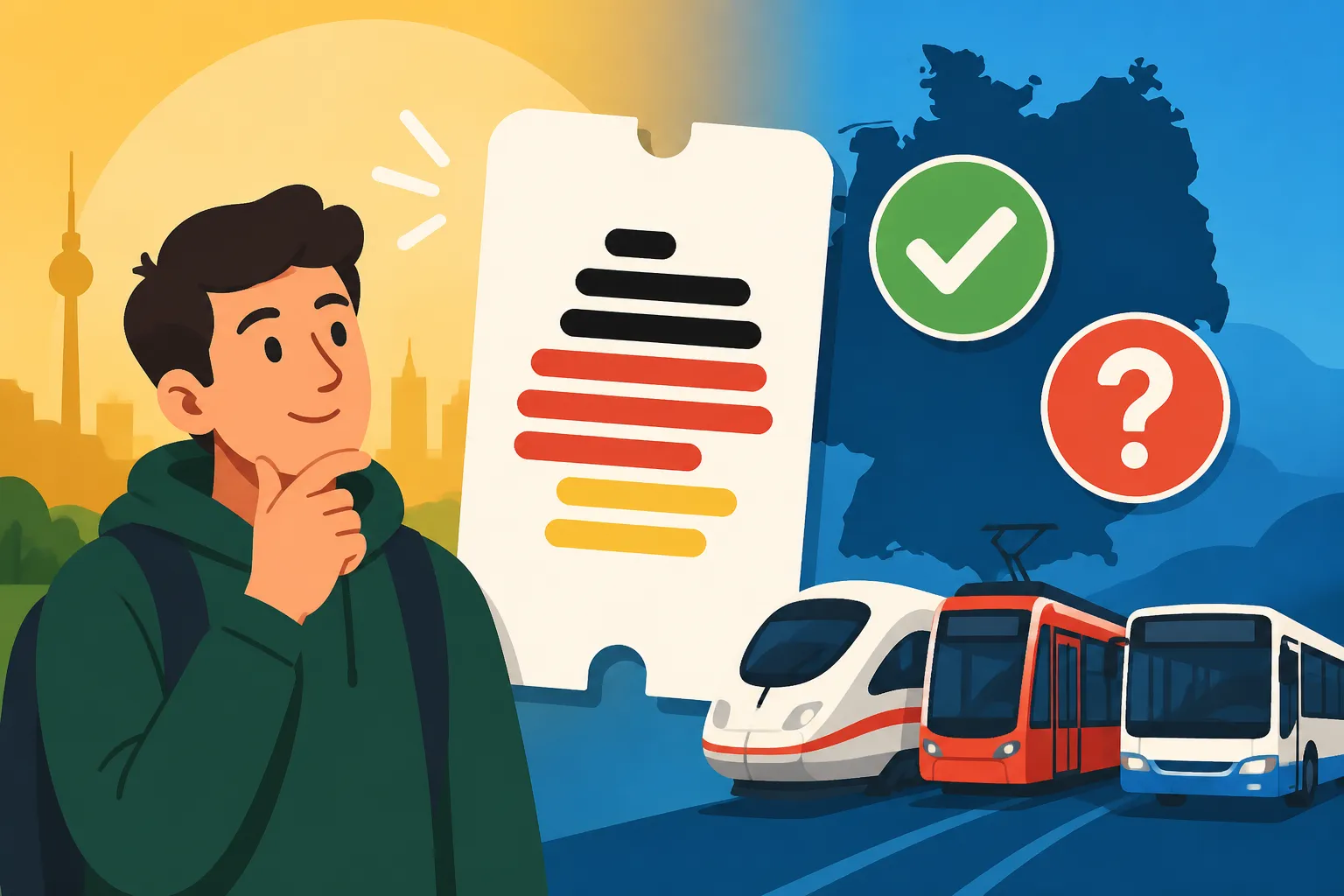
Navigating public transportation in Germany used to require an advanced degree in transit logistics, with every city and region operating its own complicated fare zones, ticketing machines, and price tiers. The Deutschland-Ticket was introduced to sweep away that complexity, replacing hundreds of local transit rules with a single, digital monthly pass that unlocks unlimited regional and local travel across the entire country.
Disclosure: This post may contain affiliate links. We may earn a commission at no extra cost to you if you make a purchase through these links. Read full disclosure.
Whether you are relocating to Germany, commuting daily, or visiting on an extended vacation, understanding how this national transit pass functions will save you considerable money and stress. This guide breaks down what the ticket covers, how the subscription model works, how to avoid common cancellation traps, and whether it makes financial sense for your personal travel itinerary.
What Exactly Is the Deutschland-Ticket?
The Deutschland-Ticket, often referred to locally as the D-Ticket, is a government-subsidized public transportation pass designed to encourage sustainable travel and simplify local transit access. Unlike traditional city passes that restrict you to a single municipality or specific concentric tariff zones, this pass covers local and regional transport across every German state.
For decades, arriving in a new German city meant deciphering regional transit authorities like Berlin’s BVG, Munich’s MVV, or the Rhine-Ruhr area’s VRR. A ticket bought in Frankfurt was completely useless the moment you boarded a bus in Stuttgart. The Deutschland-Ticket eliminates these boundaries entirely. With one active digital pass on your smartphone, you can board a city bus in Hamburg, switch to the U-Bahn in Nuremberg, and ride a regional train through the Black Forest without ever standing in front of a ticket machine or worrying about crossing regional transit borders.
How Coverage Works Across Transit Networks
The pass acts as a universal key for local transit networks. When you board any public urban or suburban transport vehicle operated by a municipal transit authority, your pass is valid. This includes all city buses, trams (Straßenbahn), underground subways (U-Bahn), and suburban commuter rail lines (S-Bahn). You can explore full details on urban mobility options in our guide to Getting Around German Cities: U-Bahn, S-Bahn, Trams, and Buses.
In addition to municipal transit, the pass extends to regional train lines operated by Deutsche Bahn and several private rail companies. These services are designated as Regional-Express (RE) and Regionalbahn (RB) trains. They connect major cities with smaller towns and rural areas, stopping more frequently than long-distance express services. You can also use the pass on select public ferries in coastal or river cities, such as the HADAG harbor ferries in Hamburg or river ferries operating in Berlin, provided they are part of the local public transport network.
Valid Modes of Transport vs Excluded Express Trains
Understanding what is excluded from the pass is just as critical as knowing what is covered. The fundamental rule of the Deutschland-Ticket is that it applies exclusively to local and regional transit. It strictly excludes long-distance, high-speed rail services.
You cannot use the pass on any of the following services:
* Intercity-Express (ICE) trains, which are Germany’s high-speed flagship service.
* Intercity (IC) and Eurocity (EC) long-distance trains.
* Private long-distance trains such as FlixTrain.
* Long-distance coach buses such as FlixBus.
* First-class carriages, unless a specialized regional upgrade pass is purchased separately.
Boarding an ICE train with only a Deutschland-Ticket is treated by conductors as traveling without a valid ticket, resulting in a substantial fine and the requirement to purchase a full-fare long-distance ticket on the spot. If you need to travel long distances quickly across the country, you must purchase separate long-distance tickets. To understand how long-distance travel operates, review our detailed guide on High-Speed Trains in Germany (ICE): Deutsche Bahn Routes and Savings.
Purchasing, Managing, and Canceling the Subscription
While the Deutschland-Ticket provides immense freedom on the tracks, the administrative mechanics behind it reflect classic German bureaucracy. The pass is not sold as a simple, single-use monthly ticket or a standard 30-day tourist pass. Instead, it is strictly structured as an ongoing, auto-renewing digital subscription (known locally as an Abo).
Navigating the Digital Subscription Model
Because the pass operates as a monthly subscription, it runs strictly on a calendar-month basis—from the first day of a given month to the final day of that same month. It does not run for 30 rolling days from the date of purchase. If you buy the ticket on the 15th of July, it remains valid only until the end of July, and your subscription will automatically renew for August unless you take proactive action.
You can purchase the subscription through various digital platforms. The primary platform used by most travelers and expats is Deutsche Bahn’s mobile application, which you can read more about in our guide on How to Use the DB Navigator App in Germany. Alternatively, you can purchase it through regional transport apps like Hamburg’s hvv switch, Berlin’s BVG, or independent national transit portals.
Payment is typically processed via SEPA direct debit from a European bank account or through standard credit and debit cards. Once purchased, the ticket is delivered digitally as a dynamic barcode stored within your chosen app or added to your digital smartphone wallet.
Managing the Cancellation Trap for Short-Term Visitors and Expats
The absolute biggest pitfall for foreign visitors, digital nomads, and new expats is missing the monthly cancellation deadline. Because the pass auto-renews automatically every month, you must explicitly cancel the subscription if you only plan to use it for a single calendar month.
The mandatory cancellation deadline across almost all issuing authorities is the 10th day of the current month for the cancellation to take effect at the end of that month.
Consider these real-world scenarios to see how this rule impacts your budget:
* Scenario A: You arrive in Germany on June 2nd and purchase the pass on the same day. You immediately log into your app account before June 10th and submit a cancellation request. Your pass remains fully valid until June 30th, and your subscription ends without renewing for July.
* Scenario B: You arrive in Germany on June 12th and purchase the pass for your trip. Because you bought the pass after the June 10th deadline, you can no longer cancel the subscription for July. You will automatically be charged for the entirety of July, even if you return to your home country at the end of June.
If you arrive mid-month and only need public transport for a few days, buying individual city day tickets or regional passes might be cheaper than paying for a full month’s subscription that you cannot cancel in time. For an overview of conventional transit fares, check our article on Public Transport Tickets and Passes: Navigating German Transit Systems.
Is the Deutschland-Ticket Worth It for You?
Determining whether the pass makes sense for your stay comes down to simple math and your personal tolerance for travel time. For many residents and visitors, the pass pays for itself in a surprisingly short amount of time, but it is not a universal solution for every travel style.
Daily Commuters vs Occasional Travelers
If you reside in Germany or are staying for several weeks, the value proposition is overwhelmingly positive. Prior to this unified system, a single monthly transit pass inside a major hub like Frankfurt, Munich, or Berlin often cost significantly more than this single national subscription. If you commute to work or university using public transport just three or four days a week, the Deutschland-Ticket will save you a substantial amount of money every month.
For tourists and short-term visitors, calculating the value depends on your specific itinerary:
* City Sightseeing: If you plan to stay within one city for three days and take only two U-Bahn trips per day, standard single tickets or a local 24-hour city card will likely be more economical.
* Day Trips and Regional Travel: If your itinerary includes traveling outside your primary city—such as taking a day trip from Munich to Salzburg or Neuschwanstein, or traveling from Berlin to Potsdam—a single round trip on a regional train often costs nearly as much as the monthly subscription fee. In these cases, buying the Deutschland-Ticket is a clear financial win, provided you manage the cancellation window properly.
When planning day trips and local excursions, booking tours via GetYourGuide can help you organize activities at your destination, while your transport pass handles getting you to and from the starting point without extra train charges.
Long-Distance Travel on Regional Trains
It is entirely possible to travel across the entire country using only the Deutschland-Ticket by linking together multiple regional train connections. For example, you can travel from Hamburg in the north to Munich in the south using solely RE and RB trains.
However, cross-country regional travel requires a trade-off between cost and convenience:
- Time Commitment: An ICE high-speed train connects major cities in a fraction of the time. The journey from Berlin to Frankfurt takes roughly four hours on an express train, whereas taking regional trains requires multiple transfers and can easily take eight to ten hours.
- Transfers and Delays: Regional trains make frequent stops. When connecting through smaller junction stations, a delay on your first leg can cause you to miss a connection, adding hours to your total travel time.
- Comfort: Long-distance ICE trains feature dining cars, quiet zones, ample luggage storage, and fast Wi-Fi. Regional trains are designed for shorter journeys, often featuring high passenger density and limited luggage space, especially during peak commute hours or holiday weekends.
If you want to evaluate whether to take a slow, scenic regional journey or opt for a fast express connection, using comparison platforms like Omio allows you to view long-distance schedules and prices alongside regional routes to decide what fits your schedule best. If you prefer to stay overnight in key transit hubs to break up a longer journey across regional lines, checking options on Booking.com makes it easy to find hotels directly adjacent to central train stations (Hauptbahnhöfe), minimizing the distance you need to haul luggage between connections.
For a deeper look into structuring long-distance journeys on regional lines, read our complete guide on How to Travel Between German Cities Without a Car.
Comparative Breakdown: Transit Options in Germany
To help you decide which ticket option aligns with your travel plans, the table below compares the primary public transit ticket types available across the country.
| Ticket Type | Scope of Validity | Included Transport | Best Suited For | Key Drawbacks |
|---|---|---|---|---|
| Deutschland-Ticket | Nationwide | Regional trains (RE, RB), S-Bahn, U-Bahn, Trams, City Buses | Commuters, long-term visitors, and budget travelers taking multiple regional trips | Auto-renewing subscription with a strict monthly cancellation deadline (10th of month) |
| Single / Local Day Pass | Single City or Local Zone | City buses, trams, local U-Bahn/S-Bahn within defined boundaries | Travelers spending 1–2 days in a single city with minimal transit needs | Expensive if crossing regional boundaries or making multiple long journeys |
| Länder-Tickets (State Day Tickets) | Single Federal State (e.g., Bavaria) | Regional trains and local transit within the specific state | Groups (up to 5 people) traveling together for a single day trip | Valid only for one day; usually restricted to travel after 9:00 AM on weekdays |
| ICE / IC Long-Distance Ticket | Point-to-Point Specific Route | High-speed trains (ICE, IC, EC) for specified booked connections | Fast long-distance travel between major metropolitan centers | Prices fluctuate based on demand; tickets can be expensive if booked last-minute |
For detailed strategies on securing low fares for long-distance express routes when the regional pass isn’t fast enough, see our article on How to Buy Deutsche Bahn Tickets and Save Money.
Practical Tips and Pitfalls Every Traveler Must Know
Using the transit system in Germany is generally smooth, but navigating ticket inspections, technical issues, and rules regarding seat reservations requires a bit of practical preparation.
Ticket Inspections, App Glitches, and Photo ID
Germany uses an open transit system without turnstiles at station entrances. You simply walk onto platforms and board trains. However, regular ticket inspections (Fahrkartenkontrolle) are carried out by plainclothes or uniformed conductors on trains and subways.
When inspected while using a digital pass, you must present two things:
1. The active digital barcode loaded inside your smartphone application.
2. A valid official photo ID (a physical passport or national identity card; driving licenses are often rejected by strict conductors).
A common issue encountered by travelers is losing mobile data coverage or having a dead phone battery during an inspection. Conductors will not accept a static screenshot of a barcode, as the digital passes utilize animated or periodically refreshing security elements to prevent fraud.
To avoid issues:
* Ensure your ticket is fully downloaded and cached in your app while you still have reliable Wi-Fi or data access.
* Carry a portable power bank to ensure your phone does not run out of battery during your journey.
* Make sure the name listed on your digital subscription matches your official identity document exactly.
For step-by-step guidance on handling regional rail lines, read our article on How to Use Regional Trains With the Deutschland-Ticket.
Seat Reservations, Luggage, and Bike Policies
Unlike long-distance trains where you can pay a small fee to reserve a specific seat, regional trains operating under the Deutschland-Ticket umbrella do not offer seat reservations. Seating is strictly on a first-come, first-served basis. During Friday afternoon rush hours or sunny holiday weekends on popular holiday routes (such as trains heading from Munich toward the Alps or from Hamburg toward the Baltic coast), regional trains can become extremely crowded, and you may need to stand for part of your journey.
Regarding extra items:
* Luggage: Standard luggage, backpacks, and suitcases travel for free. You must place them in overhead racks or under your seat to keep aisles clear.
* Bicycles: The Deutschland-Ticket does not automatically include free bicycle transportation nationwide. Some federal states allow free bike transit on regional trains during off-peak hours, but most regions require you to purchase a separate daily bike ticket (Fahrradtageskarte).
* Dogs: Rules regarding pets vary by local transit authority. In some cities (like Berlin), a dog can travel with you for free on your pass, while in other regions, you must purchase a discounted child-rate single ticket for larger dogs.
If you are planning your overall regional rail itinerary and want to know how the pass interacts with general regional networks, consult our guide on Regional Trains and the Deutschland-Ticket Explained.
Is the Deutschland-Ticket Worth It for Your Trip?
Ultimately, the Deutschland-Ticket represents one of the best values in European travel history for anyone spending an extended period in Germany or traveling frequently between neighboring regional towns. If you are living in Germany, commuting regularly, or spending a week taking daily regional trips out into the countryside, the convenience of having a single, unified transit pass far outweighs the minor administrative effort of managing the monthly subscription.
However, if you are visiting Germany for only a couple of days, arriving after the 10th day of the month without plans to return the following month, or traveling exclusively on tight schedules between major hubs like Berlin, Munich, and Frankfurt, relying solely on this regional pass will either lock you into unwanted charges or consume too much of your vacation time on slow trains. Weigh your itinerary, note the calendar dates, and choose the transit strategy that lets you enjoy your trip across Germany with total peace of mind.
Disclaimer
This article is for general informational purposes only and does not constitute professional advice. Laws, prices and regulations vary by location and change over time. Consult a qualified professional for guidance on your specific situation.