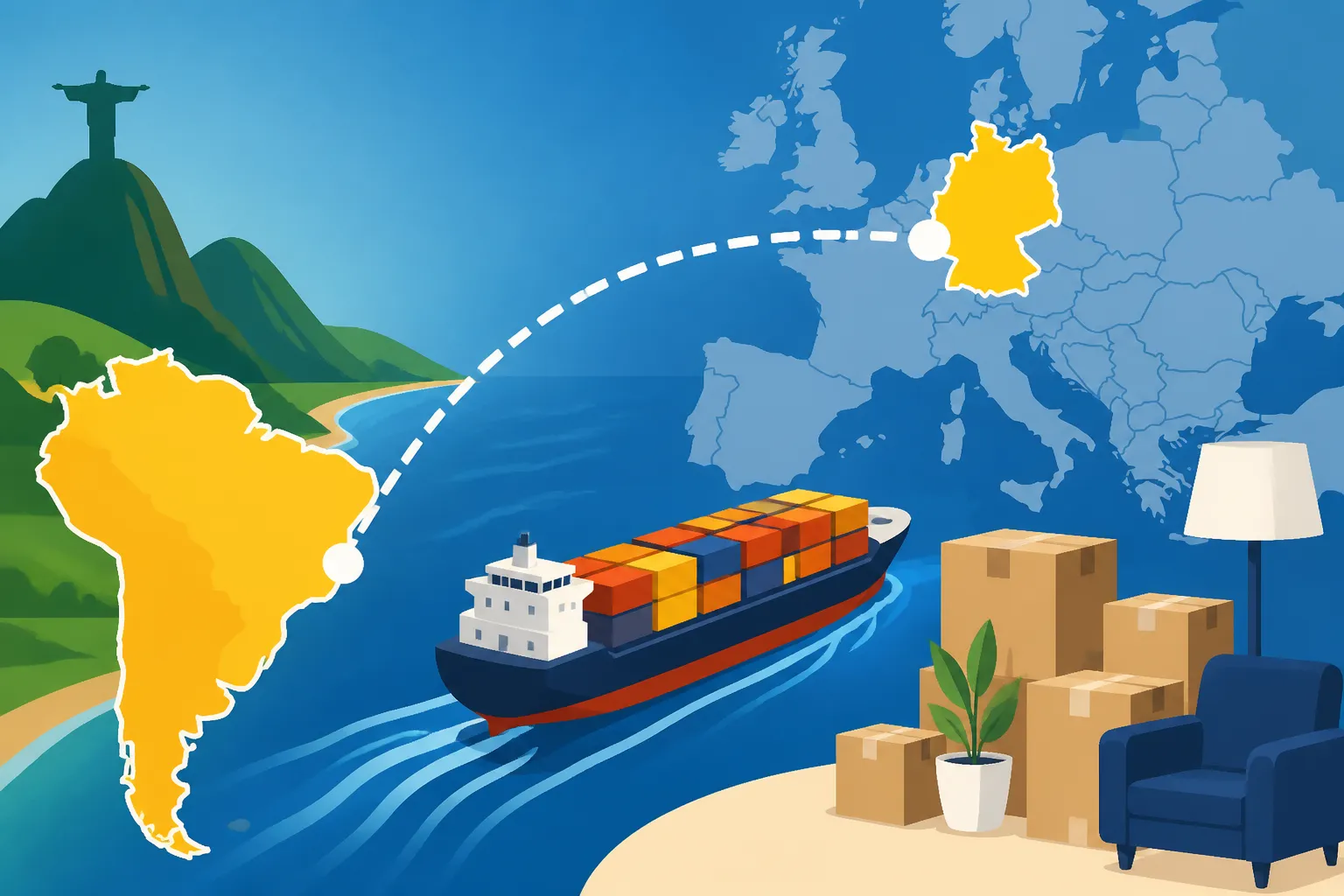
Moving to Germany from Brazil: Atlantic Shipping Routes and Timelines
Your container is booked out of Santos, your German job starts in a few weeks, and nobody can tell you when your sofa will reach Hamburg. Brazilian families moving to Germany often hit this wall. This guide covers the Atlantic shipping routes, realistic timelines, paperwork on both sides, and how to use Sirelo to compare international movers properly.
Disclosure: This post may contain affiliate links. We may earn a commission at no extra cost to you if you make a purchase through these links. Read full disclosure.
Why the Atlantic Crossing From Brazil Feels Harder Than It Should
When my partner and I packed up our apartment in Curitiba, the ocean wasn’t what worried us. Ships cross the Atlantic every day. What drove us mad was that every person we asked gave a different answer. One mover said “about a month.” Another said “it depends.” A cousin in Porto Alegre swore her shipment took most of a year, because her container sat at the Port of Santos while someone argued about a missing signature.
All of them were partly right. A Brazil-to-Germany move isn’t one event. It is a chain of separate processes, and each link has its own speed. Once you see the chain clearly, the uncertainty becomes manageable.
The Distance Is Not the Real Problem
The sailing itself is the most predictable part of your move. Shipping lines publish schedules, vessels leave on rotation, and the crossing from the Brazilian coast to northern Europe follows well-worn commercial lanes. Most of the delays come before and after the voyage:
- On the Brazilian side, the problems are collection, packing, export clearance, and waiting for a vessel with space.
- On the German side, they are unloading, customs review, and getting a delivery slot that fits your new building.
Picture a family in Belo Horizonte. They assume the “shipping time” quoted to them is the whole story. They book a short-term rental in Frankfurt for exactly that period. Then the container misses its first vessel because the export paperwork wasn’t finalised. Two weeks vanish before the ship even leaves. Nobody did anything dramatically wrong; the family simply planned around one link of the chain instead of the whole thing.
The emotional side matters too. Brazilians are used to a certain warmth and flexibility in how problems get solved. You call someone, you explain, a jeitinho appears. German logistics and customs work differently. Processes are written down, deadlines are firm, and a missing document means waiting until it arrives. Neither system is better. You just need to plan for the one you are entering.
Where Sirelo Fits Into the Picture
The biggest single decision you’ll make is which international moving company handles the chain. A good mover coordinates the Brazilian export side, books the ocean freight, and works with a partner agent in Germany for clearance and delivery. A weak one hands you a low price and then disappears when the container is stuck.
This is where Sirelo earns its place. Sirelo is a moving comparison platform. You describe your move once and receive quotes from international removal companies, along with reviews from customers who have already used them. You aren’t cold-calling five companies in Portuguese, then repeating everything in English to their German partners. You get offers you can actually lay side by side.
I wish we’d used a comparison platform from day one. We collected quotes the hard way and ended up with three documents that couldn’t be compared. One quoted per cubic metre, one quoted a flat container price, and one left out destination charges entirely. For a fuller picture of how quotes hide costs, see Comparing International Removal Quotes for Germany: Line Items That Hide Costs.
Atlantic Shipping Routes From Brazil to Germany
Your route depends on two things: where your belongings leave Brazil and where they enter Europe. Brazil has a long coastline with several major container ports. Germany’s main gateways sit in the north. The path between them isn’t always a straight line.
Brazilian Departure Ports and What They Mean for You
The Port of Santos, serving São Paulo state, is the busiest container port in Brazil and Latin America’s dominant hub. If you live anywhere in the greater São Paulo region, your shipment will very likely leave from there. High volume works in your favour, since there are frequent departures to Europe and plenty of experienced freight forwarders. The downside is congestion. Santos can be slow when volumes peak, and trucks queuing for the terminals are a familiar sight.
Further south, the ports of Paranaguá in Paraná, Itajaí and Navegantes in Santa Catarina, and Rio Grande in Rio Grande do Sul serve the southern states. Families in Curitiba, Florianópolis, Joinville, or Porto Alegre often ship from one of these. Rio de Janeiro has its own port, and Vitória serves Espírito Santo. In the northeast, Suape near Recife, Salvador, and Pecém near Fortaleza handle international container traffic.
Moving companies will usually route you through whichever port gives the best combination of trucking distance and vessel availability. That isn’t always the closest one. A household in Brasília, for example, has no coastal port at all, so the goods travel by road to the coast first. Ask every mover which port they plan to use and why.
Arriving in Hamburg, Bremerhaven, or a Neighbouring Port
On the German side, Hamburg and Bremerhaven are the two big container gateways. Hamburg is Germany’s largest port and sits deep up the Elbe. Bremerhaven, on the North Sea coast, is a major container terminal too. Both have extensive rail and road links into the rest of the country.
Many shipments bound for Germany don’t enter through a German port at all. Rotterdam in the Netherlands and Antwerp in Belgium are huge European hubs. Containers often land there and continue to Germany by truck, train, or inland barge. If you are moving to Cologne, Düsseldorf, or anywhere in the Rhine-Ruhr region, a Rotterdam or Antwerp entry can be perfectly sensible. Customs clearance for goods entering the EU can be arranged so that the final German formalities happen near your new home. Your mover’s destination agent will know which setup works best.
For the pros and cons of each gateway, see our guide Hamburg, Bremerhaven, or Rotterdam? Choosing a Port of Entry for Germany.
Direct Sailings Versus Transshipment
A direct sailing means your container stays on one vessel from the Brazilian port to the European port. Transshipment means it is unloaded at an intermediate hub and loaded onto another vessel. That hub might be another Brazilian port, a Mediterranean terminal, or a northern European hub.
Transshipment isn’t bad in itself. It is a normal part of global shipping. However, every transfer adds waiting time and a small extra risk of handling damage or delay. A container can sit at a hub for days waiting for its connecting vessel. When comparing quotes, ask whether the routing is direct or involves a transfer. A slightly higher price for a direct service can be worth it if your timeline is tight.
| Departure Region | Typical Brazilian Port | Likely European Entry | Planning Notes |
|---|---|---|---|
| São Paulo and interior | Santos | Hamburg, Bremerhaven, Rotterdam | Most departures, but terminal congestion can add waiting time |
| Paraná | Paranaguá | Hamburg, Rotterdam, Antwerp | Good option for Curitiba-area households |
| Santa Catarina | Itajaí or Navegantes | Hamburg, Bremerhaven | Popular with southern exporters; check vessel frequency |
| Rio Grande do Sul | Rio Grande | Hamburg, Rotterdam | Longer trucking from Porto Alegre region; ask about transshipment |
| Rio de Janeiro | Rio de Janeiro | Hamburg, Antwerp, Rotterdam | Convenient for Rio households; port access can be slow |
| Espírito Santo and Minas Gerais | Vitória or Rio de Janeiro | Hamburg, Rotterdam | Minas Gerais has no port, so road transport to the coast first |
| Northeast | Suape, Salvador, Pecém | Rotterdam, Antwerp, Hamburg | Fewer direct services; transshipment more common |
| Federal District and Centre-West | Santos or Rio de Janeiro | Hamburg, Rotterdam | Long inland leg; factor road time into planning |
Realistic Timelines From Packing in Brazil to Unpacking in Germany
Every family wants one number: “How long will it take?” The honest answer is a range, built from stages. You can’t control all of them. Understanding each one lets you plan housing, work start dates, and school enrolment without panic.
Before the Ship Sails
The pre-departure phase is where the most time is lost. It starts the moment you accept a quote and ends when your container is loaded onto a vessel. The stages are:
- Survey. A representative visits or does a video call to estimate the volume.
- Booking. The mover books space on a ship.
- Packing day. Professional packers wrap and label everything.
- Inventory. Each box is listed.
- Export clearance. The shipment goes through export procedures with Brazilian customs, under the Receita Federal.
- Delivery to the terminal. The container is trucked to the port.
If you are sharing a container with other households, your goods also have to wait until it’s full enough to ship. Shared containers are called groupage or consolidation. They are cheaper, but you are tied to other people’s schedules.
Consider a couple in Recife moving to Leipzig with a modest amount of furniture. They choose groupage to save money, which is sensible. But northeast ports have fewer direct European services. Their shipment waits at a consolidation warehouse for the container to fill, then waits again for a suitable vessel. Had they known, they could have shipped a few weeks earlier and spent the gap with family. Ask every mover how long goods typically wait for consolidation on your specific route.
On the Water and at the Port
Once the vessel leaves, the crossing time is reasonably predictable, measured in weeks rather than days. Direct services are faster, and transshipment adds time at each hub. Weather in the North Atlantic, port strikes, and congestion in Rotterdam or Hamburg can all add delays. Your mover can’t fix any of these, but a good one will tell you about them early.
When the vessel arrives, the container is discharged and moved to a terminal. The destination agent then handles import clearance with German customs, the Zoll. If your paperwork is complete and your goods qualify for duty relief as relocation goods, clearance is usually smooth. If something is missing, such as a signature, proof of residence, or a clear inventory, the container waits. While it waits, terminal storage charges can build up.
This is why the order of your German admin matters so much. Your Anmeldung, the address registration at the local Bürgeramt, often feeds directly into the customs process. Our guide Sequencing Anmeldung and Customs Clearance Before Your Container Lands walks through the timing in detail.
The Final Mile and the German Delivery Day
After clearance, the container is trucked to your new address. Groupage shipments are unloaded at a warehouse first, and your goods come to you on a smaller truck. Then comes the bit no Brazilian expects: the German apartment building.
Many older German buildings have narrow stairwells and no lift. Some city streets need a temporary no-parking zone, the Halteverbotszone, so the truck can park legally. That permit usually comes from the local authority and has to be arranged in advance. Your destination agent normally handles it, but confirm this in writing. For more, read Delivery Day in a German Building: Stairs, Lifts, and Street Permits.
Here is the full chain as a sequence you can plan around:
- Request quotes through Sirelo and arrange surveys with your shortlisted movers.
- Accept a quote and confirm the departure port, routing, and whether you are on a full container or groupage.
- Gather your Brazilian and German documents, including passport, visa or residence title, employment contract, and German rental agreement if you have one.
- Packing day: supervise the inventory and keep a signed copy.
- Export clearance with the Receita Federal, handled by the mover.
- Container delivered to the Brazilian terminal and loaded onto the vessel.
- Ocean crossing, plus any transshipment stops.
- Arrival at Hamburg, Bremerhaven, Rotterdam, or Antwerp, then discharge from the vessel.
- German customs clearance with your Übersiedlungsgut application.
- Onward transport to your city, with warehouse handling if you are on groupage.
- Delivery day, with a street permit if needed. Check every item against the inventory.
- Report any damage in writing within the deadline in your contract or insurance policy.
A whole-move calendar is available in An International Move to Germany: The 12-Week Planning Calendar. I strongly recommend working backwards from your job start date with it.
Container Options and How to Compare Quotes Fairly
This is the core financial decision of your move. Get it wrong and you pay for empty space, or you wait far longer than expected. Get it right and the move feels almost calm.
Full Container, Shared Container, or Air Freight
A full container load means you rent an entire container, usually a 20-foot or 40-foot unit, for your goods alone. It is sealed at your home in Brazil and, ideally, only opened again for customs inspection and at your German door. That means less handling and less risk. It costs more, but if you are shipping a whole family home, a full container is often worth it.
Groupage, or consolidated shipping, means your goods share a container with other households. You pay for the volume you use. It suits smaller moves, such as a couple with boxes, a few pieces of furniture, a bicycle, and a guitar. The trade-offs are the waiting time for consolidation and extra handling at warehouses on both ends.
Air freight is very fast, but far more expensive by weight and volume. Most families use it only for an “essentials” shipment: kitchen basics, children’s favourite items, work equipment, and clothes for a different climate. Brazilian winter clothing will not get you through a January in Hamburg, I promise.
| Option | Best For | Speed | Handling Risk | Cost Shape |
|---|---|---|---|---|
| Full container, 20ft | A small-to-medium apartment | Fastest sea option, no consolidation wait | Lowest; sealed from origin | Fixed price per container, regardless of how full |
| Full container, 40ft | A large house or a family with a lot of furniture | Same as above | Lowest | Higher fixed price, but often better value per cubic metre for big moves |
| Groupage | Smaller moves, boxes, a few furniture pieces | Slower; waits for container to fill | Moderate; handled at warehouses | Pay per cubic metre used |
| Air freight | Urgent essentials only | Fastest overall | Moderate | Much higher per kilogram or volume |
| Split strategy | Families who need some items immediately | Air for essentials, sea for the rest | Varies | Combines both cost shapes |
Not sure which container size you need? See 20ft vs 40ft Container to Germany: Which Load Size Fits Your Home. If you are weighing groupage against a full load, read Full Load vs Groupage to Germany: Cost Break-Even by Cubic Metre.
Reading a Quote Like a Veteran
A quote for a Brazil-to-Germany move is normally priced in euros or Brazilian reais, sometimes with parts in each. That alone causes confusion. If one mover quotes in reais and another in euros, the exchange rate on the day you compare can make one look much cheaper than it really is. Always convert to a single currency on the same day. Then ask which currency you will actually pay in, and when.
Next, check what is included. A proper door-to-door quote should cover these items:
- Packing materials and labour in Brazil
- Export clearance
- Trucking to the port
- Ocean freight
- Terminal handling at both ends
- German customs clearance support
- Delivery, unpacking, and debris removal
Some quotes cover only port-to-port. That leaves you to arrange and pay for everything after the container lands in Hamburg, which is not something you want to manage alone from a hotel room.
Watch for vague wording around destination charges. Terminal handling, storage beyond a free period, customs inspection fees, street permits, and long-carry fees all appear on the German side. They can be significant. If a quote is suspiciously low, it often means some of these are excluded and will be billed later, when you have no bargaining power.
Using Sirelo to Get Comparable Offers
The key advantage of Sirelo is that every mover responds to the same description of your move. You enter your origin, your German destination, the approximate size of your household, and your preferred timeframe. The companies that reply are quoting the same job, which makes real comparison possible. On Sirelo you can also read reviews from previous customers, which is the closest thing to asking a friend who has done the move.
To get the most out of it, be detailed:
- Mention if you have a piano, a large aquarium, or artwork.
- Say whether your building in Brazil has a service lift.
- Note whether your German address is a fourth-floor walk-up in Berlin.
The more accurate your description, the more accurate the quotes, and the fewer surprises later. For current details on how the platform works and what it costs to use, check Sirelo’s own website.
Once you have the quotes, treat them as the start of a conversation. Ask each shortlisted mover the same questions:
- Which port, and is the routing direct?
- Who is your destination agent in Germany?
- What exactly is excluded?
- How does your insurance work?
A mover who answers clearly and patiently is usually the one who will answer clearly when something goes wrong mid-Atlantic.
Paperwork on Both Sides of the Atlantic
Paperwork is where Brazilian and German bureaucracy meet. Your shipment has to leave one system cleanly and enter the other. Most delays I have seen, including in my own move, came from documents rather than ships.
Leaving Brazil: Receita Federal, Your CPF, and the Inventory
Exporting household goods from Brazil is generally simpler than importing them. Your mover handles the export declaration with the Receita Federal. You will still need to supply your passport, your CPF, and a detailed inventory of what is being shipped. Some movers also ask for proof of your move, such as your German visa or residence documentation, or an employment contract.
There is a separate tax question that many families overlook. If you are leaving Brazil to live abroad permanently, Brazilian tax rules involve the Comunicação de Saída Definitiva do País and the Declaração de Saída Definitiva do País with the Receita Federal. Getting this right affects how Brazil treats your income and assets after you leave. It isn’t strictly a shipping issue, but it belongs on the same to-do list. Speak to a contador in Brazil before you go.
Take the inventory seriously. Write it in clear language, item by item, ideally with approximate values. German customs will rely on it, your insurer will rely on it, and you will rely on it on delivery day when you are counting boxes in a cold stairwell. A vague list of “37 boxes, personal effects” helps nobody.
Arriving in Germany: Zoll and Übersiedlungsgut
Germany offers relief from customs duty and import VAT on household goods brought in when you transfer your normal residence from outside the EU. In German this is called Übersiedlungsgut, meaning relocation goods. To qualify, you generally need to show three things:
- You are genuinely moving your residence to Germany.
- You lived outside the EU for a sufficient period beforehand.
- The goods are your own used personal belongings, owned and used for a required period before the move.
The application goes to the Zoll on the official Übersiedlungsgut form from German customs. It is accompanied by your inventory, passport, and evidence of your German address, such as the Anmeldung confirmation or a rental contract.
For the full explanation of this relief, see Ubersiedlungsgut: Germany’s Duty Exemption for Household Goods Explained. Pay special attention to the ownership requirement. Newly bought items, like a new television bought in São Paulo the month before you leave, can be treated differently from your well-used sofa. Our guide The Six-Month Ownership Rule: Proving Your Goods Qualify for Exemption covers how to document ownership with receipts and photos.
Imagine a family moving from Florianópolis to Munich. They buy a brand-new set of kitchen appliances just before leaving, still in the boxes, thinking it is cheaper than buying in Germany. At customs, the new items stand out against an otherwise used household. Questions are asked, and clearance takes longer. A good mover would have flagged this during the survey. It is one more reason to choose your mover carefully rather than on price alone.
What Not to Pack
Some items cause trouble at German customs or simply aren’t worth the space. Food is the big one for Brazilians. Meat and dairy products from outside the EU are generally not allowed. Plants, soil, and seeds are subject to plant-health rules. Your grandmother’s homemade doce de leite and that bag of farofa may have to stay behind, or be checked very carefully against current rules first. Alcohol in quantity can trigger duty questions. Our guide Shipping Alcohol, Food, and Plants Into Germany: Duty and Phytosanitary Rules explains the details.
Wooden furniture and packing materials are another point. Untreated wood can carry pests. Raw wooden crates used in international shipping must meet international treatment and marking standards. Your mover should know this, but ask.
Electrical appliances are a different kind of problem. Brazil uses a mix of voltages, with some regions on 127V and others on 220V. Germany runs on 230V and uses Type C and Type F plugs instead of Brazil’s Type N sockets. A 220V Brazilian appliance may work with an adapter, but a 127V one usually won’t without a converter. Converters are bulky and not ideal for heavy-duty kitchen equipment. Many German rental apartments also come without a fitted kitchen, which changes the calculation entirely. Read Should You Ship Appliances to Germany? Voltage, Plugs, and Fitted Kitchens before you decide whether your refrigerator makes the journey.
Protecting Your Belongings and Your Sanity
The last part of your planning is about what happens when things don’t go perfectly, and where you’ll live while they are still moving.
Insurance and Liability in Euro Terms
A move from Brazil to Germany is usually priced and insured in euros or reais. Your cover should be thought of in those terms, based on the real replacement value of your belongings in Germany. Without extra insurance, the liability of carriers and ocean shipping lines is limited under transport law and maritime conventions. It is calculated in ways that rarely match what your belongings are actually worth. Damaged antique furniture or a broken flat-screen television may be compensated at a fraction of its replacement cost if you rely on basic liability alone.
The practical answer is transit insurance based on a valued inventory. You list your items with replacement values, and the policy covers loss or damage up to those values, subject to its terms. Some policies cover “all risks,” while others only cover total loss of the container. Some exclude items you packed yourself. Read the conditions closely, especially the deadline for reporting damage after delivery. In Germany, that deadline can be short, and missing it can void a claim. For full detail, see Moving Insurance for Shipments to Germany: Coverage, Valuation, and Claims.
When you compare movers through Sirelo, make insurance one of your standard questions. Ask whether cover is included or optional, what it is based on, who the insurer is, and how a claim works in practice. Ask whether you file it from Germany, in which language, and with what documents. A mover who explains this calmly before you sign is far more valuable than one who promises “everything is covered” without showing you the policy.
Bridging the Gap While Your Container Is at Sea
Your container won’t arrive the day you do. For several weeks, possibly longer, you will live in Germany without most of your things. Brazilian families sometimes underestimate how disorienting this is. The weather is colder, the language is new, the supermarket is unfamiliar, and you don’t even have your own pillow.
Plan for it deliberately. Many people book a furnished apartment, a serviced apartment, or a boardinghouse for the first weeks. Choosing a place where you can complete your Anmeldung is vital, because that registration feeds into everything from banking to customs clearance. For options and pitfalls, see Bridge Accommodation: Where to Stay Between Landing and Getting Keys.
Pack your suitcases as if you will live out of them for a month, because you might. Bring warm layers, a few kitchen basics if your temporary place is sparse, important documents in your hand luggage, and something familiar for children. A favourite blanket or toy makes the empty weeks easier. If you can afford an air freight essentials shipment, this is when it pays for itself.
Your Final Pre-Departure Checklist
Before you lock the door on your Brazilian home, run through this list. It is the condensed version of everything above, the things I wish someone had handed me in Curitiba.
- Compare at least several international movers on Sirelo, using the same detailed move description for each.
- Confirm in writing the departure port, the European entry port, and whether the routing is direct or involves transshipment.
- Decide between a full container, groupage, or a split with an air freight essentials shipment.
- Convert every quote into a single currency on the same day and list every exclusion.
- Settle your Brazilian tax position on permanent departure with a contador.
- Prepare a detailed, valued inventory and keep signed copies for yourself.
- Gather proof of ownership for newer items to support your Übersiedlungsgut application.
- Remove prohibited food, plants, and problematic wooden items, and decide on each appliance.
- Arrange transit insurance based on replacement value, and note the damage-reporting deadline.
- Book bridge accommodation in Germany where you can complete your Anmeldung.
- Confirm the destination agent will handle the street permit and access arrangements.
- Keep your mover’s contacts, the container or booking number, and every document in one folder you can reach from your phone.
A move across the Atlantic is a big emotional and practical undertaking. You are leaving a country with sunshine, feijoada on Saturdays, and family a short drive away, for one with long winters, efficient trains, and a lot of paperwork. The shipping part doesn’t have to be the stressful part. With a clear view of the routes, a realistic timeline, and quotes you can genuinely compare, it becomes just another task on your list.
Start with Sirelo. Describe your move once, let qualified international movers respond, read what previous customers say about them, and choose the one that answers your questions clearly. Your future self, unpacking in a German apartment with every box accounted for, will be grateful.
Disclaimer
This article is for general informational purposes only and does not constitute professional advice. Laws, prices and regulations vary by location and change over time. Consult a qualified professional for guidance on your specific situation.