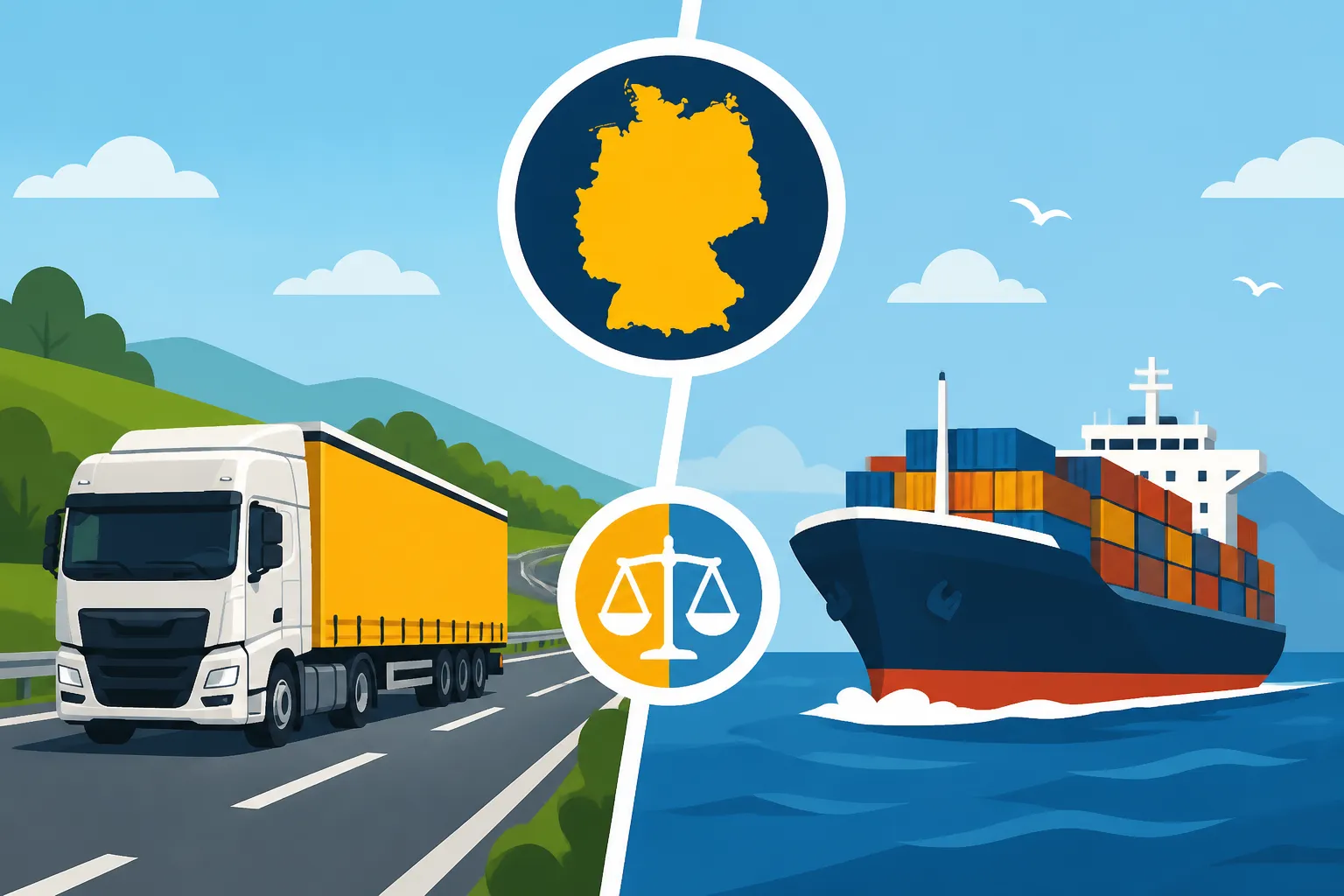
Road Freight vs Sea Freight to Germany: When Each One Makes Sense
You’ve booked your flight to Germany, but your sofa, books and kitchen boxes still have no way to get there. Some movers quote you a truck, others push a shipping container, and the price gap between them can be huge. This guide explains how road freight and sea freight really work for a move to Germany, when each one is the better choice, and how to compare quotes without getting burned.
Disclosure: This post may contain affiliate links. We may earn a commission at no extra cost to you if you make a purchase through these links. Read full disclosure.
How Road and Sea Freight Actually Work for a Move to Germany
Before you can choose between the two, you need to know what happens to your belongings once the movers close the door. On my first move to Germany I assumed “international removal” meant one thing. It actually means two very different journeys with different risks, costs and waiting times. Once you see how each one runs, the quotes in your inbox start to make sense.
Road Freight: Door to Door on a Single Truck
With road freight, a removal crew loads your belongings into a truck at your old home. The same truck, or a trailer that gets passed between drivers, drives across Europe to your new address in Germany. Most of the time nothing gets unloaded in between. The crew that wrapped your dining table is often part of the team that carries it up the stairs in Leipzig or Düsseldorf.
That continuity is the big quiet advantage of road freight. Fewer hands touch your boxes. Nothing gets moved from truck to container to crane and back again, and you’re not depending on a port terminal’s schedule. If you’re moving from Amsterdam to Cologne, Vienna to Munich, or Warsaw to Berlin, the truck basically drives a long day or two with breaks for the legally required driver rest. Then it parks outside your new building.
Road freight comes in two main forms. A dedicated load means the truck carries only your things and goes straight to you. A groupage load, also called part load or consolidated freight, means your belongings share the truck with other households heading the same way. Groupage costs less, but you lose control of the timing. The truck may wait until it’s full, and it may stop in Brussels, Frankfurt and Stuttgart before it gets to you in Freiburg.
Sea Freight: Containers, Ports and the Long Middle Leg
Sea freight is really three journeys joined together. First, a local mover at your origin packs your home and loads it into a shipping container, or into wooden crates called lift vans that later go into a container. That container travels by truck or rail to a departure port. It then crosses the ocean on a container ship, gets unloaded at a European port such as Hamburg, Bremerhaven, Rotterdam or Antwerp, clears customs, and finally goes onto a truck for delivery to your door.
Each of those legs involves a different company, a different set of fees and a different point where something can go wrong. The ship might leave a week late. The container might sit in the port waiting for a customs officer to review your paperwork. Even so, for crossing oceans, sea freight is usually the only option that makes financial sense for a full household. Flying a three-bedroom home’s worth of furniture would cost more than many people pay for the furniture itself.
You’ll also come across two loading types. A full container load means you rent a whole container, either the standard 20-foot box or the larger 40-foot one, and it gets sealed with only your belongings inside. Less than container load means your goods share a container with other shipments. LCL is cheaper for small volumes, but the extra consolidation and deconsolidation steps add time and handling.
Why the Route Usually Makes the Decision for You
This is the part most comparison articles skip. For most people, the choice isn’t really a free choice. Geography makes it. If you’re moving from France, Austria, Poland or Denmark, sea freight makes almost no sense, because there’s no ocean to cross. If you’re moving from Texas, Mumbai or Melbourne, road freight simply isn’t possible for the main leg.
The real decisions sit in the grey zones. Those include the UK, Ireland, Scandinavia, Turkey and parts of the Mediterranean, where trucks on ferries compete with containers. They also include how you combine the modes, how much you ship and which mover you trust. That last question is where a comparison platform like Sirelo earns its place. It lets you put several removal companies side by side for your exact route, so you can see which ones actually specialise in road moves, which run regular container services, and what past customers said about each of them.
Road Freight vs Sea Freight Side by Side
When I sat at my kitchen table with three quotes that looked nothing alike, what I wanted was a simple comparison of how the two methods behave. Here it is, based on the general way these services are structured rather than any one company’s prices.
| Factor | Road Freight | Sea Freight |
|---|---|---|
| Typical routes | EU countries, UK, Switzerland, Norway, Turkey, Balkans | North America, Asia, Australia, Africa, Middle East, South America |
| How the cost is shaped | Driven by distance, volume, and whether you book a dedicated truck or share one | Driven by container size or shared volume, plus port, terminal and customs charges at both ends |
| Transit pattern | Usually days for dedicated loads, longer for shared groupage | Usually weeks, with extra waiting at ports and in consolidation |
| Predictability | Generally high for dedicated loads | Lower, because sailing schedules, port congestion and inspections can shift dates |
| Handling | Often loaded once and unloaded once | Multiple transfers between truck, port, ship and truck again |
| Customs | None for moves within the EU, required for non-EU origins | Always required for non-EU origins |
| Best suited to | Full homes moving within Europe, flexible small loads | Full households crossing oceans, people who can live without their things for a while |
| Main risk | Delays from groupage stops or border queues | Delays at sea or in port, storage charges if paperwork is late |
The Shape of the Cost
I can’t give you a reliable figure for either option, and you should be wary of any article that does. Prices move with fuel costs, port congestion, season and the specific company. What I can tell you is how the bill is built, because that’s what helps you judge a quote.
A road freight quote usually bundles packing, loading, the drive itself, any ferry or tunnel crossing, and unloading. The two biggest levers are volume and exclusivity. A dedicated truck costs a lot more than a shared one, because you’re paying for the whole vehicle and the driver’s time whether you fill it or not. Some quotes also add parking-restriction permits, extra-long carries from the truck to your door, or charges for upper floors without a lift.
A sea freight quote has more parts. You’ll see origin packing and loading, transport to the port, the ocean freight itself, terminal handling charges at both ports, customs clearance, transport from the German port to your home, and unpacking. Then there are possible extras: inspections, storage if your container arrives before you have keys, and demurrage or detention charges if the container sits in port too long. For the line items movers like to hide in the small print, read Comparing International Removal Quotes for Germany: Line Items That Hide Costs.
Time and Predictability
Road freight usually wins on speed and certainty. A dedicated truck from Brussels to Hamburg can often deliver within a couple of days of loading. A shared groupage load on the same route might take one to several weeks, because the mover waits to fill the truck and plans the route around other customers. Either way, you’re dealing with roads you can see on a map and a driver you can usually reach by phone.
Sea freight runs on a calendar you don’t control. Ships sail on fixed schedules, and missing a cutoff means waiting for the next one. Ports have busy seasons. Customs can pick your container for a physical inspection, which means unloading, checking and reloading. My neighbour in Hamburg, an engineer from Toronto, slept on an air mattress for most of a month longer than he’d planned because his container sat at the terminal over a holiday weekend while one document was corrected. Build slack into any sea freight plan.
Handling and Damage Risk
Every time a box gets lifted, moved and put down, there’s a chance it gets dropped or crushed. Road freight on a dedicated truck keeps that to a minimum: loaded at origin, unloaded at destination. Groupage adds a little risk if the truck gets reorganised mid-route.
Sea freight adds risk in different ways. Containers sway on the ocean, condensation can build up inside, and goods packed in loose LCL consolidation get handled more. Good movers deal with this by using export-grade packing, wooden crating for fragile pieces, and moisture absorbers inside the container. If your quote doesn’t mention export packing for a sea shipment, ask about it. And whichever mode you pick, look closely at the insurance terms. Moving Insurance for Shipments to Germany: Coverage, Valuation, and Claims explains how valuation and claims actually work.
When Road Freight Makes Sense
Road freight is the default for most moves inside Europe, and with good reason. But “inside Europe” covers a lot of ground, from a short hop across the Dutch border to a long haul from southern Spain or through the Balkans.
Moving From Within the EU
If you’re moving to Germany from another EU country, road freight is almost always the right answer. There are no customs formalities for household goods moving inside the EU single market. The truck crosses the border like any other vehicle, and your things are treated as if you were moving from Bremen to Bonn.
Take a couple I helped last spring. They were moving a two-bedroom flat from Lyon to Stuttgart, with a mix of solid wood furniture and lots of kitchen gear because one of them is a passionate cook. A dedicated truck collected everything on a Monday morning and delivered on Tuesday afternoon. The same crew that packed their crockery in France unpacked it in Germany. A sea route would have been absurd here, since there’s no ocean to cross.
The real choice for EU movers is dedicated versus shared. If your dates are fixed, maybe because your Stuttgart lease starts on a specific day and your Lyon lease ends the same week, a dedicated truck is worth paying for. If you can be flexible, store a few things with friends or stay in temporary housing, groupage can save a lot. For short cross-border routes, especially from the east, Moving to Germany from Poland: Short-Haul Road Freight and Van Options covers the van and small-load options in more detail.
Moving From the UK, Switzerland, Norway or Turkey
These are the grey zones where road freight still often wins on practicality, but customs comes back into the picture. The UK is outside the EU’s customs territory, so a truck from London to Frankfurt needs export and import declarations. Your goods also need to qualify for duty relief as household effects. The truck itself crosses by ferry or through the Channel Tunnel and then drives on through France, Belgium or the Netherlands.
Switzerland and Norway are also outside the EU customs union, even though travelling there feels seamless. Moving from Zurich to Munich takes very little driving, but it does involve a customs stop and paperwork. Turkey is a longer route, either overland through the Balkans or by a ro-ro ferry connection to Italy and then by road. It also needs proper documentation at the EU border. For that corridor, Moving to Germany from Turkey: Road Freight Routes and Realistic Budgets is a useful next read.
For all of these, road freight usually beats sea freight because it skips the extra port handling. A UK mover could put your things in a container and ship them to Hamburg, but for most households a truck on a ferry is simpler and keeps your belongings in one vehicle. The key is picking a mover who handles customs as part of the service, not one who leaves you to work out the declarations alone. When I compared UK-to-Germany movers through Sirelo, the reviews were the most revealing part. Several customers mentioned whether the company had dealt with customs smoothly or had left them stranded at a border with a pile of forms.
Small Loads and Partial Moves
Not everyone ships a whole home. Students, people taking a job in a furnished flat, and anyone planning to buy new furniture in Germany often move only a handful of boxes, a bike and maybe a favourite armchair. For these smaller volumes inside Europe, groupage road freight is often the sweet spot. You pay for the space you use, and the mover fits your shipment around others going the same way.
Below a certain volume, it can be worth comparing groupage with courier services or even excess airline baggage. Those options don’t fit furniture, but for a few suitcases and boxes they can be faster and simpler. Excess Baggage vs Air Freight vs Courier: Sending 50-200kg to Germany goes through that small-shipment comparison. As a rough rule, once you’re shipping anything bulky that needs two people to carry, a removal company’s groupage service usually makes more sense than a parcel courier.
When Sea Freight Makes Sense
If you’re coming from outside Europe, sea freight is the realistic way to bring a meaningful amount of your life with you. The questions are how much to bring, what size of container to use, and where the ship should land.
Intercontinental Moves
Moves from North America, Asia, Australia, South Africa, South America and the Gulf states nearly always use sea freight for the main leg. The usual pattern is that a mover in your origin country partners with a German or European agent who handles customs clearance and final delivery. Your contract is often with the origin company, but the people carrying boxes into your Frankfurt apartment work for the partner agent.
This is where I’d urge real caution. The quality of an international sea move depends on that whole chain of partners, not just the friendly salesperson in your home city. Before you sign, ask who the destination agent in Germany is and whether they’ve worked together before. A platform like Sirelo is useful here because you can read reviews from people who’ve actually received shipments in Germany, not only from people who’ve packed up a house in the origin country.
Think honestly about what’s worth shipping. German apartments are often smaller than homes in North America or Australia, and many rentals come with no kitchen at all. Your large American fridge may not fit, and your appliances may run on the wrong voltage. A friend who moved from Seattle to Berlin shipped a sectional sofa that couldn’t get round the corner of her stairwell in Prenzlauer Berg. It went back down to the street and was sold on a classifieds site the same week. For US-specific planning, Moving to Germany from the US: Container Costs, Ports, and Timelines goes deeper into that route.
Choosing Container Size and Loading Type
The first sea freight decision is how much space you need. A small shipment, a few boxes plus a desk and a bed, usually goes as LCL, sharing a container with other people’s goods. A typical apartment often fits in a 20-foot container. Larger family homes may need a 40-foot container. A good surveyor, either in person or by video, will estimate your volume before quoting, and you should insist on that survey rather than relying on a guess over the phone.
The trade-off between sharing and having your own container is a lot like the road freight trade-off between groupage and a dedicated truck. Sharing is cheaper for small volumes but slower and involves more handling. A sealed full container load costs more for small volumes, but your goods aren’t touched between origin and destination, and you avoid the wait for consolidation. Where exactly sharing stops making sense depends on your volume and route. Full Load vs Groupage to Germany: Cost Break-Even by Cubic Metre walks through that calculation, and 20ft vs 40ft Container to Germany: Which Load Size Fits Your Home helps you match container size to home size.
Picking a Port and Combining Sea With Road
Most people assume a container bound for Germany lands in a German port, and Hamburg and Bremerhaven are indeed major gateways. But plenty of household shipments arrive through Rotterdam or Antwerp instead, especially if you’re heading to the Rhineland, the Ruhr or southwest Germany. From there, the last stretch is by truck, or sometimes by rail and then truck.
This hybrid setup, sea for the ocean and road for the European leg, is how nearly every intercontinental move works in practice. The choice of port affects how long that final road leg takes, what the port charges are, and how quickly customs can be cleared. If you’re moving to Munich or Stuttgart, landing in Hamburg means a long truck ride south. The Benelux ports can sometimes be more practical for the west and southwest. Hamburg, Bremerhaven, or Rotterdam? Choosing a Port of Entry for Germany compares these gateways in detail.
Customs, Paperwork and Timing Your Arrival
Whichever mode you pick, the logistics of the truck or ship are only half the story. The other half is the paperwork that lets your goods enter Germany duty-free, and the timing that makes sure you have somewhere to put them when they arrive.
EU Moves vs Non-EU Moves
For moves within the EU, customs simply isn’t a factor. You’ll still want an inventory for insurance and for checking everything off at delivery, but no customs officer will ask about your belongings. This is a big reason why road freight from EU countries feels so straightforward.
For moves from outside the EU, by road or by sea, your household goods need to clear German customs. Germany, like the rest of the EU, offers relief from import duties and import VAT for household goods that belong to people genuinely moving their residence. The goods have to meet certain conditions, including how long you’ve owned and used them, and you have to show that you’re actually relocating, usually with proof of your new address. The relief is explained in Ubersiedlungsgut: Germany’s Duty Exemption for Household Goods Explained, and the ownership condition is covered in The Six-Month Ownership Rule: Proving Your Goods Qualify for Exemption.
Here’s my strongest piece of advice for non-EU movers: let a professional handle the declarations. A good international removal company will prepare the customs relief application, the inventory and the supporting documents as part of its service, and its German agent will deal with the customs office. When you compare movers, ask directly whether customs clearance at the German end is included or billed separately.
Timing the Anmeldung, Your Keys and the Delivery
The most stressful part of my own move had nothing to do with trucks or ships. It was working out the order of everything. Customs typically wants evidence of your German residence, often linked to your address registration. But you can only register once you have a place to live. And you want your belongings delivered to that place, not to a storage unit that charges by the week.
For sea freight, this order matters a lot. If your container lands in Hamburg before you’ve registered your address and gathered the documents customs needs, it can sit at the terminal and build up storage charges. Many movers can hold your goods in a warehouse, but that costs money too. Sequencing Anmeldung and Customs Clearance Before Your Container Lands lays out how to order these steps so the paperwork is ready when the ship arrives.
For road freight, timing is easier but not trivial. Even a dedicated truck needs an agreed delivery date, and in many German cities the movers will need a temporary no-parking zone outside your building so the truck can park legally. You’ll also need to think about narrow stairwells, lift sizes and whether your building has rules about moving hours. That kind of local detail is covered in Delivery Day in a German Building: Stairs, Lifts, and Street Permits.
Living Without Your Belongings in the Meantime
Both methods involve a period when you’re in Germany and your things aren’t. With road freight inside Europe, that gap might be only a few days, or close to zero if you drive behind the truck. With sea freight, expect a longer stretch, and plan for it as if it’ll take longer than the mover promised.
Pack an essentials kit to travel with you: work clothes, a laptop, important documents, prescription medicines, a few kitchen basics and anything your children can’t sleep without. Many expats arriving by sea book a furnished flat or serviced apartment for the first stretch, both to bridge the shipping gap and to give themselves time to flat-hunt properly. For ideas on where to stay while you wait, see Bridge Accommodation: Where to Stay Between Landing and Getting Keys.
How to Compare Movers and Make the Final Decision With Sirelo
Once you know whether your move is a road job, a sea job or a hybrid, the next challenge is finding a company you can trust. This is where I made my biggest mistakes on my first move. I took one quote from the first company that answered the phone, and I learned about its subcontractors the hard way. The second time, I used Sirelo, and the process was calmer from start to finish.
Step-by-Step: Getting Comparable Quotes
The goal is to get several quotes that cover the same scope, so you’re comparing like with like rather than a cheap quote that leaves out half the work. Here’s the process I’d recommend:
- Write down your origin and destination addresses, including floor numbers and whether each building has a lift.
- Make a rough inventory of what you plan to ship, room by room, and decide what you’ll sell, donate or replace in Germany before you ask for quotes.
- Note your flexibility: whether you need a fixed delivery date or can accept a delivery window.
- Submit your move details through Sirelo, which forwards your request to removal companies that serve your route and lets you compare their responses.
- Ask each shortlisted mover for a survey, either in person or by video, so the volume estimate is based on your actual belongings.
- Check what each quote includes: packing, export packing for sea, customs clearance, port charges, delivery permits, unpacking and debris removal.
- Read the reviews on Sirelo for each company, paying particular attention to reviews from people who moved on a similar route.
- Confirm the insurance terms, the claims process and how goods are valued before you sign anything.
- Get the final agreement in writing, including the expected collection and delivery windows.
What I like about doing this through Sirelo is that it saves me from hunting down removal firms one by one across two countries. It also puts customer reviews right next to the companies. When I’m about to hand a stranger everything I own, those reviews matter more than any glossy brochure.
Red Flags to Watch for in Road and Sea Quotes
Some warning signs show up regardless of the transport mode. Be careful with any mover who quotes a firm price without a survey, demands a large upfront payment through an unusual channel, won’t name its partner agent in Germany, or gets vague when you ask about insurance. Very low quotes on sea moves are a classic trap. The price looks great until extra charges appear at the destination port and your goods are effectively held until you pay.
For road moves, watch out for groupage quotes with no delivery window at all, or companies that can’t explain how they handle a UK or Swiss customs border. For sea moves, check that origin and destination port charges and customs fees are clearly listed, either as included or as estimated extras. When the reviews on Sirelo mention hidden fees, slow communication or damaged goods, take them seriously, especially if the same complaint comes up more than once.
Three Real-Life Scenarios to Guide Your Choice
To make this concrete, here are three moves I’ve watched friends and readers go through.
Scenario one: a software developer moving from Madrid to Berlin with a studio’s worth of belongings and a road bike. Road freight was the obvious choice. Because she had a few weeks of furnished temporary housing booked anyway, she chose a groupage service, accepted a delivery window, and saved a good amount compared with a dedicated truck. She compared several movers on Sirelo, picked one with consistently strong reviews for the Spain-to-Germany corridor, and her boxes arrived in good condition.
Scenario two: a family of four moving from Chicago to Munich with a full house of furniture. Sea freight was the only realistic option. They had a video survey, decided on a container size based on the result, and sold most of their large appliances before the move. The container landed in a northern European port and finished its journey by truck. Their best decision was booking a serviced apartment for the first stretch, which took the pressure off when customs clearance took a little longer than planned.
Scenario three: a couple moving from Manchester to Cologne with a one-bedroom flat’s worth of things. This was a true grey-zone case. One mover offered a container, another offered a truck on a ferry. They chose road freight because it meant less handling and a shorter overall journey. The deciding factor was a company whose reviews specifically praised its post-Brexit customs handling. They found that detail by reading reviews on Sirelo rather than relying on sales calls.
If you’re still unsure which method suits your move, the simplest next step is to send your route and inventory through Sirelo and look at what specialist movers actually propose. The quotes, and the reviews behind them, will usually make the right answer clear.
Disclaimer
This article is for general informational purposes only and does not constitute professional advice. Laws, prices and regulations vary by location and change over time. Consult a qualified professional for guidance on your specific situation.