Should You Ship Appliances to Germany? Voltage, Plugs, and Fitted Kitchens
Moving to Germany is an exciting adventure, full of new experiences, but let's be honest, it often feels like navigating a labyrinth of unfamiliar rules and traditions, especially when it comes to setting up your home. One of the biggest headaches many of us face is figuring out what to do with our beloved household appliances. Will your trusty washing machine work here? Is it worth the cost and hassle to ship your fridge, or should you just start fresh? This comprehensive guide is here to untangle the German electrical system, demystify the infamous "fitted kitchen" scenario, and help you make an informed decision about shipping your appliances versus buying new in Deutschland.
Disclosure: This post may contain affiliate links. We may earn a commission at no extra cost to you if you make a purchase through these links. Read full disclosure.
The German Kitchen Conundrum: Why Your Appliances Might Not Fit In
The moment you start looking for a place to live in Germany, you'll quickly encounter the first major hurdle for your appliances: the kitchen itself. It's often not what you'd expect, and this can be a real shock for many newcomers.
The Infamous "Empty Kitchen" Phenomenon
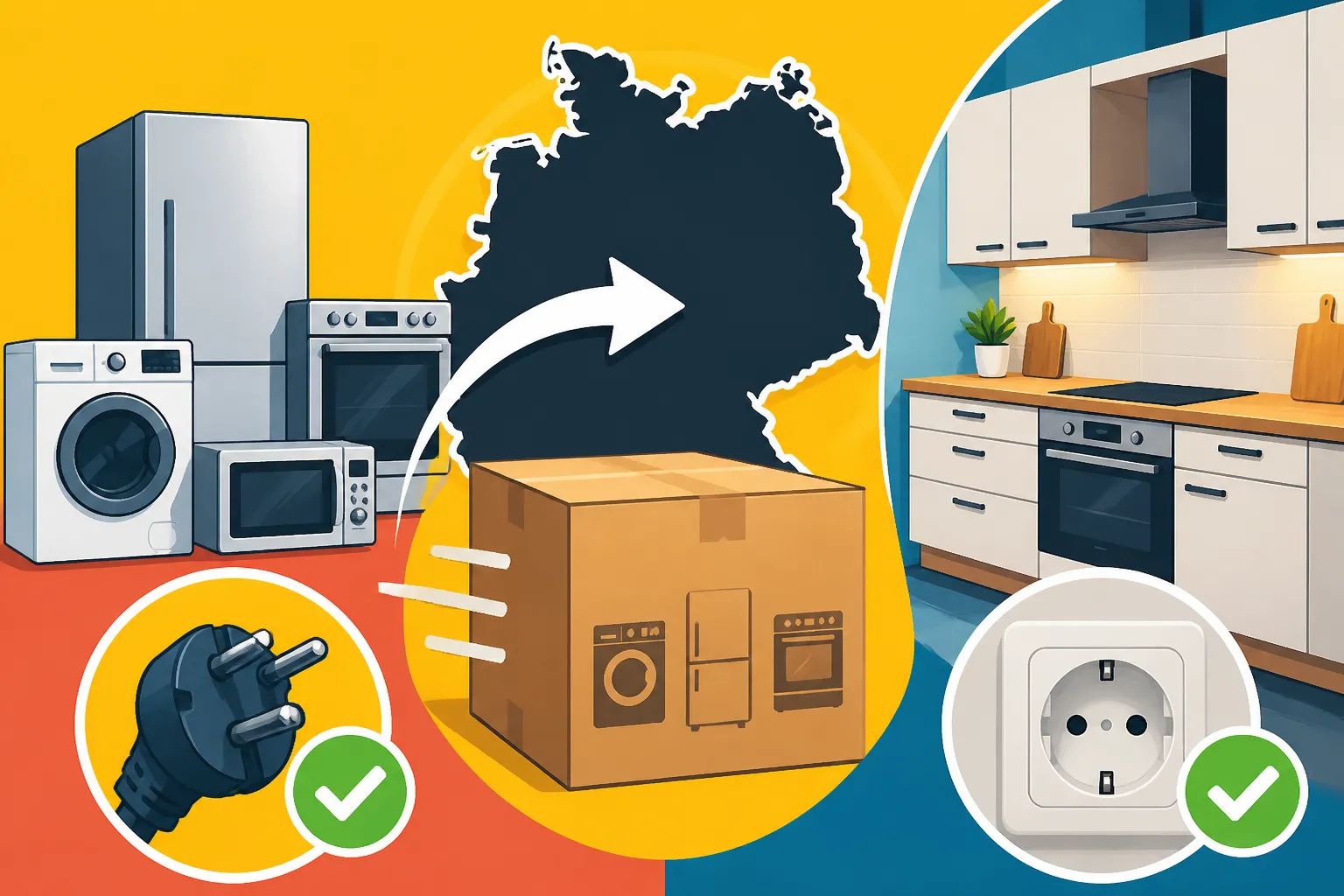
In many countries, especially the UK, USA, Canada, or Australia, when you rent an apartment or house, you expect it to come with a fully equipped kitchen – stove, oven, fridge, maybe even a dishwasher. Not so in Germany. It’s incredibly common for rental apartments to come as a completely blank canvas. We're talking bare walls, no cabinets, no sink, no oven, no stove, and certainly no fridge. This is known as the "empty kitchen" or unmöblierte Wohnung mit leerer Küche (unfurnished apartment with an empty kitchen).
Imagine walking into your new home, only to find a perfectly functional living room, bedroom, and bathroom, but just an empty space where a kitchen should be. It’s like the previous tenants packed up everything but the kitchen sink – because they took that too! This practice is deeply ingrained in German rental culture. Tenants typically purchase and install their own kitchens, which they then take with them when they move out. This means you, as the new tenant, are often expected to buy and install an entire kitchen yourself. This can be a significant upfront cost, easily running into thousands of euros for even a basic setup, before you even consider appliances. Sometimes, you get lucky and the previous tenant offers to sell their Einbauküche (fitted kitchen) to you for a buyout fee, which can be a good deal if it's in good condition and fits your taste. But even then, you'll still need to factor in appliances. For more on navigating this, check out our guide on Unfurnished Apartments in Germany: Dealing with Kitchens and Light Fixtures.
Voltage and Frequency: The Electrical Divide
Beyond the empty kitchen, the next big hurdle is the electrical system itself. Germany operates on a different standard than many countries, and this isn't just a minor difference; it's fundamental to how your electronics function.
Germany uses a 230 Volt (V) electrical supply at a frequency of 50 Hertz (Hz). For those coming from North America (USA, Canada), this is a significant departure, as they primarily use 120V at 60Hz. Other countries like the UK, Australia, and most of Europe also use 230V/50Hz, so if you're coming from one of those places, you're usually in luck on this front. However, if you're moving from a 120V country, this means your appliances are designed to draw less power and at a different cycle rate. Using a 120V appliance directly in a 230V socket without proper conversion can be disastrous. At best, your appliance won't work. At worst, it could overheat, short-circuit, emit smoke, or even cause a fire, posing a serious safety risk to you and your home. Moreover, using incompatible appliances can damage the internal components, making them permanently unusable. It’s not just about the voltage; the frequency (50Hz vs 60Hz) also matters, especially for motor-driven appliances like washing machines or refrigerators. While some universal power supplies in electronics can handle both, large appliances are very sensitive to frequency differences.
Plugs and Sockets: Type F "Schuko" Explained
Even if your appliance is compatible with 230V/50Hz (perhaps you're from the UK), you still need to contend with the physical plug types. Germany primarily uses Type F sockets, commonly known as "Schuko" plugs. These are two-pin plugs with earthing clips on the side. They're compatible with Type C (Europlug) and Type E plugs, which are common across mainland Europe.
If your appliance has a different plug type, such as a Type G (UK plug), Type A/B (North American), or Type I (Australian), it simply won't fit into a German socket. For small electronics like phone chargers or laptop power bricks, a simple travel adapter often suffices, as these devices usually have universal voltage input (check the fine print, e.g., "Input: 100-240V, 50/60Hz"). However, for high-power appliances like kettles, toasters, hair dryers, or anything with a heating element or a motor, travel adapters are a big no-no. They are not designed to handle high current loads and can overheat, melt, or cause electrical hazards. For these items, you'd need either a heavy-duty plug adapter with appropriate safety ratings or, ideally, to have the plug professionally rewired by a German electrician. Never underestimate the importance of proper electrical connections, especially in a country with strict safety standards like Germany. We've got more details on this in our guide, Household Appliance Guide: Voltage, Adapters, and Buying Electronics in Germany.
Weighing Your Options: Ship, Buy New, or Adapt?
Given the complexities of German kitchens and electrical systems, you're essentially at a crossroads. Do you cling to your trusted appliances, invest in new ones, or try to make your old ones work? Each path has its own set of pros and cons, and understanding them is crucial before you commit.
Shipping Your Beloved Appliances: The Sentimental & Costly Path
For many expats, leaving behind a perfectly good appliance feels wasteful, and there's often a sentimental attachment to items that have served them well. Plus, the thought of buying everything new can be daunting. You might think, "My washing machine is only two years old! Surely, it's cheaper to ship it." But hold your horses before you load it onto a container.
First, let's talk about the emotional aspect. We get it. Your fridge has seen you through countless late-night snack attacks, and your dishwasher has quietly handled every dirty dish. There's comfort in familiarity. However, the financial reality can quickly outweigh that sentiment. Shipping large appliances internationally isn't cheap. You'll need to factor in the actual shipping costs, which vary based on volume, weight, and distance. Beyond that, there are customs duties and taxes to consider, although personal household goods are often exempt if you're moving your primary residence. Still, it's a process. Then, there's the cost of specialized packing, crating, and insurance to protect against damage during transit. And finally, if your appliances aren't compatible with German electrical standards, you’ll then face the additional expense of voltage transformers or professional rewiring, as discussed earlier. For example, a heavy-duty step-down transformer for a washing machine can cost hundreds of euros, and it’s a bulky item that itself needs to be moved and find a home in your new apartment.
This is precisely where a dedicated international moving service becomes your best friend. They can provide accurate quotes that bundle all these costs, helping you make a clear financial comparison. A platform like Sirelo specializes in connecting expats with reliable moving companies worldwide, allowing you to get multiple, transparent quotes from movers who understand the nuances of shipping household goods to Germany. They can also advise on customs regulations and help ensure your items are properly insured. Getting a detailed quote from Sirelo can give you a concrete number to compare against the cost of buying new. For more insights into shipping, consider reading Moving Your Belongings to Germany: Customs Duties and Tax-Free Imports for New Residents.
Buying New Appliances in Germany: Practicality and Peace of Mind
For many, especially those coming from countries with different electrical standards, buying new appliances in Germany turns out to be the most practical and least stressful option. While it's an upfront investment, it offers several significant advantages.
Firstly, compatibility is guaranteed. German appliances are designed for the 230V/50Hz system and come with the correct Type F plugs. This eliminates any worries about safety, damage, or the need for bulky transformers. Secondly, you get full warranties and easy access to local repair services. Imagine your imported fridge breaking down – trying to find parts or a technician familiar with a foreign model can be a nightmare. With a locally purchased appliance, support is readily available. Popular German appliance brands like Siemens, Bosch, Miele, Neff, and Bauknecht are renowned for their quality and durability. You can find these at large electronics retailers like MediaMarkt and Saturn, department stores, specialist kitchen shops, or online platforms. These stores often offer delivery and installation services, which is a huge relief when you're setting up a whole new kitchen. You'll also find that German appliances are often designed with energy efficiency in mind, aligning with local environmental standards and potentially saving you money on your Cost of Utilities in Germany: Average Prices for Electricity, Gas, Water in the long run. The initial cost might seem high, but the long-term benefits of seamless integration, reliability, and local support often make it the smart choice.
Adapting Your Current Appliances: A Risky Endeavor?
This is the path of compromise, and it's one you need to approach with extreme caution. Attempting to adapt incompatible appliances can range from a minor inconvenience to a significant safety risk.
For small electronics with universal power supplies (think most laptops, phone chargers, camera chargers), a simple plug adapter is usually all you need. Always double-check the small print on the charger or appliance itself; it should state something like "Input: 100-240V, 50/60Hz." If it does, you're good to go with just a physical plug adapter. However, for anything with a heating element (toasters, kettles, hair dryers) or a motor (blenders, vacuum cleaners, washing machines), a simple plug adapter is not enough if you're coming from a different voltage system.
Here, you'd need a voltage converter or transformer. These devices step down the 230V German power to your appliance's required voltage (e.g., 120V). While they can work for some appliances, they come with caveats. They are often bulky, heavy, and can be expensive for high-wattage items. Moreover, they can generate heat, and if improperly sized or used, can still damage your appliance or create a fire hazard. The frequency difference (50Hz vs 60Hz) is also a concern, especially for motor-driven appliances. A 60Hz motor running on 50Hz power might operate slower, less efficiently, or even overheat and burn out over time. For critical, high-value, or safety-sensitive appliances like washing machines, dryers, ovens, or refrigerators, the consensus among expats and professionals is that adapting is rarely worth the risk, cost, and potential headaches. It's often safer and more cost-effective to buy new.
The Nitty-Gritty of Electrical Conversion and Installation
Deciding to adapt your existing appliances can be a tempting thought, especially if they're relatively new or high-quality. However, it’s crucial to understand the technical realities and potential pitfalls involved in electrical conversion and installation in Germany. This isn't just about plugging something in; it's about safety, functionality, and compliance.
Transformers and Converters: What You Need to Know
When you delve into the world of electrical conversion, you'll primarily encounter two terms: voltage converters and transformers. While often used interchangeably in casual conversation, there are important distinctions, particularly for high-power appliances.
Voltage converters are typically smaller, lighter devices designed for short-term use with high-wattage heating appliances (e.g., hair dryers, curling irons for travel). They don't provide continuous power conversion and are often not suitable for prolonged use or for motor-driven appliances. They might convert the voltage, but they don't always address the frequency difference.
Transformers, specifically step-down transformers, are what you'd need for most high-power appliances from a 120V system. These are heavy, bulky devices that physically transform the 230V input to a 120V output. You must ensure the transformer's wattage rating far exceeds the maximum wattage of the appliance you intend to use with it. For example, a washing machine might draw over 2000 watts, requiring a transformer rated for 3000 watts or more, which can weigh upwards of 10-15 kilograms and cost several hundred euros.
Even with a correctly sized transformer, several issues persist:
- Frequency Mismatch: As mentioned, a 60Hz motor running on 50Hz electricity through a transformer might experience reduced performance, increased heat, and a shorter lifespan. This is particularly relevant for washing machines, dryers, refrigerators, and dishwashers, where precise motor function is key.
- Efficiency Loss: Transformers are not 100% efficient; they consume some power themselves and generate heat. This means you're using more electricity than the appliance itself would, adding to your utility bills.
- Space and Aesthetics: A large transformer takes up considerable space and can be an unsightly addition to your kitchen or laundry room.
- Cost: The combined cost of shipping a large appliance and purchasing a heavy-duty transformer can quickly approach or even exceed the cost of buying a new, compatible appliance in Germany.
For small kitchen gadgets like blenders or stand mixers, a transformer might be a viable option if their wattage isn't excessively high and they aren't frequency-sensitive. However, for major white goods (washing machines, dryers, refrigerators, ovens, dishwashers), adapting with a transformer is generally not recommended by seasoned expats or electricians due to the expense, inefficiency, and potential reliability issues.
Professional Rewiring and Certification
Another adaptation option for some appliances is professional rewiring. This involves replacing the internal wiring or the power cord of an appliance to match the German electrical standards. This is not a DIY job and absolutely requires a certified German electrician (Elektriker).
A qualified electrician can assess if an appliance can be safely rewired and if its internal components are fundamentally compatible with 230V/50Hz. For instance, some electric ovens or cooktops might have heating elements that are designed to operate on a broader voltage range, allowing for a rewire. However, many appliances, especially those with complex electronics or motors, are simply not designed to operate safely or efficiently on a different voltage and frequency, even with rewiring. The cost of a professional rewire can also be substantial. German electricians charge by the hour, and dismantling, rewiring, and then re-certifying an appliance can be labour-intensive. You also run the risk of voiding any remaining international warranty.
Furthermore, any electrical work done in your home must adhere to strict German safety standards. If you attempt DIY electrical modifications and something goes wrong – like an appliance short-circuiting or causing a fire – your home insurance (specifically, your Haftpflichtversicherung or Hausratversicherung, which we discuss in Home and Liability Insurance in Germany: Do You Need Haftpflicht and Hausrat?) might not cover the damages. It's simply not worth the risk. Always consult with a German electrician for an expert opinion. They can tell you if a specific appliance can be safely and cost-effectively adapted, or if it's genuinely time to say "Auf Wiedersehen" to your old appliance and invest in a new one.
Making the Smart Decision: Factors to Consider
So, you've understood the challenges. Now, how do you make the right decision for your unique situation? There's no one-size-fits-all answer, but by carefully weighing several key factors, you can arrive at a choice that makes the most financial and practical sense for your move to Germany.
Cost-Benefit Analysis: Shipping vs. Buying New
This is often the most critical factor for many expats. It's not just about the sticker price; it's about the total cost of ownership and the long-term value. Let's break it down:
- Shipping Costs: Get detailed quotes for packing, transport, customs clearance, and insurance for your specific appliances. Platforms like Sirelo are fantastic for this, allowing you to compare offers from multiple international movers. You might be surprised how quickly the cost adds up, especially for large, heavy items.
- Customs Duties and Taxes: While personal household goods are often exempt if you're establishing a new residence, ensure you understand the specific rules. Mistakes can lead to unexpected fees.
- Adaptation Costs: If your appliances are electrically incompatible, factor in the cost of high-quality step-down transformers or professional rewiring. Remember, these aren't cheap and add bulk.
- Installation Costs: New appliances in Germany might come with optional installation services from the retailer, or you'll need to pay an electrician. If you bring your own, you'll certainly need an electrician for proper installation of major items (especially in an empty kitchen).
- Purchase Price of New Appliances: Research the cost of comparable new appliances in Germany. Look at brands like Bosch, Siemens, Miele, Samsung, LG at retailers like MediaMarkt, Saturn, or online. Don't forget to account for potential sales or package deals.
- Lifespan and Future Plans: How old are your current appliances? Do they have many years of reliable service left? If you're only planning to stay in Germany for a short period, the cost of shipping and adapting might be harder to justify. If it's a long-term move, investing in new, compatible appliances often pays off.
To help visualize this, here’s a simplified comparison table:
| Factor | Shipping Existing Appliance (e.g., from 120V country) | Buying New Appliance in Germany |
|---|---|---|
| Initial Cost | Shipping fees, insurance, customs, specialized packing + Transformer/rewiring cost | Purchase price of appliance + optional delivery/installation fee |
| Compatibility | Requires voltage transformer (bulky, costly, less efficient) or professional rewire (risky for some items). Frequency issues remain. | 100% compatible with German electrical system and sockets. |
| Warranty/Repair | International warranty often invalid. Difficult/expensive to find parts/service locally. | Full local warranty, easy access to repair services and spare parts. |
| Resale Value | Very low or non-existent in Germany (incompatible with local standards). | Good resale value if in good condition, as it's locally compatible. |
| Safety | Potential electrical hazards if not adapted correctly. Higher risk of fire/damage. | Designed for German standards, adhering to strict safety regulations. |
| Convenience | Hassle of managing adaptation, potential performance issues. | Plug-and-play simplicity, often includes delivery and installation. |
| Long-Term Cost | Higher energy bills (due to transformer inefficiency), potential repair costs. | Often more energy-efficient, lower operating costs. |
Using a service like Sirelo can significantly simplify the process of getting detailed shipping quotes. By entering your specific needs, you can receive offers from various moving companies, allowing you to directly compare the "ship and adapt" cost against the "buy new" cost. This clear financial overview is crucial for making a well-informed decision.
Appliance Type and Usage Frequency
Not all appliances are created equal when it comes to international moves. Some are simply not worth the effort, while others might be more feasible.
- Small Electronics (Laptops, Phones, Cameras): Most modern small electronics have universal voltage adapters (check "100-240V, 50/60Hz" on the charger). These are almost always fine with just a simple plug adapter. Bring them!
- Kitchen Gadgets (Blenders, Toasters, Coffee Makers, Mixers): These typically have heating elements or motors. If coming from a 120V country, they would require a step-down transformer. Assess their wattage; high-wattage items like kettles or powerful blenders need very large transformers. If you love a specific model and it's expensive to replace, a transformer might be an option, but often, buying a new one in Germany is simpler and safer.
- Large White Goods (Washing Machines, Dryers, Refrigerators, Ovens, Dishwashers): This is where it gets tricky. These are typically high-wattage, motor-driven, and often frequency-sensitive. Shipping them can be costly, and adapting them with transformers introduces efficiency losses, potential damage, and safety risks. Furthermore, German apartments often lack built-in kitchens (as discussed in the "Empty Kitchen" section), meaning you'd be installing a foreign appliance into a new kitchen setup. For these items, the consensus is almost always to buy new in Germany. The hassle, cost, and risk of bringing these simply aren't worth it. German appliances are built to last and are readily available.
Consider how often you use an appliance. Is it your indispensable daily coffee machine? Or a specialized gadget you use once a month? The more frequently you use it, the more important reliability and safety become, pushing the argument towards local compatibility.
Warranty, Repair, and Resale Value
These are often overlooked factors but can have significant implications down the line.
- Warranty: Most appliance warranties are regional. An appliance purchased in North America, for instance, will likely not have a valid warranty in Germany. If something goes wrong shortly after your move, you'd be footing the entire repair bill yourself.
- Repair and Parts: Even if you're willing to pay for repairs, finding replacement parts for a foreign model in Germany can be a nightmare. German technicians might not be familiar with the appliance's specific design or have access to the necessary components. This could lead to prolonged downtime or an unrepairable appliance, essentially turning your shipped item into expensive junk.
- Resale Value: If you decide to move again or upgrade your appliances while in Germany, a non-EU appliance will have virtually no resale value here. No German buyer will want an appliance that requires a transformer or special wiring. Conversely, a German-bought appliance will hold its value better and be easy to sell locally.
By carefully considering these factors – a thorough cost-benefit analysis, the type and frequency of use, and the long-term implications for warranty and repair – you can make a strategic decision that saves you both money and headaches in the long run. Remember, a smooth move is often about planning ahead and making realistic choices, and this is where professional guidance, such as that offered through Sirelo, can be a game-changer.
Streamlining Your Move with Professional Help
Moving to a new country is a monumental task, and the last thing you need is added stress from logistics and paperwork. When it comes to deciding what to do with your household appliances, having professional help is not just a luxury; it's often a necessity. This is where expert international movers come in, taking the weight off your shoulders and navigating the complex landscape of cross-border relocation.
Finding Reputable International Movers
The sheer volume of tasks involved in an international move – from visa applications and address registration to finding health insurance and setting up utilities – can be overwhelming. Adding the complexities of shipping household goods, particularly appliances, can feel like the straw that breaks the camel's back. This is why connecting with a reputable international moving company is paramount. They specialize in these intricate processes, understanding the nuances of customs regulations, international logistics, and safe packing.
However, finding the right mover can itself be a challenge. How do you know who to trust? How do you compare services and prices effectively? This is where platforms like Sirelo truly shine. Sirelo acts as a bridge, connecting you with pre-vetted, professional international moving companies that have a proven track record of successful moves to Germany. Instead of spending hours searching and contacting individual companies, you can simply input your moving details on Sirelo, and they will gather multiple quotes for you.
By using Sirelo, you gain several advantages:
- Multiple Quotes, Easy Comparison: You receive several competitive quotes from different movers, allowing you to compare prices, services offered, and company reviews all in one place. This transparency helps you make an informed decision without feeling pressured.
- Expert Advice: These professional movers are well-versed in the specifics of moving to Germany, including customs procedures, transit times, and what items are generally worth shipping versus buying new. They can offer invaluable guidance on your appliance dilemma.
- Stress Reduction: Entrusting your move to professionals means less worrying about the logistics, packaging, loading, and transit. They handle the heavy lifting (literally and figuratively!), freeing you up to focus on other crucial aspects of settling into your new life, like your Anmeldung: Registering Your Address in Germany or Finding an Apartment in Germany: Portals and Process.
Whether you ultimately decide to ship a few cherished items or just your personal effects, using a service like Sirelo ensures that any goods you do send arrive safely and efficiently.
Customs, Insurance, and Documentation
Navigating customs is a notorious pain point for many international movers. Germany, like any country, has specific rules and regulations about what can be imported, how it must be declared, and what duties or taxes might apply. For household goods being moved as part of a primary residence relocation, you can often bring them in duty-free, but this requires precise documentation and adherence to specific conditions.
A professional moving company found through Sirelo will be an invaluable asset in this area. They will guide you through the necessary paperwork, which typically includes:
- Proof of Residency/Visa: Documentation showing your legal right to live in Germany.
- Detailed Inventory: A comprehensive list of everything you are shipping, often with estimated values.
- Proof of Ownership and Use: Evidence that you have owned and used the items for at least six months prior to moving, and that they are for your continued personal use, not for resale.
- Abmeldung (Deregistration Certificate): Proof that you have deregistered from your previous address.
Beyond customs, comprehensive moving insurance is non-negotiable, especially for valuable items like appliances (if you choose to ship them). Accidents happen, and while reputable movers take every precaution, unforeseen circumstances during transit are always a possibility. Your moving company can advise on suitable insurance policies that cover damage or loss during the entire journey, from packing at your old home to delivery at your new one. Make sure you understand what the policy covers and any exclusions.
By leveraging the expertise of an international mover sourced through Sirelo, you ensure that your move is not only logistically sound but also compliant with all German regulations, allowing for a smoother, less stressful transition to your new life in Deutschland.
Disclaimer
The information provided in this guide is intended for general informational purposes only and does not constitute professional advice. While we strive to provide accurate and up-to-date information, regulations regarding customs, visas, and electrical standards in Germany can change. It is always recommended to consult with official sources, relevant authorities (such as the German customs office or a certified electrician), and professional service providers like international movers for personalized advice specific to your situation. We are not responsible for any actions taken based on the information presented herein.