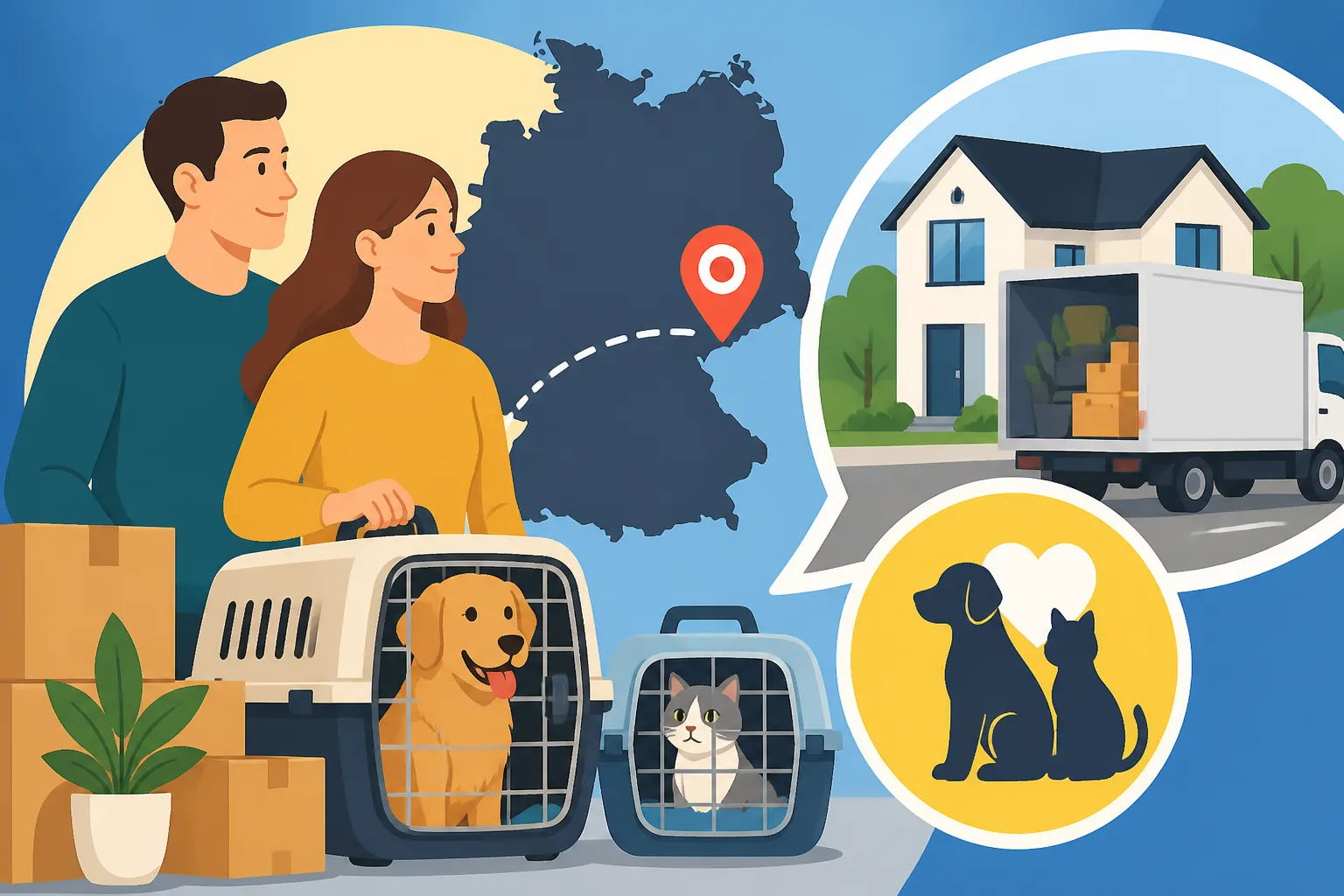
Coordinating Pet Transport With Your Household Shipment to Germany
Your movers have quoted a container that takes weeks at sea. Your dog’s rabies paperwork has its own deadlines. Your temporary flat in Germany may not accept pets at all. Families relocating with animals often discover too late that these three timelines are not in sync. This guide shows you how to line up pet transport, veterinary paperwork and your household shipment so everything arrives in the right order.
Disclosure: This post may contain affiliate links. We may earn a commission at no extra cost to you if you make a purchase through these links. Read full disclosure.
Why Pet Timing and Household Shipping Pull in Different Directions
When I moved to Germany with a nervous rescue cat and a small terrier, I assumed the hard part would be the furniture. I was wrong. The furniture behaved exactly as the moving company said it would. The animals came with vet appointments, airline rules, a landlord question and one very long night in a temporary apartment with no cat litter, because I had packed the litter tray in the shipment. The tray was somewhere on a ship in the North Atlantic.
This is the core problem. Your household goods and your pets run on separate clocks. A removal company works backwards from a loading date and a vessel or truck schedule. Your vet works forwards from a microchip date and a vaccination date. Airlines and pet carriers have their own booking windows and seasonal limits. If you plan these one at a time, they will collide.
Your Pet Travels With You, Your Furniture Does Not
This sounds obvious, but it affects every decision you make. Pets never go in a container or a removal truck with your boxes. A standard international mover will not carry a live animal in the load. Your pet travels with you in the cabin or hold of a plane, in your car, on a ferry, or with a specialist pet transporter. Your sofa travels on its own schedule, often weeks behind you.
So the real question is not “how do I ship my pet with my household goods?” It is “how do I make sure my pet arrives at a moment when I am ready for them, and how do I make sure the things my pet needs are not stuck in the shipment?” Those are two different planning jobs. The second one catches far more people out.
Think about what an animal needs in the first days in a new country. A crate or carrier. A familiar blanket. Food they already eat, because a sudden diet change on top of a move is a recipe for an upset stomach. Any medication. A lead, a harness, poo bags, a litter tray, a scratching post for a stressed cat. Every one of these is an item a removal crew will happily wrap and load if you leave it in the house on packing day. I now tell every friend who moves with a pet the same thing. Make a pet box, label it, and physically remove it from the house before the movers arrive.
The Owner Travel Window and Why Separate Shipping Changes the Rules
Here is the detail that many people miss. EU rules on moving pets distinguish between non-commercial movement and commercial movement. Non-commercial movement is the friendlier route. It applies when the pet is travelling with its owner, or with a person the owner has authorised in writing, and the pet is not being sold or transferred to someone else.
The catch is timing. If your pet travels separately from you, for example on a cargo flight booked by a pet relocation company while you fly a few days earlier, it can only stay in the non-commercial category if it moves within a short, fixed window around your own journey. You also need the right paperwork showing that link. Outside that window, the movement can be treated as commercial. That brings stricter requirements and different border procedures. The exact number of days and the documents needed are set out by the EU and checked by German authorities. Confirm the current window with your vet and your pet transporter before you book anything.
This matters for coordination because many families are tempted to stagger things. One partner flies out early to sign the lease and start work. The other stays behind to oversee the packers. The pet comes “later, once we are settled.” That plan can quietly push your animal into a different legal category. If you want to stagger arrivals, decide early who the pet is travelling with. Book their flight within the permitted window, and get the authorisation in writing if it is not the registered owner.
Where Sirelo Fits Into the Planning
I want to be honest about what a moving comparison platform does and does not do. Sirelo is not a pet airline, and it will not issue your animal health certificate. What Sirelo does very well is the part of the move that most often throws off your pet plans: the household shipment.
Through Sirelo you can describe your move once and receive quotes from several international removal companies. You can then compare their reviews, services and proposed dates side by side. For a pet owner, that comparison is the moment to lock down your loading date, your estimated delivery window in Germany, and whether the firm offers storage if your German keys are delayed. Once those dates are fixed, you can build your pet’s travel around them, rather than the other way round. Some removal companies also have contacts with pet relocation specialists or can advise on them. Ask about it when the quotes come in rather than assuming it is included.
If you are still at the stage of mapping out the entire relocation, I laid out a full timeline in An International Move to Germany: The 12-Week Planning Calendar. This article zooms in on the pet-specific pieces that sit on top of that calendar.
Building One Timeline for Paperwork, Pet Travel and Your Shipment
The single most useful thing I did on my second move, a later relocation within Germany and then a cross-border move for a friend’s family, was to put every date on one page. Vet appointments, airline booking, packing day, loading day, our flight, the container’s estimated arrival, and the delivery appointment in Germany. Seeing them together exposes the clashes immediately.
Veterinary Paperwork Depends on Where You Are Coming From
Germany applies the EU’s harmonised rules for pet dogs, cats and ferrets. What you need depends mainly on whether you are moving from another EU country, from a non-EU country the EU has “listed” for rabies purposes, or from an unlisted country. The broad pattern looks like this, but always confirm the details with an accredited vet in your country and with the German authorities. For the deeper legal detail, I recommend Bringing Your Pet to Germany: Import Rules, Quarantine, and Vet Care.
| Starting point | Identification | Rabies requirements | Main travel document | Extra steps to plan for |
|---|---|---|---|---|
| Another EU country | ISO-compliant microchip implanted before the rabies vaccine | Valid rabies vaccination, with the mandatory waiting period after a first vaccination | EU pet passport | Generally the simplest route; check the national rules of any non-EU country you drive through |
| Listed non-EU country, such as the UK or the US | ISO-compliant microchip implanted before the rabies vaccine | Valid rabies vaccination, with the mandatory waiting period after a first vaccination | EU animal health certificate completed by your vet and endorsed by your country’s official veterinary authority | Certificate is only valid for travel within a limited period after issue, so timing against your flight is critical |
| Unlisted non-EU country | ISO-compliant microchip implanted before the rabies vaccine | Valid rabies vaccination plus a rabies antibody titre blood test at an EU-approved laboratory, followed by a waiting period before entry | EU animal health certificate with titre test results | Start months ahead; the waiting period after the blood sample is often the longest item in the entire move |
A few things in that table deserve emphasis. The order matters: microchip first, then rabies vaccination. If the vaccine was given before the chip, many vets will advise revaccinating after chipping so the record is valid. The animal health certificate for non-EU arrivals has a limited validity window. You cannot get it signed months in advance “just to be safe.” It has to be timed close to travel. That makes it one of the dates your entire pet plan pivots around.
Germany does not require tapeworm treatment for dogs entering the country. That rule belongs to a small group of other countries, including Ireland, Finland, Malta, Norway and the UK. Each of them sets it as a condition for dogs entering their own territory. If you are moving to Germany, you do not need it for German entry. You would only need to think about it later if you take your dog on a trip into one of those countries. In that case, check that country’s own rules before you travel.
Germany also has its own breed restrictions. Federal law prohibits bringing certain dog breeds into the country, including Pit Bull Terriers, American Staffordshire Terriers, Staffordshire Bull Terriers and Bull Terriers, as well as crosses of these breeds. Limited exceptions exist. On top of that, each Bundesland keeps its own list of dogs considered potentially dangerous, often called Listenhunde, with rules on permits, muzzles and leads. If your dog is a bully breed or a cross, research this before you sign a moving contract. It may change whether the move is possible at all. I explain the state-level differences in Pet Ownership in Germany: Laws for Dogs, Cats, and Exotic Pets.
Birds, rabbits, rodents, reptiles and fish follow different rules from dogs, cats and ferrets. Some exotic species also fall under international species protection rules, so you may need permits on top of health paperwork. If you have anything other than a dog, cat or ferret, contact the German authorities and a specialist transporter very early.
A Coordinated Step-by-Step Timeline
Here is the sequence I now recommend to anyone moving to Germany with a pet and a household shipment. Exact lead times depend on your origin, your animal and your movers. The order is what keeps things from colliding.
- Check your pet’s eligibility before anything else. Confirm the breed is allowed into Germany and into your chosen Bundesland. Confirm the microchip is ISO-compliant and was implanted before the current rabies vaccination. If you are coming from an unlisted country, book the titre test immediately, because its waiting period will set the earliest date your pet can enter.
- Request removal quotes through Sirelo and ask each company for realistic loading and delivery windows. Ask about storage options and whether they can provide a delivery date range for Germany, not just a sailing or transit estimate.
- Choose your mover and fix the loading date. This becomes the anchor for your pet plan, because packing day is when your pet should ideally be out of the house.
- Decide how your pet will travel: in the cabin, in the hold of your own flight, as manifest cargo with a pet relocation company, or by road. Confirm the travel window rules if your pet will not be on the same journey as you.
- Book your pet’s travel and your own travel together, and get written confirmation of crate requirements, check-in times and any breed or seasonal restrictions from the airline or transporter.
- Book your vet appointment for the health certificate or passport check so the paperwork falls inside its validity window before departure. For non-EU origins, factor in the time for official endorsement by your national veterinary authority.
- Arrange a pet-friendly bridge stay in Germany for the gap between your arrival and the delivery of your household goods.
- Pack the pet box and set it aside: food for at least the first stretch in Germany, medication, copies of all documents, crate, bedding, lead, litter supplies, toys and a few familiar-smelling items.
- On packing and loading days, place your pet with a friend, sitter or boarding kennel, or shut them in one cleared room with a sign on the door telling movers not to open it.
- Travel with your pet and keep all original documents in your hand luggage. Declare your pet on arrival where required.
- Settle into the bridge accommodation, register your address, and book the delivery appointment for your household goods once your lease starts.
- On delivery day in Germany, keep your pet away from the open doors and the stairwell again, then reintroduce them to the new home once the furniture is in place.
Steps two and three are where people underestimate the value of comparing properly. A mover who quotes a vague delivery window of “several weeks” leaves you guessing how long you need temporary pet-friendly housing. A mover who gives you a clear range, and has reviews from customers saying they kept to it, lets you plan with confidence.
What to Ask Movers When Comparing Quotes on Sirelo
When the quotes arrive through Sirelo, do not just compare the bottom line. For a pet owner, the following questions separate a useful mover from a frustrating one:
- Can you give me a delivery window for my German address, and how much notice will I get before the delivery day?
- Do you offer storage at origin or in Germany if my lease start date moves, and how is that charged?
- Can your crew work around a pet that is shut in one room on packing day, and will they label that room’s contents separately?
- Do you have a relationship with a pet relocation company, or can you recommend one on my route?
- Will you handle the street parking permit for the delivery truck in Germany, often called a Halteverbotszone, or is that my job?
- What happens to my delivery slot if my container is held at customs, and who contacts me?
That last question is not paranoia. Customs paperwork for household goods coming from outside the EU depends partly on your registration status in Germany. If your Anmeldung slips, your shipment can sit in port while you sit in a temporary flat with an increasingly bored dog. I walk through that sequence in Sequencing Anmeldung and Customs Clearance Before Your Container Lands. For decoding what each mover has included or left out, read Comparing International Removal Quotes for Germany: Line Items That Hide Costs. I would not price pet-related extras without it.
Route Scenarios: How Coordination Changes by Origin
The principles stay the same, but the practical shape of the move changes a lot depending on where you start. Here are the three scenarios I see most often among friends and readers.
Moving Within the EU by Road
If you are moving from France, the Netherlands, Austria, Poland or elsewhere in the EU, you have the most flexibility. Your pet needs an EU pet passport with a valid rabies vaccination and microchip. Many people simply put the animal in their own car and drive.
The coordination challenge here is speed, not distance. EU road removals can be quick. Your household goods might arrive the day after you do, or even the same day. That is great for comfort, but it means your pet may experience packing day, a long drive and delivery day in quick succession. That is a lot of stress for a sensitive animal.
A family I helped move from Lyon to Freiburg handled this well. They booked their removal so that loading happened on a Monday and delivery on a Thursday. The cat went to a friend’s house on Monday. They drove down with her on Tuesday and spent two nights in a pet-friendly holiday apartment. They had the new flat fully set up by Thursday evening before letting her explore. The extra nights cost something, but the cat was calm. Nobody spent delivery day chasing her through an open stairwell.
If you drive through Switzerland on your way, remember that Switzerland is outside the EU. It applies its own rules for pets and goods. Check before you travel rather than assuming EU paperwork covers every border on your route.
Moving From the UK
Since Brexit, the UK is a non-EU country for pet travel. Pet passports issued in Great Britain are no longer valid for bringing pets into the EU. You will need an animal health certificate completed by an Official Veterinarian in the UK. It must be issued close to your travel date, within the validity rules.
Most UK movers to Germany travel by road with their animals, using car ferries or the Channel Tunnel vehicle shuttle. Check that your chosen crossing accepts pets and how they are handled on board, because operators differ. Flying a pet out of the UK is often more restrictive, as many airlines limit pets in the cabin on UK routes.
The coordination issue for UK movers is that household goods now go through customs formalities too. Your removal company will usually handle the export and import declarations. They will need your German address details and proof of your move. If you are driving your pet over yourself while the removal truck follows, make sure the truck’s arrival does not land on the same afternoon you are dealing with your first night in a new country with an anxious animal. A gap of a day or two is kind to everyone. When comparing UK quotes on Sirelo, ask specifically how the firm handles the post-Brexit paperwork and what they need from you, so that you are not scrambling for documents while juggling a pet crate at a ferry port.
Long-Haul Moves by Sea Freight
Moving from the US, Canada, India, Australia or Southeast Asia almost always means your household goods travel by sea. That often means weeks of transit plus time at port and inland. Your pet, meanwhile, will fly, either with you or as manifest cargo.
This is the scenario where the gap between pet arrival and furniture arrival is largest. You might live for weeks in temporary accommodation with a pet and only the contents of your suitcases. Plan that period carefully. Choose a furnished, pet-friendly rental rather than a hotel if the gap is long. Pack enough pet supplies in your luggage to last until you can shop locally. Pet supply stores such as Fressnapf exist across Germany, so you will be able to buy food and basics once you arrive, although you may not find your pet’s exact brand.
Be careful with pet food in your luggage when arriving from outside the EU. The EU restricts travellers from bringing in products of animal origin, which can include pet food containing meat or dairy. Exceptions exist for certain veterinary diets, but they are narrow. Check the rules with German customs, the Zoll, before you pack a suitcase full of kibble.
If your pet flies through Frankfurt, the airport has a dedicated animal handling facility that deals with live animal arrivals. That is reassuring if your animal arrives as cargo. Ask your pet transporter how the collection process works, which documents you need to bring, and how long clearance usually takes on the arrival day. For more detail on long-haul shipment timing, read Moving to Germany from the US: Container Costs, Ports, and Timelines.
| Route type | Typical pet travel method | Typical household goods method | Size of gap between pet and furniture | Biggest coordination risk |
|---|---|---|---|---|
| Within the EU | Owner’s car, sometimes train or plane | Road removal, dedicated or shared load | Short, often days | Packing, travel and delivery stacked too close together |
| From the UK | Owner’s car via ferry or vehicle shuttle | Road removal with customs formalities | Short to moderate | Health certificate timing and post-Brexit paperwork on the same days |
| Long-haul from outside Europe | Flight in cabin, hold or as manifest cargo | Sea freight container or shared container | Long, often weeks | Extended temporary housing with a pet and supplies stuck in the container |
| Unlisted country origin | Flight, usually through a specialist | Sea freight | Can be very long | Titre test waiting period delaying the whole move |
Look at the table and think about your own case. If you are in the last two rows, your movers’ delivery estimate is not a detail. It decides how long you must pay for pet-friendly temporary housing. That is exactly why I push people to collect several quotes through Sirelo and press each firm on realistic transit times, rather than signing the first offer that lands in the inbox.
Arrival, Delivery Day and the First Weeks in Germany
Arriving is not the end of the coordination job. In many ways, the first few weeks in Germany are where pet owners feel the friction most. You are dealing with bureaucracy, temporary housing and new routines all at once.
Bridge Housing That Actually Accepts Your Pet
Short-term accommodation in German cities can be tight, and pet-friendly short-term accommodation is tighter still. Many furnished apartments and serviced apartments state that pets are not allowed. Others accept small animals but not large dogs. Some hotels list pets as welcome but then add conditions, cleaning charges or restrictions on leaving the animal alone in the room. I unpack the wording in Pet-Friendly Hotels in Germany: What ‘Haustiere Erlaubt’ Actually Means, and the general options are covered in Bridge Accommodation: Where to Stay Between Landing and Getting Keys.
My practical advice is to book bridge housing only after you have your mover’s delivery window in hand. Then add a buffer. If your container is estimated to arrive in a certain week, book until the end of the following week if you can, with a flexible cancellation policy. Paying for a few extra nights is far less stressful than being forced to move a pet twice because your shipment slipped.
Before you sign a long-term lease, read the pet clause carefully. German rental law does not allow landlords to impose a blanket ban on all pets through a standard contract clause. Small animals kept in cages, such as hamsters or budgies, are generally allowed. Dogs and cats, however, usually require the landlord’s consent, which is weighed case by case. Get that consent in writing before you move in, not after. I have more on the housing side of this in Moving to Germany with Pets: Pet-Friendly Housing and City Guidelines.
Delivery Day With an Animal in the Building
German delivery days have their own rhythm. Movers may need a reserved parking zone on the street. They will use the stairwell, sometimes an external furniture lift, and they will keep the front door of your flat and possibly the building door open for hours. For a cat or a small dog, that is an open invitation to escape into a stairwell, a courtyard or a busy street they do not know.
On delivery day, I recommend one of three approaches:
- Keep your pet in the bridge accommodation, with a sitter, or in a boarding facility for the day. In German this is often called a Tierpension or Hundepension.
- If the pet must be at the new flat, set up one fully closed room with water, bedding, a litter tray or puppy pad and a familiar item. Put a clear sign on the door in German and English asking movers not to open it.
- Have one adult whose only job is the pet, while another adult directs the movers.
Once the crew leaves, close everything, then let your pet out into a home that already smells partly of your old furniture. That familiar smell helps more than you might expect. Our cat went from hiding under the bathroom sink in the temporary flat to sleeping on her old armchair within an hour of it arriving. For the practical side of the truck, stairs and permits, see Delivery Day in a German Building: Stairs, Lifts, and Street Permits.
If your goods arrive before your lease starts, or your lease start is delayed, storage is the safety valve. That is another reason to ask about it when you compare movers on Sirelo. Knowing your options in advance means a delayed key handover does not push you into weeks of extra temporary housing with an animal. Storage While You Relocate: Home-Country Units vs German Lagerraum explains how storage works on both ends.
Registering Your Pet and Sorting Local Obligations
Once you are in your German home, a few pet-specific tasks follow. Germany is not one uniform system here, because many rules are set by the Bundesländer and by individual municipalities.
- Register your dog for dog tax, the Hundesteuer, with your municipality. Rates and rules vary from town to town, and certain dogs can attract a higher rate. Cats are not subject to this tax.
- Check whether your Bundesland requires dog owner liability insurance, the Hundehaftpflichtversicherung. Some states make it mandatory for all dogs, others only for certain breeds, but it is wise to have it everywhere. Your general personal liability policy usually does not cover damage caused by your dog, so ask your insurer.
- Register your pet’s microchip with a German pet registry, such as TASSO or FINDEFIX, so that if your animal gets lost, a vet or shelter can trace you. In some areas registration is required for certain dogs.
- Find a local vet, a Tierarzt, and bring copies of the vaccination record. Book a check-up once your animal has settled, especially after a long flight.
- Learn the local lead and dog park rules, which can differ between cities and even between parks. Some states have seasonal leash rules for forests and fields during breeding season.
The registration details are covered step by step in Registering Pets in Germany: Pet Passports and Mandatory Registrations. For liability cover more generally, How to Get Haftpflichtversicherung in Germany is a good starting point.
Bringing It All Together
When I look back at my first move with animals, almost every stressful moment came from one of two mistakes. Either the pet’s needs were packed into the shipment, or the shipment’s timing had not been pinned down, so everything around it had to be guessed. Both are fixable with planning.
The most reliable approach I have found is to lock in the household shipment first, with a clear loading date and a realistic delivery window, and then build your pet’s paperwork, travel and temporary housing around those dates. Sirelo makes that first step much easier. You describe your move once, compare quotes and reviews from international removal companies serving your route, and choose the firm whose dates and services actually fit a household with animals. Then you can talk to your vet, your airline or pet transporter, and your German landlord with fixed dates in hand.
If you are starting to plan a move to Germany with a dog, cat or other companion, request your removal quotes through Sirelo early. Ask every company the pet-specific questions above. Put the answers on one page next to your vet appointments and travel bookings. Your pet will not thank you in words, but a calm animal sleeping on its own blanket in your new German home is thanks enough.
Disclaimer
This article is for general informational purposes only and does not constitute professional advice. Laws, prices and regulations vary by location and change over time. Consult a qualified professional for guidance on your specific situation.