Air Travel Within Europe: Budget Airlines and Flying Tips from Germany
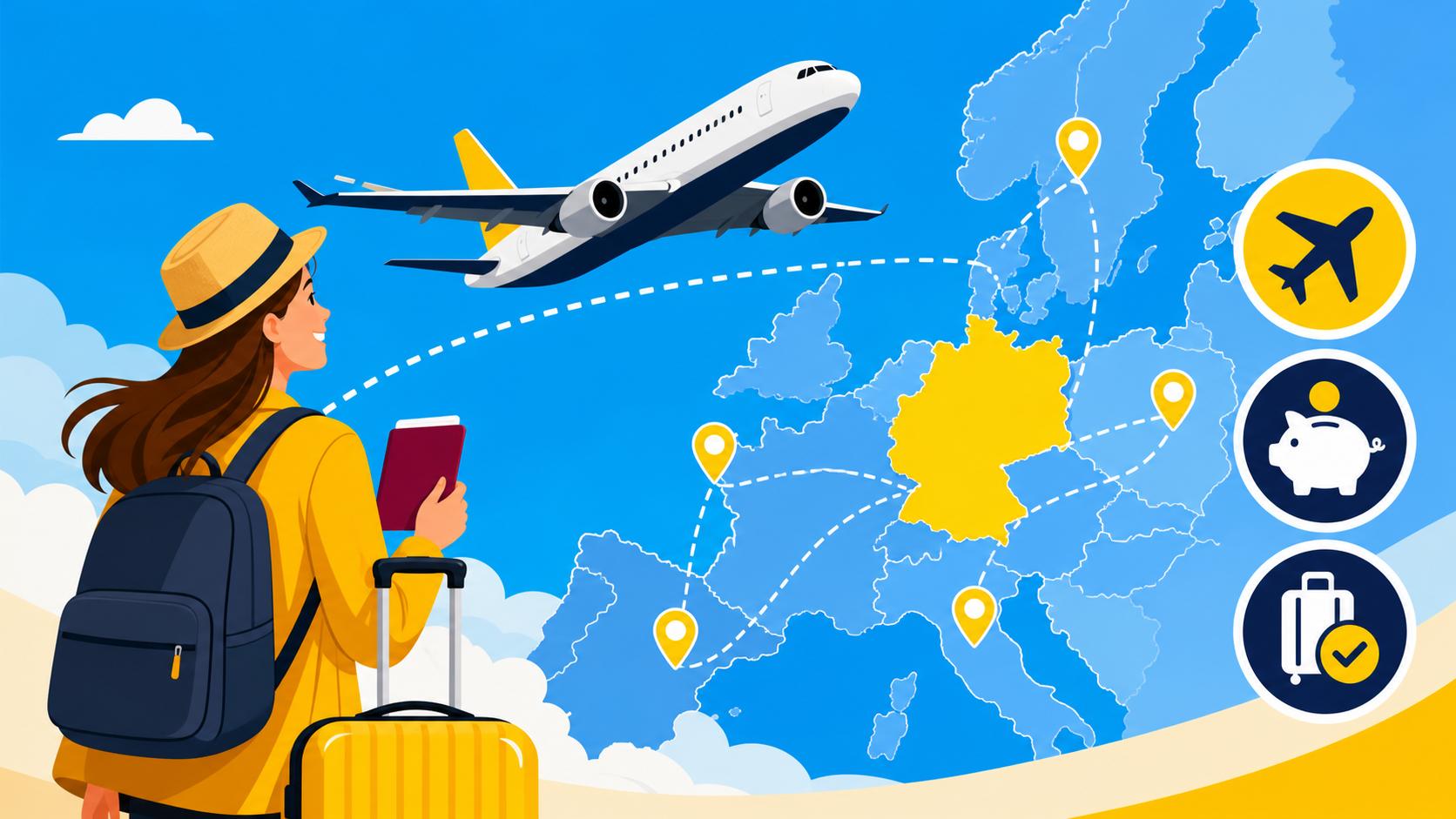
Your flight to Lisbon looked cheap on the booking site. Then came the seat fee, the bag fee, and a train ride to an airport two hours from the city on the ticket. This guide explains how budget air travel within Europe works from Germany. It covers which airports to use, how to avoid add-on traps, and how to get through airport day without surprises.
Disclosure: This post may contain affiliate links. We may earn a commission at no extra cost to you if you make a purchase through these links. Read full disclosure.
Which Budget Airlines and Airports Serve Routes from Germany
I have been flying out of Germany for years, and my first lesson was this: the airline is only half the decision. The airport you leave from often matters just as much, because it shapes your travel time, your transfer cost, and how stressful the morning feels.
The Low-Cost Carriers You Will See Most
Search for a weekend in Barcelona, Krakow or Palermo from Germany and the same names keep coming up. Ryanair runs a large network from several German airports, including some smaller regional ones. easyJet has a strong presence at Berlin Brandenburg. Wizz Air connects German cities with Central and Eastern Europe, which matters if you are visiting family in Poland, Romania or the Balkans. Eurowings belongs to the Lufthansa Group and sits between budget and traditional. It offers fare bundles that range from bare-bones to fairly comfortable. Condor focuses on holiday destinations around the Mediterranean and the Canary Islands.
Lufthansa itself is not a budget airline. Its lightest fares can still compete on some European routes, especially once you add the cost of a checked bag on a low-cost carrier. For a full breakdown of how those three compare once luggage is included, see Lufthansa, Eurowings, and Ryanair Within Germany: Total Cost With Bags.
My advice is to stay loyal to the total price, not to the brand. The airline that is cheapest to Rome may be the most expensive to Lisbon. That ranking can also flip between a Tuesday and a Friday.
Main Hubs Versus Secondary Airports
Germany has a dense airport network. Frankfurt and Munich are the big international hubs. Berlin Brandenburg, Düsseldorf, Hamburg, Cologne/Bonn and Stuttgart handle a large share of European leisure traffic. Nuremberg, Leipzig/Halle, Dortmund, Bremen, Hannover, Karlsruhe/Baden-Baden and Friedrichshafen fill in the regional gaps.
Then come the airports whose names stretch the truth. Frankfurt-Hahn is in the Hunsrück hills, a long way from Frankfurt. Weeze is near the Dutch border, not really near Düsseldorf. Memmingen in the Allgäu is often sold as a Munich option, but it is far from the city. These airports can offer very low fares. They can also cost you a long bus ride, an early alarm, and real risk if your bus is late. Read Hahn, Weeze, and Memmingen: Budget Airports That Aren’t Where They Claim before you book one.
Do not forget airports just across the border either. People in Freiburg often fly from Basel-Mulhouse. Residents of Aachen or the lower Rhine sometimes look at Dutch or Belgian airports. It is worth comparing these alongside the German options.
| Airport type | Examples | Typical upside | Typical downside |
|---|---|---|---|
| Major hub | Frankfurt, Munich | Huge route choice, frequent flights, direct rail links | Long walks, busy security, fares can be higher |
| Large city airport | Berlin Brandenburg, Hamburg, Düsseldorf, Cologne/Bonn, Stuttgart | Good low-cost network, decent public transport | Peak-hour queues during school holidays |
| Regional airport | Nuremberg, Leipzig/Halle, Dortmund, Bremen | Short security lines, quick to get through | Fewer routes, limited flight times |
| Remote budget airport | Frankfurt-Hahn, Weeze, Memmingen | Sometimes the lowest base fares | Long, costly transfers and tight connections |
| Cross-border airport | Basel-Mulhouse, airports in the Netherlands | Extra options for border regions | Different transport ticket systems, longer planning |
How to Book Budget Flights from Germany Without Getting Burned by Add-Ons
The headline fare is a starting bid, not a final price. Once you accept that, booking becomes much less frustrating.
The Real Price of a Cheap Ticket
A budget fare usually includes you, a seat assigned at random, and one small personal item that has to fit under the seat in front of you. Everything else tends to cost extra:
- A larger cabin bag for the overhead bin
- A checked suitcase
- A chosen seat
- Priority boarding
- Airport check-in
- Sometimes a printed boarding pass
Each airline sets its own fees and sizes, and these change often. Always check the airline’s own baggage and fees page for current figures before you pay.
Here is a typical scenario. You and your partner find two return tickets to Porto for about the price of a nice dinner in Munich. You add one cabin bag each way, because nobody packs for four days in a backpack, and pick seats so you can sit together. Then you book the airport bus and a taxi on the Portuguese side. The trip now costs several times the headline fare. That can still be a great deal, but do the maths before you compare it with the train or a full-service airline.
| Cost component | Usually included in the basic fare | Usually extra | What to check |
|---|---|---|---|
| Small under-seat item | Yes | No | Exact dimensions on the airline page |
| Overhead cabin bag | Sometimes on full-service fares | Often on low-cost fares | Whether it requires priority or a bundle |
| Checked suitcase | Rarely on basic fares | Yes | Weight limit and per-direction pricing |
| Seat selection | Random seat only | Yes | Whether families get free adjacent seats |
| Online check-in | Usually yes | Airport check-in can cost extra | Check-in window opening and closing times |
| Airport transfer | No | Always your cost | Distance from the airport to the city |
Timing Your Booking Around German Holidays
Germany has a quirk that catches many expats out: school holidays are staggered by federal state. When Bavaria or North Rhine-Westphalia starts its summer break, flights from Munich or Düsseldorf can jump in price overnight. Fares from Hamburg or Leipzig may stay calmer. If you are flexible, check which states are on holiday before you pick a departure airport.
Brückentage are the other big price driver. These are the bridge days between a public holiday falling on a Thursday and the weekend. Germans take one day of leave, get four days off, and fill every plane to the Mediterranean. Christmas, Easter and the long spring holiday weekends behave the same way. See Christmas Markets, Easter, and Bruckentage: Germany’s Worst Weeks to Book Late for a closer look at those weeks. If you are planning leave with your employer, Public Holidays and Your Job: What You Need to Know (Vacation Planning) explains how to stretch your vacation days around them.
A Step-by-Step Booking Checklist
This is the routine I follow every time:
- Search using a comparison site, then open the airline’s own website to confirm the fare and bag rules.
- Write down the total cost for your real luggage needs, not the cheapest bundle.
- Look up the departure airport and calculate your transfer time and cost from home.
- Check the arrival airport’s distance from your actual destination.
- Compare the total against a train option for anything under roughly a day’s travel.
- Book directly with the airline where possible, so changes and refunds are simpler.
- Enter your name exactly as it appears on the ID you will travel with.
- Set a reminder for when online check-in opens, and download your boarding pass to your phone.
Baggage, Documents and Airport Day in Germany
This is where most budget-airline drama happens: at the gate, with a bag sizer and a queue of nervous passengers.
Cabin Bag Rules and Packing Tactics
Gate agents at budget carriers really do check bags, especially on busy flights. A bag that is “almost” small enough can earn you a gate fee, which is usually far higher than paying for the bag online.
My fix was to buy a soft underseat bag made to the exact dimensions of the airline I fly most. I also bought a small digital luggage scale. Both are easy to find on Amazon Germany. Search for terms like “Handgepäck unter Sitz” with the airline name and you will see bags sized for specific carriers. The scale has paid for itself several times on return trips, when souvenirs and Portuguese canned fish push a checked suitcase towards its limit.
Liquids still trip people up. German airports have been rolling out newer security scanners, and rules on liquids and laptops can differ between airports and even between lanes. Pack toiletries in small containers in a clear, resealable bag. Check your departure airport’s website shortly before you fly. Never assume your return airport in another country follows the same rules.
ID and Residence Documents
Flights within the Schengen Area usually skip passport control. Airlines still require valid ID at boarding, so do not leave home without it. EU citizens can generally travel on a national ID card. Non-EU residents should carry both their passport and their German residence permit card. Your residence permit alone does not replace a passport for identification abroad.
Flights to Ireland, Cyprus, the UK or non-Schengen Balkan countries involve a real border check, and your documents matter even more. If you are unsure how far your permit lets you roam, see Traveling in the Schengen Area with a German Residence Permit: Your Rights and Limits.
For medical cover on short trips, Travel Insurance for Expats: When and How to Use It explains when your German coverage is enough and when a separate policy makes sense. To stay online once you land, Europe Regional eSIM Plans: Worth It for a Multi-Country Trip From Germany compares data options for multi-country trips.
Getting to the Airport by Train
Germany’s big airports are well connected by rail. Frankfurt has a long-distance train station right at the terminals. Munich Airport is linked by S-Bahn lines. Berlin Brandenburg has its own station served by regional trains and the S-Bahn. Regional and S-Bahn trains to airports are generally covered by the Deutschland-Ticket. Long-distance ICE trains are not, so check which train you are boarding.
For door-to-door details, our guides How to Get From Frankfurt Airport to the City Center, How to Get From Munich Airport to the City Center and How to Get From Berlin Brandenburg Airport to the City walk through the options. Read them in reverse for your outbound trip.
Some airlines and package holiday operators also sell combined rail and flight tickets, often called Rail&Fly. These can include the train to your departure airport. Check the terms carefully, especially what happens if your train is late.
For early flights, I add a generous buffer for German rail delays. The 6 a.m. flight that looked brilliant at booking feels very different when a cancelled S-Bahn leaves you scrambling for a taxi at 4 a.m.
When Things Go Wrong, and When Not to Fly at All
Budget flying is great until something breaks. Knowing your rights and your alternatives turns a disaster into an inconvenience.
Delays, Cancellations and Strikes
German aviation sees regular strikes. These can involve ground staff, security staff at specific airports, or airline crews, and they are usually announced a short time in advance. Download the airline’s app and turn on notifications. Check your airport’s departure page on the morning of travel.
Under EU passenger rights rules, flights departing from the EU, or arriving in the EU on an EU carrier, can qualify for care, rerouting and sometimes compensation after long delays or cancellations. Whether you qualify depends on the cause and the length of the delay. File your claim with the airline first, in writing, and keep every receipt. If the airline refuses or ignores you, Germany has an independent arbitration body for transport disputes, the Schlichtungsstelle für den öffentlichen Personenverkehr, known as söp. It can mediate without you going to court.
Practical tips that have saved me:
- Screenshot your booking and boarding pass in case the app fails.
- Ask the gate staff for a written confirmation of the delay reason.
- Keep food and hotel receipts if you are stranded overnight.
- Rebook through the airline rather than buying a new ticket yourself, unless the airline tells you to.
Train Versus Plane Within Europe
Not every European trip should be a flight. For destinations within a few hours, such as Amsterdam, Brussels, Paris, Prague or Vienna, the train often wins once you add airport transfers, security and boarding time. Trains also take you from city centre to city centre, with far more relaxed luggage rules. Start with the Deutsche Bahn Guide: Using Trains for City and Long-Distance Travel if you have never booked long-distance rail here.
For longer routes, flying usually makes more sense. Germany to Spain and Portugal: Long-Haul Overland vs Budget Flights compares the two directly. If you are heading to Britain, Germany to the UK: Flight, Rail, and Ferry Combinations covers every way across. For short trip ideas that do not need a plane at all, browse Day Trips and Travel from Germany: Tips for Exploring Europe on Weekends.
| Trip type | Usually better by | Why |
|---|---|---|
| Neighbouring capitals within a few hours | Train | City-centre stations, no security queues, generous luggage |
| Mediterranean beaches and islands | Plane | Overland journey takes most of a day or longer |
| Multi-city loop in Central Europe | Mix of both | Fly the long leg, rail between nearby cities |
| Trips with lots of luggage or sports gear | Train or full-service airline | Budget bag fees add up quickly |
| Last-minute trip in a peak week | Compare both | Last-minute fares on both can spike |
Choosing a Base That Makes Flying Easier
If you are new to Germany and still in temporary accommodation, location can make a big difference to how often you actually travel. Many newcomers spend their first months in a furnished monthly rental through a platform like Wunderflats while they look for a permanent flat. When you browse those listings, check the distance to the nearest S-Bahn or regional train line that reaches the airport. A flat ten minutes from a direct airport train turns a weekend in Lisbon into an easy Friday-evening escape, not a logistics puzzle.
Wunderflats listings also let you filter by furnishings and amenities. That helps if you are juggling travel with remote work and need a reliable desk and internet between trips.
Budget flying from Germany rewards people who plan the whole journey: the airport transfer, the bag, the holiday calendar and the backup plan. Get those right, and Europe’s cheapest fares really do open up the continent.
Disclaimer
This article is for general informational purposes only and does not constitute professional advice. Laws, prices and regulations vary by location and change over time. Consult a qualified professional for guidance on your specific situation.