End-of-Life Care and Hospices: An Overview of Palliative Care in Germany
Navigating end-of-life care in a foreign country can be emotionally and administratively overwhelming. This comprehensive guide explains the palliative care system in Germany, detailing hospice options, insurance coverage, legal rights, and essential support resources for expats facing difficult times.
Disclosure: This post may contain affiliate links. We may earn a commission at no extra cost to you if you make a purchase through these links. Read full disclosure.
Understanding the German Palliative Care System
The Philosophy Behind Palliative Medicine
Palliative care in Germany is deeply rooted in the philosophy of maximizing the quality of life for patients facing life-limiting illnesses. Rather than focusing on curing a disease that has progressed beyond the reach of curative medicine, the German healthcare system pivots towards comprehensive symptom management. This includes aggressive and tailored pain relief, respiratory support, and meticulous attention to physical comfort. The overarching goal is to ensure that patients can live their final weeks or months with as much dignity, peace, and autonomy as possible, surrounded by a care framework that respects their individual wishes.
This holistic approach extends far beyond physical symptoms. German palliative medicine recognizes that psychological, social, and spiritual distress are inextricably linked to physical pain. Therefore, care teams are inherently multidisciplinary, comprising not just specialized physicians and nurses, but also psychologists, social workers, and pastoral care providers. For an expatriate navigating this system, understanding this holistic baseline is crucial, as it ensures that your emotional and cultural needs, alongside your medical ones, are considered valid and worthy of professional attention.
To fully grasp how this fits into the broader medical landscape, you might want to review our extensive resource on Healthcare in Germany: A Comprehensive Guide for Expats. The integration of palliative philosophy into standard medical practice has improved significantly over the last two decades, meaning that whether you are in a major city like Berlin or a smaller town, access to this specialized, compassionate care is a recognized medical right.
How the Healthcare System Supports Patients
The transition into palliative care within Germany typically begins with your primary care physician, known as the Hausarzt, or your treating specialist, such as an oncologist. These medical professionals serve as the gatekeepers to the palliative network. When a curative approach is no longer viable or desired, your doctor will initiate a consultation to discuss the integration of palliative support. They will evaluate your specific needs and issue the necessary referrals or prescriptions for specialized care, whether that is for home-based support or admission to a dedicated facility.
Once the need is established, the German statutory and private health insurance systems step in to facilitate access. The system is designed to remove the financial burden from the patient during this critical time. Your doctor will write a prescription for what is known as Specialized Outpatient Palliative Care or recommend inpatient hospice admission. This documentation is then submitted to your insurance provider for rapid approval. The efficiency of this process is generally highly prioritized by German insurers, recognizing the time-sensitive nature of end-of-life care.
For expats, the bureaucracy of the German medical system can feel daunting, especially during a health crisis. However, social workers stationed within hospitals and palliative networks are specifically trained to handle these administrative hurdles. They will liaise with your health insurance fund, organize the necessary medical equipment for home care, and ensure that the transition between different care settings is as seamless as possible.
Differences Between Curative and Palliative Approaches
The shift from curative to palliative care is a profound medical and emotional transition. In the German medical model, curative care is characterized by aggressive interventions aimed at eradicating a disease or significantly prolonging life, often accepting severe side effects in exchange for a potential cure. This might involve intensive chemotherapy, invasive surgeries, or prolonged stays in intensive care units. The primary metric of success in curative care is the eradication or suppression of the illness.
Conversely, the palliative approach actively shifts the metric of success to the patient’s immediate comfort and quality of life. Medical interventions do not stop; rather, their purpose changes. For example, radiation therapy might still be used, but solely to shrink a tumor that is causing localized pain, rather than with the hope of curing the cancer. Medications are optimized to reduce nausea, alleviate breathlessness, and manage anxiety. Caregivers and family members are also heavily factored into this model, receiving guidance on how to support their loved one and manage their own physical and emotional stamina. Some caregivers find it helpful to look into nutritional and wellness support from providers like iHerb to maintain their energy levels during demanding caregiving routines.
Understanding this distinction is vital for patients and families making difficult decisions about treatment paths. In Germany, choosing palliative care is never framed as “giving up.” Instead, it is an active, medically supported choice to prioritize dignity and comfort. It is also important to note that palliative care can be provided alongside curative treatments in the earlier stages of a serious illness, gradually becoming the primary focus as the disease progresses.
Types of End of Life Care Facilities in Germany
Inpatient Hospices and Palliative Care Wards
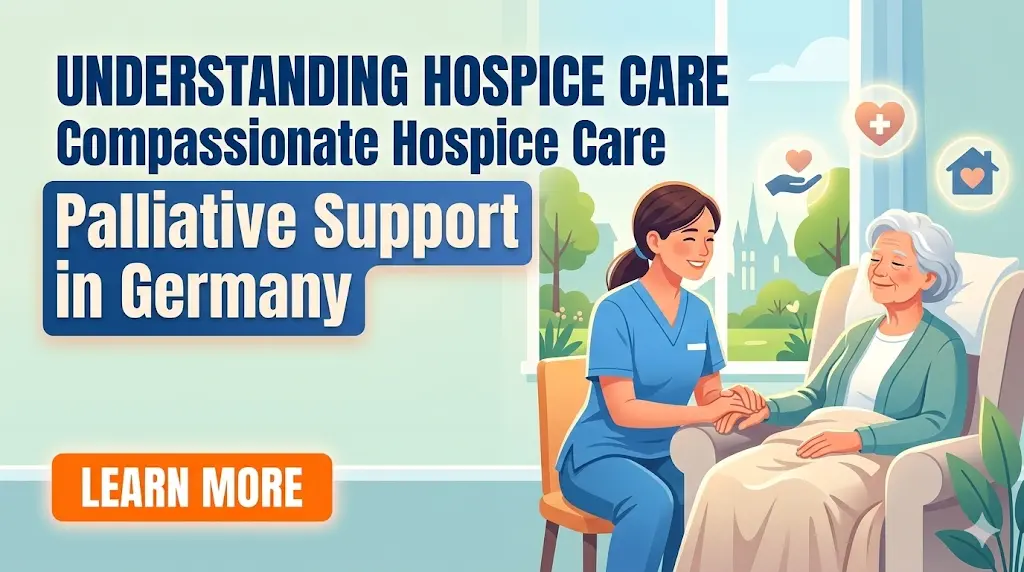
When staying at home is no longer feasible due to complex medical needs or a lack of support infrastructure, Germany offers specialized inpatient facilities. The two primary options are Palliative Care Wards inside hospitals and independent Inpatient Hospices. While they share a similar philosophy, their environments, goals, and funding structures differ significantly.
Palliative Care Wards are specialized units within a standard hospital. They are designed for patients experiencing acute, severe symptoms that require continuous monitoring and adjustment by specialized medical staff. The goal of a palliative ward is typically stabilization. Patients are admitted to manage a crisis—such as a sudden spike in pain or severe respiratory distress—with the intention of eventually discharging them back home or to a hospice once their condition is manageable. The environment is clinical but generally much more relaxed and family-friendly than a standard hospital ward.
In contrast, Inpatient Hospices are independent, home-like facilities designed for patients who are in the final stages of life and cannot be cared for at home, but who do not require acute hospital interventions. Hospices focus entirely on providing a peaceful, supportive environment for the patient’s final days or weeks. The staff-to-patient ratio is exceptionally high, and the daily routine is entirely dictated by the patient’s wishes and comfort.
| Feature | Palliative Care Wards | Inpatient Hospices |
| Primary Goal | Acute symptom management and stabilization | End-of-life care and comfort in a home-like setting |
| Location | Integrated within standard hospitals | Independent, often community-based facilities |
| Duration of Stay | Usually short-term (days to a few weeks) | Longer-term until the end of life |
| Medical Intervention | High level of specialized medical adjustment | Focus on nursing care, comfort, and emotional support |
| Environment | Clinical but adapted for comfort | Highly personalized, home-like, flexible visiting hours |
Outpatient Services and Home Care
The overwhelming majority of people in Germany express a strong desire to spend their final days in the comfort of their own homes. To facilitate this, the German healthcare system has developed a robust network of outpatient palliative care services. The most comprehensive of these is the Specialized Outpatient Palliative Care network. This service brings a multidisciplinary team of specially trained palliative care doctors, nurses, and social workers directly to the patient’s home.
These mobile teams are available around the clock, 24/7, providing immense peace of mind to both the patient and their family members. They manage complex pain relief regimens, handle medical emergencies to prevent unwanted hospital admissions, and provide extensive guidance to family caregivers. To access this service, a standard doctor must prescribe it, and the patient must be suffering from an advanced, progressive disease that requires highly specialized symptom management. For a broader understanding of how the state supports care needs, reading up on Long-term Care Insurance (Pflegeversicherung): What It Is and Who Needs It can be incredibly beneficial.
In addition to specialized medical teams, outpatient care heavily relies on standard home nursing services. These services assist with daily personal hygiene, wound care, and the administration of basic medications. Furthermore, Germany has a strong tradition of volunteer hospice services. These trained volunteers visit patients at home to offer companionship, read to them, or simply provide family members with a few hours of respite. This multi-tiered approach ensures that staying at home is a viable and supported option for many.
Specialized Pediatric Palliative Care
The loss of a child is an unimaginable tragedy, and the pediatric palliative care system in Germany is designed with an exceptional level of sensitivity and specialized expertise. Children are not simply small adults; their medical, emotional, and developmental needs during a terminal illness are entirely unique. Pediatric palliative care teams are specially trained to communicate with children about their illness at an age-appropriate level, incorporating play therapy and psychological support into the medical care plan.
Pediatric hospices in Germany function quite differently from adult hospices. They are designed to support the entire family unit over a prolonged period, as childhood terminal illnesses can often stretch over years. These facilities offer “respite stays,” where the sick child and their parents and healthy siblings can stay at the hospice for a few weeks a year. This allows the parents to step back from their grueling 24/7 caregiving duties and simply be parents again, while the medical staff takes over the complex care.
The focus in pediatric palliative care is heavily placed on creating positive memories, supporting healthy siblings who often struggle with the dynamic shift in the family, and providing profound bereavement support for the parents. The state and various charitable organizations heavily fund these institutions, ensuring that families do not face financial ruin while caring for a terminally ill child.
Navigating Costs and Health Insurance Coverage
Public Health Insurance Provisions
If you are insured under the German statutory health insurance system, you are entitled to comprehensive coverage for palliative and end-of-life care. The philosophy of the system is that financial concerns should never be a barrier to dignified care in one’s final days. Public health insurance fully covers the costs of treatment on a palliative care ward within a hospital, completely absorbing the expenses of specialized doctors, nursing staff, medications, and therapies.
Similarly, the costs for Specialized Outpatient Palliative Care are covered in full by public insurers, provided a doctor has prescribed the service and the medical necessity is confirmed. This means that the 24/7 mobile care teams that visit patients at home will not generate a private bill for the family. For inpatient hospices, the funding is slightly different but still financially secure for the patient. Hospices are financed partly by health and long-term care insurances and partly by donations, but crucially, the patient themselves does not have to pay a daily rate or co-pay for their stay. To understand more about how your overall coverage works, consult our guide on Health Insurance in Germany: Understanding Public vs Private Coverage.
It is important to ensure that all administrative steps, such as submitting the doctor’s prescription for palliative care to your insurance provider, are handled promptly. Usually, the hospital’s social services department or your chosen outpatient care team will manage this paperwork on your behalf, allowing the family to focus entirely on the patient rather than fighting bureaucratic battles.
Private Health Insurance Options
For expats who have opted for private health insurance, the coverage for palliative care is generally excellent, but the administrative processes can differ from the public system. Private insurers are legally required to offer coverage that is at least equivalent to the public system, meaning inpatient hospice stays, palliative wards, and outpatient specialized care are typically fully covered. However, unlike the public system where providers bill the insurer directly, privately insured patients may initially receive invoices that they must submit for reimbursement.
When dealing with a terminal illness, managing high-cost medical bills while waiting for reimbursement can be incredibly stressful. It is highly advisable to contact your private insurance provider immediately upon receiving a palliative diagnosis to establish a direct billing agreement. Many private insurers will arrange to pay hospitals, hospices, and specialized home care teams directly in these severe cases to relieve the administrative burden on the family. If you are currently evaluating your insurance setup, providers tailored to expats, such as Feather Insurance or Ottonova, often have dedicated English-speaking support teams that can clarify exactly how these claims are handled.
Always review the specific terms of your private policy. While standard palliative care is covered, some premium policies might offer extended benefits, such as larger allowances for alternative therapies, psychological support for family members, or more extensive coverage for medical equipment needed for home care.
Additional Financial Support and Allowances
Beyond direct medical costs, caring for a terminally ill loved one at home often results in hidden financial strains, such as lost income from taking time off work or the need to purchase special nutritional supplies. If the patient has been contributing to the German long-term care insurance system for at least two years, they are entitled to apply for a care degree.
Depending on the assigned care degree, the family may receive a monthly care allowance, which is paid directly to the patient to be used at their discretion, often to compensate family caregivers. Additionally, employees in Germany have the legal right to take up to ten days of unpaid leave (often supported by a wage replacement benefit from the long-term care insurance) to organize care for a dying relative in an acute situation. For longer-term caretaking, there are provisions for partial or full unpaid leave for up to six months, protecting your employment status.
If family members from abroad are sending financial support to assist with these supplementary costs, utilizing efficient currency exchange and transfer services like Wise can help ensure that funds are not lost to exorbitant banking fees. Understanding these financial safety nets is crucial for expats who may not have a broad local support network to fall back on.
Legal Framework and Patient Rights
Drafting a Living Will or Advance Directive
In Germany, patient autonomy is fiercely protected by law. A cornerstone of this autonomy is the Living Will, known in German as a Patientenverfügung. This is a legally binding document in which you state exactly which medical treatments you wish to receive, and critically, which treatments you wish to refuse, in the event that you lose the capacity to communicate your will. For expats, having this document translated and legally recognized in Germany is one of the most important administrative steps you can take for your healthcare.
A standard Patientenverfügung allows you to stipulate your wishes regarding life-prolonging measures, artificial nutrition and hydration, resuscitation attempts, and pain management. If you clearly state in this document that you do not want to be kept alive artificially if there is no hope of recovery, German doctors are legally obligated to follow your written directive. It completely removes the burden of life-and-death decision-making from the shoulders of your grieving family members and ensures your personal ethics and wishes are respected.
It is highly recommended to draft this document with the assistance of your Hausarzt or a legal professional to ensure the medical terminology is precise and applicable to German law. Vague statements like “I do not want to suffer” are often not legally actionable; the document must outline specific medical scenarios and your corresponding choices.
Healthcare Proxies and Power of Attorney
Alongside a Living Will, executing a Healthcare Proxy or Power of Attorney is essential. In Germany, this is typically handled through a Vorsorgevollmacht. Contrary to popular belief, if you become incapacitated in Germany, your spouse or next of kin does not automatically have the legal right to make all medical or financial decisions on your behalf. Without a designated proxy, the German state may appoint a legal guardian, which can lead to agonizing delays and decisions being made by a stranger.
A Vorsorgevollmacht allows you to appoint a trusted person—such as your partner, a close friend, or a family member—to make decisions on your behalf if you cannot. You can specify the scope of their power, limiting it strictly to medical decisions or extending it to handle financial and legal matters, such as terminating a rental lease or accessing bank accounts.
If your designated proxy lives outside of Germany, ensure they understand the legal weight of this document and how to interact with the German system. If they need to manage your German finances or pay local legal fees from abroad to assist with your estate, tools like Wise are often utilized by international families to manage cross-border transactions smoothly. Furthermore, a Betreuungsverfügung is another document where you can suggest a guardian to the court, should court-appointed guardianship become unavoidable.
Regulations Around Assisted Dying
The topic of assisted dying is legally complex and ethically debated in Germany. It is important for expats to understand the strict legal boundaries that dictate what medical professionals can and cannot do. In Germany, active assisted suicide—where a doctor directly administers a lethal substance to a patient with the intent to end their life—is strictly illegal and punishable by law.
However, passive assisted dying is legally permissible and forms a core part of palliative care. This involves the withholding or withdrawing of life-prolonging treatments, such as turning off a ventilator or stopping artificial nutrition, provided this aligns with the patient’s expressed wishes, usually documented in a Patientenverfügung.
Furthermore, indirect assisted dying is also an accepted medical practice. This refers to the administration of strong pain relief, such as high doses of morphine, aimed entirely at alleviating severe suffering, even if a known secondary effect of the medication might be the shortening of the patient’s life. The primary intention must always be symptom control. In recent years, high court rulings have slightly shifted the landscape regarding the prescribing of lethal medication for self-administration in extreme cases, but the practical application remains highly restricted, legally perilous for doctors, and generally outside the standard framework of German palliative care.
Emotional Support and Planning for Expats
Overcoming Language Barriers in Medical Settings
Facing a terminal illness is frightening; facing it in a language you do not fully command amplifies the terror significantly. In palliative care, clear, nuanced, and empathetic communication is just as critical as the medical treatment itself. Misunderstanding a prognosis or being unable to articulate the exact nature of your pain due to language barriers is a major concern for the expat community in Germany.
While many German doctors speak excellent English, the nursing staff and social workers who form the backbone of daily palliative care may not. It is entirely acceptable, and encouraged, to request English-speaking staff when organizing outpatient care or selecting a hospice. Major university hospitals and hospices in international hubs like Berlin, Munich, or Frankfurt are generally well-equipped to accommodate non-German speakers.
If English-speaking staff are unavailable, utilizing a professional medical interpreter is crucial for major consultations, such as discussing a Patientenverfügung or transitioning to a hospice. Do not rely solely on family members to translate complex medical information, as the emotional toll of translating devastating news can be unbearable for them. Some insurance policies may even cover the cost of a medical interpreter in specific palliative contexts.
Grief Counseling and Bereavement Support
Palliative care in Germany explicitly includes support for the family left behind. The process of grieving in a foreign country, separated from your extended family, cultural mourning rituals, and lifelong friends, presents unique psychological challenges for expat families. The German system offers structured bereavement support, known as Trauerbegleitung, to help navigate this profound loss.
Hospices and palliative care networks routinely offer individual grief counseling, support groups for widows or widowers, and specialized therapeutic groups for children who have lost a parent. These services are often run by trained psychologists or specialized pastoral care workers and are usually free of charge or covered by insurance.
It is important for caregivers to prioritize their own mental and physical well-being during the grieving process. The exhaustion of long-term caregiving coupled with acute grief can severely impact your health. Seeking out professional support, engaging in gentle restorative practices, and perhaps utilizing wellness aids from platforms like iHerb to support sleep and stress management can be small but necessary steps in the healing process.
Repatriation Considerations and Planning
For many expats, the ultimate question at the end of life is where they wish to rest. Deciding whether to pass away in Germany or attempt to return to your home country is a complex decision involving medical feasibility, financial logistics, and deep emotional ties. If a patient wishes to travel home while still alive, a rigorous medical assessment is required to determine if they are fit to fly, and specialized medical repatriation flights are exceedingly expensive.
If the decision is made to remain in Germany, expats must plan for what happens after death. Repatriating a deceased body across international borders involves significant bureaucratic hurdles, including obtaining international death certificates, coordinating with embassies, and adhering to strict international transport regulations regarding embalming and zinc-lined caskets.
This process is costly and logistically demanding. It is highly advisable to discuss these wishes openly with your family and check if your health or life insurance includes specific clauses for the repatriation of remains. Providers like Feather Insurance or Ottonova may have specific add-ons or guidance for international travel and repatriation coverage. Establishing contact with a German funeral director experienced in international transfers before a crisis occurs can provide immense clarity and prevent your grieving family from having to navigate complex international logistics blindly.
References
Primary sources official
- Wegweiser Hospiz- und Palliativversorgung Deutschland: The official nationwide database for searching hospice and palliative services. https://www.wegweiser-hospiz-palliativmedizin.de/en
- Federal Ministry of Health (BMG): Official information on the “Act to Improve Hospice and Palliative Care” (HPG). https://www.bundesgesundheitsministerium.de/hospiz-und-palliativversorgung.html
- German Association for Palliative Medicine (DGP): Scientific and professional guidelines for palliative care in Germany. https://www.palliativmedizin.de/
Other helpful sources
- German Hospice and Palliative Association (DHPV): Umbrella organization for hospice work and palliative care in Germany. https://www.dhpv.de/
- Charité Berlin – Palliative Medicine Center: Overview of inpatient and outpatient palliative care structures at one of Europe’s largest university hospitals. https://palliativmedizin.charite.de/en/
Disclaimer
The information provided in this article is intended for general informational and educational purposes only and should not be construed as professional medical, legal, or financial advice. While we strive to ensure the accuracy and timeliness of the information regarding the German healthcare and legal systems, regulations and insurance policies are subject to change. Always consult directly with qualified healthcare professionals, legal advisors, and your insurance provider to discuss your specific medical situation, draft legally binding documents, and confirm your coverage entitlements in Germany.