The German Health Insurance Card (Gesundheitskarte): Uses and How to Get One
Walking into a German doctor's office for the first time feels like a high-stakes audition where you have forgotten your script and your dignity. I remember standing at a reception desk in Berlin, sweating through my coat, trying to explain a sinus infection in broken German, only to be met with a silent, expectant hand held out for my Gesundheitskarte. This guide demystifies that little plastic rectangle so you can navigate the system with confidence.
Disclosure: This post may contain affiliate links. We may earn a commission at no extra cost to you if you make a purchase through these links. Read full disclosure.
What Exactly is the Elektronische Gesundheitskarte (eGK)?
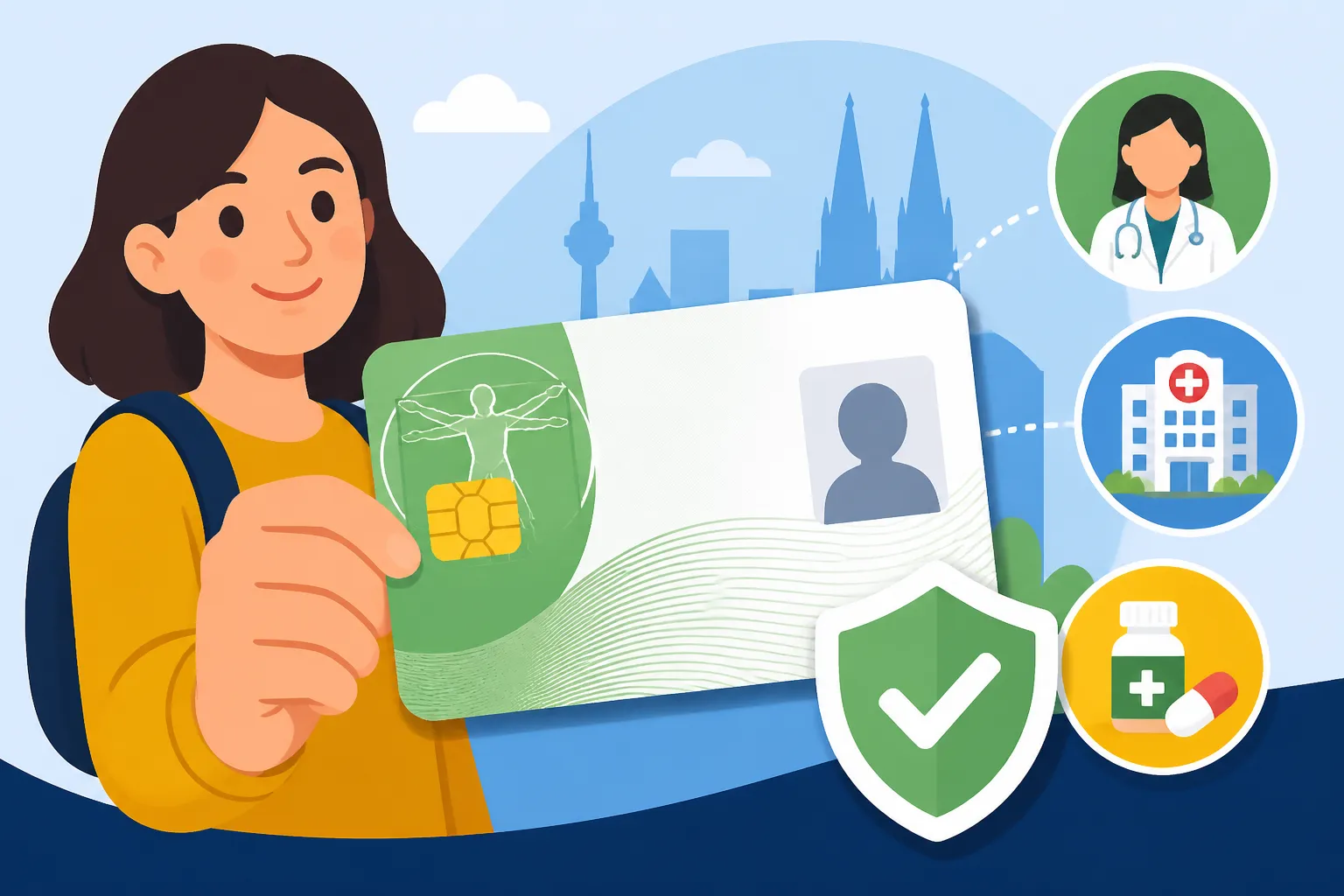
The elektronische Gesundheitskarte, commonly referred to as the eGK, is the physical manifestation of your right to healthcare in Germany. If you are enrolled in the public system, this card is your passport to every medical interaction. It is not just an ID card; it is a sophisticated piece of technology designed to streamline the communication between your insurance provider, your doctors, and the pharmacies.
The Anatomy of the Card and Its Technology
On the surface, the eGK looks like a standard credit card, but it contains an embedded microprocessor chip. This chip is the heart of the German telematics infrastructure. When you hand your card to a medical assistant, they slide it into a reader that authenticates your insurance status in real-time. This prevents the archaic need for paper vouchers that used to dominate the system decades ago. Most modern cards also feature an NFC (Near Field Communication) symbol, allowing for contactless interactions with smartphone apps provided by your Krankenkasse.
The card features your name, your unique ten-digit insurance number, and a passport-style photo. The photo was a relatively recent addition designed to prevent insurance fraud, ensuring that the person receiving treatment is the person paying into the fund. For those just starting their journey, understanding Health Insurance in Germany: Understanding Public vs Private Coverage is a vital first step before you even worry about the plastic in your wallet.
What Data is Actually Stored on the Chip?
There is often a lot of expat anxiety regarding privacy and what data the German government can see on this card. Currently, the "administrative data" is the only thing mandatory. This includes your name, date of birth, address, and your insurance status (whether you are an employee, a pensioner, or a dependent). It also confirms whether you are required to pay co-payments for medications or if you have reached your annual limit for out-of-pocket expenses.
In recent years, the system has expanded to include optional "emergency data." You can choose to have your blood type, allergies, or chronic conditions like diabetes stored on the chip. This is incredibly useful if you are ever brought into an emergency room unconscious. However, this remains voluntary. Furthermore, the card acts as the key to your electronic patient record (ePA), a digital file where doctors can store your X-rays and lab results, provided you give them explicit permission via your card and a PIN.
The Unique Insurance Number
Your insurance number (Versichertennummer) is a lifetime identifier. Even if you switch from one public provider to another, this number stays with you. It is a ten-digit alphanumeric code that you will find yourself memorizing faster than your own phone number because it is required on every single piece of medical paperwork. If you are still in the process of choosing a provider, reading about Public Health Insurance (gesetzliche Krankenkasse): What It Covers and Costs can help clarify why this number is so foundational to your life in Germany.
How to Get Your First Insurance Card in Germany
The process of getting your card is the "second act" of your arrival in Germany, usually following your address registration (Anmeldung). You cannot simply walk into a shop and buy one; it is the culmination of a successful insurance application.
The Application Process for Public Insurance
Once you have signed a contract with a public health insurance provider, they will initiate the card-issuing process. The most important step for you is the "photo upload." You will receive a letter or an email with a link to a portal where you must submit a passport-compliant photo. I have seen many expats ignore this letter, thinking it is just more German bureaucracy, only to find themselves without a card two months later when they actually get sick.
After the photo is approved, the card is printed and mailed to your registered address. This usually takes between seven and fourteen days. If you are a freelancer, the process can be slightly more complex as you need to prove your income first. In these cases, using a service like Feather Insurance can be a lifesaver, as they specialize in helping expats navigate the bridge between their arrival and their formal enrollment in the German system.
Private Insurance and the Digital Alternative
If you are a high earner or self-employed and choose to go private, the "card" situation looks a bit different. Some private insurers provide a plastic card that looks almost identical to the public eGK, while others, like ottonova, focus heavily on a digital-first approach. With a private provider, you often don't "swipe" a card at the doctor to pay. Instead, you are treated as a private patient, receive an invoice in the mail, and then use your app to scan the bill for reimbursement.
For those on short-term visas or digital nomad stints, you might not be eligible for the long-term eGK at all. In these scenarios, companies like SafetyWing provide the necessary coverage for your visa requirements, though you won't receive a German chip-card. Instead, you'll carry a digital certificate of insurance. Understanding the nuances of Private Health Insurance in Germany: Benefits, Costs, and Eligibility is essential if you are considering stepping out of the public system.
What to Do While You Wait for the Card
What happens if you have an ear infection on Tuesday but your card isn't arriving until Friday? This is a common panic point. If you are already insured but don't have the card yet, you can request a "provisional certificate of insurance" (Abrechnungsschein or Mitgliedsbescheinigung) from your provider. Most Krankenkassen can email this to you or fax it directly to your doctor's office.
As long as you have this piece of paper, the doctor must treat you. They will manually enter your data into their system. If you show up with nothing, the doctor's office may ask you to pay the "private" rate upfront, with the promise that they will refund you once you bring your card in within ten days. To avoid this stress, it is best to have your Healthcare in Germany: A Comprehensive Guide for Expats bookmarked to know your rights in these waiting periods.
Using Your Card at the Doctor and Pharmacy
The "handing over of the card" is a ritual in Germany. It happens the moment you walk through the door of a Praxis (doctor's office), often before you are even asked why you are there.
The "Check-in" Ritual at the Praxis
When you find a Finding a Doctor (Hausarzt) in Germany: How to Choose and Register, your first interaction will be with the medical assistants (MFAs) at the front desk. They will take your card and "read" it. This process creates a "treatment case" for the current quarter. In Germany, the healthcare system runs on three-month cycles (January-March, April-June, etc.). You only need to have your card read once per quarter at each specific doctor you visit.
If you visit your GP in January and return in February, you don't technically need to swipe again. However, if you return in April, the new quarter has started, and the doctor needs a fresh "read" to bill the insurance company for your visit. Always carry it with you, because "the system won't let me open your file" is a phrase you will hear often if you forget it.
The New Era of the E-Prescription (E-Rezept)
One of the most significant changes for expats in the last two years is the move to the E-Rezept. Historically, you would leave the doctor's office with a pink piece of paper for your medication. Now, your prescription is stored digitally on the central server. To pick up your medicine, you simply go to any Pharmacies in Germany (Apotheke): How to Get Medication and Advice and hand them your Gesundheitskarte.
The pharmacist slides your card into their reader, and your prescribed medications appear on their screen. There is no paper involved, and no room for losing a prescription on the U-Bahn. It is a seamless process that has made life significantly easier, provided you know that your card is the "key" to unlocking that data at the pharmacy counter.
Handling Emergency Situations
In an emergency, the card is vital but not a barrier to care. If you are rushed to the hospital, they will treat you regardless of whether you have your plastic card on you. However, someone will eventually ask for it once you are stabilized. If you are unconscious, the emergency data on your chip (if you opted in) can provide life-saving information to the doctors. It is also worth noting that for routine issues, knowing about Doctor’s Appointments in Germany: Making Appointments and Avoiding Long Waits can help you avoid the ER altogether.
| Feature | Public Insurance (eGK) | Private Insurance (PKV) |
|---|---|---|
| Card Type | Mandatory Chip Card (eGK) | Optional Plastic Card or App |
| Payment | Direct billing via card | You pay invoice, then get reimbursed |
| E-Prescription | Fully integrated via card | Often via app or paper |
| Quarterly Swipe | Mandatory for billing | Not required |
| EHIC (Europe) | Included on the back | Requires separate document/card |
The Back of the Card: Your Ticket to Europe
Many expats don't realize that their German health insurance card is actually a two-in-one deal. If you flip your card over, you will see the European Health Insurance Card (EHIC) symbol and a set of data fields.
Understanding the EHIC Functionality
The back of your card is what allows you to access state-provided healthcare during a temporary stay in any of the 27 EU countries, plus Iceland, Liechtenstein, Norway, and Switzerland. If you are hiking in the Italian Alps and break your leg, or if you get food poisoning in Paris, you present the back of your German card at the local state hospital.
You will be treated under the same conditions and at the same cost as a local in that country. This is a massive benefit of the German public system. However, it is not a replacement for European Health Insurance Card (EHIC): Using It in Germany and Abroad if you are moving permanently to another country; it is strictly for "temporary stays" like vacations or business trips.
Limitations of the EHIC
It is vital to understand what the back of your card doesn't do. It is not travel insurance. It does not cover private healthcare or costs such as a return flight to Germany or lost/stolen property. It also doesn't cover "medical tourism"—you cannot use it to go to Spain specifically to get a cheaper surgery.
For trips outside of Europe, or for more comprehensive coverage that includes repatriation, you should still look into Travel Health Insurance: What Expats Need for Schengen Visa & Short Trips. Even within the EU, many expats choose to supplement their eGK with a small private travel policy to ensure they aren't hit with unexpected costs for things the local state system doesn't cover.
Managing Your Card: Updates, Losses, and Changes
Life happens—you move to a sunnier apartment, you lose your wallet at a Christmas market, or your hair changes so much your photo looks like a different person. Managing these changes is part of the long-term expat experience.
Changing Your Address or Name
When you move within Germany and complete your new Anmeldung, you don't actually need a new card. You simply notify your Krankenkasse of your new address. The next time you go to the doctor and they swipe your card, the reader will automatically update the address stored on the chip. It is a strangely efficient moment in an otherwise paper-heavy country. However, if you change your name (e.g., through marriage), you will need to request a brand new card with the updated information and potentially a new photo.
What to Do if You Lose Your Card
Losing your Gesundheitskarte is a headache, but not a disaster. Your first step should be to call your insurance provider or use their app to report it lost. They will deactivate the old card and trigger the mailing of a new one. In the interim, they will provide you with a digital or paper certificate of replacement so you can still attend appointments.
If you suspect it was stolen along with your wallet, you should also report the theft to the police to get a Diebstahlanzeige (theft report). Some insurers might charge a small fee (usually around five to ten euros) for a replacement card if you lose it due to negligence, but many will waive this for the first instance.
Expiration and Renewal
Look at the bottom right corner of your card; you will see an expiration date. Typically, these cards are valid for five to ten years. Your insurance provider should automatically mail you a new card a few weeks before the old one expires. You don't usually need to do anything. If the old one expires and the new one hasn't arrived, that is the time to get on the phone. Once the new card arrives, you are expected to destroy the old one, specifically the chip, to protect your data.
Common Pitfalls and Troubleshooting
Even with the best technology, things can go wrong. Understanding the common "errors" can save you a lot of frustration in the waiting room.
The "Invalid Card" Error at the Terminal
Nothing is more embarrassing than the medical assistant telling you your card "isn't working" in front of a full waiting room. This usually happens for one of three reasons:
- The card is physically damaged: The chip is scratched or the card is bent.
- Your insurance is inactive: This happens often if you change jobs and there is a gap in contributions that the Krankenkasse hasn't resolved yet.
- The "Read" Error: Sometimes the doctor's software hasn't been updated to handle the newest generation of cards (G2.1 cards).
If this happens, don't panic. Ask the office to try a manual entry with your insurance number. If that fails, call your insurer immediately from the waiting room. They can often fax a confirmation of coverage to the office within minutes.
Moving Abroad and the "Abmeldung"
If you decide to leave Germany, your card does not automatically become a "souvenir." You are technically supposed to return it to your Krankenkasse or destroy it after your insurance ends. Continuing to use the card after you have deregistered (Abmeldung) and stopped paying premiums is considered fraud and can lead to massive back-payments and legal trouble. Always ensure you close the loop with your provider when your German adventure comes to an end.
The German health insurance card is more than just a piece of plastic; it is your entry ticket into one of the best healthcare systems in the world. Whether you are using Feather Insurance to get started or managing your health through the ottonova app, keeping your physical card safe and updated is the simplest way to ensure that the only thing you have to worry about at the doctor's office is actually getting better.
Disclaimer
The information provided in this article is for educational and informational purposes only and does not constitute legal, financial, or medical advice. Health insurance regulations in Germany are subject to frequent change. Always consult with a licensed insurance professional or your specific health insurance provider for the most up-to-date information regarding your coverage and requirements.