Berlin to Munich: Train, Bus, and Flight Priced Side by Side
Navigating Germany's vast and efficient public transport system can sometimes feel like trying to solve a Rubik's Cube while blindfolded, especially when you're faced with a big journey like crisscrossing the country from Berlin to Munich. Between trains, buses, and flights, each promising a different balance of speed, cost, and comfort, it's easy to get overwhelmed. This comprehensive guide is here to untangle that knot for you, breaking down every option so you can make the best decision for your travel style and budget, no matter if you're a seasoned expat or a curious tourist.
Disclosure: This post may contain affiliate links. We may earn a commission at no extra cost to you if you make a purchase through these links. Read full disclosure.
Why Berlin to Munich is a Classic German Route
The journey from Berlin, the vibrant, edgy capital, to Munich, Bavaria's elegant, traditional heart, is more than just a commute; it's a traverse across the diverse cultural landscape of Germany. As an expat who's made this trip more times than I can count, I can tell you it's a popular route for a reason. You're moving from the bustling metropolis that never sleeps to a city renowned for its beer gardens, Alpine proximity, and decidedly more relaxed pace. This roughly 600-kilometer (370-mile) stretch connects two of Germany's most economically and culturally significant hubs, meaning transport links are plentiful and generally well-developed.
For many, this journey is a vital connection to family, work, or leisure. Maybe you're flying in for Oktoberfest, heading to a business meeting, or simply exploring the breadth of German experience. Each choice of transport—train, bus, or plane—offers a distinctly different travel experience, impacting not just your wallet but also your overall impression of the country. Understanding these differences is key to enjoying your trip rather than just enduring it.
The Contrast in German City Life
Berlin, with its turbulent history, avant-garde art scene, and international population, pulsates with a raw energy that's intoxicating. It’s a city of creative freedom, startup culture, and endless possibilities, often characterized by its gritty charm and a certain "anything goes" attitude. Then you have Munich, a city that often feels like it's in a different country altogether. Here, tradition, order, and a love for the finer things in life—like crisp Bavarian beer and hearty food—take center stage. The architecture is grander, the streets are cleaner, and there’s an undeniable sense of Gemütlichkeit (coziness) that pervades daily life.
Moving between these two pillars of German identity really highlights the regional diversity of this country. It's a journey that showcases Germany's incredible ability to embrace both its cosmopolitan future and its deeply rooted past. Whether you're drawn to Berlin's museums and nightlife or Munich's English Garden and proximity to the Alps, the transition between these two cities offers a fascinating glimpse into the German soul.
Practicalities of Inter-City Travel
Beyond the cultural aspects, the Berlin-Munich route is a practical cornerstone for many. Business travelers frequently commute between the two cities for meetings or conferences, and students often traverse the distance to visit friends or family. Tourists, too, often include both cities in their itineraries to experience the full spectrum of German urban life. This high demand means that transport providers compete fiercely, often offering a range of prices and services to cater to every need. This competition is great for us, the travelers, as it means more options and often better deals. Being prepared with knowledge about these options can save you not only money but also a good deal of stress.
The Iron Horse: Traveling by Train from Berlin to Munich
Ah, the German train system, Deutsche Bahn (DB). For many, it's the quintessential German travel experience – a mix of efficiency, comfort, and sometimes, head-scratching delays. But on a route like Berlin to Munich, the ICE (Intercity-Express) is truly designed to shine. When the trains run on time, it's easily one of the most pleasant ways to travel across Germany.
The main line from Berlin Hauptbahnhof to Munich Hauptbahnhof is a high-speed route, and it’s been significantly upgraded in recent years. This means faster journey times, making the train a very competitive option against flying, especially when you factor in airport transfers and security checks. You get to glide through the German countryside, enjoying the scenery, catching up on work, or simply relaxing with a book.
The Comfort and Convenience of Deutsche Bahn (DB)
One of the biggest advantages of taking the train is the sheer comfort. Unlike cramped airline seats, even in second class on an ICE train, you'll find ample legroom and comfortable seating. First class, of course, elevates this with even more space, at-seat service, and often quieter carriages, which can be a godsend if you need to work or just want peace. There's also the Bordrestaurant or Bordbistro, where you can grab a coffee, a snack, or even a hot meal, albeit at typical train prices.
Luggage allowance is far more generous than on flights. You can bring pretty much what you can comfortably carry yourself without worrying about extra fees for an additional bag or a slightly oversized suitcase. This is a huge relief for anyone traveling with more than a carry-on, or, like me, someone who tends to overpack "just in case." Plus, you depart and arrive right in the city centers, Berlin Hauptbahnhof and Munich Hauptbahnhof, eliminating the need for expensive and time-consuming airport transfers. This convenience factor often tips the scales in favor of the train for many expats.
Understanding Ticket Types and How to Save Money
Navigating DB's ticket system can feel like its own mini-adventure, but once you get the hang of it, you can score some fantastic deals. The key is understanding the different fare categories:
- Flexpreis: This is the most flexible ticket. You can use any train on your chosen route on your travel day, and it's fully refundable. Great if your plans are uncertain, but it's also the most expensive.
- Sparpreis (Saver Fare) & Super Sparpreis (Super Saver Fare): These are your best friends for budget travel. They are significantly cheaper than Flexpreis but come with restrictions. Sparpreis allows for a specific train connection but usually includes a city ticket for public transport at your destination and is semi-refundable (for a fee). Super Sparpreis is even cheaper, ties you to a specific train, and is non-refundable.
The golden rule for saving money on train tickets is to book in advance. The further out you book, the more likely you are to find those coveted Super Sparpreis tickets. Sometimes, if you're lucky, you can find last-minute deals, but it's not something to rely on. For example, a Super Sparpreis ticket booked months ahead for the Berlin-Munich route can be as low as €20-€30, whereas a Flexpreis on the day could easily be €100+. I've learned this the hard way, paying top dollar for last-minute trips when my German efficiency failed me! You might also want to look into purchasing a BahnCard, especially if you plan on frequent train travel within Germany. This discount card offers 25%, 50%, or even 100% off tickets for a yearly fee, making it a wise investment for regular commuters. For those interested in deeper insights, checking out articles on How to Buy Deutsche Bahn Tickets and Save Money or High-Speed Trains in Germany ICE Deutsche Bahn Routes and Savings can provide even more detailed strategies.
The Journey Experience: What to Expect Onboard
Once you’re on board the ICE, the journey itself is generally quite pleasant. You'll find power outlets at most seats, so you can keep your devices charged, and free Wi-Fi is usually available, though its reliability can sometimes be a bit hit-or-miss, especially in rural areas. Announcements are made in both German and English, keeping you informed about upcoming stops and any service changes.
The scenic views as you travel from the flat northern German plains into the hillier, more forested southern regions are a welcome change from airport queues and security lines. Especially as you approach Bavaria, the landscape starts to shift, hinting at the Alpine beauty that awaits around Munich. During the 4 to 4.5-hour journey, you have plenty of time to read, work, or simply enjoy the ride. It’s a vastly different experience from being cooped up in an airplane, and for many, myself included, it’s a much more relaxing and productive way to travel.
Hitting the Road: The Bus Journey from Berlin to Munich
If budget is your absolute top priority and time isn't a pressing concern, then traveling by long-distance bus is usually your cheapest option for the Berlin to Munich route. In Germany, the bus network has grown exponentially, especially since the deregulation of intercity bus travel a few years back. Now, companies like FlixBus dominate the market, offering extensive connections.
While it won't be the fastest or the most luxurious journey, it's perfectly viable and surprisingly comfortable for the price. I've spent many hours on a FlixBus, often forking out less than a fancy coffee for a trip across state lines, and for students or those on a tight budget, it's an absolute lifesaver.
The Economics of Bus Travel
The biggest draw of the bus is, without a doubt, the price. Tickets can often be found for as low as €15-€25 if booked a few weeks in advance, making it significantly cheaper than even the cheapest train tickets or flights. This makes bus travel particularly attractive for students or backpackers who are trying to stretch every Euro as far as possible. While prices can creep up closer to the travel date, they very rarely reach the heights of last-minute train or plane tickets.
When considering the cost, remember to factor in flexibility. Unlike Sparpreis train tickets, most bus tickets allow for changes to your booking, albeit sometimes for a small fee. This flexibility can be a real boon if your plans are prone to last-minute shifts. However, be aware that while the base fare is low, some companies might charge extra for things like preferred seats, additional luggage beyond a small carry-on, or even seat reservations. Always check the fine print to avoid any surprises.
Comfort, Amenities, and Time Commitment
Let's be realistic: a bus journey, especially one that spans 7-8 hours (or sometimes more, depending on traffic and stops), is not the pinnacle of comfort. However, modern long-distance buses are far from the cramped, uncomfortable chariots of yesteryear. Most buses, particularly those operated by FlixBus, come equipped with comfortable reclining seats, air conditioning, power outlets, and often free Wi-Fi, though, like on trains, the Wi-Fi can be temperamental. There's usually a toilet onboard, which is a definite plus on such a long journey.
The primary trade-off, as you might expect, is time. The Berlin to Munich bus journey typically takes between 7 to 8.5 hours. This is considerably longer than the train or flight, and it's subject to traffic delays, especially when passing through major cities like Nuremberg or during peak travel times. So, if you're on a tight schedule or prone to motion sickness, this might not be your ideal mode of transport. However, if you view the journey itself as part of the adventure, or if you can comfortably work or sleep on a bus, it's a perfectly good option. For a more detailed look at bus options, you might find Long-Distance Buses in Germany FlixBus and Networks helpful.
Picking Up and Dropping Off
Bus stations in Germany are usually well-connected to local public transport networks, but they might not always be as centrally located as the main train stations. In Berlin, the central bus station (Zentraler Omnibusbahnhof Berlin, or ZOB) is a bit out of the city center, easily reachable by S-Bahn. In Munich, the main bus station (ZOB München) is also slightly west of the Hauptbahnhof but still very accessible via tram and U-Bahn.
Remember to factor in travel time to and from the bus station when planning your journey. While the bus ticket itself is cheap, those extra local transport tickets can add up. Moreover, bus boarding typically starts 15-30 minutes before departure, so arriving early is always a good idea to secure your spot and stow your luggage without a rush. You generally don't have the same extensive check-in process as at an airport, but it's not as simple as hopping on a train platform.
Taking to the Skies: Flying from Berlin to Munich
For those who prioritize speed above all else, flying from Berlin (BER) to Munich (MUC) might seem like the obvious choice. The flight itself is quick, typically around 1 hour and 10 minutes. However, the true travel time, once you factor in airport transfers, security checks, and potential delays, often ends up being quite comparable to, or even longer than, the high-speed train. Plus, it comes with a higher environmental footprint, which is something many expats in Germany are increasingly mindful of.
A quick search on Omio will show you that flights are available from airlines like Lufthansa and Eurowings. While the flight time itself is short, the reality of getting to and from airports means the overall door-to-door journey can often be around 3-4 hours or more, making it less of a clear winner than one might initially think.
The Real Cost and Time of Flying
While you can sometimes snag incredibly cheap flight deals, particularly from budget carriers if they operate on this route (which is less common for domestic flights in Germany compared to international ones), the actual cost often quickly escalates. The advertised price rarely includes baggage fees, seat selection, or airport transfer costs. A "cheap" €50 flight can easily become a €100+ endeavor once all these extras are piled on.
Let's break down the hidden time costs:
- Travel to/from airport: Berlin Brandenburg Airport (BER) is located south of the city, and Munich Airport (MUC) is a good distance north. Both require dedicated time and money for S-Bahn or regional train connections. Allow at least 45-60 minutes each way.
- Check-in and Security: Even for domestic flights, you need to arrive at the airport at least 60-90 minutes before departure. Security lines, especially at BER, can be notoriously long.
- Boarding and Deplaning: The actual process of getting on and off the plane.
So, while the flight is just over an hour, your total travel time can easily stretch to 4-5 hours. If your meeting is in the city center, the train's city-center-to-city-center convenience often wins out, particularly if you can book a fast ICE connection.
Luggage Restrictions and Airport Experience
One of the most frustrating aspects of flying, especially for travelers with more than a small backpack, is the strict luggage policy. Airlines are notorious for charging hefty fees for checked bags, and even carry-on sizes are increasingly scrutinized. If you’re traveling for an extended period, or for something like Oktoberfest where you might need specific attire, this can quickly add to your costs.
The airport experience itself can be stressful. The crowds, the security checks, the potential for delays or cancellations—it all adds up. I've often found myself wishing I'd taken the train when stuck in a long security line at BER, knowing that my train would have already been halfway to Munich. On the flip side, airports offer a wider range of food and shopping options if you have time to kill, and if you’re connecting to an international flight, a domestic leg by air obviously makes more sense.
Environmental Considerations
For many, including a significant number of expats in Germany, environmental impact is a serious factor. Flights inherently have a much larger carbon footprint per passenger than trains, especially high-speed electric trains like the ICE. Germany has a strong push for sustainable travel, and Deutsche Bahn heavily promotes itself as an eco-friendly alternative. If you're conscious about your environmental impact, choosing the train over a flight for this relatively short domestic route is a clear winner.
Side-by-Side Comparison: Train, Bus, and Flight
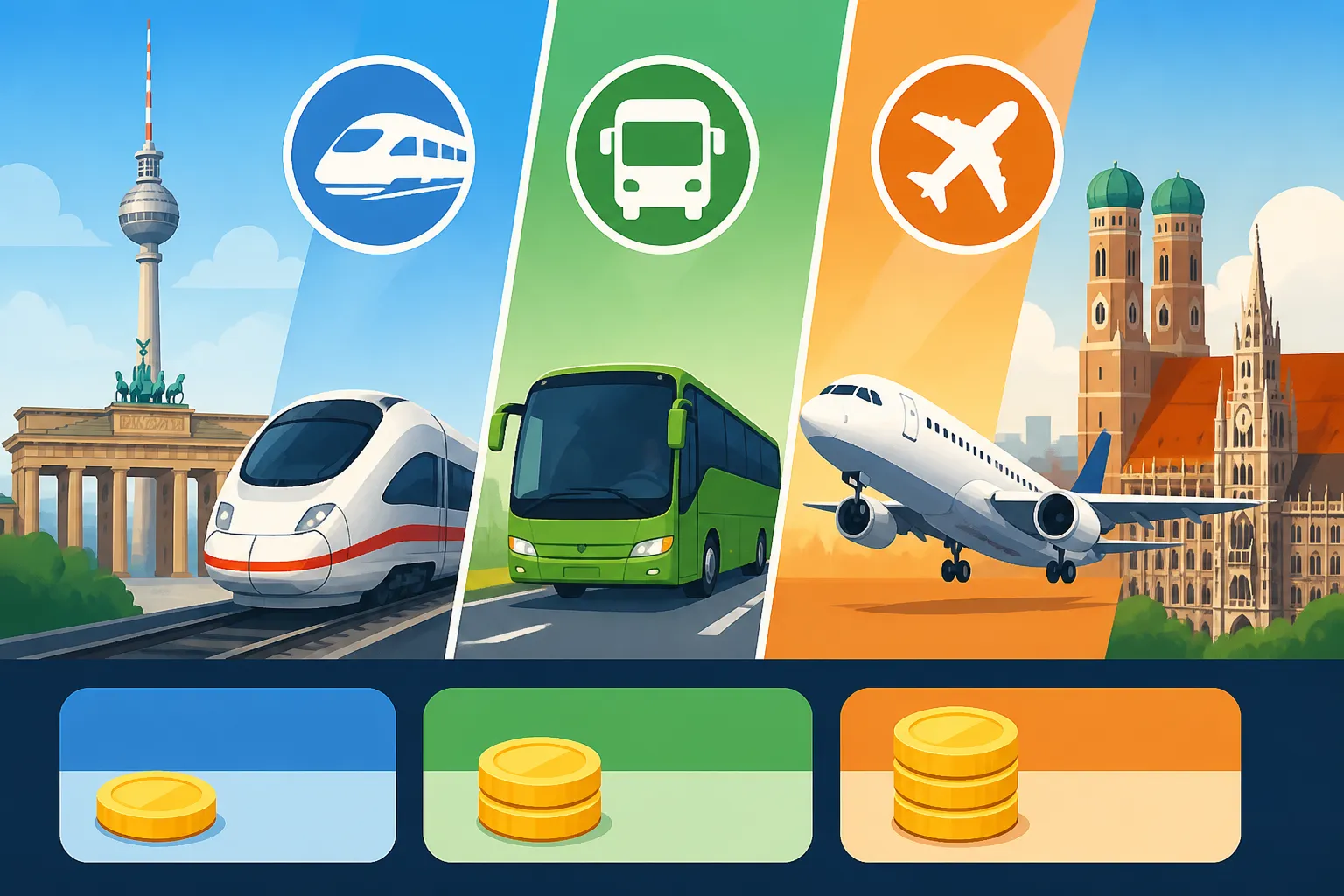
Making the right choice for your Berlin to Munich journey really comes down to balancing your priorities: cost, speed, comfort, and convenience. Let's lay it all out in a simple table to help you visualize the trade-offs.
| Feature | Train (ICE) | Bus (FlixBus) | Flight (Lufthansa/Eurowings) |
|---|---|---|---|
| Approx. Travel Time | 4 – 4.5 hours (direct) | 7 – 8.5 hours (direct) | 1 hour 10 min (flight) + 3-4 hours (total) |
| Average Cost | €30 – €120+ (depends on booking & flexibility) | €15 – €50 (depends on booking) | €50 – €150+ (plus baggage/transfers) |
| Comfort | High (spacious seats, onboard restaurant) | Medium (reclining seats, basic amenities) | Low (cramped seats, limited movement) |
| Convenience | Very High (city-center to city-center) | Medium (bus stations often outside center) | Low (airport transfers, security checks) |
| Luggage Allowance | Generous, few restrictions | Standard (1 carry-on, 1 checked included) | Strict (extra fees for checked/large items) |
| Flexibility | High (Flexpreis) to Low (Super Sparpreis) | Medium (changes possible for a fee) | Low (changes often expensive) |
| Environmental Impact | Low (electric high-speed) | Medium (diesel, but more passengers/vehicle) | High |
| Connectivity | Excellent (Wi-Fi, power outlets) | Good (Wi-Fi, power outlets) | Variable (in-flight Wi-Fi often paid) |
Speed vs. Actual Time
When we talk about "speed," it's easy to think the plane wins hands down because the flight segment itself is shortest. However, as discussed, the true door-to-door time is often a different story. If you live near Berlin's central station and your destination in Munich is also near the Hauptbahnhof, the 4-hour ICE ride will likely get you there faster than the 1-hour flight plus 3-4 hours of airport faff.
Consider this scenario:
- Train: Leave your Berlin apartment, a 15-minute U-Bahn ride to Berlin Hbf. 4.5-hour train. Arrive Munich Hbf, 10-minute U-Bahn to your hotel. Total: ~5 hours.
- Flight: Leave your Berlin apartment, 1-hour S-Bahn to BER. Arrive 90 minutes before flight (2.5 hours total). 1h 10m flight. Arrive MUC, 45-minute S-Bahn to Munich Hbf, 10-minute U-Bahn to your hotel. Total: ~5 hours 15 minutes.
As you can see, for a city-center to city-center journey, the train is often competitive and sometimes even quicker. The bus, of course, adds a few more hours to this equation.
The Comfort Factor
For many, especially on a relatively long journey, comfort is paramount. The ability to stretch your legs, walk around, grab a coffee, and work with reliable Wi-Fi often makes the train a superior experience. On a bus, you’re mostly confined to your seat, and while they're modern, it's still a bus. Flights, especially short domestic hops, are designed for efficiency, not luxury, with minimal space and often no complimentary refreshments. If you value personal space and the ability to move around, the train definitely wins. For more details on the logistics of train travel, consider reading Deutsche Bahn Guide Using Trains for City and Long-Distance Travel.
Environmental Footprint
This is becoming an increasingly important consideration for travelers. Germany, like much of Europe, is very environmentally conscious. High-speed trains like the ICE, running on increasingly green electricity, are a far more sustainable mode of transport than domestic flights. Many companies in Germany even encourage their employees to choose the train over flights for domestic business trips for this very reason. If being eco-friendly matters to you, the choice is clear.
Booking Your Journey: Making Sense of the Options
Okay, so you've weighed the pros and cons, and you have a general idea of which mode of transport suits you best. Now comes the actual booking, and this is where Omio truly shines as your ultimate travel companion. Instead of hopping between countless websites for Deutsche Bahn, FlixBus, Lufthansa, and Eurowings, trying to compare prices and schedules, Omio aggregates all these options in one convenient place. It's like having a super-powered travel agent in your pocket.
I've used Omio countless times, and it genuinely streamlines the process. You input your start and end points (Berlin to Munich), your travel dates, and it spits out all available options—train, bus, and flight—sorted by price, duration, or a "best" combination. This makes direct comparisons incredibly easy, helping you find the sweet spot between cost and convenience that's right for you. It's especially useful for expats who might not be familiar with all the local transport providers or the nuances of their booking systems.
The Simplicity of Omio's Platform
What I love about Omio is its user-friendly interface. It's clean, intuitive, and available in multiple languages, which is a massive relief when you're trying to book travel in a foreign country and don't yet have a firm grasp of German. No more struggling with translation tools or guessing what certain German terms mean on a booking page!
Here’s how it typically works:
- Enter your journey details: Simply type "Berlin" as your origin and "Munich" as your destination, select your dates, and the number of passengers.
- Compare all options: Omio will display a comprehensive list of trains, buses, and flights, complete with prices, travel times, and even the number of transfers. You can easily filter and sort these results.
- Book directly: Once you've chosen your preferred option, you can usually book directly through the Omio platform, often without being redirected to a third-party site. This keeps the entire process seamless and efficient. Your tickets are then sent directly to your email or are accessible via the Omio app.
This aggregation saves a tremendous amount of time and effort. Instead of checking Deutsche Bahn's website for train prices, then FlixBus for bus prices, then various airline sites, you get it all in one glance. It takes the guesswork and the heavy lifting out of trip planning.
Why Omio is a Game-Changer for Expats and Tourists
As an expat, I know the frustrations of German bureaucracy and fragmented information all too well. Omio cuts through that. It provides a single point of truth for inter-city travel, offering transparency and ease of use. Whether you’re looking for the absolute cheapest bus ticket, the fastest ICE connection, or comparing a budget flight, Omio presents it all clearly.
Furthermore, Omio often has mobile-friendly tickets, meaning you can just show your phone at the gate or to the conductor, which is incredibly convenient. No need to print anything or fumble with physical tickets. This embrace of digital ticketing is a small but significant detail that makes travel less of a hassle. It truly simplifies what can otherwise be a complex comparison process, especially for foreigners who are still getting the hang of German transportation quirks. Trust me, finding a tool like Omio early on in your German journey can save you a lot of headaches.
Tips for a Smooth Trip Between Berlin and Munich
Having made the journey between Berlin and Munich more times than I care to admit, I’ve picked up a few tricks along the way to make things go as smoothly as possible. These little nuggets of advice can save you stress, time, and even a bit of money.
Packing Smart and Efficiently
Regardless of your chosen mode of transport, thinking about your luggage can make a huge difference. If you're going by train or bus, you have more flexibility, but still, remember you'll be carrying it yourself. For flights, obviously, pack light to avoid those pesky baggage fees. For example, if you're planning to attend Oktoberfest in Munich, you might have specific clothing items. Weigh whether it's worth the extra baggage fee for the flight versus the ease of the train.
Also, consider what you'll need during the journey. A good book, a fully charged power bank, and some snacks and drinks are always a good idea, especially for the longer bus or train rides. Even though trains have restaurants, bringing your own can save money and cater to specific dietary needs. I always make sure to download some podcasts or movies, just in case the Wi-Fi acts up.
Mastering German Transport Etiquette
Germany has its own unspoken rules for public transport that, once understood, make for a much more pleasant experience.
- Punctuality: This isn't just a stereotype; it's a way of life. Aim to be at your platform or boarding gate with ample time. While DB trains can sometimes be delayed, it's not an excuse for you to be late.
- Quiet Hours (Ruhezeit): On trains, especially in designated quiet zones (marked with a crossed-out speaker icon), keep noise to a minimum. This means no loud phone calls, no blaring music, and generally keeping conversations subdued. Even in regular carriages, most Germans keep to themselves and appreciate a peaceful environment.
- Seating: If you have a reserved seat on a train, it will be indicated on a small display above the seat. Respect these reservations. If a seat is unreserved for a segment of the journey, you can sit there, but be prepared to move if someone with a reservation shows up.
- Luggage Storage: Use the overhead racks or designated luggage areas carefully. Don't block aisles with your bags.
Understanding these small nuances, which you can learn more about in articles like German Etiquette and Social Life for Visitors, will help you blend in and show respect for local customs, making your trip less awkward.
Staying Connected on the Go
Having a reliable mobile connection and internet access is crucial for travel, whether for checking schedules, navigating, or just staying entertained.
- German SIM Card: Consider getting a local German SIM card or an eSIM if you don't already have one. Providers like Telekom, Vodafone, or O2 offer various prepaid and contract options. This ensures you have local data and calls, which is far more reliable than relying solely on public Wi-Fi.
- Power Bank: As mentioned, a portable power bank is indispensable. While trains and buses often have outlets, they can sometimes be occupied or not working.
- Offline Maps & Tickets: Download offline maps for Berlin and Munich, and save your tickets to your phone's wallet or as screenshots. This way, you're not stranded if you lose signal.
For more information on staying connected, check out Mobile Data and eSIMs for Travel in Germany which offers practical advice.
Navigating Local Public Transport
Once you arrive in Berlin or Munich, you'll need to navigate their excellent public transport systems (U-Bahn, S-Bahn, Trams, Buses). Your central train or bus station will be well-connected. Purchase tickets before boarding and validate them. Fines for fare dodging are steep. A Getting Around German Cities U-Bahn, S-Bahn, Trams, and Buses guide can be really helpful for understanding the local systems. If you bought a Flexpreis train ticket, it often includes a "City-Ticket" for your destination, allowing you to use local public transport to reach your final destination. Always check your ticket!
Which Option is Best for You?
So, after all this, which is truly the "best" way to travel from Berlin to Munich? The honest answer, as with most things in life, is: it depends. Your personal preferences, budget, time constraints, and even your travel philosophy will dictate the ideal choice. But let me break it down one last time, offering some scenarios to help you solidify your decision. And remember, no matter which option you lean towards, Omio is there to make the booking process a breeze.
For the Budget-Conscious Traveler
If saving money is your absolute top priority and you have plenty of time on your hands, the bus is likely your champion. You can often find tickets for a fraction of the cost of other modes, especially if you book in advance. Yes, it's a long journey, but if you enjoy watching the world go by, reading, or just catching up on sleep, it's a fantastic value. Imagine spending €20 for a journey that connects two of Germany's greatest cities – that's a deal hard to beat. Just remember to factor in the time and comfort trade-offs.
For the Time-Sensitive or Business Traveler
If you need to get from city center to city center as quickly and reliably as possible, and you're willing to pay a bit more for that privilege, the high-speed train (ICE) is usually your best bet. With journey times of around 4 to 4.5 hours directly from Berlin Hauptbahnhof to Munich Hauptbahnhof, it minimizes door-to-door travel. You can work comfortably, enjoy the scenery, and avoid the airport hassle. Booking a Sparpreis ticket well in advance, perhaps through Omio, can also keep the costs reasonable, often making it competitive with flights when all fees are considered.
For the Comfort Seeker
If a relaxed, spacious, and generally hassle-free journey is what you crave, the train also stands out. The ability to move around, access a dining car, and enjoy more generous legroom significantly enhances the travel experience compared to a cramped flight or a long bus ride. For many, the ability to work, read, or simply gaze out the window without feeling restricted is invaluable. First-class train tickets, while pricier, offer an even higher level of comfort and service.
When Flying Makes Sense
While I generally lean towards trains for domestic German travel, there are specific situations where flying is still the most logical choice:
- Connecting Flights: If Berlin or Munich is just a leg of a longer international journey, flying domestically can streamline your connections.
- Last-Minute Deals (Rare): Occasionally, you might find a last-minute flight deal that makes sense, especially if it happens to be cheaper than a last-minute Flexpreis train ticket. However, this is not a common occurrence for this route.
- Specific Airport Locations: If your final destination in Munich, or starting point in Berlin, is very close to the respective airport, it might shave off some transfer time, making flying more efficient.
My Personal Recommendation
As someone who has navigated Germany's transport system for years, my default recommendation for the Berlin to Munich route is almost always the train. The balance of speed, comfort, convenience, and environmental responsibility makes it the most appealing option for most travelers. The ability to work or relax without interruption, coupled with arriving directly in the city center, is a huge advantage. And finding those great Sparpreis deals, especially if you book a few weeks out, makes it a financially sound choice too.
Whatever your preference, remember that having a tool like Omio in your planning arsenal makes comparing and booking incredibly straightforward. It empowers you to see all your options at a glance and choose the journey that aligns perfectly with your needs. So go ahead, plug in your dates on Omio, explore the possibilities, and enjoy your German adventure!
Disclaimer
Please remember that travel information, including prices, schedules, and regulations, can change rapidly. While I strive to provide the most up-to-date and accurate advice based on my experience and available information, it's always crucial to verify details with the respective transport providers (Deutsche Bahn, FlixBus, airlines) or through a reliable booking platform like Omio at the time of your travel planning. This guide is for informational purposes only and does not constitute professional advice. Always check official sources before making travel arrangements.