DB Seat Reservations: When They’re Worth the Extra Charge
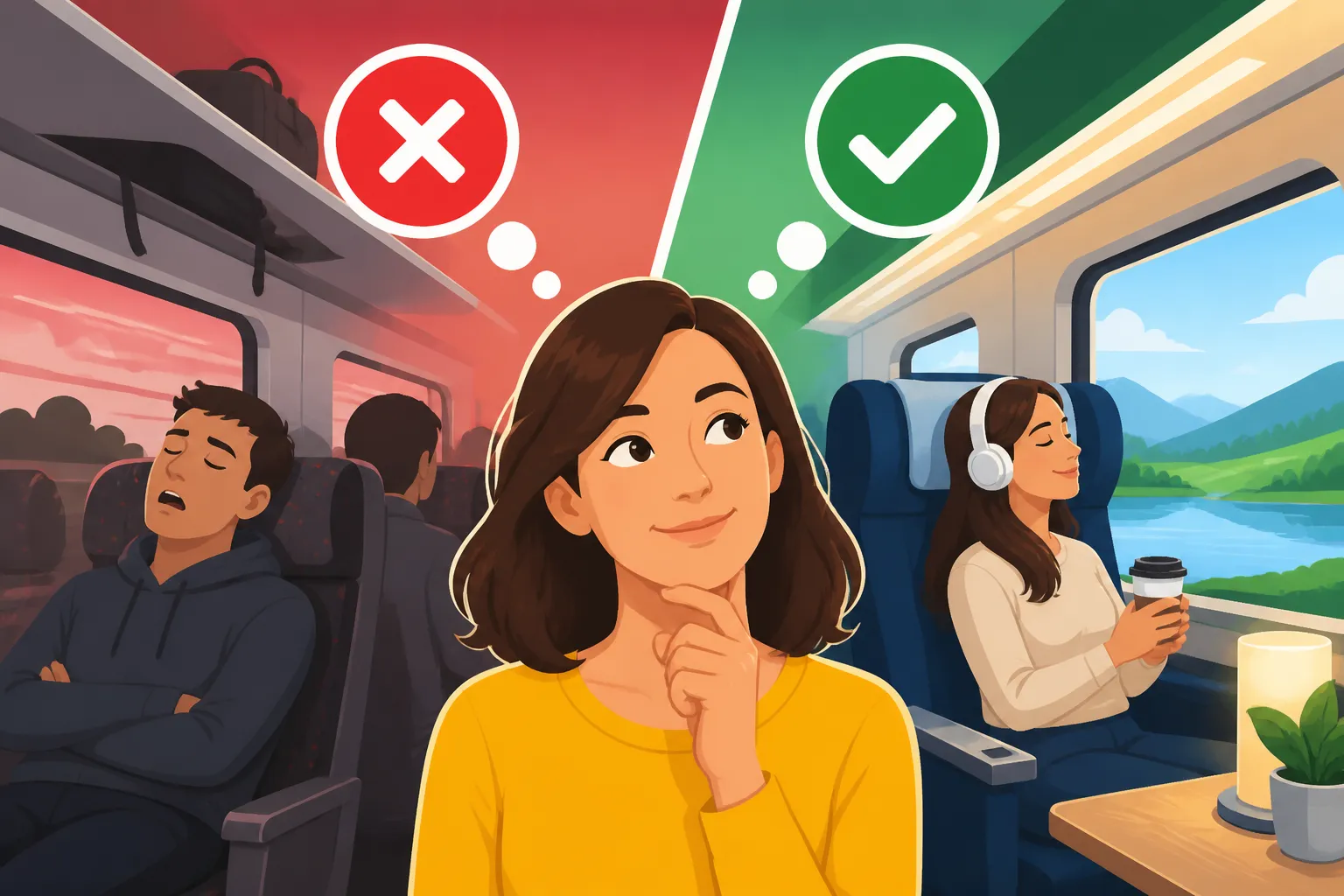
You have a cheap ticket for the Friday afternoon ICE from Berlin to Munich. Then you hit checkout and see the optional seat reservation. Is it a scam, a luxury, or the only thing between you and four hours on your suitcase in the vestibule? This guide shows when a DB seat reservation pays off, when to skip it, and how to book one cleanly.
Disclosure: This post may contain affiliate links. We may earn a commission at no extra cost to you if you make a purchase through these links. Read full disclosure.
How DB Seat Reservations Actually Work
Most newcomers misunderstand this. In Germany, a train ticket and a seat reservation are two separate things. Your ticket, the Fahrkarte, gives you the right to travel. The reservation, the Sitzplatzreservierung, gives you the right to one specific seat on one specific train. On most domestic long-distance trains, such as the ICE, IC and EC services, the reservation is optional. You can board with a valid ticket and sit in any seat that isn’t reserved.
I learned this the hard way in my first winter here. I took an IC from Hamburg to Cologne without a reservation, thinking I’d be clever and save money. Every seat had a little glowing display above it. I spent the first twenty minutes walking up and down the carriages trying to read them, sitting down, getting politely evicted at Bremen, and starting again. Nobody was rude. But I felt like the only person in the room who hadn’t been told the rules.
Reading the Seat Displays Above Each Row
On modern ICE trains, a small electronic display sits above or beside each seat. If it is blank or shows nothing relevant, the seat is free for anyone. If it shows a station pair, for example “Frankfurt (Main) Hbf to Köln Hbf”, someone has reserved that seat for that stretch. You can sit there before or after that section, but not during it.
You will also often see the phrase “ggf. freigeben”, which roughly means “release if required”. It marks a seat that someone may have reserved at short notice and that hasn’t been fully confirmed in the system. You can sit there, but be ready to move if the reservation holder shows up. On older IC carriages you may still find paper slips in a little holder above the seat instead of a screen. They work the same way.
Watch for one small quirk. If the reservation holder doesn’t take their seat shortly after departure, the reservation is generally treated as lapsed and the seat becomes free. Don’t count on this as a strategy. Conductors rarely referee seat disputes, and German passengers tend to be quite firm about their reserved seats.
Optional on Domestic Trains, Required on Some International Ones
For almost all domestic ICE and IC journeys, you never need a reservation to board. Things change on some cross-border and night services. Certain international high-speed trains and sleeper services operate on a compulsory reservation basis, so your ticket alone isn’t enough. If you plan to travel from Germany into France, Italy or onward by night train, check the booking terms for that specific train before you assume it works like a regular ICE.
This matters especially for rail pass holders. A pass covers the ride, but it does not automatically cover reservations on trains where they are mandatory. For more on that, see Interrail and Eurail in Germany: Reservation Fees and Whether It Works Here.
What the Deutschland-Ticket Means for Reservations
Many expats get tripped up here, so here it is plainly. The Deutschland-Ticket is valid on local and regional transport only: S-Bahn, U-Bahn, trams, buses and regional trains such as RE and RB services. It is not valid on ICE, IC or EC trains. So before you think about a seat reservation, check whether your journey uses long-distance trains at all. A reservation on an ICE does not make a Deutschland-Ticket valid on that train. You would still need a separate long-distance ticket.
On regional trains, seat reservations generally don’t exist. It’s first come, first served. If you travel regionally on the Deutschland-Ticket during busy times, plan to board early, stand near the doors where the train tends to empty out, or pick a less crowded departure. Paying for a reservation won’t help on those trains. For the full picture of what the ticket covers, read Regional Trains and the Deutschland-Ticket Explained.
When a Seat Reservation Is Worth the Extra Charge
I’ve ridden German long-distance trains for years, and my rule of thumb has hardened into this: the reservation charge is small compared with the misery it can prevent. But it isn’t always necessary. The decision depends on four things: when you travel, which route, who you’re travelling with, and how much luggage you have.
Peak Days, Holidays and Event Weeks
Some days are reliably brutal on the German rail network. Friday afternoons and Sunday evenings are packed with weekend commuters, students heading home, and couples in long-distance relationships. The days around public holidays are worse, especially the Brückentage, the bridge days when people take one day off to turn a holiday into a long weekend. Christmas and Easter getaway days are their own category of chaos.
Then there are the event weeks. During Oktoberfest, trains into Munich fill up with people in Lederhosen and Dirndl. During major trade fairs in Frankfurt, Hannover or Cologne, business travellers book up the morning and evening ICEs. On these days, an unreserved traveller can end up standing in a vestibule, sitting on the floor near the bike area, or, on rare severely overcrowded trains, being asked not to board at all. If you’re travelling during any of these windows, see Christmas Markets, Easter, and Bruckentage: Germany’s Worst Weeks to Book Late and Oktoberfest Travel: Booking Trains and Buses Into Munich.
Here’s a scenario I’ve seen many times. Sophie, a new arrival in Frankfurt, books a Sparpreis to Berlin on the Friday before a long weekend and skips the reservation to save a little. The train arrives already full from Basel and Karlsruhe. She stands for nearly the whole trip with her backpack between her feet. Two rows away, a student who added the reservation reads in comfort. That small charge bought four hours of sanity.
Long Routes and Busy Corridors
The longer the journey, the more a reservation is worth. On a short hop like Cologne to Düsseldorf, standing for twenty minutes is an annoyance. On Berlin to Munich, Hamburg to Stuttgart, or Cologne to Munich, standing becomes a test of endurance.
Certain corridors are also busy almost all the time. The Frankfurt to Cologne high-speed line, the Berlin to Hamburg route, and the main north to south ICE spine through Hannover, Kassel and Fulda all carry heavy traffic. Even on an ordinary Tuesday, the morning trains out of major cities can be busy with business travellers. If you’re weighing the full cost of a long trip, including whether the train is still the best option, the side-by-side numbers in Berlin to Munich: Train, Bus, and Flight Priced Side by Side show how the reservation fits into the bigger picture.
Families, Groups and Heavy Luggage
If you travel with children, I’d argue the reservation is almost always worth it. Without one, finding two or three seats together on a busy train is close to impossible. Many ICE trains also have a dedicated family area or small-child compartment, and those seats can only be guaranteed by reserving them. Picture a parent with a toddler and a pushchair walking the entire length of a full train. You don’t want that. Practical details on prams and child fares are in Booking German Transport With Kids: Child Fares, Seats, and Prams.
Groups face the same maths. Four friends travelling together can end up scattered across four carriages without reservations. Large suitcases matter too. Luggage racks fill up fast, and sitting near your bags gives you real peace of mind. A reservation lets you choose a seat near the end of the carriage, close to the luggage space, or in a specific coach. For rules on suitcases, bikes and sports gear, see Luggage and Bike Rules on German Trains and Buses.
Quiet Zones, Tables and Working on the Train
Remote workers and business travellers often reserve not just a seat but the right seat. ICE trains usually have quiet zones, marked as Ruhebereich, where phone calls and loud conversation are discouraged. There are also table seats ideal for laptops, window seats, and seats near power sockets. If you plan to work for three hours, a reservation turns the train into a decent mobile office. Without one, you may end up in an aisle seat next to a group celebrating a bachelor party.
When You Can Safely Skip the Reservation
Despite everything above, there are plenty of journeys where I happily travel without a reservation and have never regretted it.
Off-Peak Travel and Short Hops
Midweek, mid-morning and mid-afternoon trains outside holiday periods are often comfortably empty, especially on secondary routes. A Tuesday ICE from Nuremberg to Würzburg at eleven in the morning rarely needs a reservation. The same goes for short journeys of under an hour, where even the worst case is a brief stand by the door.
Early morning and late evening departures can also be quieter, apart from the commuter peaks around big cities. If you’re flexible, picking an off-peak train can save you more than the reservation would, because cheaper fares tend to show up on less popular departures.
First Class on Normal Weekdays
First class carriages are generally less crowded than second class, so on regular weekdays a first class passenger can usually find a seat without reserving. On peak days, though, first class fills up too, especially with business travellers on Monday mornings and Friday afternoons. Whether first class itself is worth it is a separate question, covered in detail in First Class vs Second Class on German Trains: What the Upgrade Buys. Check whether your fare type already includes a reservation before you add one again.
When Your Plans Might Change
A reservation is tied to one specific train. If you miss it, it’s gone. If a delay breaks your connection and you take a later train, your original reservation doesn’t move with you. You’ll need a new one if you want a guaranteed seat on the replacement service. So if your plans are fluid, or you’re on a connection-heavy itinerary prone to delays, a reservation is worth less.
That ties into your fare type as well. Flexible fares let you take any train on the day, while saver fares bind you to a specific one. Knowing which you hold changes how useful a reservation is. See Sparpreis vs Flexpreis on Deutsche Bahn: Change Rules and Refunds for the details. And if you’re dealing with a strike or major disruption, read DB Strikes and Delays: Your Rights, Compensation, and Rebooking before you spend money on new reservations.
The Reservation Decision at a Glance
This table sums up my own rules after years of riding German trains.
| Situation | Reserve a Seat? | Why |
|---|---|---|
| Friday afternoon or Sunday evening ICE | Yes, strongly | Weekend commuter peaks fill trains quickly |
| Holidays, bridge days, Christmas, Easter | Yes, strongly | Some of the busiest travel days of the year |
| Oktoberfest or major trade fair weeks | Yes, strongly | Event crowds fill specific routes |
| Journey over two hours on a main corridor | Usually yes | Standing for long stretches is exhausting |
| Travelling with children or a group | Yes | Seats together are hard to find otherwise |
| Large suitcases or bulky luggage | Usually yes | Lets you sit near luggage space |
| Planning to work or wanting a quiet zone | Yes | Lets you pick a table, window or quiet seat |
| Midweek off-peak trip on a secondary route | Usually no | Trains often have plenty of free seats |
| Short journey under an hour | Usually no | Standing briefly is a minor inconvenience |
| First class on an ordinary weekday | Often no | First class carriages are generally less full |
| Uncertain plans or tight connections | Often no | Reservation is lost if you miss the train |
| Regional train on the Deutschland-Ticket | Not possible | Regional trains generally run without reservations |
How to Book Your Seat Reservation Without the Stress
Once you’ve decided a reservation is worth it, the next frustration is the booking itself. German rail booking can feel overwhelming in a second language, especially when a foreign card gets declined or the seat options don’t make sense. This is where Omio has made my life noticeably easier.
Why I Use Omio to Plan and Book
Omio is a travel booking platform that brings trains, long-distance buses and flights into one search. It works fully in English, accepts a range of international payment methods, and shows Deutsche Bahn trains next to alternatives like FlixBus. For an expat who just wants to get from Leipzig to Stuttgart without decoding a German booking flow, that’s a real relief.
What I value most is the comparison. When I search a route on Omio, I see the train options alongside bus and flight alternatives with journey times laid out clearly. If a Friday ICE looks crowded and expensive, I can quickly check whether an earlier departure, a different day, or a bus makes more sense. Then I decide whether the reservation is worth adding. Where the operator allows it, the option to add a seat reservation to a Deutsche Bahn ticket appears in the booking flow, so you don’t have to book the seat separately.
Fees, availability of specific options, and the exact presentation can change, so always check Omio’s own booking page and terms for current details before you pay.
Step-by-Step: Booking a Ticket With a Reservation
Here’s how I book a typical long-distance trip, such as Hamburg to Munich on a busy Friday.
- Open Omio and enter your departure city, destination and travel date. Use the main station names, such as Hamburg Hbf and München Hbf, to avoid confusion with smaller stations.
- Look through the results and compare departure times, journey length and number of changes. Direct ICE trains are usually the most comfortable choice for long routes.
- Check the fare type. Decide whether you need a flexible ticket or whether a cheaper train-bound fare suits your plans.
- Select your train and look for the seat reservation option during booking. If you’re travelling at a peak time or with family, add it.
- Enter passenger names exactly as they appear on your ID, since conductors may ask to see identification alongside your ticket.
- Complete payment and save the mobile ticket on your phone. Download it for offline access too, because mobile signal on German trains can drop in tunnels and rural stretches.
- Before travel day, note your coach number and seat number from the ticket. Write them down or screenshot them so you can find them quickly on the platform.
That last step sounds trivial. On a crowded platform with a train arriving in two minutes, it isn’t.
Finding Your Seat on the Platform
German platforms are divided into lettered sections, usually labelled A to F or similar, marked on overhead signs. Each platform has a coach sequence display, the Wagenreihung, which shows where each coach will stop. Check it as soon as you reach the platform, find your coach number, and walk to the right section before the train arrives.
One quirk: trains occasionally arrive in reverse order, or the coach sequence changes at short notice. Announcements will usually mention this, often in German first. If coach numbers suddenly don’t match the sign, don’t panic. Board the nearest door and walk through the train to your coach once inside. With a reservation, your seat is waiting. The only cost is a short walk.
When you reach your seat, the display above it should show your stretch of journey. If someone is sitting there, a polite “Entschuldigung, ich habe hier reserviert” usually clears it up instantly. In my experience, Germans respect a valid reservation almost without exception.
Combining Omio With Smart Travel Habits
A reservation is only one tool. I pair it with a few habits that make German train travel calmer.
- Book early for peak dates. Popular departures on holiday weekends fill up, and reservations in the best areas, such as family zones and table seats, go first.
- Compare departure times on Omio before settling on a train. An hour earlier or later can mean a far emptier carriage and a lower fare.
- Keep a backup plan. On a strike day or when a route is disrupted, Omio’s comparison of buses and alternative trains helps you find another way quickly.
- Pack light where you can. Even with a reserved seat, a huge suitcase makes boarding a crowded train harder.
- Arrive on the platform a few minutes early so you can check the coach sequence calmly.
These habits, plus a well-timed reservation, turn the German rail system from a source of stress into one of the nicest ways to explore the country.
My Honest Verdict
The seat reservation charge looks optional, and technically it is. But having lived through standing-room-only Fridays, scattered family trips and holiday crowds, I now treat it as cheap insurance. If you travel at peak times, on long routes, with kids, with heavy bags, or with a laptop and a deadline, add it. If you’re taking a quiet midweek train for a short hop, save your money.
Whichever way you go, start your next trip by searching your route on Omio. Compare the trains, check the alternatives, and add a reservation where it makes sense, all in one place and in English. It’s the easiest way I know to make sure your German train journey begins in a seat rather than in the vestibule.
Disclaimer
This article is for general informational purposes only and does not constitute professional advice. Laws, prices and regulations vary by location and change over time. Consult a qualified professional for guidance on your specific situation.