Sick Leave in Germany: How to Get a Sick Note (Krankmeldung) and Your Rights
Navigating sick leave in Germany can be highly confusing for newly arrived expats. This guide explains your legal rights, how to obtain an official doctor’s sick note, the transition to digital health records, and exactly how your salary is protected when illness strikes.
Disclosure: This post may contain affiliate links. We may earn a commission at no extra cost to you if you make a purchase through these links. Read full disclosure.
Understanding Sick Leave in Germany
The Three Day Rule and Employer Policies
Under German labor law (Entgeltfortzahlungsgesetz), you have robust protections when you fall ill and cannot perform your duties. The absolute first and most critical rule is that you must inform your employer immediately. You do not need to disclose your specific medical condition or diagnosis—in fact, employers are legally forbidden from asking—but you must notify them of your absence and your estimated date of return before your shift begins.
Legally, you are required to submit an official doctor’s sick note (Arbeitsunfähigkeitsbescheinigung or AU) if your illness lasts longer than three consecutive calendar days. This means if you are sick on Monday, Tuesday, and Wednesday, you must present the AU to your employer on Thursday. However, this is merely the federal baseline.
Many employment contracts include a specific clause allowing the employer to demand a sick note from the very first day of illness. You must thoroughly check your specific contract to understand when your documentation is due. Missing this deadline is considered a breach of contract and can lead to formal warnings (Abmahnung). To understand how this interacts with your broader employee rights, review our guide on Employee Benefits in Germany: From Vacation Days to Parental Leave Payments.
Full Pay Continuation Entgeltfortzahlung
When you call in sick, you do not lose your income. The law guarantees Entgeltfortzahlung, which means your employer is legally obligated to continue paying 100% of your regular gross salary for up to six continuous weeks for the same illness. This is a massive financial safety net that completely removes the pressure of having to work while contagious or in pain.
It is important to note that this protection only kicks in after you have been continuously employed by the company for four uninterrupted weeks. During the first four weeks of a new job (the waiting period or Wartezeit), your employer is not obligated to pay you if you fall ill. Instead, your health insurance steps in to cover your lost wages. Ensuring you have robust coverage from day one is critical; expats frequently use services like Feather Insurance to rapidly verify their enrollment status before starting a new contract.
How to Get a Sick Note Arbeitsunfaehigkeitsbescheinigung
Visiting the Doctor and eAU Explained
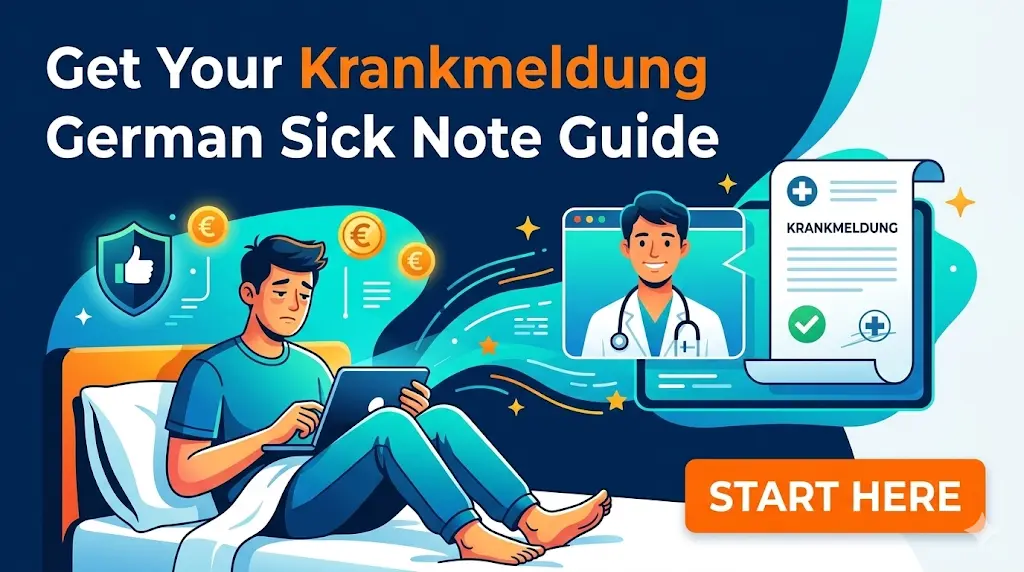
To get an official sick note, you must visit a doctor—typically your general practitioner (Hausarzt). The doctor will examine you and determine how many days you need to recover. Historically, the doctor would hand you a three-part yellow slip of paper (the famous “gelber Schein”). You had to mail one part to your health insurance and mail or hand-deliver another part to your employer.
Fortunately, Germany has heavily modernized this system. Since 2023, the electronic sick note (elektronische Arbeitsunfähigkeitsbescheinigung or eAU) has become mandatory for all individuals covered by statutory public health insurance. When your doctor declares you unfit for work, they no longer hand you the yellow slip. Instead, they transmit the eAU securely and directly to your public health insurance provider (Krankenkasse).
Your employer is then responsible for digitally retrieving the sick note data directly from your health insurance provider’s server. You simply tell your HR department, “I am sick until Friday, please retrieve my eAU.” You will only receive a single paper copy for your own personal records. Finding a local doctor who can process this quickly is vital; see our guide on Finding a Doctor in Germany: How to Choose a Hausarzt for tips on registering with a local clinic.
Note: The eAU system currently only applies to patients with statutory public health insurance. If you are privately insured, the old paper-based system often still applies, and you are responsible for submitting the physical documents to your employer and insurer.
Telemedicine and Online Sick Notes
If you are suffering from a highly contagious cold or a stomach bug, sitting in a crowded doctor’s waiting room is miserable and risks infecting others. Fortunately, German law now allows for sick notes to be issued via telemedicine. If you are already an established patient at a clinic, you can often secure an AU via a telephone consultation for up to five days.
Furthermore, digital health platforms and video consultation apps have exploded in popularity. Through these regulated apps, you can speak to a licensed German physician via video call and receive a valid digital sick note. Be wary of shady, unregulated websites offering “sick notes via WhatsApp questionnaire” without a video or phone consultation, as employers have the legal right to reject these.
While recovering at home, managing your symptoms with over-the-counter remedies is your first line of defense. Expats frequently struggle to find their preferred international wellness brands in local shops, which is why utilizing platforms like iHerb to stock up on familiar vitamins, teas, and cold remedies before illness strikes is highly recommended. To understand what medications you can buy locally, check Pharmacies in Germany: Apotheke vs Drogerie Explained.
Long Term Illness and Sick Pay Krankengeld
Transitioning to Health Insurance Payments
If you suffer from a severe injury or a chronic illness that prevents you from working for more than six weeks, your employer’s obligation to pay your 100% salary (Entgeltfortzahlung) ends. However, you are not left financially stranded. At this exact point, your health insurance takes over and begins paying you Krankengeld (sick pay).
Krankengeld is paid at a reduced rate. Under the statutory public system, it amounts to exactly 70% of your regular gross salary, but it is capped at a maximum of 90% of your net salary. You can receive this sick pay for a maximum of 78 weeks within a three-year period for the exact same illness. While this provides incredible long-term security, the drop from 100% pay to 70% gross can strain an expat’s monthly budget, particularly when paying high rent or supporting family abroad. If you need to transfer your reduced income to a foreign account to manage international obligations, utilizing a borderless service like Wise ensures you do not lose further capital to legacy banking exchange rate fees.
Public vs Private Insurance Differences
The transition to long-term sick pay is handled very differently depending on your insurance tier. If you are in the public system, the transition to Krankengeld is automatic; your Krankenkasse will contact you as the six-week mark approaches to initiate the payments.
However, if you opted for Private Health Insurance (Private Krankenversicherung or PKV), standard Krankengeld is not automatically included by default. When signing a private contract, you must actively add a daily sickness allowance module (Krankentagegeld) to your policy. If you forgot to add this module to save money on your monthly premium, you will face a total loss of income after six weeks.
Premium expat-focused private insurers like Ottonova typically build this critical protection directly into their standard expat tariffs, ensuring you are protected from this devastating loophole. To evaluate whether your current setup leaves you exposed, consult unbiased brokers like Feather Insurance who can review your policy.
| Payer | Duration | Payout Amount | Insurance Type |
| Employer | Weeks 1 – 6 | 100% of regular salary | Public & Private |
| Public Health Insurance | Weeks 7 – 78 | 70% Gross (Max 90% Net) | Statutory Public (GKV) |
| Private Health Insurance | Weeks 7+ | Varies (Must be actively chosen) | Private (PKV) via Krankentagegeld |
Navigating Expat specific Sick Leave Scenarios
Calling in Sick During Probation
The six-month probationary period (Probezeit) is a high-stress time for expats. A common misconception is that you are not allowed to call in sick during probation, or that doing so will result in immediate termination. This is false. You absolutely have the legal right to call in sick and obtain an AU during your probation period.
However, the financial mechanics are different during your very first four weeks of employment. If you get sick in week two of a new job, the employer does not pay your salary for those sick days. Instead, your health insurance steps in to pay Krankengeld from day one. It is also true that during probation, an employer can terminate your contract with two weeks’ notice without providing a reason, making extended sick leave structurally riskier during this phase.
Caring for a Sick Child Kinderkrankengeld
If your child falls ill and cannot attend daycare or school, you cannot simply use your own standard sick leave, because you are not the patient. Germany provides a specific benefit for this scenario: Kinderkrankengeld (child sickness benefit).
By law, publicly insured parents have the right to take unpaid time off work to care for a sick child under the age of 12. During these days off, your public health insurance compensates you by paying roughly 90% of your lost net earnings. Each parent is typically entitled to 15 days per child, per year (and 30 days for single parents). To claim this, you must take your child to the pediatrician and explicitly request a “Child Sick Note” (Ärztliche Bescheinigung für den Bezug von Krankengeld bei Erkrankung eines Kindes).
Because caring for a sick child often means running out of specific pediatric supplies, expats heavily utilize delivery platforms like iHerb to quickly restock children’s wellness items, herbal syrups, and immunity supplements without having to drag a sick toddler to the local pharmacy. Finally, if your child’s illness requires you to seek specialized medical advice from doctors in your home country, Wise provides the most cost-effective way to pay international consultation invoices directly from your Euro account.
References
Primary sources (official)
- Federal Ministry of Health (BMG): Official government portal explaining the electronic sick note (eAU) regulations and digital data transmission processes. https://gesund.bund.de/die-elektronische-arbeitsunfaehigkeitsbescheinigung-eau
- Federal Ministry of Justice (BMJ): The official legal text of the Entgeltfortzahlungsgesetz (EntgFG), detailing the right to continued remuneration in the event of illness. https://www.gesetze-im-internet.de/entgfg/BJNR106500994.html
Other helpful sources
- Finanztip: Germany’s leading independent consumer finance portal, offering a rigorous, step-by-step breakdown of how Krankengeld is calculated after the six-week mark. https://www.finanztip.de/gkv/krankengeld/
- AOK Health Insurance: Practical guidelines from one of Germany’s largest public insurers on how the eAU system interacts between the doctor, the insurer, and the employer. https://www.aok.de/pk/leistungen/arbeitsunfaehigkeit/krankschreibung/
Disclaimer
The information provided in this article is for general informational and educational purposes only and does not constitute professional legal or medical advice. German labor laws (Arbeitsrecht), statutory sick pay regulations (Krankengeld), and the technical requirements of the electronic sick note (eAU) system are highly complex and subject to continuous legislative updates. The exact terms of your sick leave reporting obligations and the provision of private daily sickness allowances (Krankentagegeld) will vary wildly based on your individual employment contract and specific insurance policy. Always consult directly with your HR department, a certified Fachanwalt für Arbeitsrecht (lawyer specializing in labor law), or your health insurance provider regarding your unique situation in Germany.