Wheelchair-Accessible Hotels in Germany: The Filters That Matter
Finding truly wheelchair-accessible accommodation in Germany can feel like an Olympic sport, full of hopeful searching, frustrating dead ends, and vague descriptions that leave you more confused than informed. It's a common struggle, and believe me, you're not alone in feeling exasperated by the gap between what's advertised as accessible and what's genuinely functional. This guide is here to cut through the confusion and show you how to leverage the right tools, especially platform filters on sites like Booking.com, to secure a stay that genuinely meets your needs, not just some theoretical checklist.
Disclosure: This post may contain affiliate links. We may earn a commission at no extra cost to you if you make a purchase through these links. Read full disclosure.
The Frustrating Reality of "Accessible" in Germany (and Why Filters Are Your Friend)
Navigating the German travel landscape with accessibility needs can be incredibly rewarding, but it often requires a level of diligence that can feel like a second job. The term "accessible" itself, unfortunately, isn't always uniformly applied, and what one person or establishment considers compliant, another might find completely unusable. This is where your meticulous use of filters becomes not just a convenience, but an absolute necessity.
What "Accessible" Often Means (and Doesn't Mean) Here
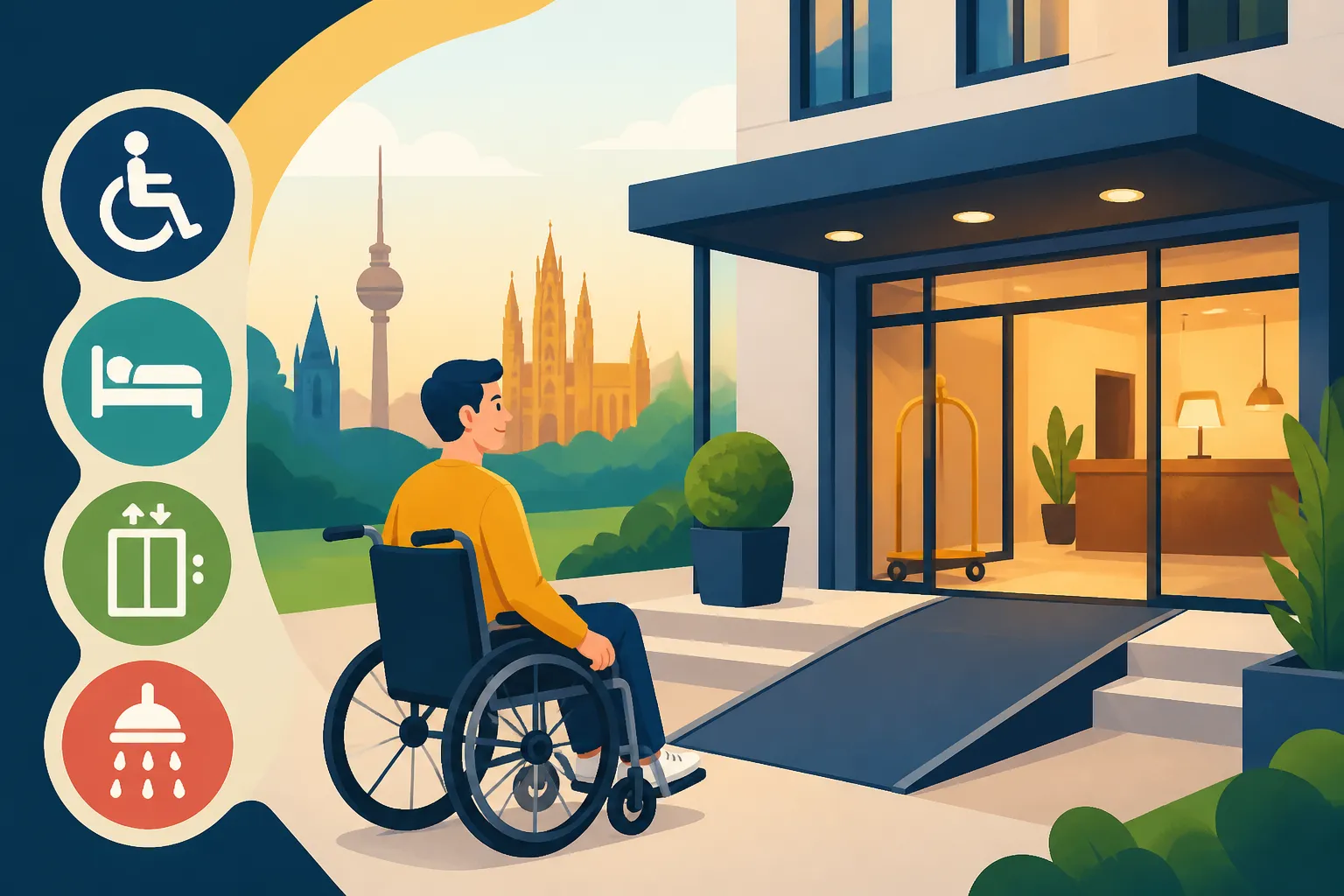
Let me tell you, as someone who's seen a fair bit of Germany, the word "barrierefrei" (barrier-free) sometimes feels like a suggestion rather than a strict standard. You might arrive at a hotel proudly proclaiming its accessibility only to find a ramp that's too steep, an elevator that's too small for a powered wheelchair, or, the classic German surprise, a perfectly level entrance but then a step inside the bathroom. It’s enough to make you pull your hair out! The biggest culprit is often the bathroom itself – a roll-in shower is not a given, even if there’s a wide door. You might find a small step, a shower tray, or grab bars placed in awkward, unhelpful positions. Similarly, accessible toilets might lack sufficient space for transferring or a proper height.
This inconsistency isn't malicious, but it stems from varying interpretations of building codes over time and a general lack of understanding among some hoteliers about the diverse needs within the accessibility spectrum. It means you can't rely on a simple "yes" to "Is it accessible?" You need to dig deeper, and that's precisely what the detailed filters on platforms like Booking.com allow you to do. Without them, you're essentially playing a game of chance with every booking, which is precisely what you want to avoid when planning a much-anticipated trip.
Why Generic Searches Won't Cut It
If you just type "accessible hotel Berlin" into a general search engine, you'll get a deluge of results that may or may not be genuinely suitable. Many hotels will simply list "wheelchair access" if they have a ramp at the entrance or a functioning elevator, without considering the granular details that make a stay truly comfortable and safe. This broad-brush approach often leads to wasted time sifting through unsuitable options or, worse, booking a place only to discover upon arrival that it falls short of your specific requirements.
This is where dedicated booking platforms become your best ally. They’ve invested in more robust filtering systems, understanding that "accessible" isn't a single checkbox. By focusing your search on Booking.com, you gain access to filters designed to drill down into the specifics, allowing you to move beyond vague assurances and into concrete details about the property and, crucially, the room itself. It transforms a broad, often misleading search into a targeted, efficient quest for genuinely suitable accommodations. Think of it as having a detailed blueprint instead of just a pretty picture.
Deciphering the Key Accessibility Filters on Booking.com
Booking.com stands out because it allows you to get much more granular than just a single "accessible" tick box. It's about combining these filters smartly to paint a complete picture of what awaits you. This isn't just about finding a hotel that says it's accessible; it's about finding one that demonstrably is for your specific needs.
The "Wheelchair Accessible" Filter: Your Starting Point
When you first initiate a search on Booking.com for your desired German city, you'll naturally want to head straight for the "Facilities" section on the left-hand sidebar. Here, you'll find the general "Wheelchair accessible" filter. This is your absolute first step, narrowing down thousands of properties to a more manageable selection. When a property ticks this box, it generally means they have at least some provisions for guests using wheelchairs, typically including ramp access or an elevator, and possibly wider doorways in common areas.
However, as we've discussed, this filter alone is rarely enough. It's a foundational filter, but it doesn't guarantee the detailed room and bathroom features that are critical for many. You might still end up with hotels that have a lift to the upper floors but a standard, compact bathroom within the room. So, while it's a necessary starting point, think of it as the first layer of a multi-layered cake. You'll need to add more ingredients (i.e., more filters and checks) to ensure the final product is exactly what you're looking for. It's about setting a baseline, then refining it.
Diving Deeper: Essential Room and Bathroom Features
This is where the real magic, and the real work, happens on Booking.com. After applying the general "Wheelchair accessible" filter, you need to go into the individual room descriptions and look for specific details. While Booking.com might not have a separate filter for every single nuance, their detailed room descriptions and photos are invaluable.
Here’s what to meticulously look for:
- Roll-in Shower (dusche mit rollstuhlzugang): This is often the most crucial and most overlooked detail. A truly roll-in shower has no lip or step, allowing a shower chair or wheelchair to be rolled directly into the showering area. Look for phrases like "roll-in shower," "bodengleiche Dusche" (floor-level shower), or "barrierefreie Dusche." If the photos show a shower tray, it's likely not roll-in, even if it has grab bars.
- Grab Bars (Haltegriffe): These are vital for transferring and stability. Check if they are explicitly mentioned around the toilet and in the shower. Pay attention to photos – are they positioned correctly and sturdy-looking?
- Lowered Sink (unterfahrbares Waschbecken): Can a wheelchair fit underneath the sink comfortably? This detail allows for easier access for washing. Look for photos that show space beneath the sink, often without a cabinet directly underneath.
- Wider Doorways (breitere Türen): While a hotel might be generally "wheelchair accessible," the individual room and bathroom doors might still be standard width. Good listings will specify door widths. While Booking.com might not have a filter for precise door width, look at images carefully or be prepared to ask.
- Space Around the Bed: Is there enough maneuvering room on both sides of the bed? This is critical for transfers and independent movement within the room. Again, photos are your best friend here.
- Accessible Toilet (rollstuhlgerechtes WC): Is there sufficient clear space next to the toilet for side or front transfers? Are the grab bars positioned correctly? This often goes hand-in-hand with the roll-in shower.
Here's a quick reference table of essential features and what to look for:
| Feature | What to Look For (Keywords/Visuals) | Why it Matters |
|---|---|---|
| Roll-in Shower | "bodengleiche Dusche," "rollstuhlzugang Dusche," no lip/step in photos | Independent or assisted showering without barriers. |
| Grab Bars | "Haltegriffe" at toilet/shower, visible in photos | Safety, stability, and assistance with transfers. |
| Accessible Toilet | "rollstuhlgerechtes WC," sufficient clear space next to toilet in photos | Easy and safe transfers to/from the toilet. |
| Lowered Sink | "unterfahrbares Waschbecken," no cabinet below sink in photos | Allows wheelchair users to comfortably access the sink. |
| Wider Doorways | Specific door width mentioned (e.g., >80cm), clear in photos | Ensures smooth entry/exit from room and bathroom. |
| Space Around Bed | Clear floor space around bed in photos, room dimensions if available | Essential for maneuvering, transfers, and use of assistive devices. |
| Emergency Pull Cord | "Notrufschnur" in bathroom | Crucial for summoning help in case of a fall or emergency. |
When browsing Booking.com, always remember that photographs are often the most truthful indicators. If a hotel only shows pictures of standard rooms, or only wide-angle shots that obscure details, that’s a red flag. Don't hesitate to use the "Ask a question" feature on Booking.com or contact the property directly for more photos or precise measurements. It’s better to be overly thorough than to arrive and be disappointed. This level of detail is critical for ensuring that your chosen accommodation is truly Accessible Travel in Germany: Mobility and Planning Tips.
Beyond the Room: Common Area Accessibility
While the room itself is paramount, the accessibility of the rest of the hotel and its surroundings can make or break your stay. Booking.com also offers filters and descriptive text that can hint at these broader accessibility considerations.
- Accessible Entrance/Lobby (Barrierefreier Zugang/Lobby): This is typically covered by the initial "Wheelchair accessible" filter, but it's good to confirm that the path from the street to check-in is smooth, wide, and without steps. Are there automatic doors? A clear, unobstructed path to the reception desk?
- Elevators (Aufzüge): For multi-story hotels, a working, sufficiently-sized elevator is non-negotiable. Look for mentions of "Aufzug" or "Lift." Crucially, are there elevators that go to all floors you might need, including dining areas or spa facilities if you plan to use them?
- Common Area Bathrooms (Accessible Toilets in Public Areas): Is there an accessible restroom outside your room, perhaps in the lobby or near the restaurant? This is often overlooked but important for comfort during extended stays or while dining.
- Accessible Dining Areas (Barrierefreie Speisebereiche): If the hotel offers breakfast or a restaurant, ensure the dining area is also accessible, including the path to it and the table setup. Sometimes, there's a lovely ramp to the main entrance, but then the breakfast room is down a flight of stairs.
- Parking (Behindertenparkplatz): If you're driving, dedicated accessible parking close to the entrance is a huge plus. While Booking.com often has a general "parking" filter, you might need to confirm the availability of accessible spots with the hotel directly.
- Proximity to Accessible Public Transport: Even the most accessible hotel might be isolated if the surrounding public transport isn't up to par. While Booking.com won't filter for this directly, once you've shortlisted hotels, you can check their location on a map relative to U-Bahn, S-Bahn, or tram stops, and then research the accessibility of those specific stations. The Getting Around German Cities: U-Bahn, S-Bahn, Trams, and Buses and Public Transport Tickets and Passes: Navigating German Transit Systems guides can be incredibly helpful here.
Remember, a good hotel doesn't just put up a sign; they integrate accessibility into their entire guest experience. While Booking.com gives you excellent tools to narrow down your choices, these broader points are where a bit of extra research and direct communication can truly pay off for your peace of mind.
Practical Tips for a Smooth Accessible Stay in Germany
Even with the best filters and detailed descriptions on Booking.com, planning an accessible trip to Germany requires a proactive approach. Think of it as a collaboration: the platform gives you the data, but you're the one asking the critical follow-up questions to ensure everything aligns with your unique needs.
Always Double-Check: The Power of Calling Ahead
This is perhaps the single most important piece of advice I can give you: always, always call the hotel directly after you've made a preliminary booking (one with free cancellation, ideally!). Even with Booking.com's excellent filters, human communication is irreplaceable. It’s not about mistrust; it’s about clarity.
Here’s why, and what to ask:
- Confirm Specifics: Reiterate your exact needs. "I saw your room has a roll-in shower. Can you confirm there is absolutely no lip or step, and that it's spacious enough for a shower chair?" Or, "What is the clear width of the bathroom door?" German properties sometimes have slightly different interpretations of "accessible," and a quick chat can bridge that gap.
- Ask for Photos/Videos: If the online photos are unclear or insufficient, politely ask if they can email you more specific pictures of the accessible bathroom, the space around the bed, or the entrance. Many hotels are happy to oblige, understanding your need for certainty.
- Verify Equipment: If you rely on specific equipment (e.g., a hoist, a commode chair), ask if the hotel can provide it, or if there's enough space for yours. Some larger, more modern hotels are increasingly offering these.
- Language Barrier: If you don't speak German, ask if there's an English-speaking staff member you can talk to. Most hotels catering to international guests will have someone. Don't be afraid to clearly explain your needs in English; it's better to struggle a little on the phone than to struggle upon arrival.
This extra step, though it takes a bit of time, will save you immense stress and disappointment. It ensures that the "accessible room" you booked is truly your accessible room.
Location, Location, Location: Accessibility Beyond the Hotel
Your hotel is your base, but your actual experience of Germany will extend far beyond its walls. Don't forget to consider the broader accessibility of the hotel's location.
- Public Transport: Research the nearest U-Bahn (subway), S-Bahn (city train), or tram stops. Are they truly step-free? Do they have lifts or ramps? Many German cities are improving, but not all stations are created equal. Apps like Jelbi (for Berlin) or the local transport authority apps often indicate accessible routes. The Deutsche Bahn Guide: Using Trains for City and Long-Distance Travel can also give you insights into broader train travel accessibility.
- Attractions and Restaurants: Is your hotel close to accessible attractions you plan to visit? Many museums, galleries, and major sights in Germany are becoming more accessible, but smaller, historic venues might pose challenges. Similarly, check if restaurants in the vicinity have step-free entrances and accessible restrooms. A quick search on local city websites or apps can often provide this information.
- Pavement and Street Conditions: Is the surrounding area generally flat, or are there steep hills and cobblestones? While you can't filter for this on Booking.com, a quick look at Google Street View around the hotel's address can give you a very good visual sense of the terrain. This can make a huge difference to your daily comfort, especially in historic cities like Dresden or Heidelberg.
Considering these external factors means you're not just booking an accessible room, but an accessible experience.
Leveraging Guest Reviews (and Being Specific in Yours)
After filtering and double-checking, there’s one more layer of wisdom to tap into: the experiences of other travelers. Booking.com's guest review section is a treasure trove of real-world insights, particularly if you know how to read between the lines.
- Search Reviews for Keywords: Use the search function within the reviews section for terms like "wheelchair," "accessible," "shower," "bathroom," "ramp," "lift," or "barrierefrei." This will highlight reviews that specifically mention accessibility features (or lack thereof).
- Look for Specific Details: Pay attention to reviews that describe why something was or wasn't accessible. "The ramp was too steep" is more helpful than "It wasn't accessible." Look for mentions of room numbers if people had a particularly good or bad experience in an accessible room.
- Read Recent Reviews: Accessibility upgrades or downgrades can happen. Focus on the most recent reviews to get the most up-to-date picture.
- Be a Contributor: After your stay, please, please, please leave a detailed review about the accessibility of your room and the hotel. Be specific! Mention the door widths, the shower type, the space around the toilet, and any other crucial details. Your experience, good or bad, will be invaluable to the next traveler desperately trying to find a truly accessible place. This collective effort is what makes platforms like Booking.com truly powerful for the accessibility community.
Ultimately, your success in finding the right wheelchair-accessible hotel in Germany hinges on a combination of diligent filtering on platforms like Booking.com, proactive communication with the hotel, and a little bit of research into the surrounding area. It might seem like a lot of work, but the payoff is a truly comfortable, stress-free trip where you can focus on enjoying Germany, rather than battling unexpected barriers.
Disclaimer
This article is for general informational purposes only and does not constitute professional advice. Laws, prices and regulations vary by location and change over time. Consult a qualified professional for guidance on your specific situation.