Understanding German Medicine Dosages: Reading Labels and Instructions
Navigating German medication can be intimidating for expats due to the language barrier and strict pharmacy laws. This guide explains how to read German medicine labels, understand dosage instructions, and safely manage your treatments while living in Germany.
Disclosure: This post may contain affiliate links. We may earn a commission at no extra cost to you if you make a purchase through these links. Read full disclosure.
Decoding the German Medicine Box
Key Vocabulary on the Front Label
When you purchase medication in Germany, the packaging (Die Verpackung) contains highly specific, legally mandated information. Expats often search the shelves for familiar international brand names like Advil, Tylenol, or Benadryl, but these specific brands are generally not sold here. Instead, you must learn to identify the Wirkstoff (active ingredient). For example, if you need Tylenol, you must look for a box containing Paracetamol; if you need Advil, you look for Ibuprofen.
The front of a German medicine box prominently displays the Handelsname (brand name), which is often immediately followed by a number indicating the strength of the dosage per unit (such as 400 mg or 600 mg). Beneath the brand name, the Wirkstoff is clearly listed in smaller print.
Identifying the Form of the Medicine
You will also see the Darreichungsform printed on the box, which tells you the physical form of the medicine. Understanding these terms ensures you do not accidentally buy a liquid when you wanted a pill. Common terms include:
- Tabletten: Standard tablets or pills.
- Kapseln: Capsules.
- Tropfen: Liquid drops.
- Salbe: Ointment or topical cream.
- Zäpfchen: Suppositories (these are surprisingly common in Germany, particularly for pediatric care and fever reduction).
It is a crucial cultural adjustment to note that you cannot buy actual medication—not even basic aspirin or cough syrup—at a standard German grocery store or convenience shop. You must visit a licensed, clinical pharmacy. We detail this strict retail divide extensively in our guide on Pharmacies in Germany: Apotheke vs Drogerie Explained. If you strongly prefer to rely on specific international wellness brands or holistic supplements that are not sold in local German pharmacies, iHerb is an excellent alternative. Many expats use iHerb to stock up on familiar over-the-counter remedies and preventative vitamins, having them delivered directly to their German address before the winter flu season strikes.
Reading the Patient Information Leaflet
Finding the Dosage Instructions
Inside every medicine box in Germany is the Beipackzettel (patient information leaflet). By European Union law, this document must be included and is notoriously long, printed on thin paper in very small type. For an expat who does not speak fluent German, this piece of paper can induce panic.
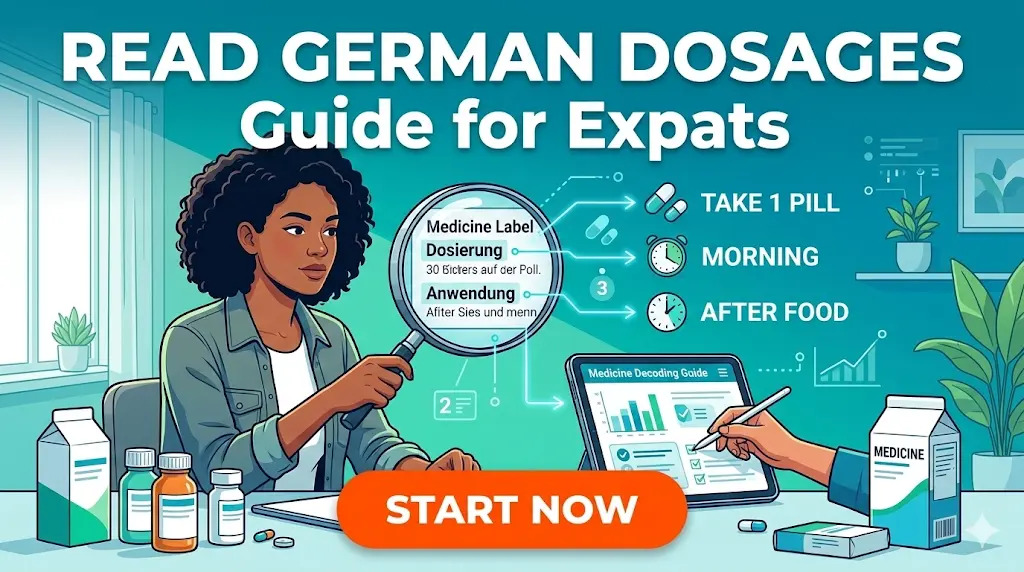
The Beipackzettel is always divided into standard, numbered sections. To find your dosage instructions, you must look for Section 3, which is almost always titled: “Wie ist [Name des Medikaments] einzunehmen?” (How to take [Name of the medication]?). Under this heading, you will find the Dosierung (dosage). The text will explicitly state the Einzeldosis (the single dose amount) and the Tagesgesamtdosis (the maximum total daily dose allowed).
To help you decode this critical section, use the following translation table for common German dosage instructions:
| German Term | English Translation | Context |
| Dosierung | Dosage | The specific section detailing how much medicine to take. |
| Erwachsene | Adults | The age and weight category for the adult dosage. |
| Kinder / Jugendliche | Children / Adolescents | The age category for pediatric dosages. |
| Einzeldosis | Single dose | How much to take at one specific time. |
| Tagesgesamtdosis | Total daily dose | The absolute maximum you can take in 24 hours. |
| Nüchtern | On an empty stomach | Must be taken before eating (usually 30-60 mins prior). |
| Nach den Mahlzeiten | After meals | Must be taken after you have eaten food. |
| Vor dem Schlafengehen | Before bed | To be taken right before going to sleep. |
Understanding the Number Notation System
When a German doctor prescribes medication, or when a pharmacist writes the instructions on your box, they frequently use a highly efficient, four-digit shorthand to communicate daily dosages. You might see a sequence of numbers written as “1-0-1-0” or “1-1-1-1”.
This sequence represents the four main times of day: morning (morgens), noon (mittags), evening (abends), and night (zur Nacht).
- 1-0-0-0: Take one dose in the morning.
- 1-0-1-0: Take one dose in the morning and one dose in the evening.
- 0-0-0-1: Take one dose right before bed.
- 1-1-1-0: Take one dose in the morning, one at noon, and one in the evening.
This standardized notation completely removes the guesswork from your daily medication schedule. If you are ever unsure, never guess. It is perfectly acceptable to ask the pharmacist to write the times out explicitly.
Navigating the Pharmacy and Prescriptions
The Role of the Pharmacist
In Germany, the Apotheker (pharmacist) is a highly trained medical professional who acts as a secondary gatekeeper for your health. When you purchase medication, they will often verbally confirm the dosage with you. A common question is, “Haben Sie dieses Medikament schon einmal eingenommen?” (Have you taken this medication before?). If you answer no, they are legally obligated to explain the Dosierung (dosage), potential Nebenwirkungen (side effects), and Wechselwirkungen (interactions with other drugs).
Prescription Types and Over the Counter Rules
The color of your prescription slip dictates both how much you pay and how the pharmacy processes your medication. Understanding this color-coded system is vital for your healthcare budget:
- Pink/Red Prescription (Kassenrezept): This is for patients with statutory public health insurance. The medication is covered by your insurance, but you must pay a statutory co-payment (Zuzahlung) of €5 to €10 out of pocket at the register.
- Blue Prescription (Privatrezept): This is for privately insured patients. You must pay the full retail price of the medication upfront and submit the receipt to your insurance company for reimbursement.
- Green Prescription (Grünes Rezept): This is a doctor’s recommendation for over-the-counter medicine (like a mild cough syrup or standard painkillers). No insurance covers this; you pay the full price out of pocket.
If you are a privately insured expat and need to transfer funds from a foreign bank account to pay a large, upfront pharmacy bill for specialized blue prescription medications, utilizing a borderless platform like Wise ensures you secure the real mid-market exchange rate. By managing your out-of-pocket healthcare expenses with Wise, you actively avoid the punitive hidden fees charged by legacy international banks.
If you become so ill that your medication requires you to stay home from work to recover, you must follow strict German labor laws regarding illness documentation. We outline exactly how to secure and submit this documentation in Sick Leave in Germany: How to Get a Sick Note Krankmeldung and Your Rights.
Health Insurance Support and Alternatives
How Your Insurance Handles Medication Costs
Your experience securing medication in Germany is fundamentally shaped by your place within the health insurance system. If you are publicly insured, your essential prescription dosages are heavily subsidized. To understand the exact baseline limits of this state-mandated coverage, review Public Health Insurance gesetzliche Krankenkasse: What It Covers and Costs.
If you hold private health insurance, your benefits are often much broader. Premium digital-first private insurers like Ottonova cater specifically to the expat demographic by offering completely English-language interfaces. With the Ottonova mobile app, managing your medication costs is incredibly seamless; you simply take a photo of your blue prescription and the pharmacy receipt, upload it, and receive rapid digital reimbursement directly to your bank account.
For expats currently evaluating their coverage options or deciding whether to transition from public to private care, utilizing specialized digital brokers like Feather Insurance is a highly strategic move. By consulting the English-speaking advisors at Feather Insurance, you can ensure your chosen policy adequately covers your specific, long-term medication needs.
Managing Your Health as an Expat
Proactive health management is the best way to navigate the German medical system. Before your prescriptions run out, ensure you have established a relationship with a local primary care physician who can monitor your dosages and authorize refills. If you have not done this yet, our guide on Finding a Doctor in Germany: How to Choose a Hausarzt provides excellent actionable steps.
Furthermore, if you ever experience a severe adverse reaction to a new medication outside of normal clinic hours, do not wait until morning to seek help. Germany operates a robust network of on-call medical services specifically designed for urgent but non-life-threatening situations.
Ultimately, by understanding the vocabulary on your medicine boxes, mastering the 1-1-1 dosage notation, and ensuring your insurance coverage is fully optimized, you can manage your health in Germany with complete confidence.
References
Primary official sources
- Bundesinstitut für Arzneimittel und Medizinprodukte (BfArM): The Federal Institute for Drugs and Medical Devices, providing the official regulatory guidelines and mandatory structural requirements for all patient information leaflets (Beipackzettel) in Germany. https://www.bfarm.de/DE/Aktuelles/Themendossiers/Packungsbeilage/_node.html
- Make it in Germany: The official portal of the German government for international professionals, offering practical, English-language overviews of navigating local pharmacies and the broader healthcare system. https://www.make-it-in-germany.com/en/living-in-germany/health-healthcare
Other helpful sources
- Apotheken Umschau: Germany’s most trusted and widely read independent pharmacy magazine, offering comprehensive guides written in accessible language on how to correctly read, interpret, and follow medication dosage instructions. https://www.apotheken-umschau.de/einfache-sprache/medikamente-heilpflanzen/medikamente-beipackzettel-verstehen-761785.html
Disclaimer
The information provided in this article is for general informational and educational purposes only and does not constitute professional medical or financial advice. Medication dosages, contraindications, and potential side effects are highly specific to individual health profiles. Always read the Beipackzettel thoroughly and consult directly with a licensed pharmacist (Apotheker) or a qualified medical physician before starting, stopping, or altering any medication regimen in Germany.