Medical Emergencies: What to Do and Where to Go in Germany
Experiencing a medical crisis in a foreign country can be overwhelming, but Germany’s highly efficient emergency system ensures rapid care. This guide explains how to use the national emergency numbers, navigate hospital triage, and access essential after-hours services like pharmacies.
Disclosure: This post may contain affiliate links. We may earn a commission at no extra cost to you if you make a purchase through these links. Read full disclosure.
Immediate Action: Navigating Germany’s Primary Emergency Numbers
Calling 112 for Life-Threatening Situations
In Germany, the number 112 is the universal lifeline for life-threatening medical emergencies and fire services. This number is toll-free, accessible from any phone (even without a SIM card), and operates 24/7 across the entire European Union. When you dial 112, you are connected to a dispatcher who can send an ambulance (Rettungswagen) or an emergency doctor (Notarzt) to your location. This service is strictly reserved for critical situations where every second counts, such as a suspected heart attack, stroke, severe unconsciousness, or traumatic injury.
The dispatchers are highly trained and, in most major German cities, can communicate in basic English. However, it is beneficial to remain calm and provide information clearly. When the ambulance arrives, the paramedics will stabilize the patient and transport them to the nearest appropriate hospital. If you are integrated into the Public Health Insurance (gesetzliche Krankenkasse): What It Covers and Costs, these services are largely covered, though a small statutory co-payment of approximately 10 euros is typical for the transport itself.
It is important to understand that an ambulance is not a taxi to the hospital. If you call 112 for a minor issue that does not qualify as an emergency, you may be billed for the full cost of the dispatch, which can range from 300 to 600 euros. For those still in the process of How to Get Health Insurance in Germany: Step-by-Step for Newcomers, ensuring you have at least temporary coverage is vital to avoid these steep out-of-pocket costs.
Using 110 for Police and Safety Emergencies
While 112 is for medical and fire emergencies, 110 is the dedicated number for the German police (Polizei). You should use 110 if you are a victim of a crime, witnessing a crime in progress, or involved in a serious traffic accident where the police are required for documentation or safety. In many medical emergencies that occur in public spaces or involve violence, the police are often dispatched alongside medical teams to secure the scene.
Expatriates should feel confident calling 110 if they feel physically threatened or have been a victim of theft. If your personal belongings, such as your wallet or credit cards, are stolen during an incident, your first priority is your physical safety, but your second should be blocking your financial accounts. Utilizing services like Wise allows you to manage your funds digitally, which can be a lifesaver if your local bank cards are compromised during an emergency.
In non-emergency situations, such as reporting a noise complaint or a non-violent theft that occurred hours prior, you should contact your local police station (Polizeirevier) directly rather than using the 110 emergency line. This ensures that the emergency dispatchers remain available for life-or-death situations. For more context on navigating local services, see our guide on Navigating Medical Care in Germany: Doctors, Hospitals, and Pharmacies.
The 5 Ws: Communicating Effectively with Dispatchers
To ensure the fastest possible response, German emergency services recommend following the “5 Ws” protocol during your call. This structured communication helps the dispatcher gather essential facts without wasted time:
- Who is calling? (Wer ruft an?): State your name and your current phone number.
- Where did it happen? (Wo ist es passiert?): Provide the exact address, floor number, or recognizable landmarks if you are outside.
- What happened? (Was ist passiert?): Describe the nature of the emergency clearly (e.g., “car accident,” “chest pain,” “fire”).
- How many people are injured? (Wie viele Verletzte?): This helps them send the right number of ambulances.
- Wait for questions! (Warten auf Rückfragen!): Never hang up first. The dispatcher might have follow-up questions or need to give you life-saving instructions over the phone.
Preparation is key for expats who might struggle with the language during a high-stress moment. Keeping these 5 Ws written down near your phone or in your wallet can provide a helpful script. If you are using Travel Health Insurance: What Expats Need for Schengen Visa & Short Trips, having your policy number handy is also helpful, although medical teams will treat you immediately regardless of whether you have your paperwork ready at that exact second.
Urgent Care Outside Regular Hours: The 116 117 Service
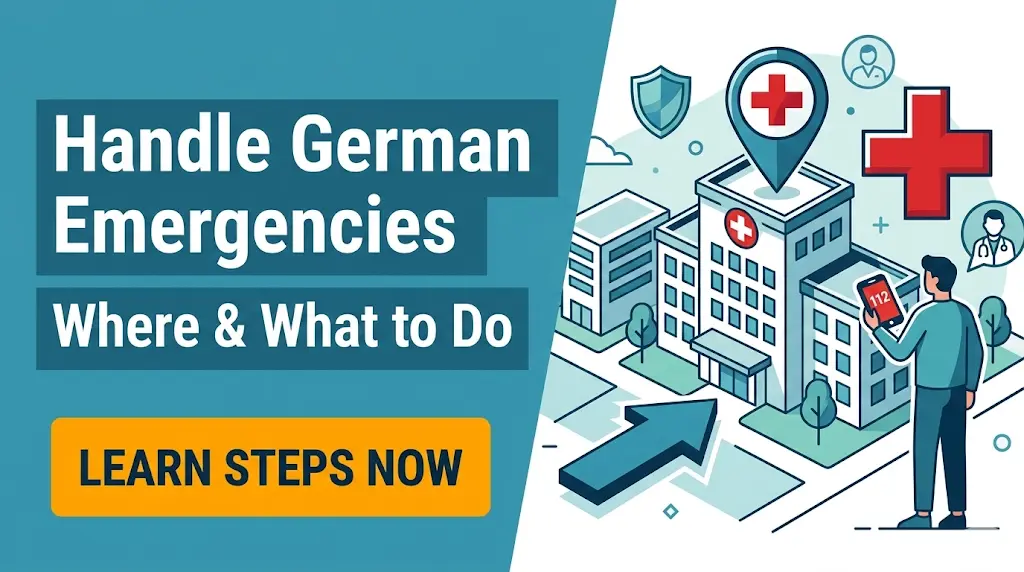
In Germany, knowing how to respond during a medical emergency can significantly affect how quickly a patient receives treatment. For life threatening situations such as severe injuries, chest pain, breathing difficulties, or loss of consciousness, the correct action is to immediately call 112, the national emergency number for ambulance and fire services. Emergency operators will ask several questions to assess the situation and dispatch the appropriate response team.
Ambulances in Germany are part of the professional emergency system known as Rettungsdienst. They are staffed by trained paramedics and, in serious cases, emergency physicians who can begin treatment before reaching the hospital. Patients are typically transported to the nearest hospital equipped to handle their condition.
For urgent but non life threatening health problems outside regular clinic hours, residents can call 116 117, the nationwide medical assistance line coordinated by the Kassenärztliche Bundesvereinigung. This service helps patients locate on call doctors and medical centers when regular practices are closed. Hospital emergency departments treat patients based on medical urgency rather than arrival time. Always bring identification and your health insurance card if possible. Clear communication and accurate location details help emergency services respond efficiently.
The Medical On-Call Service (Bereitschaftsdienst)
Not every medical issue is a 112 emergency, but many still require attention before your local doctor’s office opens on Monday morning. For urgent but non-life-threatening issues—such as a high fever, a severe earache, or a painful but non-traumatizing injury—you should call 116 117. This is the nationwide number for the Ärztlicher Bereitschaftsdienst (medical on-call service). This service connects you to doctors who work outside of normal business hours, including nights, weekends, and public holidays.
The 116 117 service acts as an intermediary between a standard doctor’s visit and the hospital emergency room. When you call, a trained operator will evaluate your symptoms and either direct you to the nearest Bereitschaftspraxis (on-call clinic) or, if you are too ill to travel, arrange for a doctor to visit you at your home. This system is designed to prevent hospital emergency departments from becoming overcrowded with cases that can be handled in a primary care setting.
For international residents, it is important to note that the 116 117 service is primarily conducted in German. If your language skills are limited, having a German-speaking friend assist with the call is ideal. If you are a student or a freelancer, this service is a critical resource to have saved in your phone. More information on specialized care can be found in Health Insurance for Students in Germany: Affordable Options and Requirements and Health Insurance for Freelancers and Self-Employed: Navigating the System.
Finding an Emergency Pharmacy (Notdienst)
If you are sick in the middle of the night and need medication, you cannot go to a standard supermarket or drugstore, as German law restricts the sale of almost all medicines to pharmacies (Apotheken). Fortunately, Germany operates a rotating “Notdienst” (emergency service) system. In every neighborhood, at least one pharmacy remains open 24/7 to provide essential medications.
You can find the nearest emergency pharmacy by looking at the window of any closed pharmacy; they are legally required to display a notice listing the nearest open Notdienst locations. Alternatively, you can search online via portals like Aponet.de or call the 116 117 service for guidance. Note that pharmacies charge a small “emergency fee” (usually around 2.50 euros) for purchases made during these late-night shifts.
For routine wellness items that are not urgent, many expats prefer the convenience of international retailers. Ordering your daily vitamins or non-prescription health products through iHerb can be more cost-effective than relying on the specialized retail prices of local German pharmacies. For more on how the pharmacy system works, see Pharmacies in Germany (Apotheke): How to Get Medication and Advice.
Poison Control Centers (Giftnotruf)
In the event of accidental ingestion of a toxic substance, chemicals, or poisonous plants, you should contact a regional Poison Control Center (Giftnotrufzentrale). Germany has several regional centers that offer 24/7 expert advice on how to handle potential poisonings for both adults and children. These experts can tell you if immediate hospital care is needed or if home-based first aid is sufficient.
It is helpful to have the container of the substance ready so you can tell the expert exactly what was ingested. Because these centers are regional, the number depends on where you live (e.g., Berlin/Brandenburg is +49 30 19240). If the person is already showing severe symptoms like unconsciousness or difficulty breathing, skip the poison hotline and dial 112 immediately. For parents, understanding these safety numbers is as important as having Family Health Insurance: Adding Your Spouse and Kids to Your Plan in place.
Hospital Emergency Departments: The Notaufnahme
Triage and Waiting Times
If you can safely transport yourself to the hospital, you should go to the Notaufnahme (emergency department). Upon arrival, you will undergo “Triage.” This is a process where medical staff assess the severity of your condition to prioritize treatment. In Germany, patients are not treated on a first-come, first-served basis; instead, life-threatening cases (like heart attacks) always go first.
If you arrive with a non-life-threatening issue, such as a broken finger or a minor cut requiring stitches, be prepared to wait for several hours, especially in busy urban hospitals. The triage nurse will assign you a color code or category based on your clinical urgency. This efficiency ensures that critical resources are used where they are needed most.
If you have a high-tier private plan through a provider like Ottonova, you may have access to private hospital wings or treatment by the chief physician once you are admitted, but the initial emergency triage is universally based on medical need, not insurance status.
What to Bring in an Emergency
While an emergency is by definition unplanned, having a small “emergency kit” or a mental checklist of what to grab can make your hospital visit much smoother:
- Health Insurance Card (eGK): This is the most critical document for billing.
- Identification: Your passport or residence permit.
- Current Medications: A list or the actual boxes of any medicine you take regularly.
- Allergy Information: A card or note detailing any known drug allergies.
If you do not have your health card with you, the hospital will still treat you in an emergency. However, you will eventually need to provide proof of insurance to avoid being billed as a private patient. If you are an expat using digital insurance like Feather Insurance, you can usually access your insurance details directly on your smartphone.
Discharge and Follow-up Care
After being treated in the Notaufnahme, you will either be admitted for inpatient care or discharged with a “temporary” medical report. This report is crucial; you should take it to your Finding a Doctor (Hausarzt) in Germany: How to Choose and Register for follow-up care. The hospital doctor will typically only provide enough medication to last until you can see your own GP, who will then issue a full prescription.
Managing follow-up appointments with specialists can sometimes take time. If you need a specific follow-up with a dermatologist or cardiologist, you will likely need a referral from your GP.
Comparing Emergency Options
To help you decide which service is appropriate for your situation, refer to the following summary table:
| Situation | Action / Number | What to Expect |
| Life-Threatening Emergency | 112 (Ambulance/Fire) | Immediate dispatch of paramedics and equipment. |
| Safety Threat or Crime | 110 (Police) | Immediate police response and scene security. |
| Urgent Illness (After-Hours) | 116 117 (On-Call) | Advice, referral to a late clinic, or home doctor visit. |
| Suspected Poisoning | Regional Poison Hotline | Expert toxicological advice over the phone. |
| Minor Injury (Self-Transport) | Notaufnahme (ER) | Assessment and treatment based on medical priority. |
| Mental Health Crisis | 112 or Crisis Hotline | Specialized psychiatric emergency support. |
Specialized Emergencies: Mental Health and Dental
Handling a Mental Health Crisis
If you or someone you know is experiencing an acute mental health crisis, Germany provides several pathways for support. In immediate danger of self-harm or harm to others, you should call 112. They can dispatch specialized medical and psychiatric teams. Most major cities also have a Krisendienst (crisis service) that offers immediate telephone support and, in some cases, mobile crisis teams.
For non-emergency support, the TelefonSeelsorge offers a 24/7 hotline for emotional distress. While many of these services are in German, larger cities like Berlin often have English-speaking suicide prevention or expat-specific mental health support groups. Maintaining your mental well-being is a core part of a successful expat life, as explored in Healthy Living in Germany: Wellness, Fitness, and Mental Health Guide.
Emergency Dental Care (Zahnärztlicher Notdienst)
A sudden, excruciating toothache or a broken tooth on a Sunday doesn’t require a trip to the general emergency room unless there is severe facial swelling that compromises breathing. Instead, you should seek the Zahnärztlicher Notdienst (emergency dental service). This is a rotating system similar to pharmacies, where specific dental practices remain open for emergencies during weekends and holidays.
You can find the currently on-call dentist by searching the website of the regional Kassenzahnärztliche Vereinigung (KZV) or calling 116 117. Be aware that emergency dentists focus on pain relief and stabilization; you will likely need to follow up with your regular dentist for permanent fillings or crowns.
Eye Emergencies and Vision Care
Sudden vision loss, chemical burns to the eye, or severe eye pain are serious emergencies. In these cases, you should seek a specialized Augenklinik (eye clinic) or an emergency room with an ophthalmology department. While standard vision tests are not emergencies, acute eye trauma needs immediate specialized care.
Conclusion
Navigating a medical emergency in Germany is a manageable process when you know the local system’s structure. By memorizing the core numbers—112 for life-threatening crises, 110 for safety, and 116 117 for urgent after-hours care—you ensure that you and your loved ones receive the right level of attention without delay.
Understanding the triage system at the Notaufnahme and knowing how to find an emergency pharmacy or poison control center provides an essential layer of security for your life abroad. With the right insurance in place and a clear plan of action, you can face any medical challenge with confidence, allowing you to focus on your recovery and your expat journey in Germany.
References
Primary sources (official)
- 116 117 – Patient Service (Ärztlicher Bereitschaftsdienst): https://www.116117.de/de/englisch.php
- Federal Ministry of Health – Emergency Services: https://www.bundesgesundheitsministerium.de/en/en.html
Other helpful sources
- Make it in Germany – Healthcare & Emergencies: https://www.make-it-in-germany.com/en/living-in-germany/money-insurance/healthcare
- European Emergency Number Association – Germany: https://eena.org/112/germany/
Disclaimer
The information provided in this article is for general informational and educational purposes only and does not constitute professional medical, legal, or financial advice. While we strive to provide accurate information regarding the German emergency system, protocols and regional phone numbers are subject to change. Always consult directly with a qualified healthcare professional, your insurance provider, or a certified legal expert regarding your specific medical needs and insurance obligations in Germany.