Enrolling Your Child in a German School: What Foreign Parents Should Know
Realizing that your child’s entire academic future in Germany might be decided by age ten based on a localized tracking system is terrifying. I spent weeks completely overwhelmed trying to decipher the enrollment zones and secondary school tiers for my daughter. This guide breaks down the German educational framework, registration deadlines, and practical steps to enroll your child confidently.
Disclosure: This post may contain affiliate links. We may earn a commission at no extra cost to you if you make a purchase through these links. Read full disclosure.
The German School System Explained for Expats
Primary School and Catchment Areas
The German educational journey officially begins with primary school, known as the Grundschule. School attendance is strictly compulsory in Germany starting at age six. Unlike some countries where homeschooling is a legal and popular alternative, homeschooling is outright illegal in Germany, save for extreme, rare medical exemptions. Your child must attend a physical school.
For the first four years (or six years if you live in Berlin or Brandenburg), all children attend the Grundschule together. However, expats are frequently shocked to learn that they generally cannot simply pick the “best” public primary school in their city. Germany operates on a strict catchment area system, known as the Sprengelpflicht.
The city is divided into highly specific zones. Your child is legally required to attend the specific public primary school designated for your street address. While you can file formal requests to transfer out of your zone, these requests are rarely granted unless you can prove a severe hardship or if the alternative school offers a specific after-school care program that your assigned school lacks. If you are moving with younger children who are not yet school-aged, understanding how these zones work is just as critical as navigating the preschool system, which we detail in Finding a Kindergarten or Daycare in Germany: How to Enroll Your Child.
The Stress of Secondary School Tracking
The most heavily debated and stress-inducing aspect of German education for foreign parents is the early tracking system. At the end of primary school—when children are usually just ten years old—their teachers will issue a recommendation for which type of secondary school they should attend based on their academic performance.
This early separation dictates their immediate academic trajectory and their future access to universities. While some federal states allow parents the final say in overriding the teacher’s recommendation, the pressure is immense.
| Secondary School Type | Typical Duration | Primary Focus and Outcome |
| Gymnasium | Grades 5 to 12 or 13 | Highly academic. Prepares students for the Abitur, the mandatory exam required to enter a university. |
| Realschule | Grades 5 to 10 | Intermediate level. Focuses on vocational, administrative, or business training preparation (Mittlere Reife). |
| Hauptschule | Grades 5 to 9 or 10 | Foundational level. Prepares students directly for blue-collar trades and the dual vocational training system. |
| Gesamtschule | Grades 5 to 13 | Comprehensive school. Combines all three tracks under one roof, allowing easier upward mobility between levels. |
Many international parents panic if their child is not immediately recommended for the Gymnasium. It is important to know that the German system has become increasingly permeable. A student can finish a Realschule, complete a vocational apprenticeship, and later take supplemental exams to enter a university. The path is not permanently locked, but navigating it requires a deep understanding of local norms.
Administrative Steps to Enroll Your Child
The Crucial Role of Your Registered Address
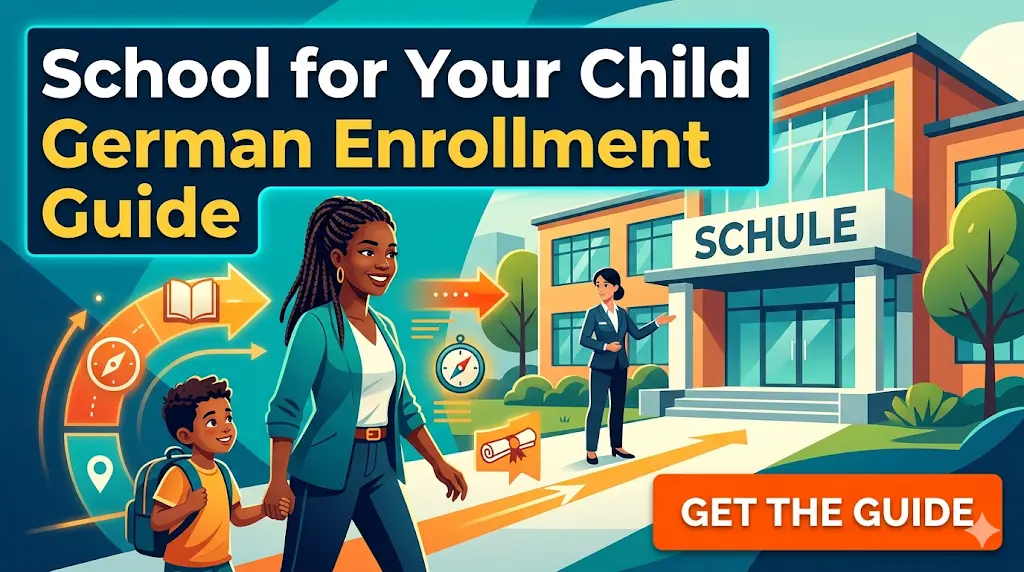
Because of the strict catchment area rules, you absolutely cannot enroll your child in a German public school until you have a legally registered address. The local school authority (Schulamt) will mail you an official enrollment invitation, but only after your family is officially in the civil registry.
This creates a massive logistical nightmare for expat families who arrive in Germany and stay in unregistered hotels or informal sublets while searching for a permanent home. Without an address, your child cannot start school. This is exactly why securing verified temporary housing through Wunderflats is a strategic necessity for families. When you book an apartment on Wunderflats, you immediately receive the necessary landlord confirmation document required by the town hall.
Using Wunderflats solves the dreaded chicken-and-egg problem of German bureaucracy. It gives you a stable, legal address to anchor your child into a specific school zone immediately upon arrival, allowing them to start their education while you take your time searching for an unfurnished, long-term lease. To understand how critical this exact piece of paper is to your entire relocation timeline, read Registering Your Address (Anmeldung): Step-by-Step Guide and carefully review Anmeldung (Address Registration) vs Visa: Why Both Are Needed in Germany.
Language Assessments and Integration Classes
If you are moving to Germany with an older child who speaks absolutely no German, do not panic. The German school system is highly accustomed to integrating newly arrived international children. You cannot simply drop a non-German speaking teenager into a standard Gymnasium chemistry class and expect them to survive.
Before they start, the local school authority will conduct a brief, highly supportive language assessment. Depending on the federal state, your child will likely be placed into a “Willkommensklasse” (Welcome Class) or a “DaZ” (German as a Second Language) program. In these specialized, smaller classes, the entire focus is on rapid language acquisition. They will gradually integrate into regular subjects like math and physical education as their vocabulary improves.
Relocating older children requires immense patience and empathy as they struggle with the language barrier. To help your entire family manage the frustration of an entirely new linguistic environment, explore the strategies we discuss in Living in Germany Without Speaking German (Yet): Tips to Get By. Furthermore, prior to starting classes, the local health department (Gesundheitsamt) will mandate a physical health check for your child, requiring strict proof of measles vaccination under German law. Managing these health documents is a vital part of the paperwork onslaught, which you can decode in Bureaucracy Basics: Understanding Bescheinigung, Anträge, and Other Paperwork.
Preparing for the First Day of German School
The Tradition of the Schultuete
The very first day of first grade (Einschulung) is treated as a massive, monumental milestone in Germany. It is celebrated with the same fervor as a major graduation. Extended family members attend, parents take the day off work, and children dress up for a special ceremony hosted by the school.
The absolute centerpiece of this tradition is the Schultüte. This is a massive, highly decorated cardboard cone that is as tall as the child. It is filled to the brim with chocolates, small toys, and school supplies, designed to sweeten the anxiety of starting formal education. If your child shows up to their first day of Grundschule without one, they will be the only one, and it will be devastating.
If you have just arrived in the country and do not have the time or the craft skills to build a massive cardboard cone from scratch, you can easily buy pre-made Schultüte kits on Amazon Germany. Ordering a beautifully themed cone directly from Amazon Germany saves you from the intense pressure of local parent craft nights, allowing you to participate in this beautiful local tradition flawlessly while dealing with the stress of your ongoing relocation.
Specific School Supplies and the Schulranzen
When you finally receive the supply list from your child’s new German teacher, you will likely be entirely baffled. German schools do not ask for generic notebooks and pens. They ask for highly specific, standardized items. You will be asked to buy notebooks with specific margin rulings (indicated by specific numbers like “Lineatur 2” or “Lineatur 4”) and a specific brand of fountain pen (Füller), which German children are taught to use from an incredibly young age to develop their handwriting.
Standing in a local stationery shop trying to translate these highly specific academic codes is exhausting. Instead of stressing, many expat parents simply type the exact “Lineatur” numbers from the supply list into Amazon Germany. Sourcing these rigid requirements through Amazon Germany ensures you buy the exact standardized notebooks the teacher demanded, saving you from a frustrating scavenger hunt across town.
The biggest financial shock of back-to-school season is the backpack, known as a Schulranzen. German children do not carry soft, generic canvas backpacks. They carry rigid, highly ergonomic, box-like backpacks designed to protect their developing spines from the heavy weight of hardcover books. These items are incredibly expensive, often costing well over 250 euros for a complete set.
You can find premium, ergonomically certified backpacks significantly cheaper by comparing models on Amazon Germany, allowing you to bypass the massive markups in local boutique luggage stores. Budgeting for these hidden educational costs is a critical aspect of your family’s financial transition. To ensure you aren’t caught off guard by these sudden expenses, carefully study the Cost of Living in Germany: A Realistic Budget for Expats.
Navigating the school system requires stamina. Knowing you have a warm, perfectly furnished Wunderflats apartment to return to after a long day of parent-teacher conferences and bureaucratic appointments takes a massive edge off the stress. By focusing on securing your address, understanding the tracking system, and preparing for the cultural traditions, you can ensure your child’s transition into the German educational system is as smooth and successful as possible. If you are still trying to figure out how this all fits into your overarching immigration strategy, be sure to reference the Moving to Germany: Comprehensive Visa & Immigration Guide.
References
Primary sources official
- Make it in Germany (Official Federal Portal) – School System & Compulsory Education: https://www.make-it-in-germany.com/en/living-in-germany/family-life/school-system
- Federal Ministry of Education and Research (BMBF) – English Portal: https://www.bmbf.de/bmbf/en/home/home_node.html
Other helpful sources
- Research in Germany – German Schools: A Complete Overview: https://www.research-in-germany.org/en/plan-your-stay/family/schools.html
- Studying in Germany – The German Education System: https://www.studying-in-germany.org/german-education-system/
Disclaimer
The information provided in this guide is for general informational purposes only and is based on the real-world experiences of expat parents navigating the German educational system. School enrollment policies, mandatory health requirements, the specific structure of secondary school tracking, and the rules governing catchment areas (Sprengelpflicht) vary significantly across the 16 German federal states. This article does not constitute legal, immigration, or official educational advice. Always consult your local school authority (Schulamt) and your municipal registration office for the exact administrative requirements in your specific city.