In-Demand Jobs in Germany: Sectors Looking for Foreign Talent
Applying for hundreds of jobs in Germany and receiving only automated rejections is a demoralizing experience that leaves many expats feeling entirely unwanted. I spent months targeting oversaturated corporate roles before realizing my skills were desperately needed in an entirely different sector. This guide breaks down the actual shortage occupations in Germany, highlighting exactly which industries are urgently searching for foreign talent.
Disclosure: This post may contain affiliate links. We may earn a commission at no extra cost to you if you make a purchase through these links. Read full disclosure.
The Reality of Germany’s Labor Shortage
The narrative surrounding the German job market often oscillates between tales of a booming tech utopia and warnings of bureaucratic nightmares. The truth lies somewhere in the middle. Germany is facing a demographic cliff, and understanding this macroeconomic reality is your greatest leverage as an international applicant.
Why Germany Needs Foreign Talent Now More Than Ever
Germany’s economic engine is fundamentally threatened by a rapidly aging workforce and a persistently low birth rate. The Federal Employment Agency (Bundesagentur für Arbeit) estimates that the country requires approximately 400,000 qualified immigrants every single year just to maintain its current economic output and support its pension system. Millions of experienced workers from the “boomer” generation are entering retirement, leaving a massive vacuum of institutional knowledge and technical execution.
For expats, this means the leverage has shifted. While German human resources departments are traditionally risk-averse and obsessed with local credentials, desperation is forcing them to modernize. Companies that previously demanded flawless German and domestic university degrees are now actively lobbying the government to lower immigration barriers. However, this desperation is not evenly distributed across all jobs. If you are applying for generic middle-management or junior marketing roles, you will still face fierce local competition. The true opportunities lie in specific, critical bottlenecks.
Understanding the depth of this demographic shift helps you negotiate better contracts and relocation packages. Employers know that if they find a qualified candidate in a critical sector, they cannot afford to lose them over minor administrative hurdles. To understand how this dynamic plays out during the hiring process, you should review Work Visas and Sponsorship: What Employers Need to Know to Hire Foreigners, which can equip you with the knowledge to reassure hesitant hiring managers.
The Expanded Shortage Occupations List
The German government does not guess which jobs are in demand; they track it obsessively through the Fachkräfteengpassanalyse (Skilled Labor Bottleneck Analysis). When a specific profession has fewer than three statistically recorded unemployed people available for every open vacancy, it is officially designated as a shortage occupation (Mangelberuf).
As of the latest updates leading into 2026, the list of officially recognized bottleneck professions has expanded massively to include over 160 distinct occupational groups. Historically, this list was confined to STEM (Science, Technology, Engineering, and Mathematics) and human medicine. Today, it has broadened to include education professionals, transportation and logistics managers, green energy technicians, and an enormous swath of skilled trades.
If your profession falls on this official list, your immigration pathway is fundamentally altered. The salary thresholds required to obtain an EU Blue Card are significantly lowered for these roles, meaning smaller companies and startups can afford to hire you without breaking their internal salary bands.
Regional Hubs: Where the Jobs Actually Are
Another common mistake expats make is focusing their job hunt entirely on Berlin. While Berlin is an undeniable hub for digital startups and international media, the vast majority of Germany’s economic power is decentralized. The demand for specific roles is highly regionalized based on the historical industrial footprint of the individual federal states (Bundesländer).
If you are an automotive or mechanical engineer, the southern states of Bavaria and Baden-Württemberg (specifically Munich and Stuttgart) are the undisputed epicenters of demand. If you work in logistics, supply chain management, or maritime engineering, the northern port city of Hamburg is your best target. Frankfurt remains the financial capital, offering the highest concentration of roles for fintech developers, actuaries, and cybersecurity experts protecting banking infrastructure.
Targeting the right region not only increases your chances of finding a job but significantly impacts your financial reality. Salaries in Munich are substantially higher than in Berlin, but the cost of housing is also astronomical. Before committing to a specific regional hub based solely on a job offer, you must meticulously calculate your budget using resources like Cost of Living in Germany: Breakdown of Expenses (Rent, Food, Transport).
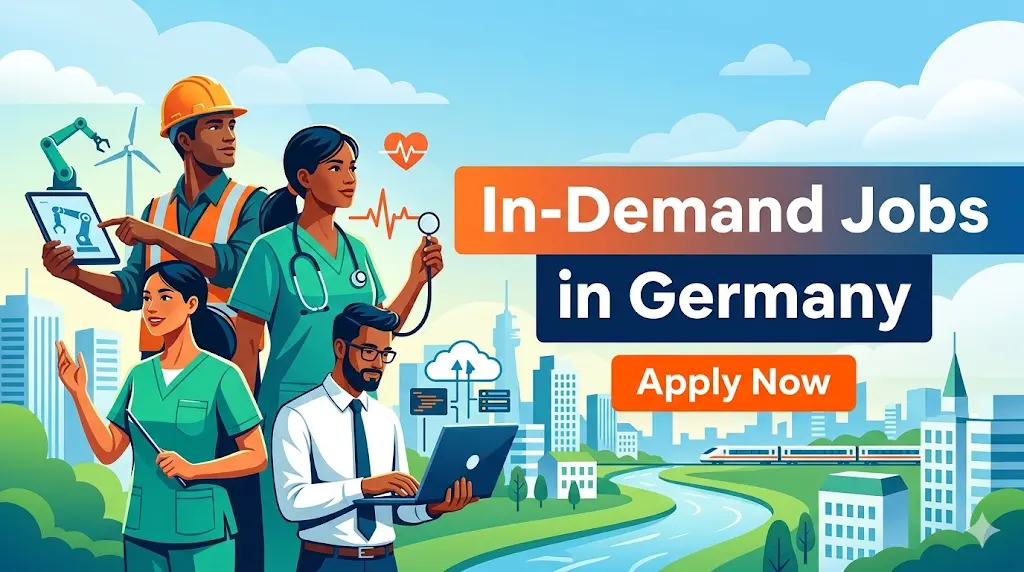
IT, Digitalization, and Tech Careers
The single most aggressively recruited sector in Germany is Information Technology. As the country pushes to digitize its traditional manufacturing base (often referred to as Industry 4.0) and modernize its notoriously analog public administration, the demand for tech talent has reached critical levels.
Software Development, AI, and Cybersecurity
Virtually every company in Germany is transitioning into a technology-driven organization. The demand is no longer confined to trendy startups; traditional automotive giants, legacy banks, and massive retail chains are desperately hunting for full-stack developers, cloud architects (AWS, Azure), and DevOps engineers. Proficiency in core languages like Java, Python, and C++ remains a reliable ticket into the German middle class.
Beyond standard development, the absolute peak of current demand lies in Artificial Intelligence, Machine Learning, and Cybersecurity. With the implementation of strict European data protection laws (GDPR) and the increasing threat of corporate espionage, cybersecurity analysts are commanding premium salaries. Similarly, data scientists who can leverage AI to optimize supply chains or automate manufacturing processes are essentially handed blank checks by desperate Mittelstand (medium-sized) companies.
When applying for these roles, your portfolio and GitHub repositories often carry more weight than your traditional resume. However, your application materials must still adhere to specific local standards. Submitting a chaotic, unstructured resume will see you rejected by the HR department before the technical lead even sees your code. Ensure your paperwork is flawless by consulting Writing a German-Style CV and Cover Letter: Tips for Success.
The IT Specialist Visa Exemption
One of the most revolutionary changes to German immigration law under the recent Skilled Immigration Act (Fachkräfteeinwanderungsgesetz) was explicitly designed for the IT sector. Recognizing that many of the world’s most brilliant coders and network architects are self-taught or hold degrees in unrelated fields, the government created a massive loophole.
You can now obtain an EU Blue Card as an IT specialist without a formal university degree. To qualify, you must prove that you have at least three years of relevant professional experience in the IT sector within the last seven years, and you must have a job offer that meets the lowered salary threshold for shortage occupations. This policy shift has opened the floodgates for international bootcamp graduates and self-taught developers.
However, proving this experience requires meticulous documentation. You cannot simply state that you coded for three years; you need formal reference letters (Arbeitszeugnisse) from past employers detailing your exact technical responsibilities. If you need help sourcing these roles or understanding how to bypass the traditional HR filters, reviewing Finding a Job in Germany: Top Job Portals and Networking Tips is highly recommended.
English vs. German in the Tech Bubble
The German tech sector is famous for its “English bubble.” It is entirely possible to land a senior engineering role in Berlin, Munich, or Frankfurt without speaking a single word of German. Startups and international tech giants operate almost exclusively in English, from their Slack channels to their all-hands meetings.
However, relying purely on English is a dangerous long-term strategy. It artificially limits your career mobility. The moment you want to transition from a startup into a highly stable, lucrative role at a traditional German engineering firm or a bank, the English bubble bursts. Furthermore, progressing into upper management often requires fluent German to negotiate with domestic stakeholders, labor unions, and local vendors.
To future-proof your tech career, you must actively dismantle the language barrier. Enrolling in structured, live classes through Lingoda is a highly effective way to build your foundational grammar outside of working hours. To specifically target the complex vocabulary of German IT infrastructure and project management, supplementing your studies by listening to GermanPod101 during your commute will help you internalize the specific phrasing expected in a bilingual boardroom.
Engineering, Manufacturing, and Green Technology
Germany’s global reputation is built on its engineering prowess. While the automotive sector is undergoing a painful transition, the broader engineering landscape is starving for talent, particularly as the country races to meet ambitious climate goals.
Mechanical, Automotive, and Electrical Engineering
The transition from internal combustion engines to electric mobility (e-mobility) and autonomous driving has not destroyed engineering jobs; it has simply shifted the skill sets required. Automotive engineers who specialize in battery technology, lightweight materials, and sensor integration are in incredibly high demand.
Mechanical and electrical engineers are equally sought after to support the automation of the manufacturing sector. As factories become smarter, professionals who can bridge the gap between heavy machinery and digital networks (Mechatronics) are critical. Furthermore, civil engineers are desperately needed to overhaul the country’s aging railway infrastructure, expand fiber-optic networks, and build new, sustainable housing to combat the nationwide housing crisis.
Interviewing for these traditional engineering roles is a highly formal affair. You will be expected to present your technical knowledge with absolute precision and adhere to strict professional etiquette. To ensure you do not inadvertently offend your future boss during the technical screening, deeply study the cultural norms outlined in Job Interview Tips for Germany: What to Expect and How to Impress.
The Boom in Renewable Energy (Green Jobs)
Germany’s Energiewende (energy transition) is one of the most ambitious national projects in the world. The country is rapidly phasing out coal and nuclear power, aiming to rely almost entirely on renewable energy sources. This policy mandate has created an explosion of “Green Jobs.”
There is an insatiable demand for wind turbine engineers, solar energy project managers, and specialists in hydrogen fuel technology. Environmental consultants and experts in circular economy and waste management are being hired aggressively by major corporations to ensure compliance with strict new EU sustainability directives.
These roles are not just morally rewarding; they are highly subsidized and incredibly stable. However, because these jobs often involve navigating complex municipal regulations and interacting with local government bodies, a strong command of German is usually non-negotiable. Utilizing Lingoda to specifically request lessons focused on environmental and regulatory vocabulary can give you a massive edge over other international candidates who only speak English.
Navigating the German Mittelstand
When targeting engineering roles, expats often overlook the Mittelstand—the medium-sized, often family-owned enterprises that form the backbone of the German economy. These companies are frequently “hidden champions,” holding dominant global market shares in highly specialized niches like optical sensors, medical manufacturing equipment, or specialized robotics.
The Mittelstand is desperate for international engineers because they are often located in smaller towns or rural areas that struggle to attract young, domestic talent drawn to the big cities. Working for a Mittelstand company offers unparalleled job security, excellent benefits, and a deeply loyal corporate culture.
However, the culture within these companies is highly traditional. Hierarchies are rigid, and communication is formal. Understanding how decisions are made and how to interact with senior master craftsmen (Meister) is vital for your daily survival.
Healthcare, Nursing, and Life Sciences
Germany’s population is one of the oldest in the world, and the healthcare system is straining under the demographic weight. The medical sector is arguably the most desperate industry in the country, actively recruiting worldwide to prevent systemic collapse.
The Critical Need for Doctors and Nurses
Hospitals, private clinics, and elderly care facilities (Altenpflege) are facing a catastrophic shortage of frontline workers. There is an immediate, critical need for registered nurses, intensive care specialists, geriatric nurses, and medical doctors across nearly all specializations. The government estimates that Germany will need hundreds of thousands of additional nursing professionals by 2030 just to maintain baseline care standards.
Because the demand is so high, hospitals and specialized recruitment agencies offer massive relocation packages. These often include paying for your flights, providing temporary housing, and funding your intensive language courses upon arrival. The job security in this sector is absolute; once you are fully integrated, it is practically impossible to be involuntarily unemployed as a healthcare professional in Germany.
However, the reality of working in the German healthcare system can be jarring. The administrative burden is heavy, and the hierarchical divide between doctors (Ärzte) and nursing staff (Pflegekräfte) is often much steeper than in countries like the US or the UK.
The Grueling Recognition Process
The greatest hurdle for foreign healthcare professionals is not finding a job offer; it is the Anerkennung (professional recognition) process. Medicine and nursing are strictly regulated professions (reglementierte Berufe) in Germany. You cannot simply land at Frankfurt airport and start treating patients, regardless of how many years of experience you have in your home country.
Your foreign medical or nursing degree must be meticulously evaluated by the state health authorities to ensure it matches the German curriculum. This process can take over a year. Often, the authorities will find “deficits” in your training, requiring you to complete adaptation courses (Anpassungslehrgänge) or pass a grueling knowledge test (Kenntnisprüfung) before you are granted your full license to practice (Approbation or Berufsurkunde).
During this waiting period, many foreign nurses are hired as nursing assistants (Pflegehilfskräfte) at a significantly lower salary until their recognition is finalized.
Language Requirements and Patient Care
In the tech sector, poor German is an inconvenience; in the healthcare sector, it is a matter of life and death. The state mandates strict language requirements for medical professionals. Nurses generally must prove a solid B2 level of German, while doctors must prove C1 proficiency and pass a specialized medical terminology exam (Fachsprachenprüfung).
You cannot fake your way through these exams. You must be able to comprehend complex medical histories, clearly explain diagnoses to terrified patients, and accurately document treatments in legally binding medical charts.
Achieving this level of clinical fluency requires rigorous, specialized training. Using platforms like Lingoda to practice highly structured speaking exercises is essential for passing the general B2/C1 exams. Furthermore, utilizing GermanPod101 to immerse yourself in audio dialogues simulating hospital admissions, patient handovers, and emergency room scenarios will drastically reduce the linguistic shock during your first week on the ward.
Skilled Trades and Vocational Occupations
The most overlooked avenue for immigrating to Germany is the blue-collar sector. Germany is experiencing a severe crisis in the skilled crafts (Handwerk), and the government has completely overhauled the visa system to attract foreign tradespeople.
Electricians, Plumbers, and Mechatronics Technicians
There is a profound national shortage of electricians, plumbers (specifically HVAC and heat pump specialists), carpenters, welders, and CNC machinists. The push for green energy has only exacerbated this; you cannot install millions of solar panels or transition entire cities to electric heat pumps without an army of skilled tradespeople.
These roles offer fantastic middle-class stability, strict union protections, and excellent salaries that often outpace junior academic roles. Furthermore, skilled tradespeople are highly respected in German society. The path to becoming a master craftsman (Meister) allows you to eventually open your own business and train apprentices of your own.
Translating Foreign Qualifications to the Dual System
The challenge for foreign tradespeople is that Germany relies on a highly specific, world-renowned dual vocational training system (Duale Ausbildung). To get a skilled worker visa, your foreign vocational training must be officially recognized as equivalent to a German apprenticeship.
This means proving that your training involved both theoretical classroom learning and practical on-the-job experience over several years. The local Chamber of Crafts (Handwerkskammer) handles this evaluation.
Salaries, Visas, and Securing the Job
Understanding which jobs are in demand is only half the battle; you must also understand what these sectors pay and how to legally enter the country to claim them.
Average Salary Expectations Across Sectors
German salaries are generally highly competitive, though they are heavily taxed to fund the country’s robust social safety net. When reviewing these averages, remember that salaries are always negotiated as a gross annual figure (Bruttojahresgehalt). Your net take-home pay will be substantially lower.
| Sector & High-Demand Role | Estimated Gross Annual Salary (2026) | Educational Requirement |
| IT: Software Developer / AI Engineer | €55,000 – €90,000+ | Degree OR 3 Years Verified Experience |
| IT: Cybersecurity Specialist | €60,000 – €95,000+ | Degree OR 3 Years Verified Experience |
| Engineering: Electrical / Mechanical | €50,000 – €85,000 | Recognized University Degree |
| Engineering: Renewable Energy | €55,000 – €80,000 | Recognized University Degree |
| Healthcare: Registered Nurse | €38,000 – €55,000 | Recognized Nursing Degree / License |
| Healthcare: Medical Specialist / Doctor | €80,000 – €150,000+ | Medical License (Approbation) |
| Skilled Trades: Electrician / HVAC | €35,000 – €55,000 | Recognized Vocational Qualification |
| Logistics: Supply Chain Manager | €45,000 – €70,000 | Degree or Vocational Qualification |
Note: Salaries vary wildly based on the federal state, your years of experience, and the size of the company (Tarifvertrag).
Fast-Tracking with the EU Blue Card and Chancenkarte
If you secure a job in one of the officially recognized shortage occupations (which now cover almost all the roles listed above) and hold a recognized degree, the salary threshold for the EU Blue Card is significantly reduced to roughly €41,041. This fast-tracks your visa process and offers a rapid pathway to permanent residency.
If you have the qualifications but haven’t found a job yet, the new Opportunity Card (Chancenkarte) is your best tool. This points-based visa allows skilled workers to move to Germany for up to a year specifically to search for employment. You can even work part-time or do trial work days (Probearbeiten) while interviewing. Points are awarded for your qualifications, age, and crucially, your language skills.
Standing Out with Language Skills and Cultural Fit
The ultimate differentiator in the German job market is the German language. While the government has lowered the legal language barriers for many visas, employers still heavily favor candidates who can integrate seamlessly into their teams.
If you are tied with another international candidate for a highly coveted engineering or logistics role, the candidate with a certified B1 or B2 German level will win the contract every single time. It demonstrates commitment, reduces the HR department’s anxiety, and ensures you won’t be isolated in the canteen. By strategically investing in Lingoda classes to secure official CEFR certificates and using GermanPod101 to master industry-specific jargon, you transform yourself from a risky foreign applicant into an indispensable, highly integrated professional ready to solve Germany’s labor crisis.
References
Primary sources (official)
- Make it in Germany – Professions in Demand: The official, multilingual federal portal detailing exactly which sectors face acute shortages and how the Skilled Immigration Act applies to them.https://www.make-it-in-germany.com/en/working-in-germany/professions-in-demand
- Federal Employment Agency (Bundesagentur für Arbeit): The government agency that officially tracks the Fachkräfteengpassanalyse (Skilled Labor Bottleneck Analysis) and publishes the official shortage occupation data.https://statistik.arbeitsagentur.de/
Other helpful sources
- Recognition in Germany (Anerkennung in Deutschland): The official portal explaining the mandatory process for having foreign academic and vocational qualifications legally recognized by German authorities.https://www.anerkennung-in-deutschland.de/html/en/index.php
Disclaimer
The information provided in this article is for general informational and educational purposes only and does not constitute professional career counseling, legal, or immigration advice. The official list of shortage occupations (Mangelberufe), EU Blue Card salary thresholds, and regulations regarding the Skilled Immigration Act (Fachkräfteeinwanderungsgesetz) are subject to frequent legislative updates by the German federal government. While utilizing language learning platforms can drastically improve your employability and help you earn points for visas like the Opportunity Card, your success in securing a job and a work permit depends entirely on your individual qualifications, successful degree recognition, and the discretionary approval of the German immigration authorities (Ausländerbehörde). Always verify current visa requirements with your local German embassy or consulate.