Insurance for Parents Visiting Germany: Cover for Older Relatives
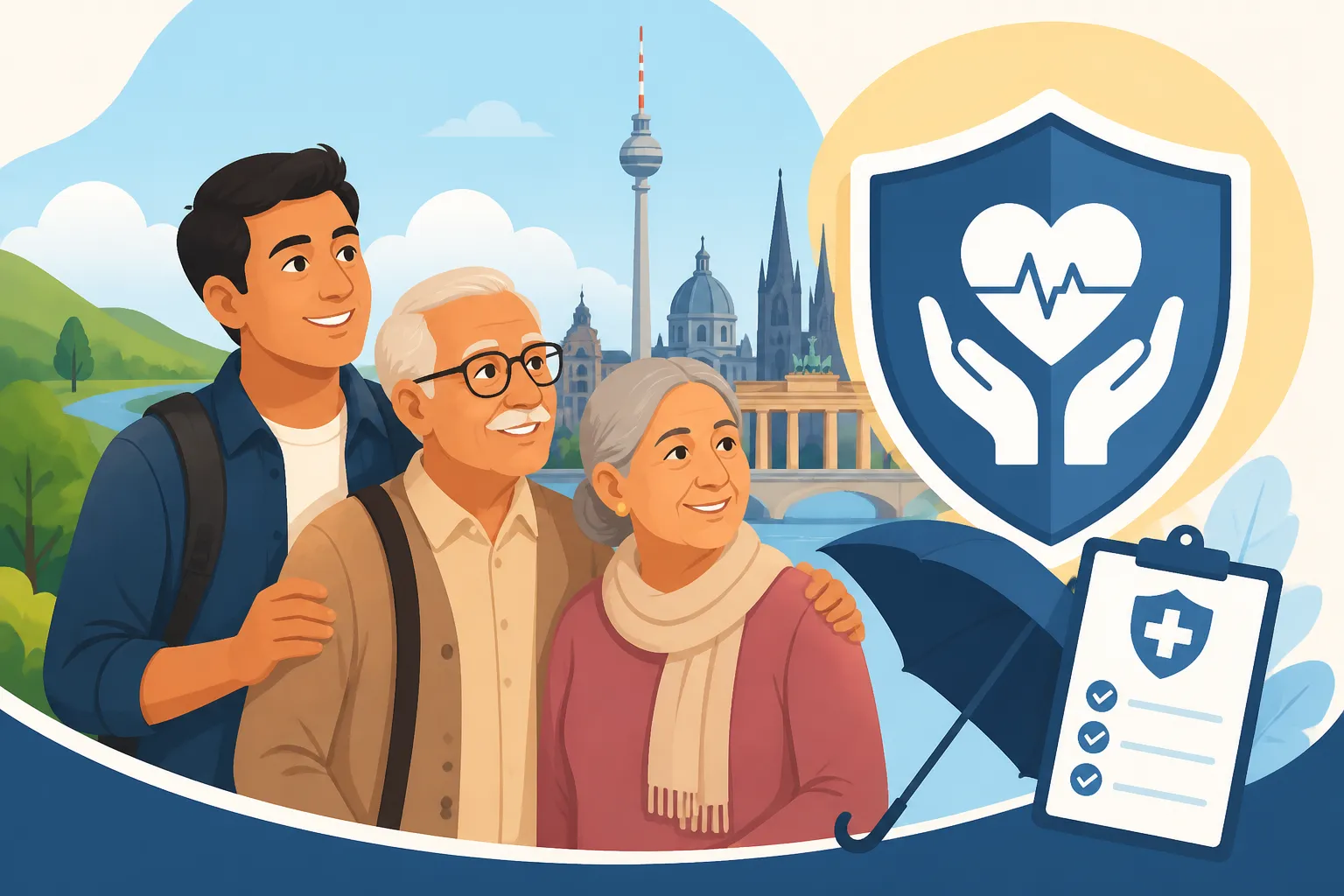
Your mother has a heart condition and lands in Frankfurt next month. Your father keeps saying he has “insurance back home.” Then the consulate asks for a policy document you have never seen. This guide covers what cover older relatives need for a visit to Germany, how it works with the visa rules, and how SafetyWing fits in.
Disclosure: This post may contain affiliate links. We may earn a commission at no extra cost to you if you make a purchase through these links. Read full disclosure.
Why Visiting Parents Need Their Own Health Cover in Germany
Here is the uncomfortable truth I learned the hard way. Germany has one of the best healthcare systems in the world, and your visiting parents are almost entirely outside it. Your public Krankenkasse covers you, your spouse and possibly your children. It does not stretch to cover your mother because she is staying in your spare room for six weeks. Family co-insurance in Germany covers only spouses and children living here, never parents.
The first time my parents visited, I assumed what most expats assume. If something went wrong, they would go to a doctor, show a passport, and sort out the paperwork later. Technically that is what happens. The “sort out later” part is the problem. Your parents become private, self-paying patients, and the bill goes to whoever signed the treatment agreement.
How German Doctors and Hospitals Bill Visitors
When a visitor without German statutory cover walks into a Praxis or a Notaufnahme, they are treated. Nobody in a German emergency department will turn your father away because his card is foreign. The billing side runs differently, though. Doctors charge private patients under the official private fee schedule, the Gebührenordnung für Ärzte, often called the GOÄ. They can apply multipliers depending on how complex the treatment was. That is why a private invoice for the same consultation can look very different from what a statutory patient would cost.
Hospitals are often stricter than clinics. For planned or longer admissions, a visitor may be asked for a deposit, a payment guarantee from an insurer, or a credit card before anything non-urgent happens. A friend of mine in Stuttgart had her mother admitted after a fall on the stairs at the Hauptbahnhof. The first question at the admissions desk after “what happened” was “who is paying?” Her mother had a printed policy confirmation and a 24-hour assistance number. The hospital called the number, and the conversation was over in minutes.
Pharmacies work the same way. A private doctor writes a Privatrezept. The Apotheke charges the full price at the counter and hands over a receipt. You claim that money back from the insurer later. If your parents need medicine late at night, see How to Find a Night Pharmacy (Notdienst Apotheke) in Germany before the trip, not during the crisis.
Why Age Changes the Insurance Conversation
Older travellers are not just younger travellers with grey hair as far as insurers are concerned. The risks are different. Falls on cobblestones are more common. So are cardiac events triggered by heat or long-haul flights, dehydration during a summer heatwave, and flare-ups of conditions that were stable at home. A seventy-year-old who walks happily around their own neighbourhood can be exhausted by a day at Neuschwanstein or a Christmas market evening in Nuremberg.
Insurers price this in. Policies are usually built on age bands, and premiums rise as you move up through them. Many policies also have an upper age limit, beyond which they will not issue cover at all. That is not a moral judgement on your parents. It is how the product is built, and you need to know where your parents sit before you choose anything.
The other big age-related issue is pre-existing conditions. Most standard travel medical policies exclude or restrict claims linked to conditions your parents already had before the policy started. That covers diabetes, high blood pressure, a previous heart procedure, and so on. For older relatives this clause matters more than almost anything else in the policy. I go into it in detail further down, and there is a deeper explainer at Pre-Existing Conditions and Travel Medical Cover in Germany.
The Home Insurance Myth
“Dad has insurance back home” is the most dangerous sentence in this whole topic. Domestic health insurance from outside Europe usually stops at the border, or covers only a narrow slice of emergency care abroad on a reimbursement basis. Even when it does pay something, it is rarely in a form a German consulate or hospital will recognise. You want a written policy document, in English or German, that names your parents, states the travel dates, confirms it covers Germany and the Schengen area, and lists an emergency assistance number. If your parents’ home policy cannot produce that, treat it as a bonus at best, not as their cover.
Schengen Visa Rules and Insurance: Getting the Basics Right
Before you choose a policy, you need to know what the visa rules require. This is where families most often get confused, so here is the rule set plainly.
A Schengen visa covers short visits of up to 90 days in any 180-day period. Parents from countries such as India or China need a Schengen visa for any such visit, even a two-week holiday. US passport holders need no visa for stays of up to 90 days in any 180-day period. A stay longer than 90 days needs a German national (D) visa, not a Schengen visa.
Who Needs What: A Quick Reference
| Situation | Visa needed | What it allows | Insurance angle |
|---|---|---|---|
| Parents from India or China, visit up to 90 days | Schengen visa | Short visits of up to 90 days in any 180-day period | Travel medical insurance must be shown as part of the Schengen application |
| Parents with US passports, visit up to 90 days | No visa | Stays of up to 90 days in any 180-day period | No visa check on insurance, but cover is still essential because German care is billed privately |
| Any nationality, stay longer than 90 days | German national (D) visa | Long stays beyond the short-visit limit | Longer stays bring different insurance requirements, so check with the consulate handling the D visa |
For the full short-stay picture, read Schengen Visa for Germany: Short-Stay Visa Requirements and Tips. If your parents are thinking about staying for a whole season, the differences are covered in National (D) Visa vs Schengen Visa for Germany.
What Consulates Look for in a Policy
For parents applying for a Schengen visa, the insurance is not a nice extra. It is a required document. Consulates and their visa service centres check that the policy:
- Names the applicant exactly as written in their passport.
- Covers the entire planned stay, from the day of entry to the day of exit.
- Is valid across the whole Schengen area, not only Germany.
- Covers emergency medical treatment, hospital care, and medical repatriation.
- Meets the minimum coverage level set by Schengen rules.
- Comes with a confirmation letter or certificate the consulate can read.
The application usually also includes an invitation from you, the host. If you are writing one, Invitation Letter for German Visa: Guide for Visitors and Hosts walks through the wording. If the consulate wants you to formally guarantee your parents’ costs, see How to Sponsor Someone to Germany: Invitation and Formal Obligation (Verpflichtungserklärung). That document is a serious commitment. It can make you liable for costs, including medical ones, which is one more reason to make sure the insurance is solid.
The 90-Day Counting Trap
The phrase “90 days in any 180-day period” catches people out because it is a rolling window, not a calendar reset. Picture this. Your mother visits for two months in spring to help with a new baby. She flies home, then wants to come back for Christmas. Look back 180 days from each day of the Christmas trip and count every day she was in the Schengen area. That total must stay at or under 90. If she spent time in Austria or Italy during the spring trip, those days count too.
From an insurance point of view, the lesson is to buy cover for the actual dates of each trip. Make sure those dates match the flights, the visa, and the invitation letter exactly. A policy that starts the day after your parents land, or ends two days before their flight home, is the kind of mismatch that gets an application returned.
Why SafetyWing Works Well for Visiting Parents
I have recommended SafetyWing to friends with visiting parents more times than I can count. My reason is not that it is the only option. It is that it fixes the most common pain points for families with relatives flying in: speed, clarity, and an online process you can handle for your parents from your own laptop in Germany.
SafetyWing’s Nomad Insurance is a travel medical product built for people who are outside their home country. That is exactly what a visiting parent is. It covers unexpected illness and injury abroad, emergency hospital treatment, and emergency medical evacuation. It is the scenario you are really worried about: a fall, a sudden infection, chest pains on a hot afternoon in Berlin.
What Makes It Practical for Families
The first thing families like is that buying it is straightforward. You choose the travel dates, enter the traveller’s details, and receive the policy documents digitally. Many adult children end up buying for their parents. In that case you can sit in your flat in Leipzig, sort the cover in an evening, and email your parents the PDF to print for their visa appointment. No back-and-forth with an agent in another time zone.
Second, SafetyWing can produce documentation that people use for visa applications. That includes a confirmation that states the insured person, the dates, and the area of cover. Consulates set their own expectations, so check the current visa requirements of the consulate handling your parents’ application. Then compare them against the policy documents before the appointment. Doing that one check calmly at home is far better than discovering a gap at the visa centre counter.
Third, there is a 24-hour assistance line. When something goes wrong, your parents or you can call and get help with where to go and how payment will be handled. In my experience that matters more than any line in a brochure. At the Notaufnahme at two in the morning, nobody is reading policy wording. You want a phone number that answers.
Where You Need to Read Carefully
I would not be doing my job if I made this sound perfect. Before you buy SafetyWing for a parent, check these points on SafetyWing’s own website and in the policy wording:
- Age bands and upper age limit. Premiums go up with age, and there is a maximum age for new policies. If your parent is above that limit, this product will not work for them. You will need a specialist senior travel insurer instead.
- Pre-existing conditions. Like most travel medical policies, Nomad Insurance limits cover for conditions your parents already had. Read exactly how SafetyWing defines these and whether any acute-onset provisions apply. The breakdown in What SafetyWing Does Not Cover in Germany: The Exclusion List, Line by Line is worth your time.
- Deductible. There is a deductible per claim or period. Look up the current amount and decide whether your parents can comfortably pay small costs out of pocket.
- Routine and planned care. Travel medical insurance is for the unexpected. It will not fund a planned hip check, a routine eye exam, or “while we’re in Germany, let’s get a second opinion” visits.
- Current prices and limits. Prices, coverage limits and policy terms change. Always check SafetyWing’s current page for the figures that apply to your parents’ age and trip length.
This is not a list of reasons to avoid SafetyWing. It is a list of things to confirm so the policy you buy matches the parent you are buying it for.
How It Compares to Other Routes
| Option | Strengths for older relatives | Weak spots | Best fit |
|---|---|---|---|
| SafetyWing Nomad Insurance | Quick online purchase, digital documents, 24-hour assistance, emergency and evacuation cover | Age bands and upper age limit, pre-existing condition limits, deductible | Parents within the age limit visiting for days to weeks |
| Specialist senior travel insurer | Built for older travellers, may offer cover for declared medical conditions | Often more paperwork, medical questionnaires, slower purchase | Parents above standard age limits or with serious ongoing conditions |
| Credit card travel cover | Comes free with some cards | Usually tied to how the trip was paid for, coverage may be narrow, documents may not suit a consulate | A supplement, rarely a main policy |
| Home-country health insurance | Already in place | Often stops at the border or reimburses only partly, documents may not be accepted | Back-up only |
For a broader look at short-term options, Insurance for Visitors and Family Coming to Germany: Short-Term Options and Insuring Overseas Visitors: Health Insurance for Family Visits both go further into the alternatives.
Before, During and After the Visit: A Practical Playbook
Buying a policy is step one. The families who have smooth visits are the ones who prepare for how the cover will actually be used.
Before They Fly
Here is the checklist I now run through with every visiting relative:
- Confirm the visa path. Parents from India or China apply for a Schengen visa for a stay of up to 90 days in any 180-day period. US passport holders need no visa for stays of up to 90 days in any 180-day period. Anyone planning more than 90 days needs a German national (D) visa.
- Check age and health against the policy. Before paying, confirm your parent is within SafetyWing’s age range. Read how pre-existing conditions are treated.
- Buy cover for the exact dates. Match the policy to the flight dates and the dates in the visa application and invitation letter.
- Print and save documents. Keep a paper copy in your parent’s hand luggage, a PDF on their phone, and a copy on your phone. Write the assistance number on a card in their wallet.
- Prepare a medication pack. Bring enough prescription medication for the whole stay plus a few extra days, in the original packaging. Add a short doctor’s letter in English listing diagnoses, medications and dosages. Some medicines are controlled in Germany, so check before travelling.
- Write a one-page health summary. Include allergies, conditions, recent surgeries, blood type if known, and the name and contact details of their home doctor. German doctors appreciate this, and it saves precious minutes.
I also suggest teaching your parents a handful of words: Notarzt for emergency doctor, Krankenhaus for hospital, and Schmerzen for pain. Point them to “Ich habe eine Reiseversicherung,” which means “I have travel insurance.” Nobody expects fluency, but these words calm a tense moment.
If Something Happens in Germany
Germany has two numbers you should both know. 112 is for real emergencies: chest pain, stroke symptoms, serious injuries, breathing problems. 116117 is the medical on-call service for urgent but non-life-threatening problems outside normal practice hours. That might be a high fever on a Saturday or a urinary infection that cannot wait until Monday. For a clear explanation of when to use which, see What to Do in a Medical Emergency in Germany (112 vs 116117).
When your parent needs care, this order of events usually works best:
- Get care first. In a real emergency, call 112. Do not delay treatment to phone the insurer.
- Call the assistance line as soon as you can. For a hospital admission, SafetyWing’s assistance team may be able to talk to the hospital directly about payment. Hospitals generally find that reassuring.
- Show the policy documents at admission. Hand over the printed confirmation along with the passport.
- For smaller issues, pay and keep everything. At a Praxis or Apotheke you will often pay on the spot. Keep every invoice, receipt and prescription.
- Ask for itemised invoices with diagnosis. German private invoices list treatment items under the GOÄ. Ask the practice to include the diagnosis. Insurers need it, and it is much easier to get at the time than weeks later.
One small scenario from my own circle. A friend’s father in Hamburg developed a painful eye infection on a Sunday. They called 116117, were directed to an on-call service, paid the private invoice, picked up eye drops from a Notdienst Apotheke, and filed the claim from the sofa that evening. It was annoying, but it was not a disaster, because the documents and the plan were already in place.
Claiming Back Costs After the Visit
The claims part is where many families lose money through simple disorganisation. German practices issue invoices that look formal and complicated, and some will not hand over every document an insurer wants. Filing a Claim From Germany: Documents Praxen Will and Won’t Give You explains which documents to request and how to ask for them politely in German.
My personal system is simple:
- Create one folder, digital and physical, per parent, per trip.
- Photograph every invoice and receipt the same day.
- Write a one-line note per expense: date, place, reason, amount paid.
- Submit the claim through SafetyWing’s online process while the details are fresh. Do not wait until your parents are home and the receipts have gone through the wash.
- Keep bank or card statements that show the payments, in case the insurer asks for proof.
When the Situation Is Serious
Most visits end with nothing worse than sore feet and a suitcase full of Lebkuchen. Still, it is worth understanding the worst-case scenario. If an older parent has a major event, such as a stroke or a serious fracture needing surgery, the questions change. Who covers treatment in Germany? Can they fly home safely? Who arranges a medical escort or a stretcher on a flight? Emergency medical evacuation and repatriation are part of what SafetyWing’s Nomad Insurance is designed to handle, but the insurer and the treating doctors decide together when it is medically necessary. For a clear picture of how this works, read Medical Evacuation and Repatriation From Germany: When It’s Needed.
This is also why I push families not to treat insurance as a box to tick for the visa. The checkbox mindset leads people to buy the cheapest thing that produces a certificate. The protection mindset asks a different question: if my mother ends up in a German hospital for two weeks, will this policy actually carry us through? For parents within the age limit visiting for days or weeks, SafetyWing answers that question well. It is quick to set up, gives clear documents for the visa file, and has a support line that picks up when you need it.
If your parents are planning a visit, look at SafetyWing’s current Nomad Insurance page tonight. Enter their ages and travel dates, read the policy wording on pre-existing conditions, and check that the documents match what the consulate expects. Twenty minutes of preparation now buys a lot of calm when they land.
Disclaimer
This article is for general informational purposes only and does not constitute professional advice. Laws, prices and regulations vary by location and change over time. Consult a qualified professional for guidance on your specific situation.