Visa Requirements for Freelancers vs. Entrepreneurs: Differences Explained
Walking into the immigration office thinking you are a simple freelancer, only to be told your work is actually a commercial enterprise, is a fast track to a visa rejection. I once had a visa application completely derailed because I did not understand the strict legal distinction between a catalog profession and a trade. This guide explains the critical differences.
Disclosure: This post may contain affiliate links. We may earn a commission at no extra cost to you if you make a purchase through these links. Read full disclosure.
The Massive Legal Difference Between Freelancers and Entrepreneurs
When expats decide to work for themselves in Germany, they often use the terms “freelancer” and “entrepreneur” interchangeably. In German immigration and tax law, these are two entirely different universes. Falling into the wrong category changes your visa requirements, your tax burden, and the level of scrutiny your application faces.
Defining the Liberal Professions
If you want to apply as a pure freelancer, your profession must fall under the legally defined Freie Berufe (Liberal Professions). This framework is governed by Section 21 Paragraph 5 of the German Residence Act.
The government has a strict list of catalog professions (Katalogberufe) that qualify for this status. These are typically roles where your personal, specialized education or artistic talent is the product. Examples include doctors, architects, software engineers, journalists, artists, tax advisors, and language teachers. You are selling your own highly specialized time and expertise.
The beauty of being classified as a Freiberufler is the lack of commercial bureaucracy. You do not have to register your business with the local trade office (Gewerbeamt), and you are completely exempt from paying the German trade tax (Gewerbesteuer). However, proving that you fit neatly into this catalog can be highly contentious. If the tax office decides you are actually operating commercially, they can forcibly reclassify you, a nightmare scenario explored in Freelancing in Germany: A Guide to the Freiberufler Visa.
Identifying Commercial Entrepreneurs
If you do not fit the strict definition of a liberal profession, you are classified as a Gewerbetreibender (Commercial Entrepreneur or Tradesperson). This falls under Section 21 Paragraph 1 of the Residence Act.
You are a commercial entrepreneur if you buy and sell physical goods, manufacture products, operate an e-commerce store, open a restaurant, or run an agency where you hire other people to do the core work for you. Even if you are a software developer (a typical freelance role), if you hire three other developers and profit from their labor to build software for clients, you have crossed the line into a commercial enterprise.
As an entrepreneur, the bureaucracy is significantly heavier. You must officially register a trade, pay membership fees to the local Chamber of Commerce and Industry (IHK), and pay the Gewerbesteuer on your profits. Understanding how these heavy trade taxes affect your bottom line is a critical survival skill mapped out in Understanding Your Tax Assessment Steuerbescheid After You File in Germany.
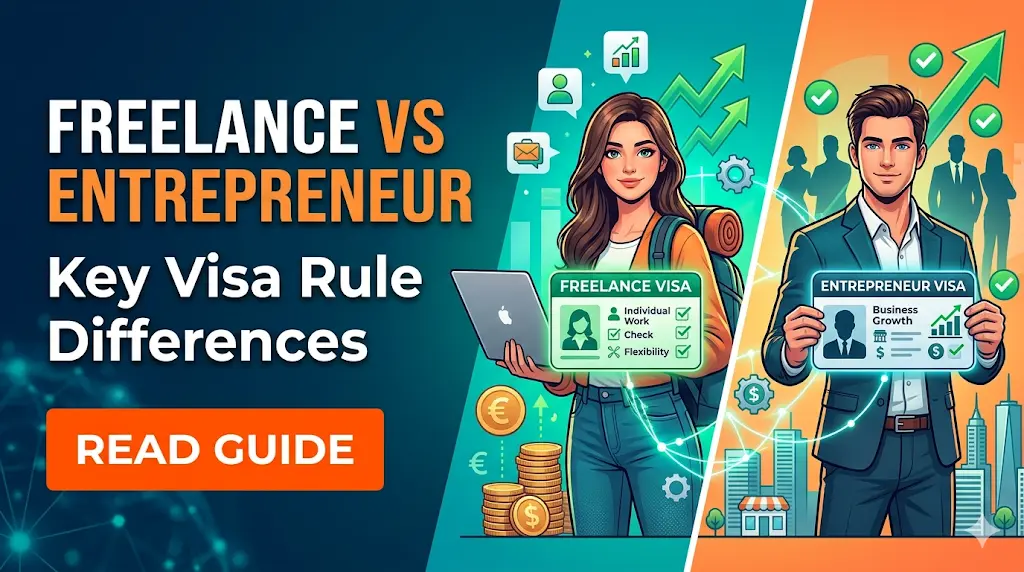
Visa Application Requirements and Regional Scrutiny
Because the economic impact of a freelance graphic designer is vastly different from an entrepreneur opening a manufacturing firm, the Ausländerbehörde (immigration office) treats these two visa applications with entirely different levels of scrutiny.
Proving Economic Need for Entrepreneurs
If you apply for an entrepreneur visa, you face an incredibly high burden of proof. The German state does not hand out commercial visas simply because you have a good idea. You must legally prove that your proposed business fulfills a specific regional economic interest or will have a positive impact on the local economy.
The immigration office will send your business plan to the local IHK and regional economic development boards for evaluation. They will scrutinize your business model, your target market, your hiring projections, and your capital investment. If your 30-page business plan and financial projections are written in English, the evaluation board will simply reject them. Utilizing Lingoking to translate your entire business plan into professional business German is absolutely essential. Because Lingoking uses certified native speakers with corporate expertise, your entrepreneurial vision is translated with the exact local terminology the IHK expects.
If your company has already been established abroad and you are bringing commercial registry documents to prove your corporate history, relying on Lingoking to provide legally sworn translations of those international corporate filings guarantees the German authorities will recognize them immediately.
Portfolios and Letters of Intent for Freelancers
Freelance visa applicants do not have to prove a massive regional economic impact or guarantee local job creation. Instead, the caseworker’s primary goal is to verify that your skills are genuine and that you will not end up relying on the German welfare system.
To prove this, you must submit a professional portfolio and, most importantly, Letters of Intent (Absichtserklärungen). These are non-binding letters from prospective German clients stating that they intend to hire you for your services once your visa is approved. Securing two or three strong letters from local German companies is usually the golden ticket to securing your Freiberufler visa. Navigating these specific document demands prevents the immediate administrative rejections discussed in Understanding the Different Types of German Visas and Residence Permits.
| Requirement | Freelancer (Freiberufler) | Entrepreneur (Gewerbe) |
| Legal Basis | Section 21 Paragraph 5 AufenthG | Section 21 Paragraph 1 AufenthG |
| Primary Approval Metric | Viability of self-support | Regional economic need & impact |
| Required Proof of Work | Letters of Intent from local clients | Comprehensive Business Plan |
| Trade Tax Liability | Exempt | Fully Subject to Gewerbesteuer |
| Chamber Membership | Not required (except specific chambers like medical/legal) | Mandatory IHK/HWK membership |
Surviving the Bureaucracy Health Insurance and Capital
Regardless of which self-employment path you take, you are entirely excluded from the protective umbrella of traditional German employment. You must independently solve the two biggest hurdles of expat life: proving your capital and securing health coverage.
Business Plans and Financial Proofs
Entrepreneurs must prove they have the physical capital required to launch their business. This means showing robust bank statements or signed venture capital agreements. However, freelancers are also subjected to intense financial scrutiny. The immigration office wants to see that you have enough savings to survive your first few months of building a client base.
In many municipalities, the caseworker will demand that a freelancer secure their first year of estimated living expenses in a blocked account, effectively treating them like an international student. If this happens, veteran expats immediately use Expatrio. Setting up a blocked account from a foreign country using legacy banks is agonizingly slow, but Expatrio allows you to open a fully compliant, government-approved blocked account digitally in days. Handing the caseworker your official Expatrio confirmation PDF proves your financial solvency instantly. Using Expatrio neutralizes the caseworker’s fear that you will run out of money, a strategy further detailed in Moving Money to Germany Declaring Savings and Large Transfers.
Additionally, if you are over the age of 45 and applying for either visa, you face a brutal extra hurdle: you must prove adequate retirement provisions. This usually requires showing a massive amount of liquid savings or a robust foreign pension plan to guarantee you will not become a burden on the state in your old age.
Securing Compliant Health Coverage
As a self-employed expat, you are not automatically enrolled in the statutory public health insurance system. In fact, public insurers frequently reject newly arrived freelancers and entrepreneurs because they cannot provide a local credit history or a guaranteed monthly income.
You cannot secure your residence permit without undeniably compliant health coverage. To bridge this terrifying gap, self-employed expats turn to Feather Insurance. Because Feather Insurance caters specifically to the unique needs of international workers, their digital platform allows you to secure comprehensive private coverage without navigating hostile German insurance brokers. Bringing a policy certificate from Feather Insurance to your visa appointment guarantees the caseworker will check the mandatory insurance box on your application. Furthermore, Feather Insurance offers specialized private policies designed for the fluctuating incomes of freelancers, ensuring your premiums remain manageable during lean months. Understanding how to legally structure your coverage outside of traditional employment is deeply analyzed in Public vs Private Health Insurance in Germany Which is Right for You?.
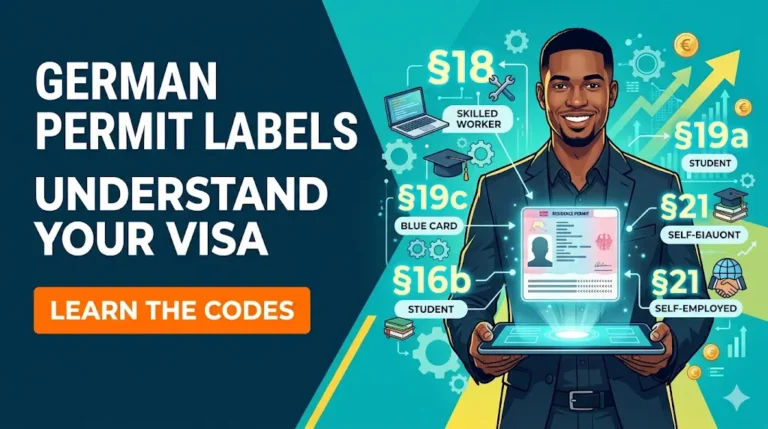
Once your business plan is approved, your capital is secured, and your health coverage is active, the immigration office will finally issue your plastic residence card. You must then meticulously check the supplementary green sheet to confirm whether you were granted a freelance or commercial title, a crucial verification step decoded in Understanding German Residence Permit Labels 18 19c etc. Mastering this vocabulary is the final step outlined in Understanding the German Immigration Terminology From Aufenthaltstitel to Niederlassungserlaubnis.
References
Primary sources official
- Make it in Germany – Visa for self-employment: The official federal government portal detailing the exact statutory requirements, capital expectations, and application steps for both freelancers and entrepreneurs under Section 21 of the Residence Act. https://www.make-it-in-germany.com/en/visa-residence/types/self-employment
- Gesetze im Internet – Aufenthaltsgesetz (AufenthG): The complete translated legal text of the German Residence Act. Section 21 explicitly details the distinct requirements for commercial self-employment (Paragraph 1) versus liberal professions (Paragraph 5). https://www.gesetze-im-internet.de/englisch_aufenthg/englisch_aufenthg.html#p0425
Other helpful sources
- IHK Berlin – Abgrenzung Gewerbe und freier Beruf: A highly detailed guide from the Berlin Chamber of Commerce and Industry explaining exactly how the tax office and local authorities draw the line between a commercial enterprise and a liberal profession. https://www.ihk.de/berlin/service-und-beratung/recht-und-steuern/gewerberecht/abgrenzung-gewerbe-freier-beruf-2253530
- Settle in Berlin – The Freiberufler Visa Guide: An incredibly practical, step-by-step expat guide explaining how to format Letters of Intent, prepare a freelance portfolio, and survive the immigration office appointment. https://www.settle-in-berlin.com/freelance-visa-germany/
Disclaimer
The information provided in this article is for general informational and educational purposes only and does not constitute professional legal, tax, or immigration advice. The distinction between a liberal profession (Freiberufler) and a commercial enterprise (Gewerbe) is highly complex and strictly enforced by the local immigration authorities (Ausländerbehörden) and the tax office (Finanzamt). Misclassifying your business activities can result in severe tax penalties, including retroactive trade tax (Gewerbesteuer) assessments, and the potential revocation of your residence permit. Always consult a certified German tax advisor (Steuerberater) and immigration lawyer before launching a business in Germany.