Getting Around Germany: Trains, Buses, Flights, and Car Hire
Standing on a platform in a secondary hub like Hamm or Mannheim, watching your connecting train pull away just as your delayed one arrives, is a rite of passage for every foreigner in Germany. I have spent countless hours pacing those concrete platforms, clutching a lukewarm coffee and wondering why the legendary German efficiency seems to vanish the moment you step onto a rail track. This guide is designed to help you navigate that chaos, providing the hard-won wisdom you need to master the German transit system without losing your mind.
Disclosure: This post may contain affiliate links. We may earn a commission at no extra cost to you if you make a purchase through these links. Read full disclosure.
The Backbone of German Travel The Deutsche Bahn
The Deutsche Bahn, or DB, is the massive entity that controls the vast majority of rail travel in the country. To the uninitiated, a train is just a train, but in Germany, the type of train you board determines everything from your arrival time to whether or not you are legally allowed to sit in that specific seat. Understanding the hierarchy of the German rail system is the first step toward becoming a savvy traveler.
Understanding ICE IC and Regional Trains
At the top of the food chain sits the Intercity-Express, or ICE. These are the sleek, white high-speed trains that can reach speeds of up to 300 km/h. They connect major metropolitan areas like Berlin, Hamburg, Munich, and Cologne with surgical precision—well, usually. When you book an ICE, you are paying for speed and a higher level of comfort. These trains feature a "Bordbistro" or "Bordrestaurant" where you can actually get a decent Schnitzel or a draught beer while flying through the countryside. If you are traveling across the country, this is almost always your best bet, provided you book in advance to avoid the astronomical last-minute prices.
Just below the ICE is the Intercity (IC) or Eurocity (EC). These are slightly older, slightly slower, and often much more charming. While the ICE usually stays on the high-speed tracks, the IC/EC might take more scenic routes, stopping at mid-sized cities. I personally love the EC trains that come in from neighboring countries like Austria or the Czech Republic; they often have a different aesthetic and sometimes even better food in the dining car. However, be aware that these trains are more prone to delays because they share tracks with slower regional traffic.
Then there are the regional trains: the Regional-Express (RE) and Regionalbahn (RB). These are the workhorses of the country. They stop frequently, they don't have fancy dining cars, and you cannot reserve a seat. If you are using the Deutschland-Ticket, these are the only trains you are allowed to board. They are perfect for day trips to smaller towns or reaching the outskirts of major cities where the high-speed lines don't go. Just remember that an RE is faster than an RB because it skips smaller stations; taking an RB for a long distance is a surefire way to spend your entire day looking at suburban train stations.
Mastering the DB Navigator App and Booking Strategies
If you live in Germany and don't have the DB Navigator app on your phone, you are effectively traveling in the dark ages. This app is surprisingly powerful, allowing you to see real-time platform changes, delay notifications, and even the "load factor" of a train (how crowded it is expected to be). I always recommend turning on the "notification" feature for your specific trip. There is nothing worse than sitting comfortably on a platform only to realize two minutes before departure that your train has been moved to a track on the other side of the station.
When it comes to booking, the "Sparpreis" (savings fare) is your best friend. These tickets are significantly cheaper but come with a major catch: "Zugbindung." This means you are legally tied to that specific train at that specific time. If you miss it, your ticket is essentially a piece of scrap paper. For more flexibility, you can buy a "Flexpreis" ticket, which allows you to take any train on that route for the day, but it will cost you nearly double. To find the best deals, I often use a comparison tool like Omio to see if the train is actually the most economical choice compared to a bus on that specific day.
One "pro tip" I always give newcomers is to always, always reserve a seat on long-distance trips. While it costs a few extra euros, the alternative is standing in the narrow corridor next to the toilets for a four-hour journey from Frankfurt to Berlin. In Germany, a seat might look empty, but check the little digital display above it. If it says "Berlin-München," someone has reserved it for that leg, and they will politely but firmly ask you to move the moment you get comfortable. Understanding How to Buy Deutsche Bahn Tickets and Save Money is essential for keeping your travel budget under control.
Dealing with Delays and Passenger Rights
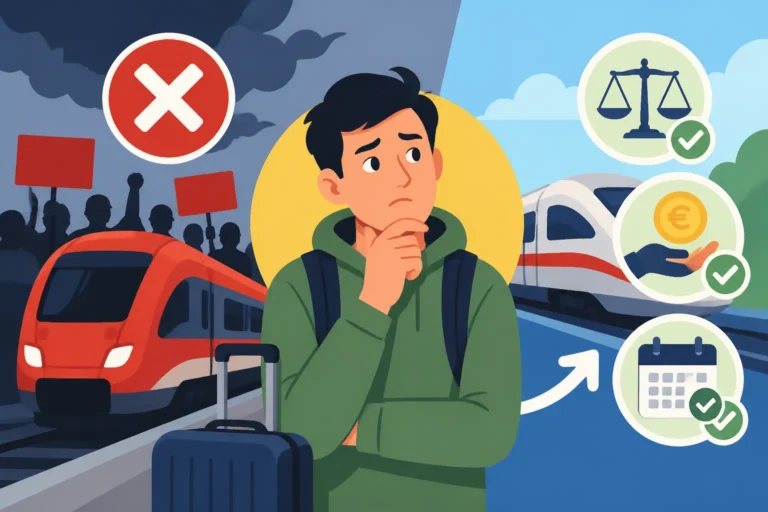
Despite the stereotype, German trains are often late. Construction on the aging rail network is a permanent fixture of life here. If your train is delayed by more than 20 minutes, the "Zugbindung" on your Sparpreis ticket is automatically lifted. This means you can hop on any other train—even a faster ICE—to get to your destination. It is one of the few silver linings of a delay. I once had a cheap regional ticket that turned into a luxury ICE ride because of a massive signal failure in Cologne.
If you arrive at your final destination more than 60 minutes late, you are entitled to a 25% refund of your ticket price. If it is more than 120 minutes, you get 50% back. You can claim this directly through the DB Navigator app with just a few taps. It won't give you back the hours of your life you spent in a cold station, but it might pay for your next dinner. Always make sure to document the delay; take a screenshot of the app showing the "Verspätung" (delay) just in case.
For those moments when the trains simply aren't running—whether due to a strike or a severe storm—don't panic. The "Reisezentrum" (travel center) at major stations will usually issue vouchers for taxis or even hotels if you are stranded overnight. I’ve seen expats get very aggressive at the counter, but in my experience, a calm "What are my options?" in basic German goes a lot further. Knowing How to Use the DB Navigator App in Germany will give you the real-time data you need to argue your case if things go sideways.
The Game-Changer The Deutschland-Ticket and Regional Transit
In May 2023, Germany introduced something that changed the lives of expats and locals alike: the Deutschland-Ticket, often called the 49-Euro Ticket. Before this, navigating the different "Verkehrsverbünde" (transit authorities) was a nightmare. Every city had its own zones, its own apps, and its own confusing ticket machines. Now, one monthly subscription covers almost everything regional.
How the 49-Euro Ticket Works
The Deutschland-Ticket is a monthly subscription that gives you unlimited access to all local and regional public transport across the country. This includes buses, trams, U-Bahns, S-Bahns, and even some ferries in places like Hamburg. The beauty of this ticket is the freedom it provides. You can wake up in Munich and decide to take a series of regional trains all the way to the Baltic Sea without ever buying another ticket.
However, there are rules. You cannot use it on ICE, IC, or EC trains. If you accidentally board a high-speed train with only a Deutschland-Ticket, the conductor will show you no mercy, and you will face a hefty fine plus the cost of a full-price ticket. Also, it is a subscription, not a one-time purchase. If you only want it for a month while you are visiting or moving, you must remember to cancel it by the 10th of the current month, or you will be charged for the next one automatically. This "hidden" subscription model has tripped up many of my friends who ended up paying for months they didn't use.
For most expats, this is the most cost-effective way to commute. If your office is in the city center and you live in a suburb, your monthly commute likely cost more than 49 euros before this ticket existed. Many employers even subsidize it, making it even cheaper. It is worth checking What Is the Deutschland-Ticket and Is It Worth It? to see if it fits your specific travel patterns.
Navigating City-Specific Networks U-Bahn S-Bahn Trams
Once you arrive in a city, you move from the national rail to the local network. The U-Bahn (Untergrundbahn) is the classic subway, mostly found in larger cities like Berlin, Munich, Frankfurt, and Hamburg. It is fast, frequent, and usually the most efficient way to cross the city center. The S-Bahn (Stadtschnellbahn) is a hybrid; it runs through the city center but also extends far out into the surrounding suburbs and neighboring towns.
In some cities, like Dresden or Leipzig, trams (Straßenbahn) are the primary mode of transport. There is something incredibly charming about gliding through a historic city center on a tram, but be careful when walking—they are surprisingly quiet and have the right of way. In western cities like Düsseldorf or Cologne, you will encounter the "Stadtbahn," which is a mix of a tram and a subway, often running underground in the center and on the streets in the outskirts.
One thing that confuses everyone is that there are no barriers at German stations. There are no turnstiles to go through. You just walk onto the platform and board the train. This leads some to believe that the transport is free. It is not. Plainclothes ticket inspectors (Kontrolleure) roam the cars, and if they catch you without a valid ticket (or an unvalidated one), you will be fined 60 euros on the spot. They don't care if you're a tourist; in fact, they’ve heard that excuse a thousand times. Make sure you understand the nuances of Getting Around German Cities: U-Bahn, S-Bahn, Trams, and Buses before you start your urban adventures.
Regional Transit Etiquette and Validation Rules
German public transport has an unwritten code of conduct. First, let people off the train before you try to get on. It sounds simple, but you will see people standing directly in front of the doors, blocking the flow. Second, keep the volume down. While Germans aren't always silent, loud phone conversations on speakerphone or playing music without headphones is considered extremely rude. If you are in a "Ruhebereich" (quiet zone) on a regional train, even whispering might earn you a "shush" from a grandmother in the next seat.
The most important technical detail is validation (Entwerten). In many cities, especially in the East and South, buying a ticket from a machine is not enough. You must stick the ticket into a small yellow or red box on the platform or inside the bus/tram to have a timestamp stamped onto it. If you have a ticket but it isn't stamped, it is considered invalid, and you will be fined. This is a common trap for newcomers.
Also, be aware of the "Kurzstrecke" (short trip) tickets. These are cheaper but only valid for a specific number of stops (usually three or four). If you stay on for five stops, you are "Schwarzfahren" (riding black/illegally). If you are ever in doubt, the DB Navigator app usually sells digital tickets that are pre-validated, which saves you the stress of finding the little stamp machine. For more details on city life, check out the Cycling in German Cities: Bikes and Bike-Sharing guide to see how to supplement your train travel with pedal power.
Long-Distance Buses The Budget-Friendly Alternative
Before 2013, long-distance buses were actually illegal in Germany to protect the state-run railway. Once the market opened up, the industry exploded. Today, buses are the primary way many students and budget-conscious expats move between cities. While they take longer than the train, the price difference can be staggering.
Why Choose Buses over Trains
The most obvious reason is the cost. While a last-minute train from Berlin to Prague might cost 80 euros, a bus might only be 20. If you are planning a trip on short notice, the bus is almost always the winner. Furthermore, buses often go to places that trains don't. If you are heading to a remote part of the Bavarian Forest or a specific town in the Harz Mountains, the train might require three changes, whereas a bus might be a direct shot.
Comfort levels have also improved significantly. Modern long-distance buses usually have reclining seats, decent legroom, Wi-Fi that actually works better than the train's, and power outlets at every seat. I often use Omio to compare the travel times; sometimes the bus is only 30 minutes slower but saves me 50 euros. That is a lot of extra money for beer and pretzels once you arrive.
However, the bus is subject to the whims of the Autobahn. Traffic jams (Staus) are a national pastime in Germany, especially on Fridays and Sundays. A four-hour bus ride can easily turn into a six-hour ordeal if there is an accident on the A8. If you have a flight to catch or a strict appointment, the train is generally more reliable, despite its own delay issues. You can read more about the specific operators in the Long-Distance Buses in Germany: FlixBus and Networks guide.
Major Routes and Station Logistics
The undisputed king of the road in Germany is FlixBus. Their bright green buses are everywhere. They have integrated almost every other smaller bus company into their network, making them a one-stop shop for bus travel. Their app is excellent and allows you to track your bus in real-time, which is essential because bus stations (ZOB – Zentraler Omnibusbahnhof) can be chaotic.
The ZOB in major cities like Berlin or Munich is often a bustling, somewhat gritty place located near the main train station. Unlike train platforms, bus bays can change at the last minute. You need to be at the station at least 15 minutes before departure to find your specific bay and load your luggage. Some drivers are very strict about the "one bag in the hold" rule, so check your booking carefully if you are moving house with multiple suitcases.
There are also international connections. You can easily hop on a bus in Frankfurt and wake up in Paris, Amsterdam, or Zurich. These "overnight" buses are a great way to save on a night’s accommodation, though your back might not thank you the next morning. If you are traveling with a lot of gear, some buses even have bike racks on the back, though these must be reserved well in advance.
Onboard Amenities and Comfort Expectations
Don't expect luxury, but do expect functionality. Most long-distance buses have a small toilet on board, though it is best used only in emergencies. The drivers usually take a 15-minute break every few hours at a "Raststätte" (highway service station). This is your chance to stretch your legs and buy overpriced snacks.
The Wi-Fi is usually "limited," meaning it’s fine for emails and WhatsApp but will throttle you if you try to stream 4K movies. I always recommend downloading your entertainment beforehand. Also, bring a portable power bank just in case the seat's outlet isn't working—it happens more often than it should.
One thing to keep in mind is the "seat neighbor" lottery. Buses are often packed to capacity. If you want a bit more space, some companies allow you to book the seat next to you for a small fee, or you can opt for "Panorama" seats at the front for a better view. For those who prefer more independence, you might consider Renting a Car and Driving on the Autobahn as a more flexible alternative to the bus.
Comparison of Major Transport Modes
| Feature | ICE Train | Long-Distance Bus | Rental Car |
|---|---|---|---|
| Speed | Fastest (up to 300 km/h) | Slowest (subject to traffic) | Moderate to Fast |
| Cost | High (Low if booked early) | Lowest | High (Fuel + Rental + Parking) |
| Flexibility | Fixed Routes/Times | Fixed Routes/Times | High (Go anywhere, anytime) |
| Comfort | High (Dining car, space) | Moderate (Cramped seats) | High (Private space) |
| Reliability | Moderate (Delays common) | Low (Traffic dependent) | Moderate |
| Eco-Friendly | Best Option | Good | Low |
Driving in Germany The Autobahn Experience and Car Hire
For many, the idea of driving in Germany conjures up images of Ferraris flying down the Autobahn at 200 km/h. While that does happen, the reality of driving here is a bit more regulated and, at times, frustrating. However, if you want to explore the "Romantische Straße" or the hidden valleys of the Moselle, a car is indispensable.
Renting a Car Requirements and Hidden Costs
Renting a car in Germany is straightforward if you have the right documents. You generally need a valid driver’s license (if it’s not in English or German, get an International Driving Permit), a passport, and a credit card. Be warned: many German rental agencies are hesitant about debit cards, and they will block a significant deposit on your credit card for the duration of the rental.
The price you see on a booking site like Booking.com is often just the beginning. In Germany, insurance is a big deal. The "Vollkasko" (CDW) usually has a high deductible (Selbstbeteiligung) of 1,000 euros or more. I always recommend getting the "zero-deductible" insurance for peace of mind. German parking spaces are notoriously tight, and a small scratch on a bumper can cost you hundreds of euros if you aren't fully covered.
Also, consider the "Winterreifen" (winter tires). From October to April, Germany has a "situational" winter tire law. If it's icy or snowy and you have summer tires on, your insurance is void and you'll be fined. Rental companies sometimes charge an extra "winter fee" to ensure the car is properly equipped. Finally, check if your car is manual or automatic. In Germany, manual is still the default. If you can only drive automatic, you must specify this, and it will likely cost more.
The Reality of the Autobahn No Speed Limit
Yes, there are sections of the Autobahn with no speed limit (indicated by a white circular sign with five diagonal black lines). However, about 40% of the network has a permanent limit, and much of the rest is covered in temporary electronic signs. If the sign says 120, do not go 121. German speed cameras (Blitzer) are often hidden and very precise.
The most important rule on the Autobahn is the "Rechtsfahrgebot." You must stay in the right lane unless you are actively overtaking. The left lane is for passing only. If you sit in the middle or left lane while the right lane is empty, you will quickly find a BMW or Mercedes inches from your rear bumper, flashing their lights. This is not just aggression; it’s the German way of saying "You are violating the traffic order."
Always keep an eye on your mirrors. You might be going a respectable 140 km/h, but someone will appear out of nowhere going 220 km/h. Signal your intentions early, and never, ever pass on the right—it is strictly illegal and extremely dangerous. If you are a bit nervous about this, read up on Renting a Car and Driving on the Autobahn for a more detailed breakdown of the rules.
City Driving and Parking Challenges
Driving in a German city center is something I avoid whenever possible. Between the one-way streets, the trams that seem to come from every direction, and the aggressive cyclists, it is a recipe for stress. Many German cities also have "Umweltzonen" (Environmental Zones), which require your car to have a green sticker (Feinstaubplakette) on the windshield proving it meets emissions standards. Most rental cars have this, but if you are driving your own car from abroad, you need to buy one at a gas station or TÜV office.
Parking is another hurdle. "Parkhaus" (parking garages) are your safest bet, but they are expensive. On-street parking often requires a "Parkscheibe"—a little blue plastic clock you set to your arrival time and place on your dashboard. If you don't have one, you will get a "Knöllchen" (parking ticket). In some areas, parking is only for residents with a specific permit (Anwohnerparken).
Navigating the city is much easier if you use an app like Google Maps or Waze, which are generally accurate with traffic data. However, be aware that using your phone while the engine is running—even at a red light—can result in a heavy fine and points on your license. If you're heading to a major city like Frankfurt, check How to Get From Frankfurt Airport to the City Center for the best non-car options.
Domestic Flights When Does Flying Make Sense
Germany is a relatively compact country with an incredible rail network, so flying domestically is often frowned upon for environmental reasons. However, there are times when it simply makes the most sense, especially if you are traveling between the far corners of the country like Hamburg and Munich.
Major Airport Hubs and Connections
The big two are Frankfurt (FRA) and Munich (MUC). Frankfurt is one of the busiest airports in the world and acts as the primary hub for Lufthansa. If you are flying into Germany from outside Europe, this is likely where you will land. Munich is the sleek, modern alternative, consistently voted one of the best airports in the world.
Other significant airports include Berlin Brandenburg (BER)—which took a decade too long to build but is now fully functional—Düsseldorf (DUS), and Hamburg (HAM). If you are flying domestically, you are usually looking at Lufthansa or its budget subsidiary, EuroWings. These flights are often very short—sometimes only 45 to 60 minutes in the air—but once you add in the time to get to the airport, security, and boarding, the train is often just as fast for distances under 500 km.
Booking sites like Booking.com can help you find flight deals, but always compare them with the ICE train travel time. For example, the train from Berlin to Munich now takes just under four hours thanks to a high-speed line. Once you factor in the commute to BER and from MUC into the city, the plane offers almost no time advantage.
Balancing Time vs Sustainability
In Germany, there is a strong cultural push toward "Klimaschutz" (climate protection). Taking a short-haul flight when a train is available is often seen as socially irresponsible. Many German companies have even banned employees from flying domestically if the train journey is under five hours.
That said, if you are a freelancer or a tourist with limited time, a 60-euro flight from Cologne to Berlin might be tempting compared to a 100-euro train ride that takes five hours. Just be aware of the "extra" costs of flying. German airports are rarely in the city center. The S-Bahn from Munich airport to the city takes 45 minutes and costs around 13 euros. These costs add up.
Connecting to Public Transport from the Airport
German airports are masterfully integrated with the rail system. Frankfurt Airport has two train stations: one for regional trains (Regionalbahnhof) and one for long-distance ICE trains (Fernbahnhof). You can literally step off a plane from New York and be on a high-speed train to Stuttgart in less than 30 minutes.
At Berlin Brandenburg (BER), the train station is directly under the terminal. You can take the "Airport Express" (FEX) or the S-Bahn straight into Alexanderplatz. This seamless integration is one of the things I love most about living here. You never feel "stranded" at an airport. Always check the local transport app or the DB Navigator for the best connection. If you are landing in the capital, How to Get From Berlin Brandenburg Airport to the City will be your most important resource.
Practical Planning Tools and Comparison Resources
To truly master getting around Germany, you need to use the right tools. I don't just rely on one app; I cross-reference everything to ensure I'm getting the best balance of price and convenience.
Comparing All Transport Modes at Once
I always start my planning with Omio. It is one of the few platforms that successfully integrates Deutsche Bahn, FlixBus, and major airlines into a single search result. It allows you to see side-by-side whether the train, bus, or plane is faster or cheaper. For an expat who is still learning the nuances of the different systems, having it all in English is a massive relief.
Another great tool is "Google Maps" for local transit. While DB Navigator is better for trains, Google Maps is surprisingly good at figuring out which bus or tram you need to take to get to a specific restaurant or doctor's office. It even shows you the "live" location of buses in many German cities now.
Accommodation and Activity Integration
When I travel within Germany, I use Booking.com to find hotels that are close to the "Hauptbahnhof" (main station). In Germany, the area around the station can be a bit busy, but it saves you from hauling luggage across cobblestone streets. Look for "Gästehäuser" or "Pensionen" for a more authentic, local feel than a standard chain hotel.
For activities, I highly recommend GetYourGuide. Since they are headquartered in Berlin, their coverage of Germany is phenomenal. Whether you want a guided tour of the Reichstag or a boat cruise on the Rhine, they have everything vetted and in English. I once used them to book a "hidden courtyards" tour in Berlin that took me to places I never would have found on my own in five years of living there.
Final Advice for the Expat Traveler
Don't be afraid to make mistakes. You will board the wrong train, you will forget to validate a ticket, and you will definitely get stuck in a "Stau" on the Autobahn at least once. It's all part of the experience. The key is to stay informed, keep your apps updated, and always have a backup plan. Germany's transport system is a marvel, even when it's frustrating, and once you learn how to play the game, the whole of Europe is at your doorstep.
Disclaimer
This guide is for informational purposes only. Transportation rules, prices, and schedules in Germany are subject to change by the respective authorities and private companies. Always verify current requirements and travel conditions on official websites before your journey.