Germany’s Regions and Where to Go: A Traveler’s Overview
Trying to plan a trip to Germany often feels like trying to solve a Rubik's cube while standing on a moving U-Bahn train. I once made the classic mistake of thinking I could "do" Berlin, Munich, and the Black Forest in a single four-day weekend, only to realize I’d spent more time staring at the back of a train seat than actually seeing a castle. This guide breaks down Germany's massive regional diversity into manageable chunks so you can actually enjoy your coffee instead of rushing to the next platform.
Disclosure: This post may contain affiliate links. We may earn a commission at no extra cost to you if you make a purchase through these links. Read full disclosure.
Northern Germany: Maritime Heritage and the Great Wind-Swept Plains
When people think of Germany, they often default to the leather trousers and rolling hills of the south. But the North is a completely different beast, characterized by its "Moin Moin" greetings, brick gothic architecture, and a bracing breeze that will make you rethink your choice of light jacket. I remember my first winter in the north; the damp cold doesn't just sit on you, it explores your soul. However, the reward for braving the weather is a region of understated elegance and incredible maritime history.
Hamburg: The Gateway to the World
Hamburg isn't just a city; it’s a state of mind. As a resident expat, I’ve learned that the locals take immense pride in their status as a "Free and Hanseatic City." The harbor is the literal and metaphorical heart of the city. You haven't truly seen Hamburg until you've taken a ferry ride at dawn or explored the Speicherstadt, the world's largest warehouse district built on oak logs. It’s hauntingly beautiful at twilight when the red bricks glow under the streetlights.
Beyond the water, Hamburg offers a grit that balances its immense wealth. The Reeperbahn is famous for its nightlife, but if you look closer, the side streets are filled with tiny galleries and independent coffee roasters. For a place to stay, I usually check Booking.com for boutiques in the Sternschanze neighborhood, which is far more local and "alternative" than the polished city center. It’s the kind of place where you can find a world-class flat white and a punk rock vinyl store within ten feet of each other.
The Baltic and North Sea Coasts
If you keep heading north, you hit the coastlines. The North Sea side is famous for the Wadden Sea, a UNESCO World Heritage site where the tide recedes so far you can actually hike on the ocean floor. It is a surreal experience, though I highly recommend hiring a guide so you don't get trapped by the incoming tide—a mistake more than one tourist has made. The islands like Sylt are the Hamptons of Germany, full of thatched-roof houses and expensive champagne.
On the other hand, the Baltic coast (Ostsee) is calmer and feels like stepping back into the early 20th century. Islands like Rügen are famous for their white chalk cliffs and historic seaside resorts. You will see "Strandkörbe"—those iconic hooded beach chairs—everywhere. They are essential because the wind is relentless. If you are looking for a quieter, more "slow travel" experience, this is the region for you. It’s where Germans go to recover from the stress of the city, and the pace of life reflects that.
Bremen and the Hanseatic Soul
Bremen is often overlooked in favor of its larger neighbor, Hamburg, but that is a mistake. The city feels more intimate and accessible. The Schnoor district is a medieval maze of tiny houses that look like they were built for hobbits. I once spent an entire afternoon just getting lost there, stopping for "Klaben" (a rich fruit bread) in a bakery that looked like it hadn't changed since the 1700s.
The Hanseatic influence is visible in the massive Town Hall and the statue of Roland, symbols of the city's historical independence. For those moving between these northern hubs, using Omio is a lifesaver for comparing the regional trains against the faster ICE lines. Sometimes the regional train takes an extra hour but saves you fifty Euros, which buys a lot of seafood in the Bremen market square.
Eastern Germany: Prussian History and the Resurgence of Cool
Traveling through Eastern Germany is a lesson in layers. You have the weight of Prussian history, the scars of the Cold War, and a modern, vibrant energy that is particularly visible in its younger populations. Since the reunification, the "New States" have undergone a massive transformation. For an expat, this region offers some of the most fascinating cultural deep-dives you can find in Europe.
Berlin: The Ever-Changing Capital
Berlin is a city that refuses to be one thing. Every neighborhood, or "Kiez," feels like a different country. From the posh villas of Charlottenburg to the graffiti-drenched streets of Kreuzberg, the city is a patchwork. When friends visit, I always tell them to read up on Berlin for First-Time Visitors: Neighborhoods and Highlights because you can easily spend your whole trip in the wrong part of town for your personality.
The history here is unavoidable. Standing at the Brandenburg Gate or walking through the Holocaust Memorial is a heavy experience, but it’s part of the city’s DNA. Berlin doesn’t hide its past; it confronts it. However, don’t spend all your time at museums. The real Berlin is found in the "Späti" culture—buying a beer at a late-night convenience store and sitting on a canal bridge at sunset. It’s a city that values freedom above almost everything else.
Saxony: Dresden and Leipzig
Dresden is often called the "Florence on the Elbe," and for good reason. The skyline, with the Frauenkirche and the Zwinger Palace, is one of the most beautiful in the world. It’s hard to believe that much of this was piles of rubble after 1945. The reconstruction is a testament to the city’s resilience. If you want a more guided experience of the art galleries, I’d suggest checking GetYourGuide for a tour of the Green Vault—the wealth on display there is truly staggering.
Leipzig, meanwhile, is often dubbed "the new Berlin." It’s grittier, cheaper, and arguably more creative right now. It has a massive classical music heritage—Bach spent much of his life here—but today, it’s the old industrial spinning mills (the Spinnerei) turned into art complexes that draw the crowds. It feels like a city on the verge of something big, and the energy in the student-heavy Plagwitz district is infectious.
The Spree Forest: A Cultural Pocket
Just an hour south of Berlin lies the Spreewald, a labyrinth of canals and ancient forests. This is home to the Sorbs, a Slavic minority with their own language and traditions. I love coming here when the chaos of Berlin becomes too much. You can rent a canoe and paddle through the forest, stopping at "pickle stands" along the water. Yes, pickles. The Spreewald gherkin is a protected regional specialty, and they are surprisingly delicious when eaten fresh from a barrel.
It’s a place where life moves at the speed of a paddle. You will see traditional wooden houses and maybe even a postman delivering mail by boat. For an expat, it’s a reminder that Germany is far more than just its major cities. It is a collection of these tiny, preserved pockets of culture that have survived against the odds.
Southern Germany: The Land of Alps and Fairy Tales
This is the Germany of postcards. If you want mountains, castles, and people singing in beer halls, you head south. But as someone who has lived here, I can tell you there is a lot of nuance behind the stereotype. The south is wealthy, traditionally conservative, and fiercely proud of its regional identity.
Bavaria: Mountains and Monarchy
Bavaria is almost a country within a country. They have their own dialect, their own customs, and a very specific "Mia san Mia" (we are who we are) attitude. Munich is the shining star here, a city that feels like a village of 1.5 million people. It is clean, safe, and expensive. If you are planning a trip, definitely look into Bavaria for Travelers: Munich, the Alps, and Beyond to understand how to balance the city sights with the natural beauty of the nearby Tegernsee or Garmisch-Partenkirchen.
Then, of course, there are the castles. Neuschwanstein is the big one, the inspiration for Disney’s castle. It is beautiful, but a resident’s tip: the view from the Marienbrücke is better than the tour inside. The interior was never actually finished because King Ludwig II ran out of money (and sanity). Still, standing in the foothills of the Alps, looking up at that white limestone fortress, you can’t help but feel the "Gemuetlichkeit" that the Bavarians talk so much about.
Baden-Württemberg and the Black Forest
To the west of Bavaria lies Baden-Württemberg, the home of Porsche, Mercedes-Benz, and the legendary Black Forest. The forest isn't just a woods; it’s a dense, dark, and magical region of steep valleys and high-altitude meadows. I highly recommend staying in a traditional "Gasthof" in a town like Triberg or Gengenbach. You can find these easily on Booking.com, and they often come with a breakfast spread that will keep you full until dinner.
For a deeper look at the local life, check out The Black Forest: Villages, Trails, and Cuckoo Clocks. The region is famous for its precision engineering, which extends from cars to the intricate cuckoo clocks. But the real draw is the hiking. The air in the Black Forest feels different—cleaner, crisper. After a long hike, there is nothing better than a slice of authentic Black Forest cake, which, by law, must contain a significant amount of Kirschwasser (cherry schnapps).
Lake Constance: The Three-Country Sea
The Bodensee (Lake Constance) is a massive lake that borders Germany, Austria, and Switzerland. It’s the Mediterranean of the North. The climate is mild enough that they grow flowers and grapes on the islands. Mainau, the "Flower Island," is a must-visit in the spring. The town of Lindau, located on an island in the lake, has a harbor entrance guarded by a massive lion statue and a lighthouse—it is one of the most picturesque spots in the entire country.
Life on the lake is about leisure. You can take a ferry from Germany to Switzerland just for lunch. For an expat, it’s a great example of the seamless borders of the EU. If you’re traveling around the lake, I’d suggest using Omio to check the catamaran schedules versus the train lines, as the boat is often the more scenic and relaxing way to get between Konstanz and Friedrichshafen.
Western Germany: The Rhine Valley and the Industrial Heart
Western Germany is where the old world of wine and castles meets the new world of industry and modern art. The Rhine River is the lifeblood of this region, serving as both a historical border and a vital transport route.
The Rhineland: Cologne and the Carnival
Cologne is a city with a soul. The people here are known for being the friendliest in Germany—more open and talkative than the stereotypical "stern German." The Cologne Cathedral (Kölner Dom) is the first thing you see when you step out of the train station, and it is genuinely breath-taking. It took over 600 years to build, and you can feel every second of that history in its cold stone.
If you visit in February, you will experience the madness of Carnival. The entire city shuts down, everyone puts on a costume, and people drink "Kölsch" (the local beer) in the streets. It is chaos, but a very organized German kind of chaos. For a more sober look at the region’s history, I often recommend The Rhine Valley: Castles, Wine, and River Towns. The section of the Rhine between Mainz and Bonn is a UNESCO site because it has the highest concentration of castles in the world.
The Moselle Valley: Vineyards and Steep Slopes
While the Rhine is grand, the Moselle is intimate. The river twists and turns through narrow valleys where the vineyards are so steep that workers have to use mountain-climbing gear to harvest the grapes. This is the home of German Riesling. Towns like Cochem and Bernkastel-Kues look like they were pulled straight from a Brother’s Grimm story.
I once spent a week here during the autumn harvest, and the smell of fermenting grapes hangs in the air of every village. It’s a great region for cycling, as the paths along the river are flat, even if the hills around you are not. You can book wine tasting tours via GetYourGuide to ensure you get a spot at the smaller, family-run estates that might not have a formal "tasting room" open to the public.
The Ruhr Area: From Coal to Culture
The Ruhr area was once the industrial engine of Europe, a landscape of coal mines and steel mills. Today, it’s one of the most interesting examples of urban renewal. The Zeche Zollverein in Essen, once the world’s largest coal mine, is now a massive museum and art complex. They’ve turned old gas tanks into diving pools and cooling towers into climbing walls.
It’s not "pretty" in the traditional sense, but it is fascinating. The cities of Dortmund, Essen, and Bochum flow into one another, forming a massive polycentric metro area. For expats interested in Castles, History, and Architecture in Germany, the Ruhr offers a unique "industrial heritage" perspective that you won't find in the medieval towns of the south.
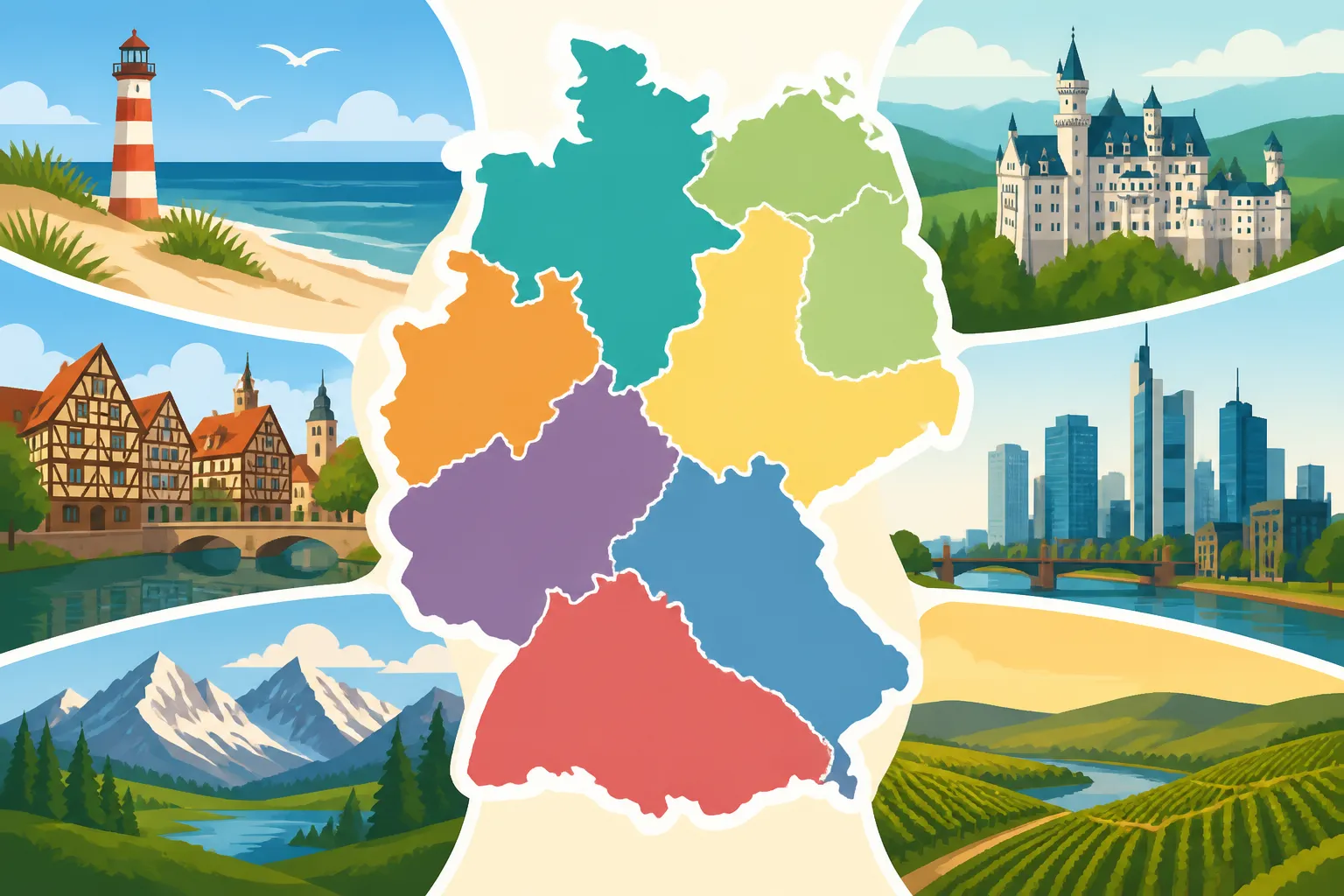
Comparison of German Regions
| Region | Primary Vibe | Signature Dish | Best For | Hub City |
|---|---|---|---|---|
| North | Maritime & Understated | Fischbrötchen | Coastal air & History | Hamburg |
| East | Creative & Historic | Currywurst | Urban cool & Culture | Berlin |
| South | Alpine & Traditional | Schweinebraten | Nature & Fairy tales | Munich |
| West | Jovial & Industrial | Himmel un Ääd | Wine & Festivals | Cologne |
| Central | Fairy Tale & Forested | Ahle Wurst | Hiking & Mythology | Frankfurt |
Central Germany: The Intellectual and Fairy Tale Heart
Central Germany—specifically Hesse and Thuringia—is often the part people drive through to get somewhere else, which is a tragedy. This is the land of the Brothers Grimm and the intellectual center where Goethe and Schiller changed the course of European literature.
Hesse: Skyscrapers and Cider
Frankfurt is the gateway for most international travelers, and it is the only German city with a genuine skyscraper skyline. It’s a financial powerhouse, but if you step away from the banks, you find the "Ebbelwoi" (apple wine) taverns in Sachsenhausen. This cider is an acquired taste—sour, tart, and usually served in a "Bembel" (a blue-and-white stoneware jug).
North of Frankfurt, the landscape turns into the rolling hills of the Grimm brothers' tales. Towns like Marburg and Kassel are steeped in folklore. In Kassel, the Bergpark Wilhelmshöhe is a stunning park with a massive statue of Hercules overlooking the city. It’s a great place to burn off a heavy German lunch, and you can usually find great apartment stays on Booking.com that overlook the park.
Thuringia: The Green Heart
Thuringia is often called the "Green Heart" of Germany. It is home to the Thuringian Forest and cities like Weimar and Erfurt. Weimar is particularly special; it’s where the German Enlightenment happened. Walking through the park on the Ilm, you can visit Goethe’s garden house. It’s a small, humble place that makes you realize how much the environment influences thought.
Erfurt, the state capital, has one of the best-preserved medieval city centers in Germany. The Krämerbrücke is a bridge lined with inhabited houses and shops, similar to the Ponte Vecchio in Florence but with a distinctively German half-timbered aesthetic. For transport within this central belt, I find Omio to be the best for catching the smaller regional bus lines that connect the mountain villages where trains don't always go.
Practical Survival Tips for Your Travels
Before you head out to explore these regions, there are a few "expat-learned" realities you need to accept. German efficiency is real, but it’s also very traditional.
Cash is King (Mostly)
Even today, the struggle with Cash vs Card in Germany: What Visitors Should Know is a daily reality. In Berlin, many "cool" bars are cash-only. In small Bavarian villages, the local bakery might look at your credit card like it’s an alien artifact. Always carry at least 50 Euros in cash. It saves you the embarrassment of having to leave your ID at a restaurant while you hunt for an ATM.
The Sunday Silence
Sundays are sacred. Almost every supermarket and shop in the country is closed. If you don't plan your grocery shopping on Saturday, you’ll be eating at a gas station or a train station on Sunday. This is part of the German commitment to work-life balance, but it can be a shock for travelers. Use your Sundays for hiking or visiting museums, which are usually open.
Dining and Social Etiquette
When you sit down at a restaurant, don’t wait for a host to seat you unless there is a sign. Usually, you just find a free table. And when it comes to the bill, tipping isn't the 20% madness of the US. Check Tipping in Germany: When, Where, and How Much for the specifics, but generally, rounding up or adding 5-10% is the norm. Also, when you toast, make eye contact. If you don't, legend says you’ll have seven years of bad luck in your love life. The Germans take their eye contact very seriously.
Getting Around: A Resident's Guide to Transport
Navigating Germany is easy once you understand the hierarchy of the system.
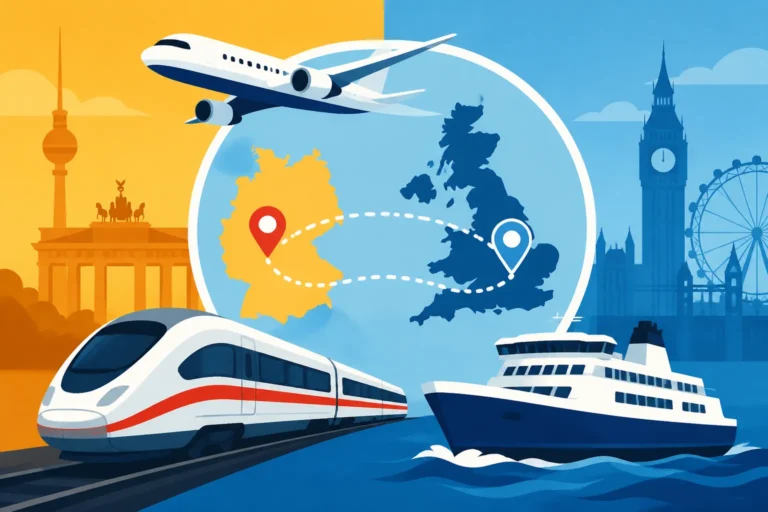
- The ICE (InterCity Express): These are the high-speed white trains with the red stripe. They are comfortable, have Wi-Fi (usually), and are the best way to get between major hubs like Hamburg and Munich. Read High-Speed Trains in Germany (ICE): Deutsche Bahn Routes and Savings to learn about "Sparpreis" tickets—if you book early, you can save a fortune.
- Regional Trains: These are the red trains. They are slower but reach every tiny village. If you have time, the Regional Trains and the Deutschland-Ticket Explained guide is essential. For 49 Euros a month, you can take unlimited regional transport across the whole country. It’s the best deal in Europe.
- The Autobahn: If you rent a car, remember that "no speed limit" only applies to certain sections. When there is a limit, the cameras are everywhere. Also, stay out of the left lane unless you are overtaking. There is always someone in a black Audi who wants to go 220 km/h, and they will be behind you in a heartbeat.
For a smooth trip, I always tell people to check Staying Safe in Germany: Common-Sense Tips for Travelers. While Germany is very safe, pickpockets love crowded train stations, and knowing the German Social Etiquette for Visitors: Greetings and Punctuality will help you blend in and get better service from the locals.
Culinary Regionalism: What to Eat Where
You cannot say you’ve been to Germany if you’ve only eaten bratwurst. Every region has a specialty that locals will defend with their lives.
- North: Try the "Labskaus." It looks like a pink mash (beets, potatoes, corned beef) topped with a fried egg and herring. It sounds terrifying, but sailors have eaten it for centuries for a reason—it’s pure energy.
- East: You have to try "Königsberger Klopse"—meatballs in a white caper sauce. And of course, the Sausages and Street Food in Germany (Currywurst and More) in Berlin is a rite of passage.
- South: Go for the "Kässpätzle." It’s the German version of mac and cheese but better, made with fresh egg noodles and mountain cheese. Pair it with a liter of local brew after reading German Beer Culture: Styles, Beer Gardens, and Breweries.
- West: In the Rhineland, ask for "Himmel un Ääd" (Heaven and Earth)—mashed potatoes and apples served with black pudding. It’s the perfect comfort food for a rainy day.
Disclaimer
The information provided in this guide is based on personal experience and current travel conditions in Germany. Regulations, prices, and opening hours can change. Always check official government websites or local tourism boards before finalizing your travel plans. This guide is for informational purposes only.