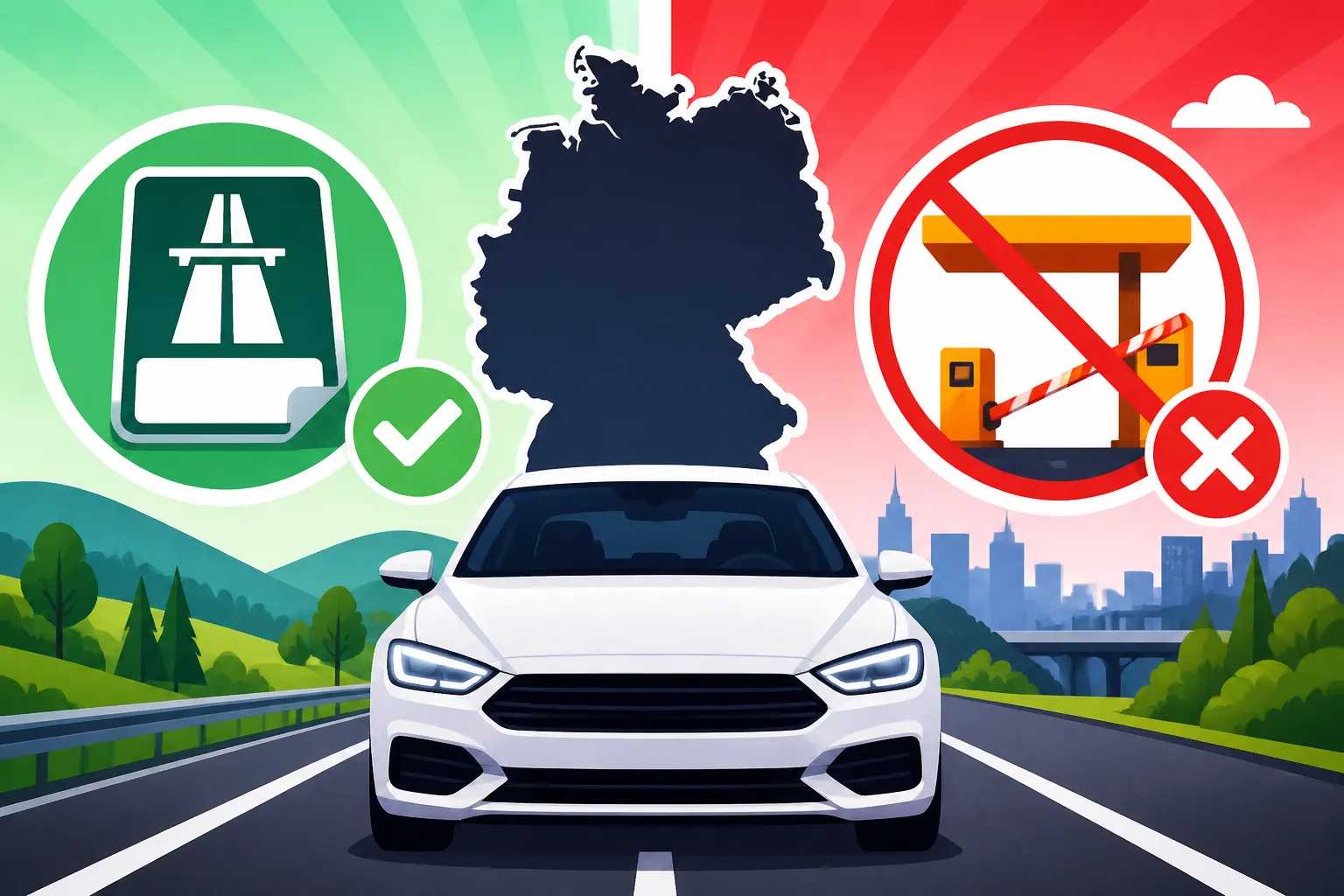
Do You Need a Vignette or Toll to Drive in Germany?
You've just moved to Germany, or maybe you're planning an epic road trip through this beautiful country, and a question inevitably pops into your mind: "Do I need one of those pesky vignettes, or are there tolls I need to worry about?" Believe me, it's a completely valid concern. Many of Germany's neighbors rely on them, and the thought of accidentally incurring a hefty fine for missing a sticker or a toll booth can be a real headache. Well, let's clear up this particular piece of German bureaucracy together so you can hit the road with confidence. This guide will walk you through everything you need to know about driving on German roads, including the surprising truth about tolls and vignettes for passenger cars, and what to watch out for if you're venturing beyond Germany's borders.
Disclosure: This post may contain affiliate links. We may earn a commission at no extra cost to you if you make a purchase through these links. Read full disclosure.
The Short Answer: Do You Need a Vignette for Germany?
One of the first things that often catches expats and tourists off guard when they start planning a German road trip is the absence of a familiar system found in so many other European countries. Let's get straight to it:
The Good News for Most Drivers
For the vast majority of drivers in Germany, specifically those in passenger cars (that's cars, motorcycles, and small vans under 3.5 tonnes), you can breathe a sigh of relief. Germany does not require a vignette or a general road toll for its extensive network of Autobahnen (motorways) and Bundesstraßen (federal highways). This is a huge relief for many, especially if you've previously navigated the sticker systems of Austria or Switzerland. You won't need to stop at a petrol station near the border to buy a little decal for your windscreen, nor will you see electronic gantries deducting money from your account as you zip along the Autobahn. The German government, after much debate over the years, decided against implementing such a system for private vehicles.
This unique approach means you can generally enjoy the famed German Autobahn, with its stretches of unrestricted speed limits (where indicated, of course!), without the added cost or complexity of a national toll system for your personal vehicle. It’s a definite perk, making spontaneous road trips or cross-country commutes much simpler from a financial and administrative perspective.
Where Vignettes Are Required and Why Germany is Different
The concept of a vignette is essentially a time-based road tax paid in advance for the right to use a country's motorways and expressways. You purchase a physical sticker (or sometimes an digital version), display it, and you're good to go for a set period. Countries like Austria, Switzerland, the Czech Republic, Slovakia, and Slovenia all operate on a vignette system. If you plan a trip from Germany into these countries, you absolutely need to acquire their respective vignettes before crossing the border to avoid steep fines.
Germany's decision to forgo a national vignette for passenger cars stems from several factors, including strong public opposition, concerns about the administrative burden, and complex legal challenges related to potential discrimination against non-German drivers. Historically, the maintenance and construction of German roads have been primarily funded through general taxation and fuel duties. While there have been political discussions about introducing a Pkw-Maut (car toll) for passenger vehicles, particularly for foreign-registered cars, these plans faced significant hurdles and were ultimately scrapped. So, for now, if you're driving your personal car in Germany, you can enjoy the roads without worrying about a vignette.
Understanding Toll Roads in Germany: Not What You Expect
While the national vignette is a no-show for passenger cars, what about other types of tolls? The idea of a "toll road" can mean different things in different countries, and Germany has its own specific, albeit limited, interpretations.
The LKW-Maut: Commercial Vehicles Only
Here's where things get interesting and sometimes confusing for newcomers. Germany does have a comprehensive toll system, but it's exclusively for heavy goods vehicles (LKW in German, meaning trucks) that weigh 7.5 tonnes or more. This system is known as the LKW-Maut.
The LKW-Maut was introduced to ensure that large commercial vehicles contribute fairly to the wear and tear of the road infrastructure and to account for their environmental impact. This isn't a simple sticker system; it's a sophisticated electronic toll collection system that tracks trucks' movements on motorways and federal roads. Trucks are equipped with an On-Board Unit (OBU) that automatically records their distance travelled, or drivers can manually declare their routes. The toll costs vary depending on the distance driven, the number of axles on the vehicle, and its emission class.
So, if you're driving a standard passenger car, a campervan that's under 7.5 tonnes, or a regular moving truck for personal use that's below this weight threshold, the LKW-Maut is absolutely not something you need to worry about. It's strictly for commercial haulage. This distinction is crucial and often misunderstood by those not familiar with German road laws.
Private Toll Roads and Special Cases
Now, while the vast majority of German roads are toll-free for passenger cars, there are a couple of very rare exceptions in the form of privately operated tunnels or access roads. These are not part of the national Autobahn or Bundesstraße network and operate more like a private business charging for a specific service. They are few and far between, so you're unlikely to stumble upon them by accident unless you're heading to a very specific destination.
The most prominent examples include:
- Warnowtunnel (Warnow Tunnel) in Rostock: This tunnel connects the western and eastern banks of the Warnow river in Rostock, a city in northern Germany. It's a convenient shortcut, especially if you're heading to or from the Baltic Sea coast. You pay a fee directly at the toll plaza, and the prices can vary slightly depending on the season and time of day. You can pay by cash or card.
- Herrentunnel (Herren Tunnel) in Lübeck: Also in northern Germany, near the city of Lübeck, this tunnel crosses the Trave river. Similar to the Warnowtunnel, it's a private toll road offering a bypass. You pay directly at the entrance.
These isolated cases are clearly signposted, so you won't be caught off guard. You'll approach a toll booth (Mautstelle) much like you would in other countries, where you can pay with cash or a card. These are not part of a broader German toll system but rather user fees for specific infrastructure projects. For most travel, especially if you stick to the main road networks, you will never encounter them.
Driving Through Neighboring Countries: Where Vignettes Become Crucial
Okay, so Germany itself is pretty relaxed when it comes to tolls and vignettes for passenger cars. That's fantastic news! However, if you're an expat living here, you're probably already itching to explore beyond Germany's borders, and that's where you absolutely must pay attention. Many of Germany's direct neighbors, and indeed many popular European travel destinations, operate strict vignette or toll systems for all vehicles, including passenger cars.
Essential Knowledge for Cross-Border Trips
Ignoring these requirements is not just a minor oversight; it can lead to significant fines that can easily overshadow any savings you thought you were making. These fines often run into hundreds of euros, and enforcement is increasingly sophisticated, using cameras and electronic checks.
Here’s a quick rundown of some key neighboring countries and their requirements:
| Country | System Type | How to Buy (Examples) | Consequences of Not Having |
|---|---|---|---|
| Austria | Vignette (digital or physical) | At border crossings, petrol stations, tobacconists (Tabak Trafik), online via ASFINAG | Fines starting from €120, rising to several hundred euros for non-payment or tampering. |
| Switzerland | Vignette (physical only) | At border crossings, post offices, petrol stations, online via Swiss Post. | Fines of CHF 200 plus the cost of the vignette. |
| Czech Republic | Vignette (digital only) | Online via e-Dalnice, post offices, selected petrol stations. | Fines up to CZK 20,000 (approx. €800). |
| Slovakia | Vignette (digital only) | Online via eznamka.sk, selected petrol stations. | Fines up to €500. |
| Slovenia | Vignette (digital only) | Online via evinjeta.dars.si, petrol stations, post offices. | Fines from €300 to €800. |
| France | Tolls (péage) | Pay-as-you-go at toll booths (cash/card), electronic tag (e.g., Liber-t). | Fines if you try to bypass, or inability to exit toll roads. |
| Italy | Tolls (pedaggio) | Pay-as-you-go at toll booths (cash/card), electronic tag (e.g., Telepass). | Fines and possible car impoundment if tolls are evaded. |
This table is not exhaustive, but it highlights the importance of checking requirements for every country you plan to drive through. Don't assume anything!
Planning Your Route: Avoiding Fines and Headaches
To avoid unwelcome surprises and hefty fines, smart planning is your best friend when embarking on cross-border journeys from Germany.
- Use Reliable Navigation Apps: Apps like Google Maps, Apple Maps, and Waze are excellent for planning. Crucially, they often have options to "avoid tolls" or will clearly indicate when a route includes toll roads or requires a vignette. While Omio is fantastic for comparing train and bus travel, for driving, these dedicated navigation apps are your go-to. GetYourGuide can help you find amazing experiences once you reach your destination, but planning the drive there needs specific tools.
- Check Official Sources: Always consult the official websites of the national road authorities for the countries you're visiting. For instance, ASFINAG for Austria, or the Swiss Federal Customs Administration for Switzerland. These sites provide the most up-to-date information on vignette purchases and toll payment methods.
- Purchase in Advance: For vignettes, it's always best to purchase them before you reach the border. Many petrol stations just before the border in Germany will sell vignettes for neighboring countries. You can also buy them online in advance for digital vignettes, which is often the most convenient option. Just make sure you allow enough time for online purchases to be processed and registered.
- Know Your Payment Methods: For countries with traditional toll booths like France or Italy, ensure you have a credit card accepted internationally or enough local currency (Euros, in most cases) for manual payment. Some tolls in France are automated, so having a card ready is essential.
- Consider Public Transport for Day Trips: Sometimes, for a quick day trip into a neighboring country, it might be easier and cheaper to use Germany's excellent public transport system. The Deutsche Bahn can get you to many border towns, and from there, you can explore locally without taking your car. This can save you the hassle and cost of buying a short-term vignette or paying multiple tolls for a brief visit. You can easily compare options and book tickets through services like Omio.
Remember, a little preparation goes a long way in ensuring a smooth and stress-free driving experience across Europe.
Environmental Zones and Green Plaques (Umweltplakette): Not a Toll, But Important
While not a toll or vignette in the traditional sense, there's another crucial sticker you might need for your car in Germany, especially if you plan to drive into city centers: the Umweltplakette, or environmental badge. This often causes confusion for new arrivals, so let's clarify.
What is an Umweltplakette?
An Umweltplakette is a sticker placed on your car's windscreen that indicates its emission class. It comes in different colours – green, yellow, and red – with green being for the cleanest vehicles. The purpose of these badges is to identify which vehicles are allowed to enter designated "environmental zones" (Umweltzonen), which exist in many German cities and towns. These zones are established to reduce air pollution in urban areas by restricting access for vehicles that don't meet certain emission standards.
The Umweltplakette is not a toll for using a road network, nor is it a time-based payment like a vignette. It's a one-time purchase that is valid for the lifetime of the vehicle (as long as the license plate remains the same). If you buy a new car or change your license plate, you'll need a new badge. The vast majority of vehicles in Germany today, especially newer ones, qualify for the green badge, which is the only one that grants access to most Umweltzonen.
Where and How to Get One
If you're planning to drive into the city centers of major German cities like Berlin, Munich, Hamburg, Cologne, Frankfurt, or Stuttgart, you will almost certainly need a green Umweltplakette. Without it, you risk a fine if you enter an environmental zone.
Getting one is straightforward:
- Vehicle Inspection Stations: The easiest way to get an Umweltplakette is to visit a certified vehicle inspection station, such as TÜV, DEKRA, GTÜ, or KÜS. You simply show them your vehicle registration document (Fahrzeugschein or Zulassungsbescheinigung Teil I), and they will issue the correct badge on the spot, usually for around €5-€15.
- Online: You can also order the badge online from various service providers. Be sure to use a reputable site, as there are many third-party vendors. You'll need to upload a copy of your vehicle registration document. The badge will then be mailed to you, which takes a few days. For example, some city portals or organizations like TÜV Nord offer online ordering.
- For Foreign-Registered Cars: If you have a foreign-registered car, you can still obtain an Umweltplakette. You'll need to provide documentation of your vehicle's emission class. Again, an inspection station or a reliable online service can help.
Consequences of Not Having One: If you drive into an Umweltzone without the required badge (or with the wrong colour badge), you risk a fine of €100. It's not a penalty point offense, but it's an unnecessary expense that's easily avoided. Even if you don't see signs explicitly stating "Umweltzone" everywhere, once you pass the main entry sign, you're in it. Just remember: if you plan to explore German cities by car, get that green sticker!
Practical Tips for Driving in Germany and Beyond
Driving in Germany is, for the most part, a pleasure thanks to well-maintained roads and clear signage. But a little insider knowledge can make your experience even smoother.
Always Check Before You Travel
Even with all this information, regulations can change. Before any significant road trip, especially if you're crossing borders, always perform a quick check for the latest information on tolls, vignettes, and environmental zones. Government websites and reputable motoring clubs (like Germany's ADAC) are your best resources. What was true last year might have a slight amendment this year. This is particularly relevant given ongoing discussions about infrastructure funding across Europe.
Navigation and Apps
While we've touched on this, it bears repeating: your smartphone is your best co-pilot. Apps like Google Maps, Waze, and Here WeGo are indispensable. They not only provide real-time traffic updates but can also be configured to factor in tolls or even suggest routes that avoid specific types of roads. This becomes incredibly helpful when you're trying to skirt around a paid tunnel or avoid a country's vignette system for a very short transit. Remember to download offline maps if you're venturing into areas with spotty cell service, especially in more rural parts of Germany or mountainous regions of neighboring countries.
Insurance and Breakdown Cover
Beyond tolls and stickers, don't forget the practicalities of car maintenance and safety. Ensuring you have robust car insurance in Germany is not just a legal requirement but a financial safeguard. You can learn more about Car Insurance in Germany: Types of Coverage and Costs. Additionally, breakdown cover from an organization like ADAC (or a reciprocal agreement from your home country's motoring club) can be a lifesaver. Imagine being stranded on the side of the Autobahn and trying to arrange a tow in German – having a service handle that for you is priceless.
It's also a good idea to ensure your vehicle undergoes regular TÜV and Vehicle Inspections: Keeping Your Car Road-Legal in Germany. These inspections ensure your car is safe and roadworthy, which is paramount for both domestic and international travel.
Public Transport as an Alternative
Sometimes, the best way to get somewhere isn't by car at all. Germany boasts an incredibly efficient and far-reaching public transport system. For inner-city travel or even inter-city journeys, trains and buses can often be more relaxing, environmentally friendly, and sometimes even faster than driving, especially if parking is a nightmare at your destination. Consider checking out resources like Public Transport Tickets and Passes: Navigating German Transit Systems or even Deutsche Bahn Guide: Using Trains for City and Long-Distance Travel for longer trips. If you’re just doing a Day Trips and Travel from Germany: Tips for Exploring Europe on Weekends, ditching the car can make it a lot easier.
For instance, if you're heading from Berlin to, say, Prague, it might be more cost-effective and stress-free to take a bus (like FlixBus, which you might find listed on Omio) or a train rather than dealing with Czech vignettes and city parking. It all depends on your travel style and specific destination.
Ultimately, driving in Germany is generally a fantastic experience, free of the common tolls and vignettes that can complicate travel elsewhere in Europe. Just remember to do your homework if you plan to leave the country, and you'll be set for smooth sailing on the German roads!
Disclaimer
The information provided in this guide is intended for general informational purposes only and does not constitute legal or professional advice. While we strive to keep the information accurate and up-to-date, regulations regarding tolls, vignettes, and environmental zones can change. Always verify current requirements with official government sources or reputable motoring organizations before undertaking any journey, especially international travel. We are not responsible for any fines or penalties incurred due to reliance on this information.