How to Experience a Beer Hall in Munich
Walking into a Munich beer hall for the first time can feel like stepping onto a film set where everyone knows the script but you. The roar of a thousand conversations, the heavy scent of roasted pork, and the intimidating sight of a waiter carrying ten massive glass mugs can be overwhelming. This guide is designed to strip away that "tourist panic" and teach you the unspoken rules of the Bavarian table so you can enjoy your liter of Helles with the confidence of a local.
Disclosure: This post may contain affiliate links. We may earn a commission at no extra cost to you if you make a purchase through these links. Read full disclosure.
Choosing Your Venue: Where History Meets the Hops
Munich is home to the "Big Six" breweries, and each has its own flagship hall that serves as its spiritual home. If you are coming from out of town, you’ve likely booked your travel through Omio to reach Munich Central Station, which puts you within walking distance of several legendary spots. The choice of where to go depends entirely on the vibe you are seeking. Some halls are rowdy and filled with brass bands, while others are wood-paneled sanctuaries of quiet contemplation.
The Hofbräuhaus is, of course, the most famous. It is the one every tourist visits, and for good reason—the history is palpable. However, as someone who has lived here, I can tell you that the local favorites often lie elsewhere. The Augustiner-Stammhaus on Neuhauser Straße offers a much more authentic "old Munich" feel with its stunning Art Nouveau decor and a crowd that includes plenty of locals alongside the visitors. If you want to see the brewing process or take a deeper dive into the history, you can find various brewery tours through GetYourGuide that often culminate in a tasting at these historic locations.
For those who want to stay close to the action, I always recommend checking Booking.com for hotels in the Altstadt or Maxvorstadt areas. Being within walking distance of a beer hall is a blessing, especially after you've realized how quickly a liter of Bavarian beer can go to your head. Don't feel restricted to the city center, though. The Paulaner am Nockherberg or the Lowenbräukeller offer massive, beautiful spaces that feel slightly less "produced" than the ones directly on the Marienplatz tourist trail. You can find more about these locations in our guide to Bavaria for Travelers: Munich, the Alps, and Beyond.
The Atmosphere of the Big Halls
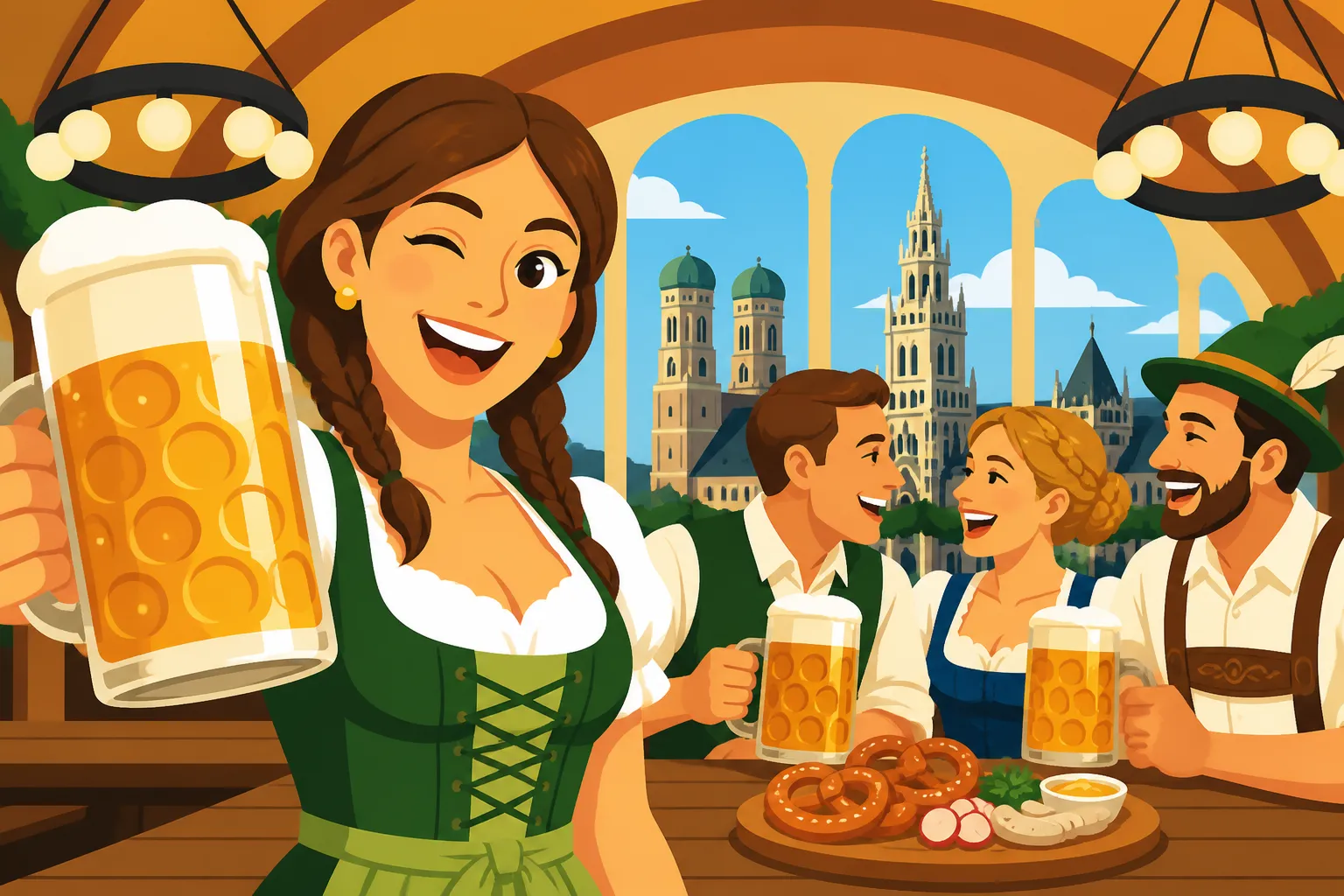
When you step into a place like the Hofbräuhaus or the Hacker-Pschorr Bräuhaus, the first thing that hits you is the acoustic. These buildings were designed with high, vaulted ceilings and stone or wooden floors that bounce sound everywhere. It is not a place for a quiet first date; it is a place for communal celebration. You will see "Oompah" bands in traditional Lederhosen playing brass instruments, and the "Bierdimpfe" (the local regulars) sitting in their usual spots, often with their own personalized mugs locked in cages nearby.
Understanding the difference between the "Schwemme" (the large, open taproom area) and the smaller side rooms is key. In the Schwemme, the energy is high, the service is fast, and the noise is constant. If you prefer something a bit more refined, look for rooms labeled "Bräustüberl" or "Gaststube," which are usually quieter and focus more on the dining experience. For more on what to see during your stay, check out Munich for First-Time Visitors: What to See.
Local Favorites Away from the Crowds
If the chaos of the city center is too much, I highly suggest taking the U-Bahn out to a spot like the Ayinger am Rotkreuzplatz. While Ayinger isn't one of the "Big Six," their beer is world-class, and the hall feels much more like a neighborhood living room than a tourist attraction. This is where you’ll see families celebrating birthdays and old men playing cards. It is essential to understand the cultural nuances of these spaces, which we cover in German Beer Culture: Styles, Beer Gardens, and Breweries.
Another gem is the Giesinger Bräustüberl. Giesing is a gritty, traditional neighborhood that has resisted much of the gentrification seen in other parts of Munich. Their beer hall is modern but respects all the old traditions. It’s a great place to see the "new" Munich—young professionals and old-school laborers sitting side-by-side. To navigate the city's transport efficiently, make sure you know How to Use the DB Navigator App in Germany.
Decoding the Rules: Etiquette and Unwritten Laws
The biggest mistake foreigners make is standing at the entrance of a beer hall waiting to be seated. In a traditional Munich beer hall, there is no host. You are expected to find your own seat. This leads to the most important rule of Bavarian drinking: the shared table. You will rarely find a table for two. Instead, you will see long wooden tables that seat eight to ten people. If there are two empty spots at a table already occupied by six strangers, those spots are fair game.
Walk up to the table and ask, "Ist hier noch frei?" (Is this spot still free?). Almost always, the answer will be a nod or a simple "Ja." You sit down, and that’s it—you don’t necessarily have to engage in a long conversation with your neighbors, but a polite nod is expected. This communal seating is the heart of the experience. It breaks down social barriers and is the primary reason why beer halls feel so inclusive. For a deeper look at social norms, see our guide on German Social Etiquette for Visitors: Greetings and Punctuality.
The Myth of the Stammtisch
As you wander through the hall, you will notice certain tables have a small, ornate sign that says "Stammtisch." Do not sit here. This is the "regulars' table." It is reserved for a specific group of people who have been meeting at that exact spot, on that exact day, for perhaps decades. Even if the table is completely empty, sitting there is a major faux pas. If you accidentally do sit down, a waiter will likely ask you to move within minutes.
The Stammtisch is a sacred institution in Bavaria. It is where local politics are discussed, business deals are made, and friendships are solidified over generations. Respecting this boundary is one of the quickest ways to show you aren't just another clueless tourist. You can read more about these traditions in Beer Gardens and Beer Halls in Germany.
Ordering and Paying Without the Stress
Service in a beer hall is famously "efficient," which can sometimes come across as brusque to those used to North American or British hospitality. Waiters (often called "Kellner") are managing huge sections and carrying incredible weights. When they come to your table, be ready. You don't "order a beer"; you order a "Mass" (pronounced like 'moss,' not 'mass'). In Munich, a Mass is one liter. If you ask for a "small beer," you might get a pitiful look, though most places do offer a "Halbe" (half-liter), especially for wheat beer.
When it comes to paying, keep in mind that many traditional halls still prefer cash. While things changed slightly during the pandemic, the "Cash is King" rule still holds weight in the more historic venues. When you want the bill, say "Zahlen, bitte." The waiter will likely pull out a large leather wallet and settle the bill right there at the table. To avoid awkwardness, check our advice on Cash vs Card in Germany: What Visitors Should Know. Also, don't forget the tip; a few euros or rounding up is standard. See Tipping in Germany: When, Where, and How Much for the specifics.
| Term | Meaning | How to Use It |
|---|---|---|
| Mass | One Liter of Beer | "Eine Mass, bitte." |
| Halbe | Half-Liter of Beer | "Eine Halbe Helles, bitte." |
| Stammtisch | Regulars' Table | Look for the sign and avoid sitting there. |
| Prost | Cheers | Make eye contact! It’s mandatory. |
| Brotzeit | Savory Snack | Usually a platter of meats and cheeses. |
What’s on the Menu? Beyond the Liter of Helles
While the beer is the main event, the food in a Munich beer hall is designed to provide the "foundation" necessary to handle liter-sized servings of alcohol. This is not "light" food. It is heavy, salty, and incredibly satisfying. The most iconic dish is the "Schweinshaxe" (roasted pork knuckle). It’s a massive hunk of meat with a thick layer of "Kruste" (crackling) that should be so crisp it practically shatters when hit with a knife.
If you aren't quite hungry enough for a full pork knuckle, the "Brotzeit" is your best friend. This is a platter of local cheeses, cold cuts, radishes, and "Obatzda"—a savory Bavarian cheese spread made from camembert, butter, and paprika. It’s perfect for sharing with the table. For those with specific dietary needs, it’s worth checking How to Eat Vegetarian or Vegan in Germany, as many halls now offer surprisingly good plant-based alternatives like "Kasspatzn" (cheese noodles) without the bacon bits.
Understanding the Beer Styles
Most visitors default to a "Helles," which is the classic Munich pale lager. It is clean, crisp, and dangerously easy to drink. However, don't ignore the "Dunkel" (dark lager), which has a maltier, slightly chocolatey profile without being heavy like a stout. If you are visiting in the morning—a perfectly acceptable time for a beer in Munich—the tradition is to have a "Weißbier" (wheat beer).
Weißbier is served in a tall, curvy glass and is traditionally paired with "Weisswurst" (white sausages). There is a specific rule for Weisswurst: they must never "hear the noon bells." This means they are a breakfast or early lunch food, served in a bowl of hot water. You must peel the skin off before eating. To learn more about ordering, see How to Order Beer in Germany Like a Local.
Essential Beer Hall Food Pairings
| Drink | Traditional Food Pairing | Why it Works |
|---|---|---|
| Helles | Schweinshaxe | The crispness of the lager cuts through the fat of the pork. |
| Dunkel | Ochsenfetzen (Ox strips) | The malty sweetness complements roasted beef flavors. |
| Weißbier | Weisswurst & Pretzel | The carbonation of the wheat beer balances the soft texture of the sausage. |
| Radler | Obatzda | A refreshing mix of beer and lemonade is great with salty cheese. |
A quick tip from a veteran: always check the daily specials board ("Tageskarte"). These are often seasonal dishes that use fresher ingredients than the standard menu and are usually a few euros cheaper. If you’re traveling during a specific season, you might find "Starkbier" (strong beer) in the spring or special festival brews in the autumn. For a complete overview of what's available, read German Regional Dishes Every Visitor Should Try.
Logistics and Practical Planning
Munich is a busy city, and the beer halls are its busiest hubs. If you are arriving from elsewhere in Europe, using Omio to book your high-speed ICE train is the most efficient way to get into the city center. Once you are at the Hauptbahnhof, you are literally ten minutes away from your first beer. If you haven't booked your stay yet, I suggest using Booking.com to find a place near the "U3" or "U6" subway lines, as these run through the heart of the city and make getting home after a few liters much safer.
If you want a guaranteed seat at a specific time, especially for a group of more than four, you should try to reserve a table online via the brewery’s website. However, note that for Friday and Saturday evenings, reservations are often booked months in advance. For the solo traveler or a couple, reservations aren't necessary—just be prepared to "elbow in" and find a spot at a shared table.
When to Visit to Avoid (or Join) the Chaos
Timing is everything. If you go to a beer hall at 7:00 PM on a Saturday, expect a wall of sound and a struggle to find a seat. If you want the "classic" experience with the band and the buzz but without the stress, try a late Sunday morning (around 11:00 AM) or a weekday afternoon. Monday through Wednesday evenings are generally much more relaxed, allowing you to actually talk to your companions.
Keep in mind the German holidays. On Sundays, most shops in Germany are closed, but the beer halls are very much open and often at their busiest with local families. You can learn more about this in What Closes on Sundays in Germany?. If you are in town for Oktoberfest, the beer halls in the city center actually become a sanctuary for those who couldn't get into the tents at the Wiesn, though they remain incredibly crowded.
Safety and Getting Home
Munich is one of the safest cities in the world, but "Bierleichen" (beer corpses—people who have overindulged) are a real thing. The local police and transit staff are used to it, but you don't want to be one of them. The public transport system (MVV) runs late, and the S-Bahn (suburban trains) runs all night on weekends.
If you feel like you’ve had one too many, don't be afraid to order a "Spezi" (a mix of cola and orange soda) or a "Radler" (beer mixed with lemonade) to slow down. The water in Munich is also excellent and perfectly safe to drink, so stay hydrated between liters. Before you head out, make sure your phone is charged so you can check your route. For more logistical tips, our guide on Travel Logistics in Germany: Money, Safety, and Connectivity is an essential read.
Disclaimer
The information provided in this guide is for informational purposes only. While we strive to provide the most accurate and up-to-date advice regarding German culture and travel, rules and prices at specific venues may change. Alcohol consumption should be handled responsibly and in accordance with local laws. We are not responsible for any issues arising from the use of the services mentioned (Omio, GetYourGuide, Booking.com) or from your personal experiences in the venues described.