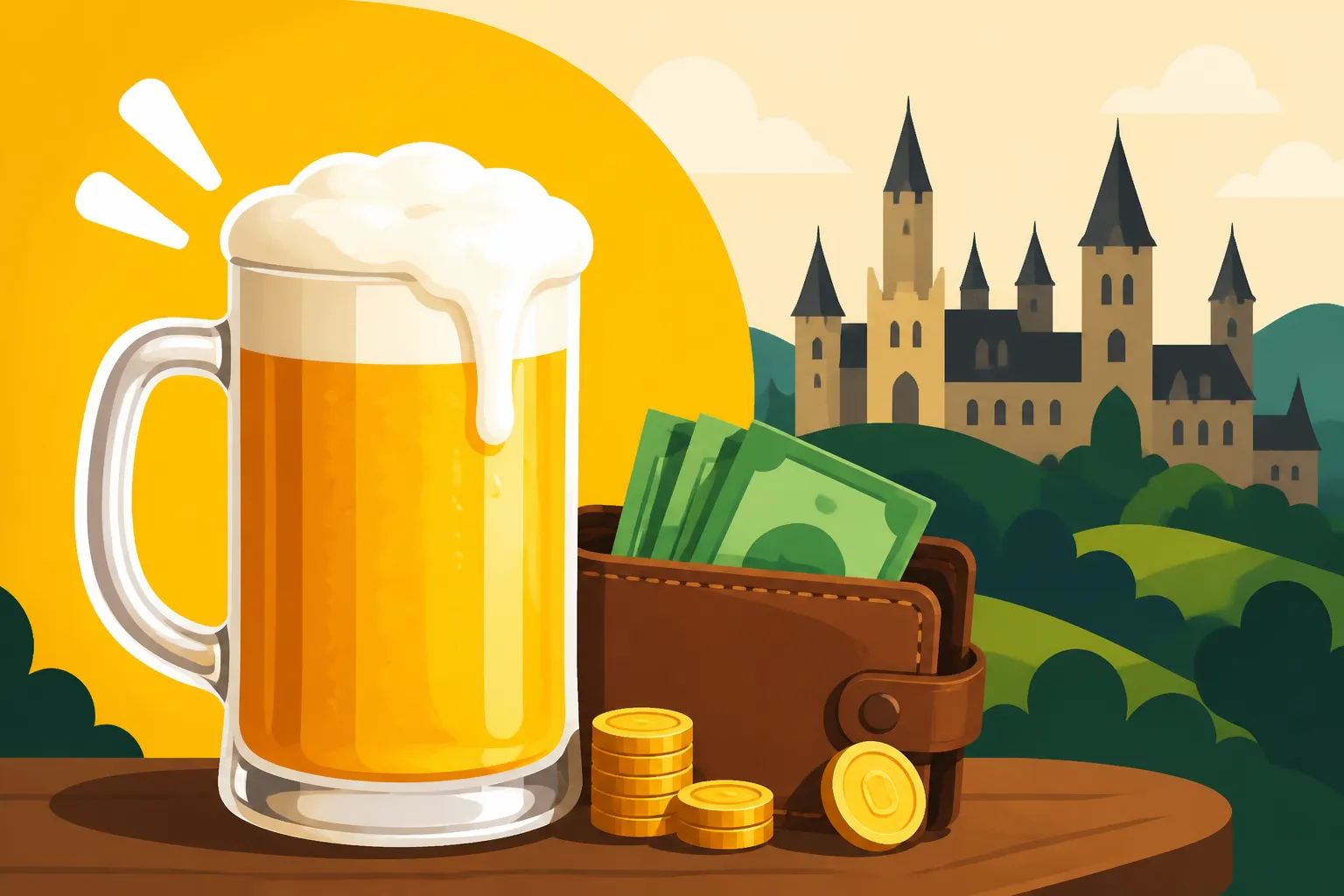
How Much Does Beer Cost in Germany?
Many newcomers arrive in Germany expecting a land where beer flows cheaper than water, only to be baffled by the multi-layered pricing systems, the ubiquitous bottle deposits, and the stark contrast between a supermarket shelf and a Munich beer garden. This guide breaks down exactly how much you will pay for a brew across different regions and settings to ensure your budget stays intact.
Disclosure: This post may contain affiliate links. We may earn a commission at no extra cost to you if you make a purchase through these links. Read full disclosure.
Regional Pricing Variances Across the Federal Republic
If you are planning a trip across Germany, the first thing you will notice is that "German beer prices" are not a monolith. The cost of a pint—or more accurately, a half-liter—fluctuates significantly depending on which Bundesland (state) you are standing in. As a veteran expat, I have spent years watching these prices creep up, especially in the post-pandemic economy where energy costs have hit breweries hard.
In the south, particularly Bavaria, beer is treated as "liquid bread." You might think this means it is the cheapest, but because Munich is one of the most expensive cities in Europe, you will often pay a premium. In a traditional Munich beer garden, a 0.5L glass of Helles typically ranges from 5.00 to 6.50 Euro. If you head further north to Berlin, the prices for a standard Pilsner in a local "Kneipe" (pub) are slightly more forgiving, usually hovering between 4.00 and 5.50 Euro. However, Berlin is also the heart of the German craft beer scene, where a small 0.33L pour of an IPA can easily set you back 7.00 Euro or more.
Western Germany, specifically the Rhineland, operates on a different scale entirely. In Cologne, you drink Kölsch, which is served in tiny 0.2L glasses called "Stangen." While the individual price looks low—usually around 2.20 to 2.80 Euro—the speed at which the "Köbes" (waiter) replaces your empty glass means the total bill adds up faster than you’d expect. For a deeper look at how these regional differences affect your overall wallet, check out the Where to Live in Germany: City and Region Guide for Foreigners. To save money while moving between these regions, using platforms like Omio can help you find the cheapest train or bus connections, leaving more in your budget for the local tap.
Supermarket vs. Gastronomy: The Great Price Divide
One of the biggest shocks for foreigners is the massive price gap between buying a beer to drink at home and ordering one at a restaurant. Germany has some of the most affordable high-quality retail beer in the world. If you walk into a local Rewe or Edeka, a 0.5L bottle of a premium brand like Augustiner, Rothaus, or Weihenstephaner will cost you somewhere between 0.90 and 1.30 Euro. Discount brands can go as low as 0.50 Euro.
However, once you sit down at a table, you are paying for the service, the atmosphere, and the "Gemütlichkeit." It is perfectly normal for a restaurant to charge 5.00 Euro for the exact same bottle that costs 1.00 Euro down the street. When budgeting, I always recommend looking at the Cost of Living in Germany: Budgeting Guide for Expats to understand how these daily expenses fit into a larger financial plan.
There is also the "Späti" culture, primarily in Berlin and other major cities. These late-night convenience stores are the middle ground. You can grab a chilled bottle for 1.50 to 2.50 Euro and drink it on the street—a practice known as "Wegbier." It’s a quintessential German experience that feels a bit rebellious if you come from a country with strict open-container laws, but here, it’s just Tuesday. To find the best neighborhoods for this kind of local life, you might browse Booking.com for stays in districts like Friedrichshain or Neukölln, where the Späti culture is most vibrant.
Understanding the Pfand (Deposit) System
I cannot count how many times I’ve seen tourists leave their empty bottles on top of a trash can, thinking they are being tidy. In reality, they are leaving money on the table. Germany uses a "Pfand" system to encourage recycling. When you see a price on a supermarket shelf, the deposit is usually NOT included in the large print.
For most standard glass beer bottles (0.33L or 0.5L), the deposit is 0.08 Euro. If it’s a bottle with a "swing-top" (like Flensburger), it might be 0.15 Euro. Cans and plastic bottles carry a much higher deposit of 0.25 Euro. While 8 cents sounds negligible, a crate of 20 bottles represents 3.10 Euro in deposits (including the crate itself). For a meticulous breakdown of this process, see our guide on How to Return Bottles and Claim Pfand in Germany. Managing these small amounts is a core part of Money Matters in Germany: Complete Financial Guide for Expats.
| Setting | Average Price (0.5L) | Includes Pfand? | Notes |
|---|---|---|---|
| Supermarket | 0.80 – 1.30 Euro | No (+0.08) | Cheapest option; return bottle for refund. |
| Späti (Convenience Store) | 1.80 – 2.80 Euro | Usually No | Often chilled; consumed on the go. |
| Local Kneipe (Pub) | 3.50 – 5.00 Euro | Yes | Standard neighborhood prices. |
| Restaurant (City Center) | 4.50 – 6.50 Euro | Yes | Prices vary by brand and location. |
| Beer Garden (Munich) | 5.50 – 7.50 Euro | Yes/No | Sometimes a "Pfandmarke" (token) is given for the glass. |
| Oktoberfest (Wiesn) | 14.50 – 15.50 Euro | No | Served as a 1.0L "Mass" only. |
The "Festive" Markup: Oktoberfest and Christmas Markets
If your visit coincides with a major festival, throw the standard price book out the window. The most famous example is the Munich Oktoberfest. The price of a "Mass" (one liter of beer) is set annually and has been rising steadily. In recent years, it has officially crossed the 14-Euro mark, with many tents charging upwards of 15 Euro once you account for the "Bedienungsgeld" (service tip).
Keep in mind that you cannot order a small beer at Oktoberfest; it is the liter or nothing. For many, this is a "bucket list" expense, but for an expat living here, it’s a day to brace the bank account. If you are planning a trip specifically for this, I highly suggest reading Oktoberfest in Munich: A First-Timer's Guide to understand the hidden costs, like table reservations and food. You can often find specialized brewery tours or tent experiences through GetYourGuide, which might include beer vouchers in the ticket price.
Christmas Markets (Weihnachtsmärkte) are another trap for the unwary. While Glühwein is the star, beer is always available. Here, you will encounter the "Tassenpfand" or "Glaspfand." You might pay 10.00 Euro for a beer, but 4.00 Euro of that is a deposit on the heavy glass mug or glass. If you return the glass, you get your 4.00 Euro back. If you keep it as a souvenir, you’ve just bought a very expensive piece of glassware. Understanding these small cultural nuances is part of German Beer Culture: Styles, Beer Gardens, and Breweries.
Tipping and Hidden Service Costs
In many countries, the price on the menu is just the starting point. In Germany, the price you see on the "Speisekarte" (menu) must by law include VAT (Mehrwertsteuer) and service charges. However, tipping is still expected, though not at the 20% levels common in North America.
For a round of beers, the common practice is to "round up." If your beer costs 4.80 Euro, you give the server 5.00 Euro and say "Stimmt so" (It’s fine). If you are at a table with a large bill, a tip of 5% to 10% is appropriate. It is important to note that you should tell the waiter the total amount you want to pay as you hand them the cash or card. If the bill is 45 Euro and you want to tip 5 Euro, you hand them a 50-Euro note and say "Fifty." Don't wait for change and then leave coins on the table; it’s considered slightly less sophisticated here. For more on this, see Tipping and Service Charges in Germany: Who and How Much to Tip.
If you find yourself in a tourist-heavy area, such as near the Cologne Cathedral or the Brandenburg Gate, prices will naturally be 20-30% higher. To avoid these traps and find where the locals actually drink, I always recommend checking How to Find Authentic Restaurants in Germany (Not Tourist Traps).
Tips for Drinking on a Budget
If you are a student or an expat trying to make ends meet, there are ways to enjoy the culture without going broke. First, look for "Sternburg" or "Oettinger" in the supermarket—they aren't the fanciest, but they are the staples of the budget-conscious German student. Second, take advantage of the "Feierabendbier" (end-of-work beer) tradition. Many locals will grab a beer from a Späti and sit in a public park like the Englischer Garten in Munich or Tempelhofer Feld in Berlin. It is entirely legal and much cheaper than a bar.
Another tip is to look for "Brauhaus" locations that are slightly outside the city center. These often serve their own house-brewed beer at prices significantly lower than the big international brands. Plus, the food is usually better and more authentic. You can pair your affordable brew with local snacks by following our guide on German Regional Dishes Every Visitor Should Try.
Ultimately, while the price of beer in Germany has risen, it remains one of the few things that feels "fairly" priced compared to other Western European nations. Whether you are paying 90 cents at a supermarket or 15 Euro at a world-famous festival, you are participating in a culture that spans centuries. Just remember to bring your bottles back for the Pfand—your future self will thank you for the extra couple of Euros.
Disclaimer
This guide is for informational purposes only. Prices mentioned are based on average market data at the time of writing and are subject to change due to inflation, local taxes, or seasonal adjustments. Alcohol should always be consumed responsibly and in accordance with local German laws. Only those of legal drinking age (16 for beer and wine, 18 for spirits in Germany) should purchase or consume alcoholic beverages. Under no circumstances is this guide an encouragement to engage in excessive drinking. Always check the current local regulations and venue policies during your visit.