How to Plan Travel Around German Public Holidays
Coming to Germany for the first time, you might expect a modern, 24/7 European powerhouse. Then, you land on a Thursday in May, realize every supermarket is shuttered for Ascension Day, and spend your first evening scavenging for a stale sandwich at a gas station. This guide ensures you never face the "holiday hunger" or the "bridge day" traffic nightmare by teaching you how to navigate Germany’s complex, regional, and often silent public holiday system like a seasoned local.
Disclosure: This post may contain affiliate links. We may earn a commission at no extra cost to you if you make a purchase through these links. Read full disclosure.
Understanding the Patchwork of German Public Holidays
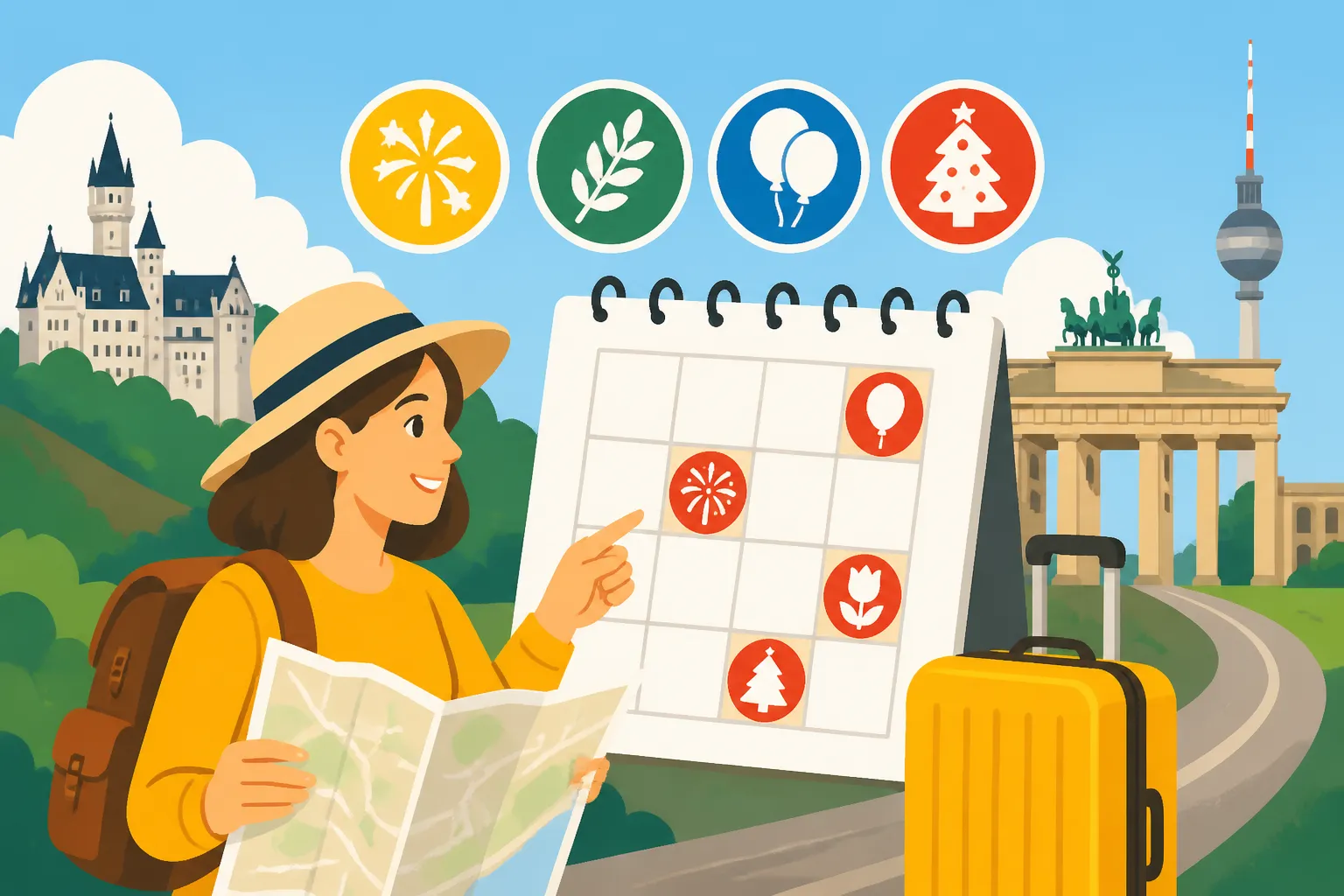
One of the first things I learned after moving here is that "Germany" does not always act as one single entity when it comes to time off. While there are federal holidays that apply to every single soul from Flensburg to Garmisch-Partenkirchen, many of the most disruptive (or delightful) holidays are state-specific. If you are planning a road trip from Berlin to Munich, you might leave a city where it is a normal working Tuesday and arrive in a city where every shop is closed and a brass band is marching down the street.
Germany is divided into 16 federal states (Bundesländer), and they guard their regional holidays fiercely. This is largely a north-south divide rooted in religious history. The northern and eastern states, historically Protestant, tend to have fewer holidays. The southern and western states, particularly Bavaria and Baden-Württemberg, are predominantly Catholic and boast significantly more days off. For a deeper look at the cultural impact of these days, you should check out the guide on German Public Holidays: How They Affect Life and Work.
Federal vs. State Holidays: The 16-State Confusion
There are nine holidays that are celebrated nationwide. These include New Year’s Day, Good Friday, Easter Monday, Labor Day (May 1st), Ascension Day, Whit Monday, German Unity Day (October 3rd), and the two days of Christmas. Outside of these, you are at the mercy of regional legislation.
Take, for instance, August 15th (Assumption Day). If you are in Saarland or parts of Bavaria, it is a public holiday. If you are in Saxony, it is a regular workday. Then there is the "Augsburg Peace Festival" on August 8th, which is a public holiday only within the city limits of Augsburg. I once made the mistake of trying to run errands in Augsburg on that day, only to realize I had to drive twenty minutes out of town just to find an open post office. Knowing these nuances is essential for German Public Holidays: How They Affect Life and Work.
The Phenomenon of Silent Holidays (Stille Tage)
This is a concept that catches many expats off guard. Germany has a set of "Silent Holidays," such as Karfreitag (Good Friday) or Totensonntag (Sunday of the Dead). On these days, the law mandates a Tanzverbot—literally a "dancing ban." This isn't a plot from a movie; it is a real administrative regulation where clubs are closed, and public events with loud music are prohibited.
If you are planning a stag do or a wild weekend in Berlin or Hamburg, you absolutely must check if your dates coincide with a Silent Holiday. Trying to find a party on Good Friday is a lesson in futility. It is a time for reflection, family, and quiet, and even if you aren't religious, the authorities expect you to respect the "Ruhe" (quiet). Understanding Quiet Hours and Sundays in Germany (Ruhezeit) is vital because these rules apply to visitors just as much as locals.
The Brückentag Strategy: Maximizing Your Time Off
If you want to know why the Autobahn looks like a parking lot on a random Friday in June, look at the calendar for a Thursday holiday. Germans are masters of the Brückentag (Bridge Day). If a holiday falls on a Thursday, almost every employee in the country will take the Friday off to create a four-day "long weekend."
This cultural obsession with Bridge Days has a massive impact on travel logistics. If you are trying to book a hotel or a train ticket during a Brückentag window, expect prices to soar and availability to plummet. I always recommend using a platform like Omio to compare the costs of trains versus long-distance buses during these periods, as the price spikes on the Deutsche Bahn can be eye-watering.
The Impact on Transport and Crowds
During a Bridge Day weekend, the "Deutschland-Ticket" users come out in full force. Regional trains become incredibly cramped, and seat reservations on high-speed ICE trains are no longer a luxury—they are a necessity. If you don't reserve a seat, you might find yourself sitting on your suitcase in the hallway between carriages for four hours.
For long-haul journeys, I suggest checking Omio at least six weeks in advance to lock in "Sparpreis" (saver) tickets. If you wait until the week of a holiday like Ascension Day or Corpus Christi, you will likely pay three times the standard rate. This is also the time when you should double-check your seat reservations.
Planning Your Itinerary Around School Holidays
It isn't just the public holidays you have to watch out for; it’s the Schulferien (school holidays). Unlike some countries where all schools go on break at the same time, Germany uses a staggered system to prevent the entire country from hitting the road at once. However, the system only works so well.
The Sommerferien (summer holidays) are the biggest hurdle. If the states of North Rhine-Westphalia and Bavaria happen to have overlapping holiday weeks, the roads leading to the Baltic Sea or the Alps will be congested for hours. If you can, try to schedule your visits to major attractions through GetYourGuide during mid-week windows outside of these school breaks to avoid the worst of the crowds.
Survival Tips for Holiday Travel in Germany
The most important rule for surviving a German public holiday is simple: The shops are closed. And I don't just mean the boutiques; I mean the grocery stores, the malls, and the hardware stores. In Germany, the "Sonntagsruhe" (Sunday rest) is extended to all public holidays.
Navigating Closures and Sunday Rules
If a holiday falls on a Thursday, and you haven't stocked your fridge by Wednesday evening, you are going to have a very hungry 24 hours. The only exceptions are shops located inside major train stations (Hauptbahnhof) or airports. These will be packed with people in the same predicament as you, so expect long lines for a loaf of bread.
If you find yourself in a medical pinch, remember that pharmacies follow a strict rotation for emergency service. You can use an Emergency Pharmacy Finder: Getting Medicine After Hours in Germany to find which local "Apotheke" is open after hours or on a holiday. For general advice on what to do when the city shuts down, read our guide on German Public Holidays: How They Affect Life and Work.
Essential Booking Strategies for Accommodations
When a public holiday approaches, the best hotels in popular areas like the Moselle Valley or the Zugspitze region sell out months in advance. I personally use Booking.com to secure refundable rates early. This allows me to "plant a flag" in a destination while I'm still figuring out the logistics.
Always check the "special conditions" section on Booking.com for hotels in smaller villages. Some family-run guesthouses might have restricted check-in hours on holidays, or their on-site restaurant (which might be the only place to eat in the village) could be closed for a private family event. Knowing What Closes on Sundays in Germany? beforehand will save you a lot of stress.
| Holiday Name (German) | Date | Regional or National? | Expected Impact |
|---|---|---|---|
| Neujahr | Jan 1 | National | Total closure; very quiet morning. |
| Heilige Drei Könige | Jan 6 | BW, BY, ST | Regional closures in the South/East. |
| Karfreitag | Varies | National | Silent holiday; no dancing/loud music. |
| Ostermontag | Varies | National | High travel volume; schools on break. |
| Maifeiertag | May 1 | National | Protests in cities; hiking in the country. |
| Christi Himmelfahrt | Varies | National | Huge "Bridge Day" potential (Thursday). |
| Pfingstmontag | Varies | National | Popular for camping and outdoor trips. |
| Fronleichnam | Varies | Southern/Western States | Major regional closures; Bridge Day. |
| Tag d. Deutschen Einheit | Oct 3 | National | Festivals; museums often stay open. |
| Allerheiligen | Nov 1 | Southern/Western States | Silent holiday in many Catholic regions. |
| 1. & 2. Weihnachtstag | Dec 25/26 | National | Entire country shuts down; family time. |
Major Holidays Breakdown: What to Expect
Each major holiday has its own "vibe" and logistical challenges. Planning for a trip during the Christmas season is vastly different from planning one during the May Day long weekend.
Easter, Christmas, and the "Between the Years" Period
Easter is a massive travel window. Many Germans take the entire week off, leading to a surge in demand for family-friendly destinations. If you want to book a specialized tour during this time, I recommend using GetYourGuide to see which operators are actually running. Many smaller, independent guides take the holidays off to be with their own families.
Christmas is even more extreme. From midday on December 24th (Heiligabend) until the morning of December 27th, the country essentially pauses. Public transport runs on a severely reduced "Sonntag" schedule. If you aren't staying with family, make sure your hotel offers a dinner service, as finding an open restaurant on Christmas Eve can be nearly impossible without a reservation made weeks in advance. For more on the logistics of this season, see Christmas in Germany: Traditions, Markets, and Holiday Tips for Expats.
Labor Day and German Unity Day
May 1st (Tag der Arbeit) is a unique day. In cities like Berlin (specifically Kreuzberg) and Hamburg, there are often large political demonstrations that can lead to localized transport diversions. In the rest of the country, it is a day for "Maiwanderung"—groups of friends pulling wagons (Bollerwagen) full of beer through the woods. It's a great time to be outdoors, but don't expect a quiet hike!
October 3rd (Tag der Deutschen Einheit) celebrates reunification. Since this is a fixed date, its impact depends on which day of the week it falls. If it’s a Tuesday or Thursday, the "Bridge Day" effect is in full swing. Because this is a civic holiday rather than a religious one, museums and galleries often remain open, making it a great day for cultural sightseeing. Check our guide on Unity Day and German Public Holidays for specific event ideas.
Practical Logistics: Money and Health
Since most businesses are closed, you need to be prepared. While Germany is slowly becoming more card-friendly, some smaller kiosks or independent cafes that remain open on holidays might still insist on "Nur Bargeld" (Cash only). I always suggest keeping at least 50 Euros on you. For more on this, check How Much Cash Should You Carry When Traveling in Germany?.
If you get sick, don't panic. While your regular "Hausarzt" (GP) will be closed, you can call 116117 for the non-emergency medical on-call service. They can direct you to the nearest open clinic. If you just need over-the-counter meds, the Pharmacy Sundays: How to Find an Open Apotheke After Hours is your best friend.
Final Thoughts on Timing Your Trip
The best way to enjoy Germany is to lean into the holiday spirit rather than fighting it. If you know the shops are closed, buy your Riesling and Brot on Wednesday, find a park, and join the locals in their mandatory relaxation. If you use tools like Omio for your transport and Booking.com for your stays, the "closed" signs won't be a hurdle—they'll just be part of the authentic German experience.
Planning ahead means you get to choose whether you want to be in the middle of a Bavarian festival or tucked away in a quiet village where the "Silent Holiday" rules let you finally hear the wind in the trees. Just remember to check the state-specific calendar before you cross any borders!
Disclaimer
The information provided in this guide is for educational and informational purposes only. Public holiday dates, regional regulations, and "Silent Day" laws in Germany are subject to change by local and federal authorities. While we strive to keep this information up-to-date, we recommend verifying specific holiday closures and transport schedules with official sources (such as the interior ministry of the respective federal state or Deutsche Bahn) before finalizing your travel plans. We are not responsible for any inconveniences or financial losses resulting from changes in holiday legislation or unexpected business closures.